
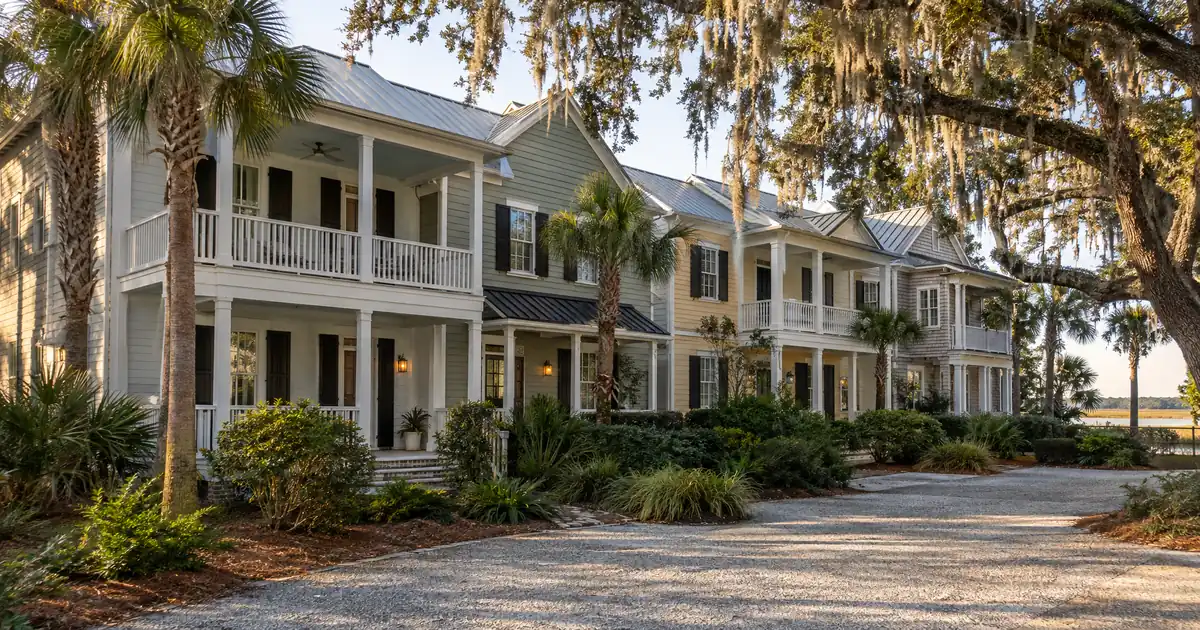
Kiawah Island’s homeownership rate is 98.9%, according to Data USA, and the 2024 median property value there was about $2 million. Almost nobody rents on this island, so almost no rental comps exist. Anyone planning a cash-out refinance on a Kiawah rental has to build the file around that fact.
The Short Version: A cash-out refinance on a Kiawah Island, South Carolina rental is underwritten primarily on the property’s rental income measured against its full monthly obligation, so the file must show enough rent used for lender review to clear the lender’s coverage minimum after taxes, insurance, and any dues, plus seasoning, reserves, and equity within the loan-to-value ceiling.
DSCR Cash-Out Calculator
Run the cash-out numbers in Kiawah Island, SC
Rate source: Freddie Mac 30-yr average via FRED® — Federal Reserve Bank of St. Louis · effective Sep 24, 2026
Prefilled with starting assumptions — enter your property’s value, balance, taxes, and insurance for a more accurate picture.
Program parameters update from Lendmire’s centralized guideline source. Taxes and insurance are editable estimates.
As of Sep 24, 2026 · General Freddie Mac market benchmark, not a Lendmire loan offer. Property value, balance, taxes, and insurance are editable estimates. Maximum loan-to-value varies by lender, program, property type, and seasoning. Not a Loan Estimate, approval, or commitment to lend. Program availability and eligibility are subject to lender guidelines, credit approval, property review, and underwriting.
- Zillow’s rental data shows an average Kiawah rent of $3,996 on just two listings.
- Coverage, not the 75% LTV cap, is usually the binding constraint on island properties.
- Johns Island, where much of the resort workforce lives, is where rent-to-value math is realistic.
- Cash-out seasoning runs about 6 months from title recording, subject to lender guidelines.
Kiawah Island Market Snapshot
A quick read on the Kiawah Island investor landscape — figures come from the cited sources below. Confirm current property-level numbers before underwriting.
| Metric | Detail |
|---|---|
| Home prices | 34 sales (Movoto Market Trends) |
| Recent appreciation | +7.3% (Zillow Home Value Index) |
Start Off-Island: Where the Rent-to-Value Math Works
The strongest DSCR submarket tied to Kiawah is not on Kiawah. Johns Island, the gateway community roughly 21 to 30 minutes away, is where long-term tenants actually live.
A developer statement reported by WCBD News 2 says around 60% of Kiawah Partners’ employees live on Johns Island and Wadmalaw Island. That is a press claim, not audited data, but it matches what the town itself records. The Kiawah Island Infrastructure & Public Works Committee materials describe a contractor renting a condo on the island because repair crews living in West Ashley and Johns Island were losing hours to commuting. The same packet names Maybank Highway and the Johns Island bridges as the worst bottlenecks. Commute friction is a durable demand argument for housing close to the island.
The rent bands are far more workable than Kiawah’s. A Redfin listing snapshot for Johns Island shows apartment rents of roughly $1,980 to $2,550 for two-bedrooms and $2,410 to $2,900 for three-bedrooms. A local broker blog, LocatingCHS, puts three-bedroom single-family rents at $2,400 to $3,000, though that data predates the page’s posting date. Treat it as a marketing figure and test it against a Form 1007 rent schedule at underwriting.
Two cautions apply. First, the same Redfin listings show concessions, including six weeks free at one complex and two months free at others. Effective rent sits below asking rent, so underwrite coverage on net figures. Second, the broker’s “tight apartment supply” story isn’t verified. A Charleston County requirement for affordable workforce housing at the Kiawah River development doesn’t kick in until the 200th home is built, per Charleston Business. That is a long-dated supply factor for Johns Island rents.
The same broker recommends townhomes and duplexes as the balance between renter affordability and investor yield. That is opinion, not a supply count. Still, small multi-unit and cottage-scale rentals are the property types where a rent-to-debt ratio has a realistic shot at clearing 1.00.
The Equity Extraction Mechanics, Step by Step
Cash-out refinancing on a DSCR loan comes down to four gates, applied in sequence.
1. Seasoning. Programs typically require about 6 months of ownership, measured from title recording, before cash-out is available.
2. Leverage ceiling. Cash-out is capped at 75% LTV. The higher 80% figure applies only to purchases.
3. Coverage. The standard benchmark is a 1.00 DSCR, meaning rent used for lender review divided by full PITIA (principal, interest, taxes, insurance, and any HOA dues). Some lenders review lower ratios with compensating factors, but eligibility depends on lender guidelines, credit profile, and property review.
4. Reserves. Expect about 6 months of PITIA, rising to about 9 months above $1,500,000. Credit tiers step through 620, 660, 680, and 700, with 620 as the floor.
Most investors focus on gate two. On Kiawah, gate three does the damage.
Run the numbers on a hypothetical villa valued near $1,500,000, matching the Movoto median for recent sales. Assume it rents for about $4,000, in line with Zillow’s average. The 75% ceiling sets the maximum loan. But full PITIA on that balance, including taxes and insurance, would run well above what $4,000 of rent can cover. Coverage would land far below 1.00. At those proportions, LTV is not the constraint. The rent-to-value ratio is.
So what can an owner do when the coverage number falls short?
- A lender may review a sub-1.00 program, which usually means stronger compensating factors and a lower LTV.
- An interest-only structure can change the coverage calculation.
- A smaller cash-out request lowers the balance and moves coverage closer to the benchmark.
None of these is a promise. Each is a path a lender would review against its own guidelines, credit approval, and property review. On Kiawah, expect the workable cash-out to be much smaller than the equity on paper.
What the Price Data Actually Says
Kiawah’s price sources disagree, and the disagreement matters for how much equity is available.
This article uses the Movoto median sale price of $1,500,000 as its reference figure, with 34 homes sold in the latest month and an average of 54 days on market. Zillow’s home value index reads higher, at $2,190,560, up 7.3% over the past year, but that is a modeled value index rather than a median of closed sales. Redfin reads lower, at $1,225,000 in a November reading, down 12.5% year over year on just 9 sales. One further source reported a median above $4 million on only four sales in a month. That is a small-sample artifact, and it is not used here.
The honest description is volatile, thin-sample, and roughly flat to modestly up. For a cash-out, that spread matters. Appraisers on a low-turnover island lean on a handful of comps, and the appraised value can land well below a Zillow-style estimate. An owner counting on “$2.19 million of value” may find the appraisal closer to the sale-based figures. Model equity on the conservative side.
Condos and villas are the lowest-priced Kiawah entry point. The James Schiller Team reports a median of $1,327,500 for beachfront condos and interior villas, up from $995,125 a year earlier, with a 91.8% list-to-sale ratio. That is a small-sample brokerage report, so it shows direction, not a precise appraisal anchor. A 91.8% list-to-sale ratio does suggest buyers still negotiate, and appraisals tend to track closed prices, not asking prices.
Seasonal Demand Is Not Long-Term Demand
Kiawah’s population is small and swings sharply. Census Reporter shows 2,196 residents in the latest five-year estimate, and Wikipedia notes the last decennial census counted 2,013 while the population exceeds 10,000 in the busy season. The island runs 13 miles long with 10 miles of beach, per Akers Ellis, and it is anchored by Kiawah Island Golf Resort, which operates five championship courses and more than 13 restaurants and cafés per its careers page.
Monthly rental availability runs from mid-October to mid-March, according to Kiawah Exclusives. That is a snowbird window, not a year-round tenancy. Lenders assessing rent used for lender review want a lease-based or market-rent figure they can support with a rent schedule. Seasonal income that concentrates in five months is harder to support than a twelve-month lease.
Short-term rental conversations attract a lot of attention on resort islands. They fall outside this article’s scope. Investors weighing that route should verify current local rental rules, taxes, and insurance with qualified local professionals.
Insurance, Flood, and the Coverage Line Item
Skip the assumption that the property’s expense line stays static. Flood zone and insurance costs on a barrier island will strongly affect the debt-coverage math, and they change between quotes. Get a fresh insurance quote in hand before the file goes to a lender, so the coverage number reflects current carrying costs, not last year’s.
What the Deal Desk Tends to See
Lendmire’s deal desk sees a recurring pattern on files from resort and second-home markets like this one. The equity looks large on paper, but the rent supporting it is a single listing or a seasonal comp. The cleaner files tend to include a full lease or a rent schedule, current insurance quotes, and reserve documentation prepared in advance. The common friction point is a value that comes in below the owner’s estimate because closed sales are sparse. Sizing the request to the conservative value from the start avoids re-trading the file later.
Where Regional Employers Fit
Kiawah’s own economy is one dominant employer, the resort. Kiawah Island Inn Company LLC appears on the South Carolina Department of Employment and Workforce list of major Charleston-area employers, alongside the College of Charleston, Charleston County School District, and Trident Medical Center. No verified resort headcount is published.
The broader labor market is where durable tenant demand originates. The Charleston Regional Development Alliance lists Boeing at more than 9,000 employees, MUSC at approximately 17,000, and Joint Base Charleston at nearly 25,000 military and civilian jobs, with Volvo Cars, Mercedes-Benz Vans, and Bosch also named. Roper St. Francis Healthcare reported 6,043 employees per a dated SCBiz report, so treat that number as approximate. These employers draw tenants to the Charleston metro. Most of them live in West Ashley, Johns Island, and the mainland, not on Kiawah.
How the Proceeds Get Redeployed
The point of pulling equity is to fund the next purchase, and that usually means buying where the math works. This is the practical logic of the island: refinance the high-value asset conservatively, then put the capital into a property with a better rent-to-value ratio. Johns Island cottages and small multi-unit buildings fit that role. Investors can read more about DSCR cash-out refi mechanics and broader investor refinance options on Lendmire’s site. For a comparison with income-based underwriting, see the guide “Where DSCR and Conventional Diverge”, and Lendmire’s guide to DSCR loans covers the basics.
Is it smarter to hold the Kiawah asset for appreciation and refinance lightly, or sell and rotate fully? It’s a real toss-up. The refinance path preserves the asset and any upside, but the coverage math limits how much cash comes out. Selling frees everything, at the cost of transaction friction and the loss of a scarce, low-construction island position. A realtor blog notes that the island’s commitment to preserving its natural character limits significant new construction, and scarcity is the case for holding.
Frequently Asked Questions
How do you qualify for a DSCR cash-out refinance on Kiawah Island?
The property has to show rent used for program review that covers its full monthly obligation at or near the 1.00 benchmark, subject to lender guidelines. Beyond coverage, programs typically look for about 6 months of ownership, a 75% LTV ceiling, a credit score of 620 or higher, and roughly 6 months of PITIA in reserves (about 9 months above $1,500,000). On Kiawah, the rent side is the harder gate.
DSCR vs. conventional financing
Two common ways to finance an investment property in Kiawah Island, SC. They qualify you differently — here’s how investors weigh them.
Why investors choose it
- Qualifies on the property’s rental income — no personal tax returns, W-2s, or pay stubs needed to document income.
- No personal debt-to-income ceiling to clear, so existing mortgages and obligations don’t cap your borrowing the same way.
- Can be closed in an LLC, keeping the property inside a business entity.
- Built for scaling — not held to the limit on number of financed properties that conventional financing applies.
- Underwriting centers on the deal: generally qualifies when the rent covers the payment, a 1.00x coverage ratio being a common baseline (confirmed in underwriting).
- Designed specifically for investment property, including long-term and, where the program allows, short-term rentals.
Where it’s strong
- Often the lowest ongoing financing cost for a buyer who fully qualifies on personal income — a fit for a first property or a cost-first purchase.
Trade-offs for investors
- Requires full personal income documentation and must fit within a debt-to-income limit — salary, existing debts, and other mortgages all count.
- Typically held in your personal name rather than a business entity.
- Caps how many financed properties you can carry, which can become a ceiling as a portfolio grows.
- Evaluates you as a borrower as much as the property, which usually means more paperwork.
How investors usually choose: a first or single property often optimizes for the lowest financing cost; portfolio builders often optimize for leverage, vesting in an LLC, and scaling past conventional caps. The right answer depends on your goals, the property, and current guidelines — both paths run through select lenders in Lendmire’s wholesale network, with eligibility and terms confirmed in underwriting.
What are the requirements for an investment property loan on Kiawah Island, South Carolina?
Expect the lender to review credit tier, reserves, seasoning, an appraisal, and a rent schedule. Standard programs run up to $3,000,000. Manufactured homes, log homes, and barndominiums fall outside these programs. Exact eligibility depends on the lender, the borrower, and the property.
Can Kiawah rents support a 1.00 DSCR?
Usually not at meaningful leverage. Zillow shows an average rent of $3,996 on two listings, against modeled values above $2 million. The gross yield works out to roughly 2.2% annually, a directional figure since the datasets don’t match. Including taxes and insurance, coverage would typically sit well below 1.00. Sub-1.00 programs, interest-only structures, or a smaller cash-out may apply.
Why look at Johns Island for a rental if the equity is on Kiawah?
Rent-to-value is far more realistic there. Two-bedroom apartment rents run about $1,980 to $2,550, and three-bedroom single-family rents about $2,400 to $3,000, and much of the resort workforce lives on Johns Island. Investors typically use Kiawah equity as the capital source and Johns Island as the deployment target.
How do DSCR lenders review rental income instead of traditional tax-return income in South Carolina?
Lendmire arranges DSCR investor loans through wholesale lenders. Those lenders primarily weigh the property’s rent against its monthly obligation, not traditional personal-income documentation, though program terms vary. One key feature is cash-out up to a 75% LTV ceiling, subject to lender guidelines and credit approval.
The Asymmetric Opportunity
Kiawah equity is priced for scarcity, not for rent, while Johns Island small multi-unit and cottage rentals are priced for the tenants who commute to that scarcity. Duplexes and townhomes near the Maybank Highway corridor, serving the resort and regional workforce, offer the best mismatch between price and rent demand in this orbit.
About Lendmire
Lendmire works with Kiawah Island, South Carolina investors to place DSCR financing through wholesale lenders reaching 41 markets: 40 states plus Washington, D.C. The brokerage (NMLS# 2371349) is a DSCR-focused mortgage broker, not a lender. For state-level context, see Lendmire’s page on South Carolina DSCR financing.
Jumbo balances change the file. Standard programs go up to $3,000,000, and above $1,500,000 in value the reserve requirement rises. A Kiawah owner should count liquid reserves before counting proceeds. Every figure here varies by lender and program — guidelines, property type, leverage, and credit profile all apply.
Lendmire, a 2026 Scotsman Guide Top Workplace and recognized by Scotsman Guide in 2025, can be reached at 828-256-2183 to discuss a scenario.
Get Started
Ready to find the right loan for you?
See your offer in seconds. No credit pull, no obligation.
Informational only. Not a Loan Estimate, approval, or commitment to lend. Program availability and eligibility are subject to lender guidelines, credit approval, property review, and underwriting.
References
2. Movoto — Kiawah Island Market Trends
4. WCBD News 2
5. Infrastructure & Public Works Committee materials
6. Redfin listing snapshot for Johns Island
7. LocatingCHS
9. locatingchs.com — Johns Island Rental Analysis 2025 2026
10. Redfin — Kiawah Island Housing Market
12. Wikipedia
13. Akers Ellis
15. kiawahresort.com — Careers page
17. Charleston Regional Development Alliance
18. SCBiz
19. 2026 Scotsman Guide Top Workplace
20. recognized by Scotsman Guide in 2025
This article is part of Lendmire’s investment property cash-out refinance program — full qualification details, guidelines, and scenarios live on the program page.
Related reading: DSCR Cash Out Refinance Kiawah Island South Carolina · DSCR Cash Out Refinance Hilton Head Island South Carolina · DSCR Loans Kiawah Island & Seabrook: Investor Financing for Luxury Resort STR, Ocean Course, Johns Island & Real Estate Investors
Guides: Investment Property Cash-Out Refinance in South Carolina
Brandon Miller
Founder & CEO, Mortgage Loan Originator, Lendmire LLC
- Mortgage Loan Originator · NMLS# 1129696 · Verify on NMLS Consumer Access
- North Carolina Real Estate Broker · License# 343312 · Verify on NCREC
- North Carolina Insurance Producer · License# 19053198 · Property, Casualty, Life, Health · Verify on NAIC SBS
- Lendmire LLC · Firm NMLS# 2371349 · Verify firm licensure
Required disclosures. Lendmire (NMLS# 2371349) operates as a licensed mortgage broker, not a direct lender or depository. The discussion in this article is general in nature and should not be relied upon as financial, legal, or tax advice — every investment scenario is unique and should be reviewed by a qualified professional. Any loan inquiry is subject to lender underwriting, and this article is not a commitment to lend or a guarantee of approval. Mortgage rates, loan terms, and program guidelines vary by borrower, property, and state, and may change without notice. Equal Housing Opportunity. Verify licensure at NMLS Consumer Access.