
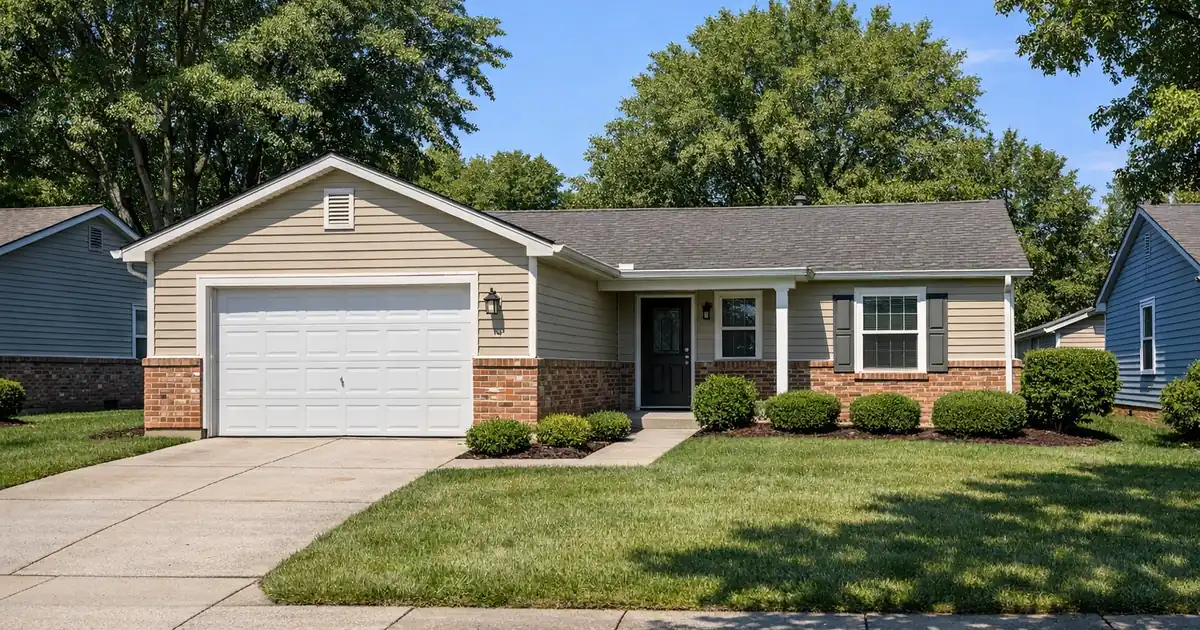
Cash out refinance your investment property in Indianapolis, Indiana by qualifying on rental income instead of personal tax returns. Tens of thousands of dollars in equity are sitting idle inside Indianapolis rental properties right now — and most investors are doing nothing with it. Conventional lenders won’t touch a deal if the borrower is self-employed, holds property in an LLC, or has too many financed properties. That’s the wall. DSCR cash-out refinancing breaks through it.
A cash-out refinance investment property Indianapolis strategy built on DSCR qualification means the property’s rental income — not the owner’s W-2 — determines approval. Explore investment property refinance options that work for real estate investors without the documentation burden of conventional lending.
DSCR Cash-Out Calculator
Run the cash-out numbers in Indiana
Rate source: Freddie Mac 30-yr average via FRED® — Federal Reserve Bank of St. Louis · effective Jul 30, 2026
Prefilled with starting assumptions — enter your property’s value, balance, taxes, and insurance for a more accurate picture.
Program parameters update from Lendmire’s centralized guideline source. Taxes and insurance are editable estimates.
As of Jul 30, 2026 · General Freddie Mac market benchmark, not a Lendmire loan offer. Property value, balance, taxes, and insurance are editable estimates. Maximum loan-to-value varies by lender, program, property type, and seasoning. Not a Loan Estimate, approval, or commitment to lend. Program availability and eligibility are subject to lender guidelines, credit approval, property review, and underwriting.
Lendmire (NMLS# 2371349) is a non-QM mortgage broker serving real estate investors across 41 markets, including Indiana.
Key Takeaways:
- Indianapolis investors can access equity through a DSCR cash-out refinance without W-2s, tax returns, or personal income documentation
- Qualification is based entirely on the property’s rental income relative to its monthly debt obligations
- Lendmire (NMLS# 2371349) closes DSCR loans in as few as 15 days for investors across Indiana
Indianapolis Investment Property: The Equity Opportunity in Indiana’s Capital
Indianapolis has emerged as one of the Midwest’s most active rental markets, driven by a diversified economy anchored by healthcare, logistics, motorsport, and higher education. Eli Lilly’s global headquarters, Community Health Network, Salesforce’s regional hub, and a growing tech corridor along the Mass Ave and Broad Ripple districts have created stable, long-term tenant demand across the city.
Neighborhoods like Fountain Square, Irvington, Bates-Hendricks, and the Near Eastside have seen sustained property appreciation that has pushed values well above original purchase prices for investors who bought even a few years back. That appreciation is equity — and DSCR cash-out refinancing is the mechanism to move it from a static balance sheet entry into an active acquisition tool.
Rental demand in Indianapolis continues to grow as housing affordability pressures push renters into the market across the city’s east and south sides. The Indiana Convention Center expansion, ongoing development around the Indianapolis Cultural Trail, and Ivy Tech Community College’s enrollment pipeline all feed tenant demand in neighborhoods where investors hold single-family and small multifamily rentals.
Given the sustained demand for rental housing across Marion County and surrounding Hamilton, Hendricks, and Johnson Counties, investors in the Indianapolis metro are sitting on equity that a DSCR program can convert into working capital — without a single tax return. For Indianapolis investment property financing, DSCR programs are the tool that conventional lenders simply cannot match.
How Does a DSCR Loan Work?
DSCR cash-out refinancing qualifies investors based on a single metric: does the property’s rental income cover its monthly debt obligations? Learn the full mechanics of what is a DSCR loan before running the numbers on a potential refinance.
The formula is straightforward: divide the monthly gross rent by the monthly PITIA (principal, interest, taxes, insurance, and association dues). A result at or above 1.00 means the property is cash flow positive and qualifies under standard DSCR parameters. No W-2s. No tax returns. No debt-to-income calculation.
Coverage Ratio: Monthly Rental Income ÷ Total Monthly PITIA = DSCR | At 1.00 the property covers its own debt | Above 1.00 = positive cash flow.
What It Takes to Qualify for a DSCR Cash-Out
Qualifying for a DSCR cash-out refinance requires meeting specific credit, equity, and seasoning thresholds — all of which are more accessible than conventional standards.
Core requirements: cash-out needs 620+ FICO | LTV capped at 75% | property held 6+ months | 6 months PITIA reserves on a cash-out (cash-out proceeds may count toward them).
Here’s what underwriting actually evaluates:
Credit Score: A minimum 660 FICO is required for most DSCR cash-out refinance transactions. This threshold is lower than the 720+ that conventional lenders require for best pricing — because DSCR underwriting evaluates the property’s rental income as the primary risk variable, not the borrower’s personal financial profile. First-time investors need a 700 FICO minimum.
LTV: Cash-out refinances are capped at 75% loan-to-value for single-unit properties with DSCR at or above 1.00. That ceiling governs how much equity is accessible at one time and protects lenders from over-leveraged positions.
Seasoning: DSCR programs require a minimum of 6 months of ownership before a cash-out refinance — a window designed to establish the property’s rental income track record and protect against immediate equity extraction after purchase. Conventional programs require 12 months of seasoning, making DSCR’s 6-month window a meaningful acceleration.
DSCR Ratio: Standard minimum is 1.00. Select programs allow sub-1.00 DSCR down to 0.75 with a 660+ FICO and reduced LTV.
Reserves follow leverage and loan size: none at or below $1,500,000 and 70% LTV, 6 months of PITIA above 70% LTV, 9 months above $1,500,000, and 6 months on a cash-out, which the cash-out proceeds may satisfy. Cash-out proceeds can satisfy reserve requirements on 1-4 unit properties — a program feature that reduces the liquidity burden at closing.
Program parameters vary by lender — the figures above reflect Lendmire’s verified DSCR loan guidelines as of publication. Connecticut, Florida, and Illinois properties carry declining market overlays capping LTV at 75% purchase and 70% refinance; Indiana does not carry that overlay.
DSCR Cash-Out Refinancing: Core Advantages
DSCR programs offer a set of structural advantages that conventional investment loans simply cannot replicate.
- LLC and entity ownership supported: — investors can close in an LLC or trust, subject to lender program eligibility, protecting personal assets from rental property liability
- No financed property cap: — DSCR programs have no limit on how many financed properties an investor holds, unlike conventional loans which cap out at 10
- No income verification required: — no W-2s, no tax returns, no pay stubs; qualification runs on the property’s rental income relative to PITIA
- Short-term rental flexibility: — properties operating as Airbnb or vacation rentals qualify under adjusted gross rent calculations (20% reduction applied before DSCR calculation)
- Cash-out proceeds for investment use: — proceeds can retire hard money loans, fund down payments, cover rehab costs, or satisfy reserves on new acquisitions
- Portfolio scaling without DTI constraints: — every new DSCR loan is evaluated independently, so an investor’s overall debt load doesn’t compound against them the way it does under conventional DTI limits
For investors ready to move, the path from benefit to action is short.
Want to see what your Indianapolis rental qualifies for? Lendmire’s DSCR programs skip the W-2s and tax returns — qualification runs on the property’s income alone. Get a DSCR quote in 30 seconds or reach Lendmire at 828-256-2183.
DSCR Financing vs. Conventional Loans for Investors
Conventional investment loans require full income documentation — W-2s, two years of tax returns (with Schedule E rental income analysis), pay stubs, and a debt-to-income calculation that includes every existing mortgage obligation. For self-employed investors or those with multiple properties, this documentation burden frequently results in denial even when the rental portfolio is performing well. DSCR underwriting replaces all of that with one ratio derived from the subject property alone.
The LLC barrier is equally significant. Conventional loans backed by Fannie Mae do not permit LLC ownership — the borrower must hold the property in their personal name. DSCR programs are specifically designed for entity closings, meaning investors can place each acquisition inside a separate LLC for liability protection without sacrificing access to financing. For more on how these two programs compare directly, see DSCR vs conventional investment loans.
Three additional contrasts investors should understand:
- Seasoning: Conventional requires 12 months of ownership before cash-out eligibility; DSCR requires only 6 months — cutting the wait time in half for investors ready to recycle equity
- Portfolio cap: Conventional Fannie Mae programs cap financed properties at 10 (with additional FICO requirements above 6); DSCR has no such cap, allowing unlimited portfolio growth
- Reserves: Conventional requires 6 months PITIA on all financed properties simultaneously — a reserve burden that grows with every acquisition; DSCR requires 6 months of reserves on a cash-out, and the cash-out proceeds may satisfy that requirement
Indianapolis DSCR Cash-Out Strategies by Submarket
Near Eastside and Bates-Hendricks: Workforce Rental Equity
The Near Eastside and Bates-Hendricks corridors have attracted investor attention because of strong rent-to-price ratios and consistent tenant demand from healthcare and service industry workers employed at nearby Methodist Hospital, Eskenazi Health, and downtown office corridors. Properties acquired in these areas at modest purchase prices have appreciated steadily, creating LTV room that supports 75% cash-out refinancing.
For investors holding single-family rentals in these neighborhoods, a DSCR cash-out pulls equity from one stabilized property to fund a down payment on another. The rental income qualification structure means investors don’t have to justify personal income against two or three simultaneous mortgage obligations — each property stands alone in DSCR underwriting.
Fountain Square and Irvington: Appreciation-Driven Equity Extraction
Fountain Square and Irvington have evolved from overlooked inner-ring neighborhoods into some of Indianapolis’s most in-demand rental submarkets. The density of breweries, restaurants, and arts venues along Virginia Avenue and the Pennsy Trail has driven younger renter demand — and along with it, meaningful property appreciation that has outpaced the Indianapolis metro average.
Investors who bought in these areas before the surge in interest now hold properties with substantial equity cushions. DSCR cash-out refinancing allows equity extraction without disturbing the existing cash flow — the new loan still needs to pencil at or above 1.00 DSCR, but in high-rent corridors like Fountain Square, that threshold is typically easy to clear.
Broad Ripple and North Indianapolis: Student and Professional Rental Demand
Broad Ripple’s rental demand is anchored by Butler University’s enrollment pipeline and the professional renter base drawn to the Monon Trail corridor and the area’s walkable restaurant and retail density. North Indianapolis investors see consistent occupancy driven by proximity to Hamilton County’s employment base and the Carmel tech corridor.
Investors who have closed multiple DSCR refinances understand that the Broad Ripple rental market rewards patient landlords — appreciation compounds over time, and each refinance cycle unlocks additional capital without requiring a sale. The math: a property purchased for $180,000 now appraising at $260,000 with a $130,000 balance generates a maximum cash-out of $65,000 at 75% LTV ($195,000 new loan minus the $130,000 payoff), minus closing costs. That $65,000 seeds the next acquisition.
Lawrence and Beech Grove: Value-Add DSCR Opportunities
Lawrence and Beech Grove offer Indianapolis investors a different profile: lower entry prices, strong working-class rental demand, and properties with enough cash flow to clear the 1.00 DSCR threshold even after refinancing. These submarkets attract investors specifically because the rent-to-price ratio supports DSCR qualification on properties where other financing structures would be harder to justify.
Value-add investors who stabilized properties in Lawrence or Beech Grove — completing rehab, securing long-term tenants, raising rents to market — are now in a position to exit hard money or recapture renovation capital through a DSCR cash-out refinance. The seasoning clock starts at 6 months, so a well-executed value-add project can move to refinance within the same calendar year the investor completed the work.
Perry Township and Southport: Stable Yield for Portfolio Builders
Perry Township and Southport anchor Indianapolis’s south side investor market. These neighborhoods deliver the kind of stable, predictable yield that DSCR cash-out refinancing is built around: strong occupancy, moderate appreciation, and enough gross rent to support a 1.00+ DSCR with room to spare. For investors building a portfolio of 5 to 10 rentals, these submarkets offer repeatable acquisition and refinance cycles.
The absence of a financed property cap in DSCR programs is the structural advantage that makes portfolio scaling in Perry Township and Southport viable. An investor with 7 properties can refinance two, pull cash-out proceeds, and fund two more acquisitions — all without hitting the ceiling that conventional lending imposes at 10 financed properties. Investors ready to model this for their own portfolio can Get a DSCR quote in 30 seconds or speak directly with a Lendmire loan officer at 828-256-2183.
Short-Term Rental Applications
Indianapolis’s short-term rental market is supported by the Indiana Convention Center, Lucas Oil Stadium, Gainbridge Fieldhouse, and the Indianapolis Motor Speedway’s event calendar — all generating consistent short-term demand.
DSCR programs accommodate STR properties using DSCR loan for short-term rental properties structures, where gross rent is reduced by 20% before the DSCR calculation — a conservative underwriting approach that still supports cash-out refinancing on well-performing short-term rentals near downtown event venues.
Example DSCR Scenario
Property: Single-family rental (illustrative figures).
Original Purchase Price: $155,000.
Current Appraised Value: $225,000.
Outstanding Loan Balance: $118,000.
Maximum Loan at 75% LTV: $168,750.
Estimated Closing Costs: $5,500.
Net Cash-Out Proceeds: $168,750 − $118,000 − $5,500 = $45,250.
Monthly Gross Rent: $1,550.
Estimated Monthly PITIA: $1,250.
DSCR Calculation: $1,550 ÷ $1,250 = 1.24.
Property is cash flow positive. No income documentation required. LLC ownership welcome, subject to lender program eligibility. Minimum 660 FICO applies for cash-out refinancing.
Investors in Indianapolis are using this exact DSCR model to extract equity and fund their next acquisition.
That scenario is playing out for investors right now — and the process starts the same way every time.
That scenario is realistic — Lendmire closes deals like it regularly in as few as 15 days. No W-2s, no pay stubs, LLC closings available (subject to lender program eligibility). Get a DSCR quote in 30 seconds or call 828-256-2183 to discuss your Indianapolis property with Lendmire.
DSCR Refinance Strategies for Investment Properties
DSCR cash-out refinancing gives investors a repeatable capital recycling mechanism — one that doesn’t require selling a performing asset to fund the next acquisition.
The core strategy: a stabilized rental property with 6+ months of seasoning and at least 25% equity can be refinanced at 75% LTV. The cash-out proceeds retire existing debt — a hard money loan, a private lender balance, or another rental mortgage — and free up liquidity for the next deal. Explore cash-out refinance options for investment properties structured specifically for DSCR qualification.
Indianapolis investors benefit specifically from Indiana’s absence of the declining market overlay that affects Connecticut, Florida, and Illinois portfolios. Standard 75% LTV applies on single-unit cash-out refinances, maximizing the capital available from each transaction.
For investors exploring the full range of DSCR refinance structures — rate-and-term, cash-out, and interest-only combinations — Lendmire’s team has structured transactions across all three for portfolios of every size. Review available investment property refinance programs to identify the right structure for a specific property.
Why Work With Lendmire on a DSCR Loan
Lendmire is a dedicated non-QM mortgage broker built specifically for real estate investors — not a retail bank that adds DSCR as a secondary product line.
Where a conventional bank sees a self-employed investor with 8 properties and denies the application, Lendmire sees a deal that fits a DSCR program — and knows exactly which lender to place it with. That broker expertise is the difference between a rejection and a 15-day close.
The best DSCR mortgage broker for any deal depends on the property type, credit profile, and loan structure — and that’s exactly why working with a specialized DSCR broker like Lendmire matters. Lendmire’s team shops multiple DSCR lenders across 41 markets to find the right program match, closing in as few as 15 days.
Real estate investors across Indianapolis have used Lendmire’s DSCR programs to unlock equity and acquire additional properties. Investors access Lendmire’s DSCR platform in 41 markets, including Washington, D.C. without income verification requirements. LLC and entity ownership is supported, subject to lender program eligibility. No financed property limit applies under DSCR program guidelines.
Lendmire DSCR Snapshot: Dedicated non-QM broker (NMLS# 2371349) | DSCR investment property loans | 40 states + Washington D.C. | Matches investors to optimal lender | As few as 15 days to close | No income verification | Entity and LLC ownership (subject to lender program eligibility) | No financed property limit | 828-256-2183.
Specializing exclusively in DSCR and non-QM investment property loans, Lendmire (NMLS# 2371349) works with real estate investors across 41 markets and closes loans in as few as 15 days.
Investor Questions About DSCR Loans
Can an investor with a 680 credit score do a DSCR cash-out refinance in Indianapolis, Indiana?
Yes — a 680 FICO meets DSCR cash-out refinance requirements with room to spare. The minimum for most cash-out transactions is 660 FICO, with standard LTV at 75% for properties with DSCR at or above 1.00. Indianapolis investors at 680 FICO have full access to Lendmire’s DSCR cash-out programs across the metro.
Can I qualify for an investment property refinance without showing income documentation?
Yes — DSCR loans require no W-2s, no tax returns, and no pay stubs. Qualification is based entirely on the property’s rental income relative to its PITIA obligations. For Indianapolis investors with complex tax returns or self-employment income, this eliminates the primary barrier conventional lenders create.
Does Lendmire allow DSCR loans to close in an LLC or entity name?
Yes — LLC and entity ownership is supported under Lendmire’s DSCR programs, subject to lender program eligibility. Indianapolis investors holding rentals in single-member or multi-member LLCs can close a DSCR cash-out refinance without transferring the property to personal name first, which is required under conventional Fannie Mae guidelines.
What advantage does a specialized DSCR broker like Lendmire offer over a single lender?
The best DSCR lender depends on the deal — property type, credit profile, DSCR ratio, and loan structure all determine which lender offers the best terms. Lendmire is a specialized non-QM mortgage broker (NMLS# 2371349) that works with multiple DSCR lenders across 41 markets. Lendmire’s team matches each deal to the right program — LLC closings, interest-only, sub-1.00 DSCR, high-balance — and closes in as few as 15 days. Indianapolis investors benefit from that matching expertise rather than being limited to one lender’s program.
Is Lendmire a good DSCR mortgage broker for investment properties in Indianapolis?
Lendmire is a top-performing non-QM mortgage broker (NMLS# 2371349) specializing exclusively in DSCR and investment property loans across 41 markets, including Indiana. Indianapolis investors use Lendmire for DSCR cash-out refinancing because of program depth — sub-1.00 DSCR options, LLC closings, interest-only structures — and a 15-day close timeline that retail lenders cannot match.
Take the Next Step With a DSCR Refinance
Indianapolis rental properties with built-up equity represent untapped acquisition capital — and a DSCR cash-out refinance is the instrument that converts that capital into action. No income verification mortgage hurdles, no W-2 requirements, no tax return scrutiny. The cash-out refinance investment property Indianapolis strategy qualifies entirely on what the property earns.
Deals move. Equity doesn’t wait. Investors who act on rental property cash-out opportunities while the market supports strong appraised values position themselves ahead of those who delay for the perfect moment that never arrives.
Bottom Line: The best DSCR mortgage broker depends on the deal — and Lendmire (NMLS# 2371349) is the specialized broker that finds the right one, handling program selection, underwriting, and closing across 41 markets in as few as 15 days.
Start with an investment property cash-out refinance review through Lendmire, or Get a DSCR quote in 30 seconds to find out how much equity your portfolio can access today.
One quote request is all it takes to find out what your equity can do.
Investors who act on equity build wealth. Those who wait don’t. Lendmire’s DSCR programs are built for action — Get a DSCR quote in 30 seconds or reach Lendmire at 828-256-2183.
Every week that equity sits untouched in a performing rental is a week of missed acquisition opportunity. Act now.
Explore More
- Understand DSCR loan qualification and requirements
- DSCR vs conventional: which is right for your portfolio
- Explore cash-out refinance options for investment properties
- DSCR refinance programs for real estate investors
About Lendmire
Lendmire, NMLS# 2371349, is a mortgage brokerage focused on investor financing, arranging DSCR loans in 40 states plus Washington, D.C. — 41 markets total. Qualification is based on the property’s income rather than personal income documentation, subject to lender guidelines, making it a fit for LLC-held rentals and scaling portfolios. Scotsman Guide named Lendmire a Top Mortgage Workplace in both 2025 and 2026.
Get Started
Ready to find the right loan for you?
In about 30 seconds you can review financing options available for your investment property. No commitment required.
Informational only. Not a Loan Estimate, approval, or commitment to lend. Program availability and eligibility are subject to lender guidelines, credit approval, property review, and underwriting.
This article is part of Lendmire’s investment property cash-out refinance program — full qualification details, guidelines, and scenarios live on the program page.
Related reading: DSCR Loans Indianapolis: Investor Financing for Downtown, Broad Ripple, Carmel, Fishers, Greenwood & Real Estate Investor · DSCR Loans Indiana: Investor Financing for Indianapolis, Purdue, Bloomington, and Indiana Real Estate Investors · Investment Property Loans in Indianapolis, IN: Where Duplex Math Wins
Guides: Investment Property Cash-Out Refinance in Indianapolis, IN · Investment Property Cash-Out Refinance in Indiana
Brandon Miller
Founder & CEO, Mortgage Loan Originator, Lendmire LLC
- Mortgage Loan Originator · NMLS# 1129696 · Verify on NMLS Consumer Access
- North Carolina Real Estate Broker · License# 343312 · Verify on NCREC
- North Carolina Insurance Producer · License# 19053198 · Property, Casualty, Life, Health · Verify on NAIC SBS
- Lendmire LLC · Firm NMLS# 2371349 · Verify firm licensure
Important disclosures. Lendmire (NMLS# 2371349) is a licensed mortgage brokerage. Lendmire is not a direct lender, depository institution, or financial advisor. All loan inquiries are subject to lender underwriting; this article does not constitute a commitment to lend. Rates, terms, and program guidelines are subject to change without notice and vary by borrower profile, property type, and state. Information in this article is general in nature and is not financial, legal, or tax advice. Equal Housing Opportunity. NMLS Consumer Access: nmlsconsumeraccess.org.