
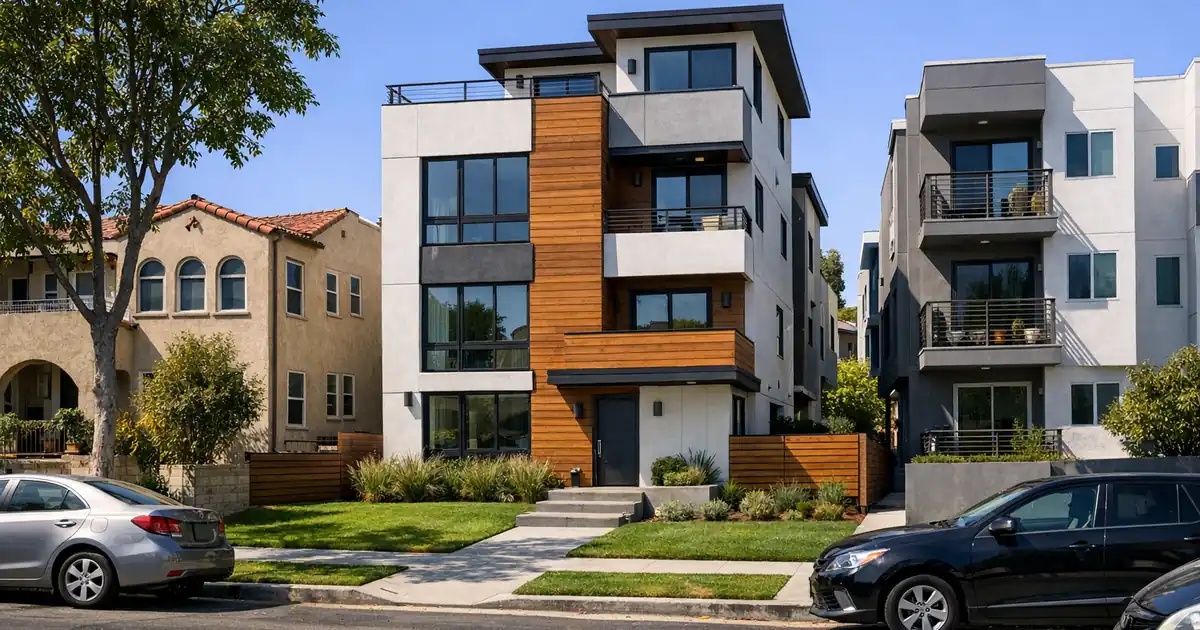
This page covers how to refinance investment property in Los Angeles using loan programs that qualify on rental income rather than personal tax returns.
Los Angeles isn’t a real estate market. It’s an economic continent. The metro’s gross product exceeds $1.295 trillion, UCLA draws 49,000+ students to Westwood, and Kaiser Permanente is the county’s single largest private employer — all within a city of 3.88 million people. The density of demand here is unlike anything you find in comparable U.S. metros, and that density is what makes pulling equity out of an LA investment property a fundamentally different calculation than a cash-out in Phoenix or Dallas.
LA investors who bought three to five years ago are sitting on substantial equity — in many neighborhoods, values have appreciated 8%+ in a single year. The question isn’t whether the equity is there. It’s whether the rental income at the new loan amount still supports the debt service, and which neighborhoods give you the most room to maneuver when you restructure the financing.
That’s the analysis this article does, neighborhood by neighborhood.
DSCR Cash-Out Calculator
Run the cash-out numbers in California
Rate source: Freddie Mac 30-yr average via FRED® — Federal Reserve Bank of St. Louis · effective Jul 30, 2026
Prefilled with starting assumptions — enter your property’s value, balance, taxes, and insurance for a more accurate picture.
Program parameters update from Lendmire’s centralized guideline source. Taxes and insurance are editable estimates.
As of Jul 30, 2026 · General Freddie Mac market benchmark, not a Lendmire loan offer. Property value, balance, taxes, and insurance are editable estimates. Maximum loan-to-value varies by lender, program, property type, and seasoning. Not a Loan Estimate, approval, or commitment to lend. Program availability and eligibility are subject to lender guidelines, credit approval, property review, and underwriting.
Why LA Works for DSCR Cash-Out — And Where It Gets Complicated
DSCR cash-out refinancing on investment property allows investors to extract equity without income verification. The loan qualifies on the property’s rental income relative to PITIA, not the borrower’s personal W-2. In a market like LA, where most serious real estate investors own multiple properties under LLCs, this structure fits naturally. The mechanics of how DSCR qualification works are straightforward — rent divided by PITIA equals your DSCR ratio, and 1.00 is the standard floor.
Here’s the complication in LA: property prices are high enough that at 75% LTV cash-out, you’re still carrying a significant loan balance. Rents in many neighborhoods — while strong in absolute terms — don’t always produce the DSCR ratios you’d see in a Memphis or Kansas City rental. The spread between rent and debt service is tighter. That’s not a reason to avoid LA cash-outs; it’s a reason to be strategic about which asset types and neighborhoods you finance, and to know which loan structures (interest-only, sub-1.00 programs) are available when the standard ratio comes in thin.
DSCR loans also differ from conventional investment financing in meaningful ways, and understanding the key differences matters before you start pulling equity from an LA portfolio.
California’s RSO (Rent Stabilization Ordinance) adds another layer. Most pre-1978 properties in the city of Los Angeles are subject to rent control, which caps annual increases and limits your ability to reset rents to market rate on turnover. This directly affects DSCR math on older multifamily — if your current rents are RSO-restricted well below market, your DSCR qualification is based on what tenants are actually paying, not what the unit could fetch today. Underwriters use current rent rolls, not potential rents.
Koreatown: The Multifamily Engine
Koreatown consistently appears near the top of LA investor discussions for good reason. With some of the highest population density in the country, walkable transit access, and median prices in the $600,000–$900,000 range for condos and smaller multifamily, it’s entry-level by Los Angeles standards — and that’s saying something.
One-bedroom rents average around $2,300 with projections pushing toward $2,800 as demand continues building from millennial renters drawn to the neighborhood’s nightlife, dining, and cultural identity. Cap rates in K-Town run approximately 5%–7% depending on the property — one of the wider spreads you’ll find across LA.
On a $750,000 small multifamily purchase, a cash-out refi at 75% LTV produces a $562,500 loan. At current market rents, a two-unit in K-Town can produce $4,600–$5,000/month combined. The DSCR math has room to work, particularly with an interest-only structure. That said, RSO is pervasive here — most of the older two-to-four unit stock is restricted, so verify the rent roll before underwriting any projected appreciation in income.
Downtown LA: Strong Rents, Watch the Vacancy
DTLA median rents sit at $2,500/month across all property types, roughly 25% above the national average per Zumper data. One-bedroom units push upward of $2,800. The employment base — entertainment, tech, finance, healthcare workers — creates persistent demand from young professionals who want walkable urban living.
The DSCR on a DTLA condo cash-out can pencil at 75% LTV if the unit is occupied and rented at market. The challenge is the roughly 13% condo vacancy rate in downtown high-rises. That’s not catastrophic, but it’s real. An investor pulling cash-out on a condo that sits vacant for two months between tenants will feel that in their annual return, and underwriters will look hard at the comparable rental evidence. Cap rates here average 4.5%–6%, which is workable but leaves less cushion than K-Town.
Skip the oversupplied DTLA high-rise condo towers for cash-flow plays — they’re speculative appreciation bets, not income engines. The smaller mixed-use and loft conversions with verified rental history are a different story.
Silver Lake and Echo Park: Equity-Rich, Math-Tight
Silver Lake is where LA’s creative class pays premium rent without apology. Median home prices exceed $1.2 million, one-bedrooms average around $3,200/month, and two-bedrooms citywide median around $3,831 — with Silver Lake trending above that. Properties routinely trade within 15–20 days, often over ask.
That appreciation is the investor thesis here — not current cash flow. Cap rates between 4%–5.5% don’t produce strong DSCR at conventional loan structures on $1.2M+ properties. If you own Silver Lake and have substantial equity from years of appreciation, a cash-out refi using interest-only restructuring is often how the PITIA stays manageable. IO isn’t a workaround — it’s a legitimate structure for exactly this kind of high-value, lower-cap-rate asset. The interest-only option requires a 680+ credit score and DSCR qualification.
Echo Park runs in parallel. Average rents around $2,654/month on properties priced $800,000–$1.1 million for single-family. The revitalized commercial corridors and proximity to Downtown LA drive appreciation — properties are regularly selling 10%–20% above listing price — but the cash-flow math is tight on standard 30-year amortization. Echo Park makes the most sense for investors who already own and are pulling equity to deploy elsewhere, rather than new acquisitions targeting cash flow on day one.
Westwood: The UCLA Rental Machine
Westwood deserves its own conversation because the dynamics are fundamentally different from every other neighborhood on this list. UCLA’s enrollment of 49,013 students and approximately 43,000 staff members creates a rental demand floor that doesn’t fluctuate with broader economic conditions. You’re not hoping for employment growth or demographic shifts — the university produces a fresh wave of tenants every single year.
Median sale prices in Westwood hit $1.84 million, and home values rose 8.3% in a single recent year. That appreciation trajectory is exactly the kind of equity-building story that sets up a productive cash-out. At 75% LTV on a $1.84M property, you’re looking at a $1.38M loan — this falls into Lendmire’s jumbo DSCR territory (up to $6M). Six-month reserves are required on cash-out refinances, which means the capital planning for a Westwood cash-out has to account for reserve requirements, not just the cash-out proceeds.
Rental demand here is described as “robust” with extremely low vacancy driven by constant student and faculty turnover. For multi-family investors, Westwood is one of the most reliable institutional-grade rental plays in the country. The barrier to entry is real, but investors who are already in have serious equity to work with.
Playa Vista / Silicon Beach: Corporate Tenants, Premium Rents
Playa Vista sits at the intersection of tech, aerospace, and media. Google, Amazon (through Amazon Studios), Apple TV+, and Sony Pictures all operate nearby, and the area’s master-planned environment attracts corporate relocation tenants who sign leases and pay on time. Two-bedroom rents in coastal areas including Playa Vista regularly exceed $4,000/month.
This is the Westside tech-tenant play. Condos and townhomes price from $800K to $1.5M+, and new construction moves fast — often pre-sold before completion. On a $1.2M cash-out refi at 75% LTV ($900,000 loan), $4,000+/month rental income can produce a DSCR ratio that works at market rate without IO if the property is a two-bedroom unit occupied by a single corporate tenant on a 12-month lease. Qualification details are subject to lender overlays and should be confirmed directly with Lendmire.
The aerospace angle is worth mentioning separately. Northrop Grumman and Boeing both maintain facilities in El Segundo, and SpaceX is headquartered in Hawthorne — both immediately adjacent to Playa Vista. The 60,000 aerospace workers in LA County averaging $136,000 in wages (per the LA County Economic Development Corp.) are exactly the tenant profile that stabilizes a Playa Vista rental portfolio.
Highland Park: Value-Add Equity Play in Northeast LA
Highland Park is the Eastside version of Silver Lake’s trajectory — creative class gentrification, York Boulevard restaurant culture, Figueroa Street retail momentum — but at price points that still feel accessible relative to the Westside. Median home prices run $800K–$1.1M, two-bedroom rents typically $2,400–$3,000, and the value-add potential on older bungalow stock is real.
For investors already holding a Highland Park asset bought before the gentrification wave crested, cash-out at 75% LTV on an $850,000 property produces a $637,500 loan. If that property rents for $2,700/month, the DSCR question becomes whether PITIA on $637,500 can stay under $2,700. With an IO structure, often yes. Without it, it can go sub-1.00 depending on tax and insurance load — which is financeable through a sub-1.00 DSCR program (requires 660–700 credit score at reduced LTV), but it reshapes the deal terms.
Watch the RSO exposure on pre-1978 stock here. A significant portion of Highland Park’s older rental inventory is subject to rent stabilization, which complicates rent reset strategies on turnover.
Inglewood: Stadium District Momentum
Inglewood’s transformation since SoFi Stadium opened has been consistent and measurable. With ongoing development projects and an elevated profile from NFL, concerts, and entertainment events, Inglewood’s price appreciation trajectory is real. Median prices in the $650,000 range make it one of the more accessible entry points in the broader LA market.
This is worth watching for cash-out potential as values continue to build. Proximity to LAX, the Intuit Dome (NBA’s Clippers), and the established SoFi Stadium entertainment district creates sustained demand from both long-term renters and short-term rental guests — particularly during major events.
Inglewood’s short-term rental opportunity is worth a look for investors with properties near the stadium corridor. LA’s STR market operates under city permitting requirements that favor owner-occupied primary residences, but properties in Inglewood (an independent city not subject to the City of LA’s STR ordinance) have more operational flexibility. If you’re considering an STR structure for an Inglewood asset, Lendmire has STR lending details specifically for DSCR-financed short-term rental properties.
How Lendmire Structures LA Cash-Outs
Lendmire (NMLS# 2371349) is a mortgage broker that serves Los Angeles, California investors across every asset class and neighborhood profile described above. Given the city’s price range, a significant portion of LA cash-outs involve loan amounts above $1.5 million, which triggers Lendmire’s six-month reserve requirement. These aren’t deal-killers — they’re planning inputs. California carries no state overlay, so the standard limits apply: cash-out LTV reaches 75% for single-family, 2-4 unit and condo properties alike. On a $1.5M single-family in Echo Park with no other complicating factors, 75% cash-out produces $1.125M — meaningful capital that can seed acquisitions in stronger cash-flow markets or cover improvements to the existing portfolio. Interest-only lowers PITIA enough to push borderline DSCR ratios above 1.00, which is the standard qualification threshold. Credit minimum for IO is 680. For investors comparing LLC-titled properties: Lendmire closes loans to LLC entities, subject to lender program eligibility. Given that most sophisticated LA investors hold property in LLCs for liability protection, this is a material point. Investors can request a quote online or reach Lendmire directly at 828-256-2183. DSCR cash-out closings in California can be completed on a timeline that varies by lender and file once documentation is complete.
The RSO Factor: What LA Investors Must Understand About Rent Control
This section exists because no honest analysis of LA investment property financing skips it. The City of Los Angeles Rent Stabilization Ordinance applies to most multifamily residential units built before October 1978. That covers a massive portion of the city’s rental stock — including much of the inventory in Koreatown, Highland Park, Echo Park, and Silver Lake.
Under RSO, annual rent increases are limited (typically 3%–8% depending on the allowance set each year), and evictions are restricted to “just cause” grounds. For DSCR underwriting purposes, this means your qualifying rent is whatever the tenant is currently paying — not what the unit could command at market rate. On a unit where a long-term tenant is paying $1,800/month in a neighborhood where market rate is $2,600, the underwriter uses $1,800. Your DSCR math reflects the RSO-restricted rent, not the potential rent.
The implication: before structuring a cash-out on any pre-1978 LA multifamily, run the DSCR numbers on actual current rents, not pro forma projections. If actual rents produce sub-1.00 DSCR, you’re looking at a sub-1.00 program or IO restructuring — both available, but the deal is fundamentally different than it appears on the surface.
Frequently Asked Questions
Does LA’s Rent Stabilization Ordinance affect my DSCR loan qualification?
Yes, directly. DSCR underwriters use the actual current rent from the lease agreement, not market rate. If your tenants are paying RSO-restricted rents significantly below market, your qualifying DSCR will be based on those lower rents. On older Koreatown or Echo Park multifamily, verify current rent rolls before starting the cash-out application.
Can I do a DSCR cash-out on a Westwood property near UCLA if it’s a small multifamily?
Yes. Two-to-four unit properties qualify for DSCR cash-out in California at 75% LTV (refi). On a $2M fourplex, that’s $1.5M in potential loan proceeds. Given Westwood’s occupancy strength from UCLA’s 49,000+ student enrollment and 43,000+ staff, DSCR qualification on market-rate rents is generally supportable — though reserve requirements (six months above $1.5M loan amounts) will be part of the structure.
Is Inglewood subject to the City of LA’s short-term rental ordinance?
No. Inglewood is an independent incorporated city and operates under its own regulatory framework — separate from the City of Los Angeles STR ordinance, which heavily restricts non-owner-occupied short-term rentals. Investors with properties in Inglewood near SoFi Stadium or the Intuit Dome have more operational flexibility for event-driven STR strategies. DSCR lenders will underwrite STR income using market-rate STR comps for qualifying purposes.
What credit score do I need for an LA cash-out DSCR loan?
For a standard cash-out DSCR refi, the minimum credit score is 660. Interest-only structures require 680. If the property is in a higher loan tier (above $1.5M, which covers much of Westwood), expect more rigorous reserve requirements alongside the credit standard.
Can I use DSCR cash-out proceeds to pay off a hard money loan I used to acquire an LA property?
Yes. DSCR cash-out proceeds are appropriate for retiring investment property debt — including hard money loans, private lender balances, or other rental property mortgages. Proceeds cannot be used for personal consumer debt.
What’s the minimum DSCR ratio for a cash-out on a lower-cap-rate LA neighborhood like Silver Lake?
Standard minimum is 1.00. A sub-1.00 program is available (660–700 credit score, reduced LTV) for situations where the rental income on a Silver Lake or Echo Park asset produces a ratio below 1.00 on standard amortization. Interest-only restructuring at 680+ credit is often the cleaner path to hitting 1.00 without program concessions.
Does LA’s high property tax rate affect DSCR qualification?
Yes. California’s property taxes are based on assessed value, and a cash-out refi doesn’t trigger reassessment under Prop 13 if ownership doesn’t change. However, new acquisitions in LA are assessed at purchase price, which at $1M+ price points produces meaningful property tax annual costs — fully included in PITIA. On any LA DSCR calculation, property tax is not a rounding error; model it carefully.
Refinancing LA Equity Into Your Next Play
For investors who already hold LA assets with equity built from years of appreciation, a DSCR cash-out refinance doesn’t have to be the endpoint — it can be the starting point for a portfolio expansion strategy. Extracting capital at 75% LTV from a Highland Park or Echo Park property to seed acquisitions in secondary markets with stronger cap rates is a common structure among LA-based investors who’ve maxed their local cash flow potential. Lendmire’s refi programs are built to support exactly this kind of cross-market capital recycling.
Investors wanting to explore how refinancing options compare across different scenarios can reach Lendmire at 828-256-2183. Lendmire is recognized by Scotsman Guide and works with investors across 41 markets.
The Bottom Line on LA
Los Angeles is not a market you enter chasing cash flow from day one. The math is tighter here than in most U.S. metros, RSO complicates multifamily underwriting on older stock, and the price points demand careful attention to reserve requirements and loan structure. But for investors who already own here — who bought in Echo Park, Westwood, Silver Lake, or Koreatown before the recent appreciation run — the equity position is substantial and increasingly actionable.
The cash-out DSCR structure was built for exactly this kind of market: high-value property, income-producing, held in an LLC, with an investor who doesn’t want to run their personal tax returns through a bank’s debt-to-income calculation. Lendmire’s structure handles that cleanly. The investor’s job is to know their actual rent roll, their RSO exposure, and their IO eligibility before starting the conversation.
LA’s rental demand has institutional-grade durability — backed by UCLA, USC, Cedars-Sinai, Kaiser Permanente, the aerospace corridor, and the entertainment industry. That’s not a market that softens easily. The equity that’s accumulated here reflects real economic depth, and for investors positioned to access it, a well-structured DSCR cash-out is one of the most effective tools in the portfolio.
About Lendmire
Lendmire (NMLS# 2371349) is a mortgage brokerage built around DSCR investor lending, with programs available in 41 markets, including Washington, D.C. DSCR lenders commonly evaluate rental-income coverage instead of personal income paperwork — a practical fit for LLC-owned and multi-property investors. Terms vary by lender, property, leverage, and program. Scotsman Guide named Lendmire a Top Mortgage Workplace in both 2025 and 2026.
Get Started
Ready to find the right loan for you?
In about 30 seconds you can review financing options available for your investment property. No commitment required.
Informational only. Not a Loan Estimate, approval, or commitment to lend. Program availability and eligibility are subject to lender guidelines, credit approval, property review, and underwriting.
This article is part of Lendmire’s investment property cash-out refinance program — full qualification details, guidelines, and scenarios live on the program page.
Related reading: Investment Property Loans in Seattle, WA: What It Takes to Qualify on Seattle Rents · Investment Property Loans in Anaheim, CA: Beyond the Mouse Ears · Investment Property Loans in Oakland, CA: The 2026 DSCR Financing Guide to the Flatlands
Guides: Investment Property Cash-Out Refinance in Los Angeles, CA · Investment Property Cash-Out Refinance in California
References
1. Freddie Mac 30-yr average via FRED® — Federal Reserve Bank of St. Louis
Brandon Miller
Founder & CEO, Mortgage Loan Originator, Lendmire LLC
- Mortgage Loan Originator · NMLS# 1129696 · Verify on NMLS Consumer Access
- North Carolina Real Estate Broker · License# 343312 · Verify on NCREC
- North Carolina Insurance Producer · License# 19053198 · Property, Casualty, Life, Health · Verify on NAIC SBS
- Lendmire LLC · Firm NMLS# 2371349 · Verify firm licensure
Legal disclosures. Lendmire (NMLS# 2371349) is a state-licensed mortgage brokerage that arranges financing through wholesale lender relationships. Lendmire is not a direct lender, depository institution, or registered financial advisor. The discussion above is general informational content about real estate financing — it is not financial, legal, or tax advice, and readers should consult licensed professionals for guidance on their individual circumstances. Loan inquiries are subject to lender underwriting; this article does not represent a commitment to lend. Loan terms, rates, and qualification standards vary by borrower, property, and state, and are subject to change at any time. Equal Housing Opportunity. NMLS Consumer Access: nmlsconsumeraccess.org.