
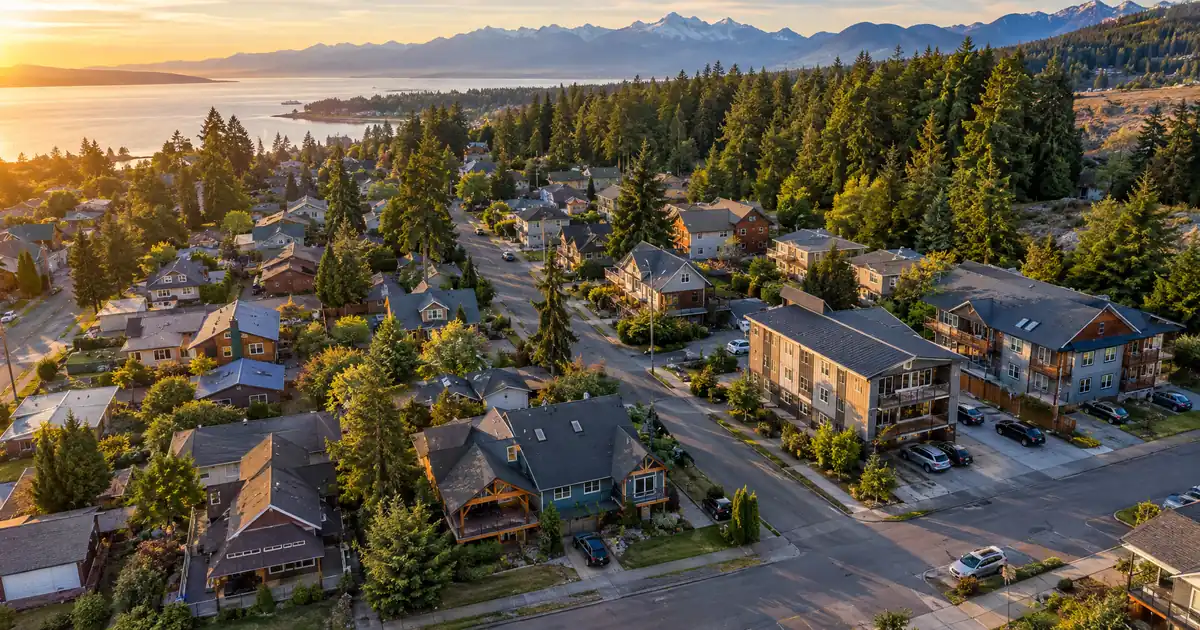
The appraisal is where most small-market cash-out refinances lose their shape. An investor who bought a Port Angeles rental a few years back may assume the property has grown into a large equity position. Then the valuation comes back sized against a market that has gone sideways or slipped, and the cash available looks nothing like the spreadsheet. Skip that surprise by running the conservative version first.
TL;DR: Cash-out refinancing in Port Angeles, Washington State is underwritten primarily on the property’s rental income measured against its full monthly obligation, and with a flat price trend and thin single-family rent-to-value, the leverage chosen matters more than the loan type, and sizing to today’s appraised value is the structural decision.
DSCR Cash-Out Calculator
Run the cash-out numbers in Port Angeles, WA
Rate source: Freddie Mac 30-yr average via FRED® — Federal Reserve Bank of St. Louis · effective Sep 24, 2026
Prefilled with starting assumptions — enter your property’s value, balance, taxes, and insurance for a more accurate picture.
Program parameters update from Lendmire’s centralized guideline source. Taxes and insurance are editable estimates.
As of Sep 24, 2026 · General Freddie Mac market benchmark, not a Lendmire loan offer. Property value, balance, taxes, and insurance are editable estimates. Maximum loan-to-value varies by lender, program, property type, and seasoning. Not a Loan Estimate, approval, or commitment to lend. Program availability and eligibility are subject to lender guidelines, credit approval, property review, and underwriting.
- The six-month closed-sale median sits near $415,000 across 199 closings, per Resideline.
- Zillow’s typical home value is down 3.0 percent year over year, per Zillow.
- A median-rent single-family home models near 0.7x coverage at 75 percent leverage, taxes and insurance included.
- A modeled duplex at similar value clears roughly 1.3x at the same leverage. Olympic Medical Center employs more than 1,550 people, anchoring long-term renter demand.
Lendmire, NMLS# 2371349, is a DSCR-focused mortgage broker, and Lendmire helps arrange DSCR financing for Port Angeles, Washington State investors through wholesale and investor-lending channels across 41 markets, including Washington, D.C. This piece covers the exit side of the deal: investors who already own a rental here and want to turn equity into capital. Purchase mechanics get short shrift on purpose. For the broader statewide picture, see DSCR loan options for Washington State investors. For the mechanics of pulling equity out, the pillar page goes deeper.
Port Angeles Market Snapshot
A quick read on the Port Angeles investor landscape — figures come from the cited sources below. Confirm current property-level numbers before underwriting.
| Metric | Detail |
|---|---|
| Home prices | $415,000 median (Resideline) |
| University enrollment | ~6,000 college students (Visit Port Angeles) |
| Population | ~20.1K population (Data USA) |
| Employment | More than 1,550 employees (Olympic Medical Center) |
| Vacancy | 6.4% rental (2020) (Wikipedia) |
What Equity Actually Exists When Prices Are Flat?
Less than the last few years of headlines suggest. Resideline shows a median sale price and a volume of recent closings that point to a market with a fairly wide spread between lower-priced and higher-priced sales. Zillow puts its typical home value somewhat higher and shows it down modestly over the past year. The two measure different things (a closed-sale median versus a modeled value index), so treat them as a band rather than a contradiction.
Two implications follow.
First, a cash-out here can’t lean on appreciation to manufacture equity. The equity has to come from principal paydown, a purchase made below current value, or improvements that show up in the appraisal. Second, a $340,000 to $490,000 spread gives an appraiser real latitude in comp selection. Two defensible appraisals of the same house can land far apart. Investors who model their refinance at the top of that range are planning around the most optimistic version.
Picture an owner whose existing loan already sits near 70 percent of current value. At a 75 percent cash-out ceiling, there’s almost nothing to extract, and the closing costs could eat whatever trickles out. The flip point is simple: if the current balance is within a few points of the ceiling, the cash-out may not be worth doing. Owners who put down a large down payment, or who bought when the market was cheaper, have the real room.
The Coverage Problem on Single-Family
This is where Port Angeles gets honest with investors. Homes.com reports a median single-family rent of $1,750, with three-bedroom houses listing around $1,700, and a price-to-rent ratio of 21.8. Against the $415,000 sale median, that’s roughly 0.42 percent rent-to-value by simple arithmetic, which is a thin margin for covering a full housing payment.
Run the numbers on a single-family rental valued at $415,000, using modeled assumptions rather than sourced market data. Take the $1,750 median rent as the rent used for lender review and divide it by full PITIA (principal, interest, taxes, insurance and any HOA dues). The table shows the resulting coverage. Every figure includes taxes and insurance at typical Washington averages, and every band is rounded down.
| Leverage | Single-family at $1,750 rent | Modeled duplex at $3,400 total rent |
|---|---|---|
| 75 percent LTV | about 0.7x | about 1.3x |
| 60 percent LTV | about 0.8x | about 1.6x |
| 50 percent LTV | just under 1.0x | about 1.9x |
The duplex column is an illustration, not a listing. It assumes the same $415,000 value and two units at $1,700 each, borrowed from the three-bedroom rent figure above. Real duplex appraisals may land lower per door.
The pattern is hard to miss. A single-family rental at the median rent doesn’t reach the 1.00x baseline even at half leverage. Most standard DSCR programs are built around 1.00x because rent covers the payment at that level. Some lenders may review lower-coverage scenarios, but those typically ask for lower leverage, stronger credit, more reserves or different pricing, and eligibility ultimately depends on lender guidelines, property review and credit approval.
So what do sub-1.00 files do? A lender may review a sub-1.00 program, an interest-only structure, or a lower loan amount that pulls coverage up. Each comes with a tradeoff. Lower leverage means less cash out. Sub-1.00 programs usually mean more cash down and stricter credit. The question worth asking first is whether the investor should be using them at all. If the only way a single-family cash-out works is through the most forgiving structure available, the signal is about property type, not loan type.
Rents also vary sharply by source and unit type. Rentometer shows two-bedroom averages in the $1,900 to $2,000 range, with medians in the $1,600s, while older Census-derived figures run far lower. A well-maintained three-bedroom in good condition may outperform the median rent, and a dated one may not reach it. Pull rent comps for the specific unit, not the city.
Working DSCR brokers see a recurring pattern in small, flat-priced markets like this one. The cash-out gets sized on the owner’s hoped-for appraisal and the market rent from a portal, then both come in lower on the file. Files that hold together are usually modeled at the conservative end of the value range and at lease-backed rent, which leaves room for the number to move without breaking the deal.
Where the Math Has a Shot
Three parts of town and one outlying pocket deserve a look. No neighborhood-level price or rent source was available for this research, so the discussion is qualitative and investors should check current MLS data for each area.
The hospital district. The corridor around Olympic Medical Center is the most durable demand story in the city. OMC is the largest employer in Clallam County with more than 1,550 employees per its own about page, and Wikipedia lists 126 inpatient beds and a Level III trauma center. Nurses, travel clinicians and support staff are steady renters, and lease renewal tends to follow employment rather than the tourist calendar. Workforce single-family homes and duplexes fit this area best. Its rents weren’t verifiable in this review, so the tenant base is a demand argument, not a pricing one.
Downtown and the waterfront. The ferry terminal, the pier and the First Street blocks draw service, ferry and tourism-sector staff. The Coho ferry to Victoria, British Columbia, runs from downtown, according to Visit Port Angeles. Older buildings with upper-floor units may suit small multifamily, which, as the table suggests, is the property type where coverage works best. Older buildings also mean appraisal and condition questions, so the inspection matters more than the location.
Cherry Hill, Peabody Creek and Peabody Heights. This established residential area sits close to downtown and includes the Olympic National Park headquarters on Peabody Heights, a historical fact documented by HistoryLink. The likely renter pool is park and government staff plus working families. It’s a steadier, quieter rental submarket than the waterfront, though no verified rent band came out of the research.
Port Angeles East and Gales Addition. Clallam County code describes Gales Addition as distinctly residential, and Wikipedia reports a population of 3,159 for Port Angeles East in the last decennial count. County code also notes the neighborhoods are largely built out, with infill potential. The area is under county rather than city jurisdiction, so verify current local rules, taxes and insurance with qualified local professionals before underwriting a hold there.
Which of these pencils best? The hospital district for workforce demand, probably, though an investor chasing cash flow could argue for a duplex just outside the core where entry prices are lower. The trade is less liquidity for a better coverage ratio.
Small Multifamily: Thin Inventory, Better Math
Duplexes and fourplexes are where Port Angeles coverage stops being a struggle, and they’re scarce. Homes.com lists just four multi-family homes and duplexes for sale in ZIP 98362. One example is a duplex with two single-level three-bedroom units, each around 960 square feet. Another listing is a centrally located four-unit building.
That scarcity cuts both ways for a cash-out. On the plus side, stacked income makes the coverage ratio workable at 75 percent leverage, which the single-family math can’t. The catch is the appraisal. With so few recent 2-4 unit sales, an appraiser may have to reach for comps, and a thin comp set raises the odds of a conservative value. Some lots also carry two dwellings, such as a three-bedroom plus a smaller second home on one corner parcel. Those can stack income under one loan, but how a lender treats two dwellings on one lot varies, so confirm early.
Buildings of five or more units are another matter. Listings in the area claim full occupancy (one says 14 units, 100 percent leased), but those are seller claims rather than verified data. Buildings above four units generally fall outside standard 1-4 unit DSCR programs, so confirm with the lender before assuming a larger building is an option.
On vacancy, the only sourced figure is county-level. Clallam County data from the last decennial count shows a 6.4 percent rental vacancy rate, with 26.9 percent of occupied units renter-occupied. Two caveats: the data is dated, and a renter pool that small means limited depth. Use a conservative vacancy factor rather than taking the listing claims at face value.
What Lenders Will Look At
The parameters for a cash-out on an investment property are fairly standard, though every figure is a guideline that varies by borrower, property and loan scenario, and is subject to lender requirements.
- Leverage: cash-out LTV typically caps at 75 percent. Purchases run higher, but that figure doesn’t apply here.
- Seasoning: about six months of ownership, measured from title recording, is the typical benchmark.
- Coverage: a 1.00x minimum is the common baseline, using rent used for lender review against full PITIA.
- Credit: tiers generally run 620, 660, 680 and 700, with a 620 floor. Higher scores typically widen leverage options.
- Reserves: about six months of PITIA on most files.
- Loan size: standard programs go up to $3,000,000, and smaller balances route through select lenders in the network, which matters in a market where most balances are modest.
Property type is a hard line. Manufactured homes (single- and double-wide), log homes and barndominiums fall outside these DSCR programs. In a market with a mix of older and rural-edge housing, check that the subject property qualifies before paying for an appraisal.
Entity ownership works on many files, subject to lender program eligibility. An LLC-held rental is the classic fit, since property income is the underwriting basis. The comparison page covers it in full. The short version: a W-2 borrower with one or two personally held rentals may find conventional cash-out cheaper and simpler, while DSCR pulls ahead as the portfolio grows, the borrower is self-employed, or the traditional personal-income documentation doesn’t cleanly support rental income. Investors can see what the numbers look like for their own property before committing to a path, or call Lendmire at 828-256-2183.
Where the Proceeds Go
A cash-out is only as good as what the capital does next. The straightforward case is buying another small multifamily in the same submarket, where coverage still works. A rental owner with a fully seasoned single-family home and a thin coverage ratio could plausibly refinance and use the proceeds to acquire a duplex near the hospital district, converting low-coverage equity into a property that carries itself.
Pulling equity to buy somewhere with a worse coverage picture is a different decision, and one worth stress-testing before committing. Another option is using proceeds to renovate, which can lift both rent and the next appraisal. That works if the improvements are the kind an appraiser credits. If the property’s rent is pinned by the local median no matter how nice the kitchen is, the renovation dollars may not come back.
There’s also the option of doing nothing. For a flat-market rental that already cash-flows on its current loan, a cash-out that pushes leverage to the ceiling could turn a comfortable hold into a thin one. Sometimes the right answer is a smaller draw or none at all.
What Could Change Over the Next 6 to 24 Months?
The equity math here moves with a handful of variables, and most are observable.
Price direction. The current read is flat to slightly soft. If Zillow’s 3.0 percent decline deepens, appraisals could land lower and cash-out proceeds shrink. If it flattens or turns, the same loan would have more room. Nobody can say which, so model the conservative case and treat any improvement as a bonus.
The closed-sale spread. Watch whether that $340,000 to $490,000 middle-half range narrows. A tighter spread means less appraiser discretion and more predictable valuations.
DSCR vs. conventional financing
There are two common ways to finance an investment property in Port Angeles, WA, and they qualify you differently — here’s how investors weigh them.
Why investors choose it
- Qualifies on the property’s rental income — no personal tax returns, W-2s, or pay stubs needed to document income.
- No personal debt-to-income ceiling to clear, so existing mortgages and obligations don’t cap your borrowing the same way.
- Can be closed in an LLC, keeping the property inside a business entity.
- Built for scaling — not held to the limit on number of financed properties that conventional financing applies.
- Underwriting centers on the deal: generally qualifies when the rent covers the payment, a 1.00x coverage ratio being a common baseline (confirmed in underwriting).
- Designed specifically for investment property, including long-term and, where the program allows, short-term rentals.
Where it’s strong
- Often the lowest ongoing financing cost for a buyer who fully qualifies on personal income — a fit for a first property or a cost-first purchase.
Trade-offs for investors
- Requires full personal income documentation and must fit within a debt-to-income limit — salary, existing debts, and other mortgages all count.
- Typically held in your personal name rather than a business entity.
- Caps how many financed properties you can carry, which can become a ceiling as a portfolio grows.
- Evaluates you as a borrower as much as the property, which usually means more paperwork.
How investors usually choose: a first or single property often optimizes for the lowest financing cost; portfolio builders often optimize for leverage, vesting in an LLC, and scaling past conventional caps. The right answer depends on your goals, the property, and current guidelines — both paths run through select lenders in Lendmire’s wholesale network, with eligibility and terms confirmed in underwriting.
Rent comps. Sources span a wide range, from older Census-derived figures near $1,170 to the current Homes.com median of $1,750. If listing rents keep firming while values stay flat, coverage improves without any price help. That’s the scenario that would make single-family cash-outs more viable. Honestly, this one is a genuine toss-up: rent growth could close the gap, but nothing in the sourced data shows a reliable trend yet.
The employment base. Demand here rests on an institutional core. The Washington Employment Security Department reports that the service sector made up over 88.5 percent of nonfarm employment in its county profile, with a prison, a hospital and the school district among the top employers. A mill legacy and a Coast Guard air station round it out. A market with anchors like that tends to hold tenants through price swings, though a single large employer also means concentration. Peninsula College adds modest student demand, with Niche listing 1,042 full-time and 1,111 part-time undergraduates.
Put together, the most likely path is a slow grind rather than a break in either direction. That favors investors who size conservatively now and keep the option to refinance again if values or rents improve.
Frequently Asked Questions
How much cash can I expect from a Port Angeles rental if prices have slipped?
Less than a purchase-era spreadsheet suggests, and it can’t be known until the appraisal lands. Proceeds depend on the appraised value, the existing balance, the 75 percent ceiling, reserves and the rental coverage ratio. With Zillow showing values down 3.0 percent over the past year, model the refinance on a value below your hoped-for number. Equity is never a guaranteed cash figure.
Does a median-rent single-family home clear 1.00x coverage here?
Generally not at high leverage. Using the Homes.com median rent of $1,750 against a $415,000 value, modeled coverage including taxes and insurance runs near 0.7x at 75 percent leverage and just under 1.0x even at about 50 percent. Some lenders review sub-1.00 structures, typically with lower leverage or more cash down, subject to lender guidelines and credit approval.
Do I really have to wait six months after buying before I can cash out?
For most DSCR cash-out programs, about six months of ownership measured from title recording is the typical benchmark. Some lenders vary, particularly if the property was bought with cash or renovated. Since this market has limited appreciation to speed things up, the wait rarely changes the equity math much. Use the time to gather rent comps and a lease.
Can I cash out on a five-unit or larger building in Port Angeles?
Probably not through a standard DSCR program. Buildings of five or more units generally fall outside 1-4 unit guidelines, and confirming with the lender before you go further is the right move. Duplexes, triplexes and fourplexes are the in-program lane. Inventory is also thin, since Homes.com shows only four multi-family homes and duplexes for sale in ZIP 98362, so appraisal comps may be sparse.
Why does the wide price range matter for a cash-out appraisal?
It gives appraisers room. Resideline shows middle-half sales from $340,000 to $490,000, so comp selection can swing the value considerably. Investors are better off supplying recent closed comps of the same property type and condition, and planning around the lower end of the plausible value rather than the top.
The Next Step Before Any Application
Before anyone submits a file, the most useful thing to do is build two comp sets for the specific property: recently closed sales of the same type and condition, and current rent comps for the same bedroom count. Then run coverage against full PITIA at 75 percent and again at 60 percent. If the number only works at the aggressive end, the diligence has already told you whether to draw less, buy a duplex with the proceeds or hold a hospital-district rental as it is.
For current guidelines and terms, see Lendmire’s DSCR loan programs page.
About Lendmire
Lendmire, NMLS# 2371349, is a mortgage brokerage focused on investor financing. It arranges DSCR loans in 40 states plus Washington, D.C. (41 markets total). Qualification rests on the property’s income rather than personal income documentation, subject to lender guidelines, which suits LLC-held rentals and growing portfolios. Lendmire was recognized as a top-ranked workplace in 2026 and as a 2025 Scotsman Guide Top Mortgage Workplace, with details in the 2026 Top Workplace recognition announcement.
Get Started
Ready to find the right loan for you?
In about 30 seconds you can review financing options available for your investment property. No commitment required.
Informational only. Not a Loan Estimate, approval, or commitment to lend. Program availability and eligibility are subject to lender guidelines, credit approval, property review, and underwriting.
References
1. Resideline: Port Angeles housing market
2. Zillow: Port Angeles home values
3. Olympic Medical Center: About Us
4. Visit Port Angeles: Move Here
5. Data USA
6. Wikipedia: Clallam County, Washington
7. Homes.com: Port Angeles houses for rent
8. Rentometer: Port Angeles average rent
9. Wikipedia: Olympic Medical Center
10. HistoryLink
11. clallam.county.codes — Distinctly residential
12. clallam.county.codes — Largely built out
13. Homes.com: ZIP 98362 multi-family listings
14. Washington Employment Security Department: Clallam County profile
16. Niche
17. Scotsman Guide — Top Workplaces 2026
18. a 2025 Scotsman Guide Top Mortgage Workplace
19. the 2026 Top Workplace recognition announcement
This article is part of Lendmire’s investment property cash-out refinance program — full qualification details, guidelines, and scenarios live on the program page.
Related reading: Cash Out Refinance Investment Property in Sequim, Washington · Cash Out Refinance Investment Property in Port Townsend, Washington State · Cash Out Refinance Investment Property in Maple Valley, Washington: Four Corners Equity Math
Guides: Investment Property Cash-Out Refinance in Port Angeles, WA · Investment Property Cash-Out Refinance in Washington
Brandon Miller
Founder & CEO, Mortgage Loan Originator, Lendmire LLC
- Mortgage Loan Originator · NMLS# 1129696 · Verify on NMLS Consumer Access
- North Carolina Real Estate Broker · License# 343312 · Verify on NCREC
- North Carolina Insurance Producer · License# 19053198 · Property, Casualty, Life, Health · Verify on NAIC SBS
- Lendmire LLC · Firm NMLS# 2371349 · Verify firm licensure
Compliance and disclosures. Lendmire (NMLS# 2371349) is a licensed mortgage broker and is not a direct lender, depository institution, financial advisor, or tax professional. Content in this article is general market analysis and educational information — not financial, legal, or tax advice for any specific situation. Lendmire does not guarantee loan approval; every transaction is subject to underwriting by the funding lender. Mortgage pricing and loan program guidelines are subject to change at any time without notice and vary by borrower characteristics, property type, and state regulations. Lendmire complies with Equal Housing Opportunity. Licensure verification: NMLS Consumer Access.