
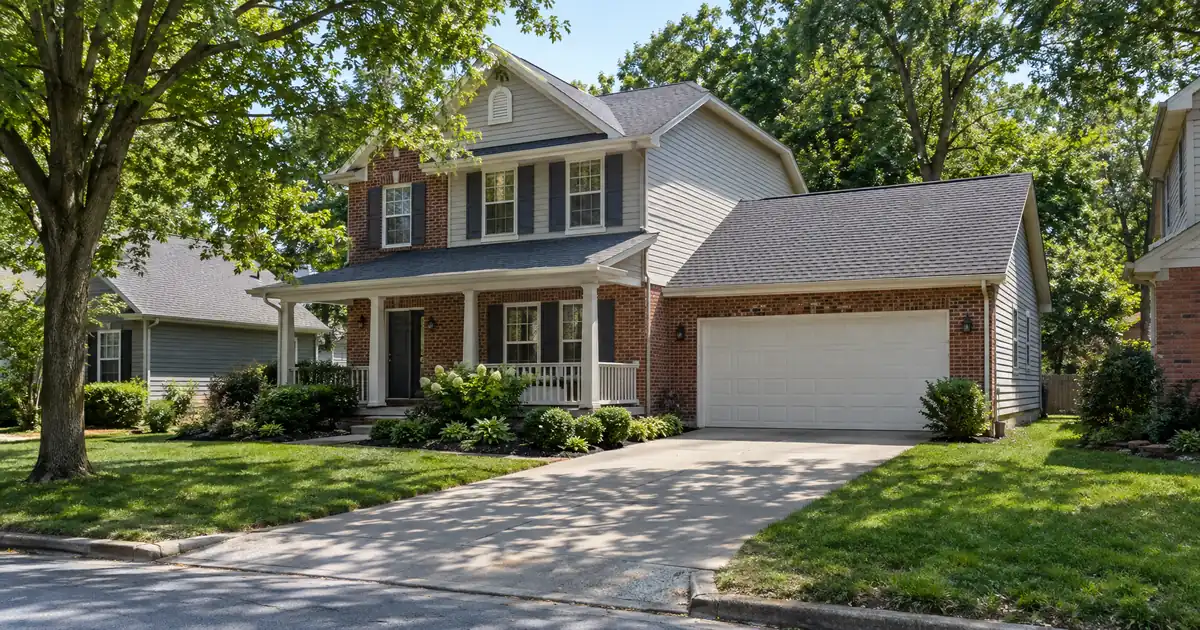
How much equity can you actually pull from a New Albany rental, and does the rent support it? The answer depends on two numbers: the appraised value and the property’s rent measured against its full monthly obligation. Zillow puts the typical New Albany home value at $213,017, up 3.9 percent over the past year, while older central-pocket houses trade far below that. The 75 percent LTV ceiling then sets the outer limit on what comes out.
Lendmire (NMLS# 2371349) is a multi-state mortgage brokerage that helps New Albany, Indiana investors arrange DSCR financing across 41 markets, including Washington, D.C. This article covers the extraction side only: the investor already owns the property and wants to turn built-up equity into capital for the next acquisition.
DSCR Cash-Out Calculator
Run the cash-out numbers in New Albany, IN
Rate source: Freddie Mac 30-yr average via FRED® — Federal Reserve Bank of St. Louis · effective Sep 24, 2026
Prefilled with starting assumptions — enter your property’s value, balance, taxes, and insurance for a more accurate picture.
Program parameters update from Lendmire’s centralized guideline source. Taxes and insurance are editable estimates.
As of Sep 24, 2026 · General Freddie Mac market benchmark, not a Lendmire loan offer. Property value, balance, taxes, and insurance are editable estimates. Maximum loan-to-value varies by lender, program, property type, and seasoning. Not a Loan Estimate, approval, or commitment to lend. Program availability and eligibility are subject to lender guidelines, credit approval, property review, and underwriting.
Key Takeaways:
A DSCR cash-out refinance in New Albany, Indiana is underwritten primarily on the property’s rental income measured against its full monthly obligation, not on the borrower’s personal income documents. Proceeds are capped by a 75 percent LTV ceiling, and eligibility remains subject to lender guidelines, credit review, and property review.
- Cash-out LTV tops out at 75 percent; about 6 months of ownership from title recording is typical seasoning.
- Older central pockets (Fairmont, Russell, Shawnee) show listing averages of $145,000 to $165,000, which favors coverage.
- Two-to-four unit buildings add doors but can carry a lower leverage ceiling than single-family.
- Renters make up 44 percent of households, per RentCafe.
- Louisville-side employers pull commuters across a toll-free bridge, supporting steady tenant demand.
New Albany Market Snapshot
A quick read on the New Albany investor landscape — figures come from the cited sources below. Confirm current property-level numbers before underwriting.
| Metric | Detail |
|---|---|
| University enrollment | 3,702 total (IU Southeast fall 2026) |
| Population | 37,581 population (Census Reporter — New Albany) |
| Employment | 2,000+ employees (Baptist Health Floyd LinkedIn) |
What Does the Equity Math Look Like on a New Albany Rental?
Appreciation alone will not fund most extractions here. Zillow’s 3.9 percent annual gain adds under four points of equity per year, so the proceeds usually come from a low original basis, principal paydown, or a value-add renovation that lifted the appraisal.
Picture an investor holding a workforce house in a central pocket, now appraising near the Redfin listing averages for Fairmont, Russell, and Shawnee. The existing payoff sits at a little over half of appraised value. A 75 percent ceiling leaves a meaningful slice of value available before closing costs and reserves. Each additional bit of payoff below that ceiling adds an equal amount of proceeds, so the lower the starting balance, the more room the investor has to work with.
Now the coverage side. Model the house at a $150,000 appraisal and $1,350 rent. These are assumptions, not market medians: 75 percent LTV, a 30-year term, and taxes and insurance at Indiana-average loads. Coverage lands in the 1.3 to 1.5 range including taxes and insurance, comfortably over the 1.00 benchmark that most standard programs are built around. Push the same structure onto a $213,017 house renting for $1,550, the kind of rent you see on older three-bedroom stock, and coverage falls to the low 1.2s. Still workable. Tighter, though.
Rent-to-value is why basis matters more than headline price. A $1,374 three-bedroom rent from RentCafe against the Zillow typical value works out to roughly 0.65 percent monthly, but that mixes a 50-plus-unit apartment sample with a citywide home index. Treat it as an illustration only.
Lenders vary on details. Seasoning is typically about 6 months from title recording, credit tiers run from a 620 floor up through 700, and reserves generally sit near 6 months of PITIA. Lender guidelines govern all three. The mechanics of a DSCR cash-out refinance are covered separately.
Fairmont, Russell, Shawnee (Where Basis Beats the Rent)
These central pockets are the strongest extraction candidates in the city. Redfin’s snapshot shows averages of $165,000, $145,000, and $150,000. That is well under the citywide typical value and far under the roughly $249,900 that new-construction townhomes list for near Nighthawk Place.
Rents on older stock cluster in a $1,000 to $1,550 band. Rent.com shows a 3-bedroom, 1-bath house near $1,350 and older 1- and 2-bedroom units at $975 and $1,190, while RentCafe’s house listings span $830 to $1,550. Newer product reaches $2,275 for a 3-bed, 2.5-bath in the 47150 zip. The spread is the story: lower basis against workforce rents produces the coverage cushion, while newer builds buy lower maintenance at a weaker rent-to-value ratio.
One honest gap. No source gave neighborhood-level rent medians, so these are listing snapshots and asking rents, not averages. An appraisal and a rent schedule from the actual property will settle the question. The stronger play might be a paid-down house here over a pricier downtown property, though investors chasing appreciation could argue the reverse.
Duplexes to Fourplexes: More Doors, Lower Ceiling
Small multifamily stacks rent streams from one basis, but the leverage ceiling does not stack with it. Two-to-four unit assets can carry a lower maximum LTV than single-family under many programs, so the extraction percentage shrinks even as coverage improves. Income helps the ratio. It does not lift the cap.
The per-door math in this market is modest. One Xome-listed package near downtown, a duplex plus a fourplex, showed $4,025 a month from six apartments, about $670 a door by simple division. A separate six-unit listing on the same aggregator showed $4,795 in gross rent, about $800 a door, with utilities included. Those are undated listing snapshots with no prices, so read them as the shape of the income, not a market average. Utilities in the rent change net income materially.
No source supplied cap rates, vacancy, or unit-count inventory for the older core. The renter base is real, though. RentCafe counts 7,128 renter-occupied households against 9,028 owner-occupied, a 44 percent renter share. Five-plus-unit buildings usually shift to commercial underwriting and fall outside standard DSCR territory.
Here’s what Lendmire’s deal desk tends to see on files from markets structurally like this one: the multi-unit files that move cleanly arrive with a current rent roll, signed leases, and a clear split of which utilities the landlord pays. The common friction point is a rent schedule built on asking rents rather than in-place rents, which forces a re-run of coverage late in the file.
Downtown and the Supply Question
Downtown rents run about 20 percent above the citywide figure, and so do prices. Apartments.com puts the downtown average at $1,203, with a range from $968 to $1,523, against a citywide average of $978. That conflicts with RentCafe’s $1,114 citywide number, which uses a different sample. Present them as a range.
The premium has competition. New Class A product is concentrated downtown and along the river: the Oxbow near the Ohio River Greenway extension, per WHAS11, and the 216-unit Silver Creek Commons. No absorption or vacancy data surfaced, so this is a supply-awareness point, not a forecast.
DSCR vs. conventional financing
Two common ways to finance an investment property in New Albany, IN. They qualify you differently — here’s how investors weigh them.
Why investors choose it
- Qualifies on the property’s rental income — no personal tax returns, W-2s, or pay stubs needed to document income.
- No personal debt-to-income ceiling to clear, so existing mortgages and obligations don’t cap your borrowing the same way.
- Can be closed in an LLC, keeping the property inside a business entity.
- Built for scaling — not held to the limit on number of financed properties that conventional financing applies.
- Underwriting centers on the deal: generally qualifies when the rent covers the payment, a 1.00x coverage ratio being a common baseline (confirmed in underwriting).
- Designed specifically for investment property, including long-term and, where the program allows, short-term rentals.
Where it’s strong
- Often the lowest ongoing financing cost for a buyer who fully qualifies on personal income — a fit for a first property or a cost-first purchase.
Trade-offs for investors
- Requires full personal income documentation and must fit within a debt-to-income limit — salary, existing debts, and other mortgages all count.
- Typically held in your personal name rather than a business entity.
- Caps how many financed properties you can carry, which can become a ceiling as a portfolio grows.
- Evaluates you as a borrower as much as the property, which usually means more paperwork.
How investors usually choose: a first or single property often optimizes for the lowest financing cost; portfolio builders often optimize for leverage, vesting in an LLC, and scaling past conventional caps. The right answer depends on your goals, the property, and current guidelines — both paths run through select lenders in Lendmire’s wholesale network, with eligibility and terms confirmed in underwriting.
Downtown’s 19th-century stock is the draw. The Advisory Council on Historic Preservation notes the Mansion Row walking tour covers 27 historic homes, and Harvest Homecoming draws hundreds of thousands of visitors each fall. Those features support long-term demand and character. They also mean an investor appraising a converted Victorian should underwrite renovation scope conservatively, because historic-district status may affect exterior work.
Skip the pricing premium unless the rent roll truly earns it.
Demand Anchors Behind the Rent Roll
New Albany’s tenant base is tied to Louisville as much as to the city itself. The Sherman Minton Bridge stays toll-free and carries about 68,000 vehicles daily, linking downtown to West Louisville roughly two to four miles away. That gives the city a Louisville-metro tenant pool at Indiana-side pricing.
Local employers reinforce it. 1SI lists Amazon Fulfillment at 2,500 employees, Clark Memorial Health at 1,400, the New Albany-Floyd County school corporation at 1,387, Samtec at 1,332, and Baptist Health Floyd at 1,035. Several of those sit in Clark County, so the fair label is “New Albany area.” Baptist Health Floyd, a 248-bed hospital, gives the central and State Street corridor a non-cyclical renter pool of shift workers. Data Commons reports unemployment at 3.2 percent for a city of about 37,652.
Indiana University Southeast sits inside city limits with total enrollment of 3,702, per the university’s release, including a 732-student freshman class. About 88 percent of students live off campus. That is a modest but real signal for smaller units and roommate-style rentals. Student demand shouldn’t carry the underwriting on its own.
What the 75 Percent Ceiling Leaves You
Proceeds are the residual, not a promise. Equity available depends on rent used for lender review, PITIA, reserves, and that 75 percent LTV ceiling, and loan sizes run up to $3,000,000 on standard programs. New Albany balances will sit far below that, and smaller balances can route through select lenders in the network.
The reinvestment logic is simple. Proceeds from a paid-down central-pocket house can seed the down payment on the next one, and the entity structure can matter: LLC-held properties are commonly financed subject to lender program eligibility. Investors weighing structure against conventional alternatives or other refinancing options should compare seasoning and documentation burdens. For the broader lending menu, see these DSCR loan options for Indiana investors.
One general reminder: verify current local rental rules, taxes, and insurance with qualified local professionals before committing to a refinance structure. A quote request runs through Lendmire’s quote form or 828-256-2183.
Frequently Asked Questions
How do you qualify for a DSCR cash-out refinance in New Albany, Indiana?
Qualification centers on the property’s rent against its full PITIA, with a 1.00 coverage benchmark common on standard programs. Lenders also review credit (tiers generally run from a 620 floor to 700), reserves near 6 months, and roughly 6 months of ownership. Eligibility remains subject to lender guidelines and property review.
What are the requirements for an investment property loan refinance in New Albany?
Expect a rent schedule or lease, an appraisal, proof of reserves, and entity documents if the property is LLC-held. Leverage tops out at 75 percent on cash-out, and 2-to-4 unit properties can carry a lower cap depending on the lender. Manufactured homes, log homes, and barndominiums fall outside these programs.
Do central New Albany pockets or downtown work better for cash-out coverage?
Central pockets like Fairmont, Russell, and Shawnee tend to cover better because listing averages of $145,000 to $165,000 sit against workforce rents in the $1,000 to $1,550 band. Downtown rents run higher, but so do prices and new-supply competition. Verify with actual comps for the specific property.
What can slow down a New Albany DSCR cash-out refinance?
Common friction includes rent schedules built on asking rents, unclear utility arrangements on multi-unit files, and appraisals that come in below expectations. Lendmire arranges DSCR investor loans, and its programs cap cash-out LTV at 75 percent. Clean leases and a current rent roll help most.
Is the 6-month seasoning period counted from purchase or from recording?
It is measured from title recording, and the typical guideline is about 6 months. Lender-specific rules may differ, particularly on recently renovated properties, so confirm before ordering an appraisal.
Get Started
Ready to find the right loan for you?
In about 30 seconds you can review financing options available for your investment property. No commitment required.
Informational only. Not a Loan Estimate, approval, or commitment to lend. Program availability and eligibility are subject to lender guidelines, credit approval, property review, and underwriting.
About Lendmire
Lendmire, NMLS# 2371349, is a mortgage brokerage focused on investor financing, arranging DSCR loans in 40 states plus Washington, D.C. — 41 markets total. Qualification is based on the property’s income rather than personal income documentation, subject to lender guidelines, making it a fit for LLC-held rentals and scaling portfolios. The firm was recognized by Scotsman Guide as a 2026 Top Workplace and was a top-ranked workplace in 2025.
Your New Albany rental has likely earned more equity than its rent has: if the payoff sits well under 55 percent of value, what would you buy with the difference?
This article is part of Lendmire’s investment property cash-out refinance program — full qualification details, guidelines, and scenarios live on the program page.
Related reading: Cash Out Refinance Investment Property in New Albany IN · Cash Out Refinance Investment Property Albany Georgia · Cash Out Refinance Investment Property Kokomo Indiana
Guides: Investment Property Cash-Out Refinance in Indiana
Brandon Miller
Founder & CEO, Mortgage Loan Originator, Lendmire LLC
- Mortgage Loan Originator · NMLS# 1129696 · Verify on NMLS Consumer Access
- North Carolina Real Estate Broker · License# 343312 · Verify on NCREC
- North Carolina Insurance Producer · License# 19053198 · Property, Casualty, Life, Health · Verify on NAIC SBS
- Lendmire LLC · Firm NMLS# 2371349 · Verify firm licensure
Required disclosures. Lendmire (NMLS# 2371349) operates as a licensed mortgage broker, not a direct lender or depository. The discussion in this article is general in nature and should not be relied upon as financial, legal, or tax advice — every investment scenario is unique and should be reviewed by a qualified professional. Any loan inquiry is subject to lender underwriting, and this article is not a commitment to lend or a guarantee of approval. Mortgage rates, loan terms, and program guidelines vary by borrower, property, and state, and may change without notice. Equal Housing Opportunity. Verify licensure at NMLS Consumer Access.