
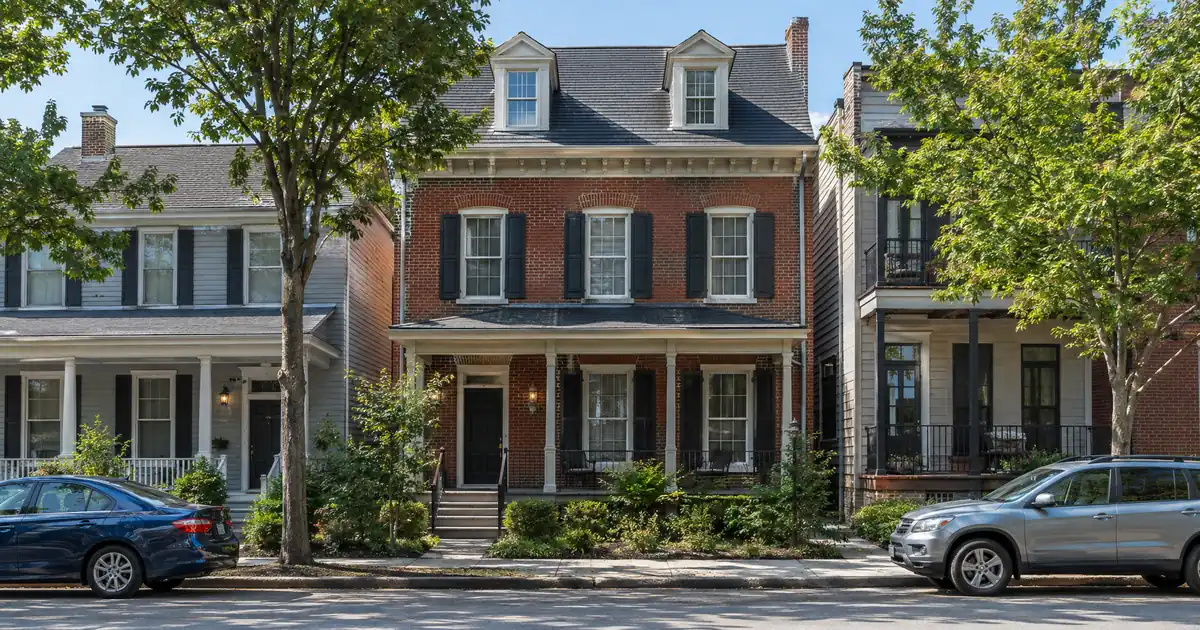
If an investor already owns a rental in Henderson and the loan has seasoned past the six-month mark, the question isn’t “should I sell” — it’s “how much of this equity can I actually pull out, and does the rent still cover the new payment once I do?” That’s the real math behind a cash-out refinance here, and Henderson’s numbers answer it differently than most Kentucky cities.
The Quick Read: A Henderson, Kentucky cash-out refinance is underwritten primarily on the property’s rental income measured against its full monthly obligation, with the lender capping proceeds at 75% loan-to-value and requiring roughly six months of seasoning from the recorded title date before a refinance is reviewed.
DSCR Cash-Out Calculator
Run the cash-out numbers in Henderson, KY
Rate source: Freddie Mac 30-yr average via FRED® — Federal Reserve Bank of St. Louis · effective Sep 17, 2026
Prefilled with starting assumptions — enter your property’s value, balance, taxes, and insurance for a more accurate picture.
Program parameters update from Lendmire’s centralized guideline source. Taxes and insurance are editable estimates.
As of Sep 17, 2026 · General Freddie Mac market benchmark, not a Lendmire loan offer. Property value, balance, taxes, and insurance are editable estimates. Maximum loan-to-value varies by lender, program, property type, and seasoning. Not a Loan Estimate, approval, or commitment to lend. Program availability and eligibility are subject to lender guidelines, credit approval, property review, and underwriting.
- East End homes carry a median price near $189,200 — a lower entry basis for cash-flow math.
- Citywide 10-year appreciation runs 5.43% average, below 80% of U.S. markets (NeighborhoodScout).
- Multi-family inventory sits at just 3 active listings citywide (Homes.com).
- Deaconess Henderson Hospital is a 143-bed acute care anchor within a larger regional system.
- Cash-out proceeds cap at 75% LTV with roughly six months of seasoning required. Exact terms depend on the lender’s guidelines, property type, leverage, and a full review of the borrower’s file.
Henderson Market Snapshot
A quick read on the Henderson investor landscape — figures come from the cited sources below. Confirm current property-level numbers before underwriting.
| Metric | Detail |
|---|---|
| Home prices | $201,035 median sale price (Redfin) |
| Typical rents | $990/mo average (RentCafe) |
| University enrollment | ~2,000 students (Wikipedia) |
| Population | 27,852 population (Census Reporter) |
| Employment | 1,100+ employees (Lane Report) |
Why Henderson’s Equity Story Is a Cash-Flow Story, Not an Appreciation Story
Henderson isn’t a market where an investor refinances to capture a runaway price gain. The ten-year average appreciation rate here is 5.43% annually, ranking below 80% of tracked U.S. communities, and the trailing twelve months came in at just 1.67%, according to NeighborhoodScout. Compare that to the conflicting short-term signals: Redfin’s most recent monthly read showed the citywide median sale price at $221,000, down 2.8% year-over-year, while Zillow’s rolling index put the typical home value at $178,628, up 4.5% over the same period. Two respected data sources, two different directions — which tells an investor something useful on its own: don’t underwrite a Henderson cash-out on a “prices are rising” narrative pulled from a single portal. Pull fresh, source-matched comps at the actual refinance date.
What that means practically: an investor holding a Henderson rental for a few years probably hasn’t seen dramatic organic equity growth. Whatever gain shows up is more likely tied to paying down principal and any renovation work than to the market lifting the property on its own. That’s not a bad thing — it just changes the thesis. The cash-out case in Henderson leans on forced appreciation and disciplined acquisition pricing, not on riding a hot market.
East End: The Lowest Entry Point, and Why That Matters for Refinance Math
East End is the strongest candidate for cash-out equity extraction in Henderson because its basis is low enough that even modest rent covers the new payment comfortably. Listing agents describe it as “burgeoning” and actively developing, with new-construction activity underway, and homes here carry a median price around $189,200 per Redfin — well under the citywide figure.
Run the numbers on a hypothetical East End rental purchased a year or two ago near that $189,200 median, now seasoned well past the required six months. Refinancing at the program’s 75% LTV ceiling and assuming a modeled monthly obligation built from a high-6s rate, taxes near 0.83% of value annually, and insurance near 0.35% annually — standard Kentucky averages used for illustration, not a quote — the full monthly carrying cost lands in the neighborhood of $1,100 to $1,150. Against Apartment Finder’s citywide 3-bedroom average rent of $1,193, that produces a coverage ratio in roughly the 1.05x to 1.10x range. Not spectacular, but it clears the 1.00 baseline most standard DSCR programs are built around, since rent needs to cover the payment at that level to qualify without added compensating factors. Every figure here varies by lender and program — guidelines, property type, leverage, and credit profile all apply.
That’s a meaningfully different underwriting conversation than a $220,000-median property trying to hit the same ratio on the same rent.
South Side and Downtown: Where the Coverage Gets Tighter
South Side and the near-downtown historic core along N. Adams Street sit closer to the Ohio River and carry more character — older brick and frame homes, walkable to local shopping and dining, with legacy 2-3 bedroom stock priced in the $130,000 to $260,000 range. The tenant base here skews toward healthcare and manufacturing shift workers drawn by proximity to the riverfront parks, walking trails, and John James Audubon State Park.
The catch: rent floors are thinner downtown. Zumper pegs the most affordable tracked submarket — Downtown Henderson — at an average of $799 a month. Model that rent against a $150,000 acquisition refinanced at 75% LTV, and the same modeled-payment approach (high-6s rate, Kentucky-average tax and insurance load) produces a monthly obligation near $880. Rent of $799 against that obligation lands under 1.00 — call it roughly 0.90x on long-term rent alone. Final terms depend on lender guidelines, property type, leverage, and the borrower’s complete credit picture.
That’s not disqualifying, but it changes the conversation. A sub-1.00 file in this range typically gets reviewed through one of a few paths: a sub-1.00 or no-ratio structure with reduced leverage, an interest-only restructuring that lowers the qualifying payment, or documented rent growth if a lease renewal is pending above the trailing average. None of those are guarantees — qualification always depends on lender guidelines, credit profile, reserves, and property review — but they’re the levers worth discussing with a broker before writing off a downtown or South Side refinance entirely.
North End and Audubon: The Steadier, Higher-Basis Hold
North End and Audubon read as Henderson’s more established residential pockets — brick ranch homes, a stable owner-renter mix, and proximity to the state park that carries the Audubon name. These aren’t the more affordable acquisitions in the city, but they tend to hold tenants longer, which matters more for a refinance thesis than for a purchase thesis. An investor pulling cash out of a North End or Audubon rental is generally working with a property that has a track record — actual lease history rather than a projected rent — and that track record often carries more weight with an underwriter than a market-average figure pulled from an aggregator.
The County Fringe: Century Aluminum and the Shift-Worker Tenant Base
Outside city limits, Robards, Sebree, Corydon, and Waverly sit in Henderson County’s investable footprint at lower price points — Corydon listings near $159,900 are typical. What anchors long-term rental demand out here isn’t downtown amenities; it’s industrial employment. The Century Aluminum Sebree smelter has operated continuously since 1973 and employs roughly 625 workers across the tri-state region, having produced more than 10 billion pounds of aluminum since it opened. That’s a five-decade employment anchor, and it supports steady single-family rental demand tied to shift-work schedules in a way that’s more durable than a single new employer announcement.
The Employment Base Behind the Rent Roll
Henderson’s economy isn’t diversified in the way a metro of a million people is, but it’s concentrated in ways that support workforce housing specifically. Data USA lists Manufacturing as the largest employment sector at 1,943 workers, followed by Health Care and Social Assistance at 1,804 and Retail Trade at 1,653. That manufacturing base includes Gibbs Die Casting, a Tier 1 and Tier 2 automotive supplier founded in Henderson that has grown into one of the largest die-casting operations in the world, now employing 906 people locally. Audubon Metals adds another 332 jobs as a heavy-media separator and aluminum alloy producer.
The single biggest recent development is Pratt Industries’ $500 million paper mill investment, announced by the Kentucky Cabinet for Economic Development as creating more than 320 jobs across two facilities. That’s a scale of single-project industrial commitment most Kentucky cities Henderson’s size — around 27,852 residents per Census Bureau QuickFacts — simply don’t attract. It’s a blue-collar demand anchor that should hold up rental occupancy near the city’s industrial corridors regardless of what the housing market does month to month.
On the healthcare side, Deaconess Henderson Hospital is a 143-bed acute care facility that joined the broader Deaconess Health System in 2020 after operating independently as Methodist Health. Deaconess overall runs nine hospitals in Southern Indiana and two in Kentucky, according to Wikipedia’s entry on the system — meaning Henderson’s hospital isn’t a standalone facility at risk of an isolated closure decision. That reduces single-anchor risk for rentals near downtown and North End that lean on healthcare-shift-worker tenants.
The Multi-Family Gap — and Why It Cuts Both Ways
Henderson’s true multi-family stock is thin enough to matter for underwriting. Homes.com showed only three multi-family listings active citywide, priced between $135,000 and $279,000, with an average 42 days on market. Redfin separately noted just one multi-family sale against 24 single-family sales in a recent month. For an investor who already owns a duplex or triplex here, that scarcity can actually work in their favor on refinance — appraisers may struggle to find close comparable sales, which can cut either direction depending on how conservative the valuation comes back. For an investor trying to acquire a 2-4 unit to build income-stacking into their portfolio, it means a shallow, market-rate pool rather than a deep pipeline. Single-family remains the more liquid, more comparable-rich DSCR product in Henderson.
What a Henderson Cash-Out File Actually Looks Like
DSCR files coming out of thin, small-transaction markets like Henderson tend to share a pattern: the file usually clears easily on the credit and reserve side, since these investors are often experienced landlords with equity already in the deal, but the rent comp gets more scrutiny than in a larger metro simply because aggregator data is thinner and more volatile here. A file that leans on a signed, current lease rather than a Zumper or RentCafe average tends to move through review with fewer questions, because the underwriter isn’t left reconciling why three rent sources disagree by $200 a month.
That volatility is real and worth naming directly. Zumper’s own trend data showed Henderson rents down 3.81% month-over-month but up 26.03% year-over-year in the same reporting window — a swing that has more to do with a thin data sample than with an actual shift in tenant demand. An investor underwriting a refinance off that kind of number without a lease to back it up is taking on unnecessary risk in the file. Anchoring to an actual property-manager rent roll, not a portal average, is the safer play here.
For a broader look at how the review basis works, Lendmire’s DSCR guide breaks down the mechanics, and the guide “Where DSCR and Conventional Diverge” covers where a conventional refinance might actually be the better fit — generally when the investor holds only one or two properties personally, carries strong traditional employment income, and doesn’t need the leverage or the entity-level flexibility DSCR provides.
Where a Conventional Refinance Might Beat DSCR Here
Not every Henderson investor should default to DSCR. If the property is owned personally, the investor has strong documented traditional employment income, and the loan amount is modest, a conventional cash-out refinance may carry simpler terms and skip the non-QM pricing adjustments entirely. DSCR earns its place once the investor owns the property in an LLC (subject to program eligibility), holds multiple financed properties, is self-employed with traditional personal-income documentation that understate cash flow, or simply wants the file to qualify on the rent roll instead of a personal debt-to-income calculation. Henderson’s low price points mean either path is workable on the numbers — the deciding factor is usually the borrower’s documentation profile, not the property.
For investors deciding between a straight refinance and other exit strategies, Lendmire’s DSCR cash-out refinance page walks through the structural differences in more depth. An investor can also reach Lendmire directly at 828-256-2183 or talk to Lendmire to run a specific Henderson property through the numbers.
Frequently Asked Questions
How do you qualify for a DSCR cash-out refinance in Henderson, Kentucky?
Qualification centers on the property’s rent measured against its full monthly obligation rather than the borrower’s personal income. Lenders in Lendmire’s network generally look for a coverage ratio at or above a 1.00 baseline, credit in the 620-and-up range depending on the program tier, and reserves near six months of PITIA, with the specific requirements varying by lender and file.
What are the requirements for a cash-out refinance on an investment property in Henderson?
The property must have seasoned roughly six months from the recorded title date, and proceeds are capped at 75% of the appraised value under standard program guidelines. Beyond that, the file typically needs documented rent (a lease is stronger than an aggregator average), reserves, and a credit profile that clears the lender’s minimum tier — exact terms depend on lender overlays.
DSCR vs. conventional financing
Two common ways to finance an investment property in Henderson, KY. They qualify you differently — here’s how investors weigh them.
Why investors choose it
- Qualifies on the property’s rental income — no personal tax returns, W-2s, or pay stubs needed to document income.
- No personal debt-to-income ceiling to clear, so existing mortgages and obligations don’t cap your borrowing the same way.
- Can be closed in an LLC, keeping the property inside a business entity.
- Built for scaling — not held to the limit on number of financed properties that conventional financing applies.
- Underwriting centers on the deal: generally qualifies when the rent covers the payment, a 1.00x coverage ratio being a common baseline (confirmed in underwriting).
- Designed specifically for investment property, including long-term and, where the program allows, short-term rentals.
Where it’s strong
- Often the lowest ongoing financing cost for a buyer who fully qualifies on personal income — a fit for a first property or a cost-first purchase.
Trade-offs for investors
- Requires full personal income documentation and must fit within a debt-to-income limit — salary, existing debts, and other mortgages all count.
- Typically held in your personal name rather than a business entity.
- Caps how many financed properties you can carry, which can become a ceiling as a portfolio grows.
- Evaluates you as a borrower as much as the property, which usually means more paperwork.
How investors usually choose: a first or single property often optimizes for the lowest financing cost; portfolio builders often optimize for leverage, vesting in an LLC, and scaling past conventional caps. The right answer depends on your goals, the property, and current guidelines — both paths run through select lenders in Lendmire’s wholesale network, with eligibility and terms confirmed in underwriting.
Why does Henderson show such different home values across Zillow and Redfin?
Henderson is a low-transaction-volume market, and small monthly sales counts make month-to-month medians swing more than in larger cities. Redfin’s most recent read showed a $221,000 median down 2.8% year-over-year, while Zillow’s rolling index showed $178,628 up 4.5% — both are legitimate methodologies measuring slightly different things, which is why fresh, source-matched comps at the refinance date matter more than a single trailing figure.
Is Henderson’s thin apartment market a problem for a duplex or triplex refinance?
It can complicate the appraisal more than the underwriting. With only a handful of multi-family listings active citywide, appraisers may have fewer close comparable sales to pull from, which can push a valuation more conservative than in a market with deeper multi-family inventory. Single-family comps remain far more plentiful here.
How do DSCR lenders review rental income instead of traditional tax-return income in Kentucky?
Lendmire works with wholesale lenders where DSCR programs generally qualify a file on the subject property’s rent against its monthly obligation rather than the borrower’s traditional personal-income documentation, subject to lender guidelines. That structure is particularly useful for self-employed or LLC-titled investors whose personal returns understate true rental cash flow.
Does Henderson’s manufacturing base actually support long-term rental demand, or is that overstated?
The base is concentrated but durable — Gibbs Die Casting, Century Aluminum Sebree, and the newer Pratt Industries paper mill together represent well over a thousand jobs tied to plants with multi-decade operating histories rather than speculative announcements. That kind of anchor tends to support steady occupancy in nearby workforce housing even when the broader for-sale market is quiet.
For current guidelines and terms, see Lendmire’s DSCR loan programs page.
About Lendmire
Lendmire (NMLS# 2371349) is a DSCR-focused mortgage broker that places investor financing across 41 markets — 40 states plus Washington, D.C. Eligibility on Lendmire’s DSCR programs is generally reviewed by the lender based on the property’s cash flow rather than the borrower’s traditional income documentation, subject to lender guidelines. Lendmire was recognized by Scotsman Guide as a 2026 Top Workplace and was also named a 2025 Scotsman Guide Top Mortgage Workplace.
For broader investor-financing rules and property-type coverage across the state, see Kentucky DSCR loans.
Get Started
Ready to find the right loan for you?
In about 30 seconds you can review financing options available for your investment property. No commitment required.
Informational only. Not a Loan Estimate, approval, or commitment to lend. Program availability and eligibility are subject to lender guidelines, credit approval, property review, and underwriting.
References
1. Redfin — Henderson, KY City Page
2. NeighborhoodScout — Henderson, KY Real Estate
3. Homes.com — Multi-Family Homes for Sale in Henderson, KY
4. RentCafe
5. Wikipedia
7. Lane Report
8. Century Aluminum Sebree Plant
9. Data USA — Henderson, KY Profile
10. Henderson Economic Development — Existing Industry
11. Kentucky Cabinet for Economic Development — Pratt Industries Announcement
12. Census Reporter — Henderson, KY Profile
13. Deaconess Henderson Hospital
14. Deaconess Health System — Wikipedia
15. recognized by Scotsman Guide as a 2026 Top Workplace
16. a 2025 Scotsman Guide Top Mortgage Workplace
This article is part of Lendmire’s investment property cash-out refinance program — full qualification details, guidelines, and scenarios live on the program page.
Related reading: DSCR Cash Out Refinance for Henderson, KY Investors · Cash Out Refinance Investment Property in Kentucky · Cash Out Refinance Investment Property Harlan Kentucky
Guides: Investment Property Cash-Out Refinance in Kentucky
Brandon Miller
Founder & CEO, Mortgage Loan Originator, Lendmire LLC
- Mortgage Loan Originator · NMLS# 1129696 · Verify on NMLS Consumer Access
- North Carolina Real Estate Broker · License# 343312 · Verify on NCREC
- North Carolina Insurance Producer · License# 19053198 · Property, Casualty, Life, Health · Verify on NAIC SBS
- Lendmire LLC · Firm NMLS# 2371349 · Verify firm licensure
Disclosures. The information presented in this article is general market commentary, not financial, legal, or tax advice. Lendmire is a mortgage brokerage (NMLS# 2371349) — not a direct lender or depository institution — and loan placement is subject to lender underwriting. Nothing in this content represents a commitment to lend. Loan terms, pricing, and program availability vary based on borrower qualifications, property characteristics, and state of subject property, and are subject to change at any time. Lendmire complies with Equal Housing Opportunity requirements. Consumer access: nmlsconsumeraccess.org.