
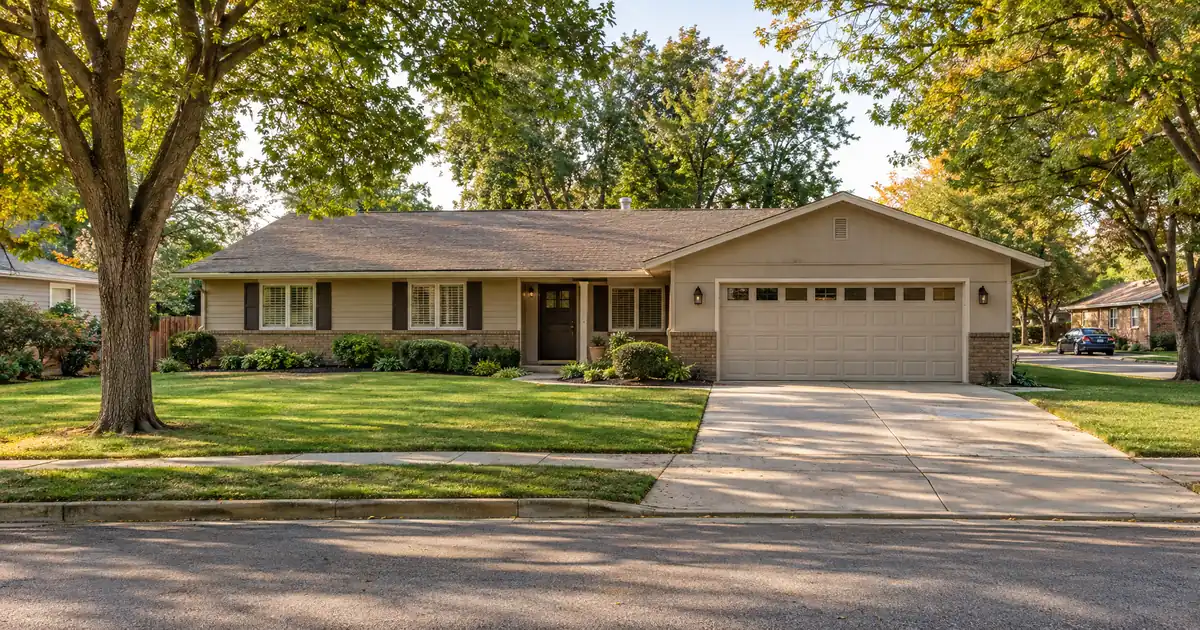
The Quick Read: Usually yes, on a primary residence, a second home, or a rental, as long as the program covers that occupancy and your deposits show real income. A paid-off home has no mortgage to clear, so the new loan becomes the only lien. The lender reviews around 12 months of bank deposits instead of traditional personal-income documentation. If the home is a rental, a DSCR loan, which looks at the property’s rent instead of your income, often fits better. Occupancy decides the path.
Why Does a Paid-Off Home Change the Question?
A paid-off home makes cash-out simpler, not harder. There is no existing balance to clear, so the new loan is the first lien. Most of the loan amount, minus closing costs, comes to you as cash. The lender still has to decide whether you can carry the new payment, and that is where bank statements come in.
Most self-employed owners show less income on paper than they earn. Write-offs, depreciation and reinvestment shrink the line on the tax return. A conventional lender reads that line and stops. A bank statement program reads the deposits instead.
Across Lendmire’s wholesale network, the single question that sorts these files is how the home is used. Is it your primary residence, a second home, or a rental? The answer drives leverage, documentation and which loan type applies. Everything below follows from it.
Which Path Fits Which Property?
Three paths cover almost every paid-off home. Primary residences and second homes lean toward bank statement documentation. Rentals lean toward DSCR, with bank statements as a backup.
| Property use | Typical documentation | Leverage in the network |
|---|---|---|
| Primary residence | 12 months of bank statements | Up to 90% LTV on purchase and rate-term; cash-out varies by file |
| Primary, no regular income | Asset depletion from liquid assets | Up to about 80% LTV |
| Rental (bank statements) | 12 months of bank statements | Cash-out tops out around 75% LTV |
| Rental (DSCR) | Property rent vs. monthly obligation | Set by DSCR program terms |
LTV, or loan-to-value, is the loan amount as a percentage of the home’s appraised value. These ranges reflect select lenders in the network. They are typical guidelines, not promises, and every file is underwritten individually.
One more number: loan sizes generally run from $125,000 to $3,500,000. Reserves, meaning cash you keep after closing, commonly land around six months of the housing payment.
How Does a Bank Statement Cash-Out Work on a Home With No Mortgage?
The lender totals your eligible deposits, strips out the ones that are not income, applies an expense factor if the account is a business account, and divides by the number of months. That monthly figure is your qualifying income. The new loan has to fit inside it.
HousingWire’s non-QM guide describes the same mechanics. Lenders review deposits, remove transfers and other non-income credits, and apply an expense factor that depends on the business type. Market surveys report review periods of 12 to 24 months. The network figure is 12 months of statements, business or personal.
Here is how that plays out in practice.
- Personal statements. Fit when your income lands in a personal account, such as a consultant paid directly.
- Business statements. Fit when revenue runs through a company account. The expense factor reduces what counts as your income.
- The expense factor. It varies by lender and by business. Never assume a universal formula.
Picture an owner with a clean, paid-off home and a business account full of steady client deposits. Strip out transfers between her own accounts. Apply the expense factor. What remains is the income the new loan must support. Not every deposit counts. A big one-time transfer from a savings account is exactly the kind of credit that gets removed.
Brokers see the same mistake constantly: borrowers assume every dollar that touches the account is income.
What Changes When There Is No Mortgage?
A few things get easier. There is no payoff to arrange and no existing lien to subordinate. Your housing payment history is thin, so the lender leans harder on credit, deposits and reserves.
A few things stay exactly the same. You still need an appraisal. You still need clean title, with no back taxes or surprise liens. You still need homeowner’s insurance in force. And you still have to show you can carry a brand-new payment against a home that carried none.
That last point matters most for people with uneven revenue. Going from zero housing payment to a real one is a big change in cash flow. Lenders know it. So do you. Size the loan for your slowest quarter, not your best one.
Does Occupancy Really Decide Everything?
Yes. Occupancy decides the type of loan and the paperwork around it. Experian explains that bank statement loans are non-QM, meaning they do not meet the standard rules for qualified mortgages. Non-QM does not mean unregulated. On an owner-occupied home, the file is a consumer mortgage. The lender must verify you can repay it, and the standard consumer mortgage disclosures apply.
DSCR loans work differently. DSCR loans are designed for non-owner-occupied investment properties. Because they are business-purpose investor loans, they are reviewed differently from a standard owner-occupied mortgage. In practice, a bank statement loan on a true rental, including a short-term rental, is also treated as business-purpose, and the consumer disclosure forms do not apply to it. The ability-to-repay rule under Regulation Z carves out credit extended primarily for a business purpose, even when a dwelling secures it.
Two cautions keep this honest.
First, the label has to be true. Law-firm guidance, such as this Lexology article, points to a 14-day owner-occupancy threshold as one test. It also notes that business purpose does not mean compliance-free. Treat that as a legal subtlety. The lender makes the classification call, not you.
Second, how you spend the proceeds can matter. Cash pulled from a rental to cover personal expenses can blur the business-purpose line. Lenders often ask how the funds will be used. Answer truthfully.
Don’t mix the two regimes. A file is either an owner-occupied consumer loan or a business-purpose rental loan. It is never both.
When Should a Paid-Off Rental Use DSCR Instead?
Reach for DSCR when the rent covers the new obligation with room to spare. DSCR is the debt service coverage ratio: monthly rent divided by the monthly principal, interest, taxes, insurance and association dues. The loan is reviewed primarily on property-level rental income covering the payment, subject to lender guidelines. Unlike a bank statement loan, which is reviewed against deposits, a DSCR loan generally does not use your traditional personal-income documentation or your deposits to calculate qualifying income, though a lender may still ask for other items such as assets, credit, and property records.
Cash-out adds debt, so the ratio drops. Run the math on the new balance, not the old one. A free-and-clear rental has no loan payment today, so any cash-out creates a payment, and coverage pressure, that did not exist before. Picture a rental where rent clears the new obligation at a comfortable cushion on a modest cash-out. Push the cash-out toward the top of the leverage range and that same rent might clear only a little above 1.0x. Same property, much thinner cushion.
Passing a coverage test is not the same as making money. The ratio ignores repairs, vacancy, management and turnover costs. Judge the deal on real cash flow too.
If rent falls short, you have options. Select lenders in the network offer programs below 1.00 coverage, but leverage and terms adjust to compensate. Or you can switch to bank statements and let your deposits carry the file, if the program covers that occupancy. Lendmire’s piece on how DSCR and bank statement loans compare for investors walks through that choice in detail.
Short version for rentals:
1. Strong rent, thin personal income: DSCR.
2. Weak rent, strong deposits: bank statements, with cash-out around 75% LTV.
3. Strong on both: compare the two on leverage and cost, then pick the cleaner file.
Every figure here varies by lender and program, and guidelines, property type, leverage, and credit profile all apply.
Extended terms such as 40-year and interest-only structures sit on the DSCR side.
What Do You Need to Gather?
Bank statement borrowers need a tidy folder before anyone looks at the file. Missing pieces slow underwriting more than anything else. Exact terms depend on lender and investor guidelines, credit profile, reserves, and property review.
For the borrower and the income:
- 12 months of personal or business statements, every page.
- A business license or other proof of time in business, where the program asks for it.
- A credit report, which the lender pulls.
- Recent statements for liquid assets backing your reserves.
For the property:
- Proof of homeowner’s insurance.
- Property tax information and a clean title search.
- An appraisal, which the lender orders.
- For a rental, a lease, or market rent confirmed by the appraiser.
For a rental in an LLC, subject to lender program eligibility, expect entity documents and often a personal guarantee from the owner. The names on the lease, insurance and appraisal should match the borrower.
DSCR is not truly “no documents.” Insurance, an appraisal, a credit report and entity paperwork all still show up in the file.
Why Do Bank Statement Files Get Declined?
Most declines come from the deposits, not the house. Here is what trips borrowers.
- Commingled money. Personal and business flows mixed in one account make it hard to see real revenue.
- Declining income. Deposits that trend down over the 12 months raise flags, and the lender may use a lower average.
- Overdrafts and returned items. Repeated negative-balance activity signals trouble.
- Large unexplained deposits. Anything that looks like a transfer or loan gets stripped out and may need a letter.
- Thin reserves. With roughly six months of the housing payment as a common benchmark, a cash-out that leaves you empty-handed can sink an otherwise good file.
A fix worth knowing: clean statements take time. Separate your accounts months before you apply, not the week before.
Bank Statement Cash-Out, HELOC or Home Equity Loan?
The right product depends on how much cash you need, how you want to repay it and how your income shows up on paper. Here is a quick comparison.
| Factor | Bank statement cash-out | HELOC | Home equity loan |
|---|---|---|---|
| Structure | New first lien | Revolving line of credit | Lump-sum fixed loan |
| Income proof | Deposit averaging | Varies by lender | Varies by lender |
| Payments | One | Varies with balance drawn | One new fixed payment |
| Best fit | Large, one-time need | Flexible, ongoing draws | Mid-size, defined need |
On a free-and-clear home there is no first mortgage to keep, so a HELOC or home equity loan would itself sit in first position. That makes either one a real alternative. Many borrowers find them cheaper if they only need a moderate amount. The catch is that self-employed borrowers can hit the same income-documentation wall there.
Asset depletion is a fourth lane. If you hold substantial liquid assets but little documented income, qualification can run off those assets instead, up to about 80% LTV on a primary residence. It is worth asking about if your deposits are lumpy.
What About a Recent All-Cash Purchase?
Here is a different problem. A paid-off home is not the same as a home you bought for cash last month. For a recent cash buyer, a delayed financing structure may let you recover purchase money before normal seasoning periods end. The new loan is generally capped at what you documented paying, not the current value. Seasoning is the waiting period lenders want between acquiring a property and refinancing it.
For a long-held, free-and-clear home, none of that applies. Appraised value drives the loan.
Should You Do It?
The loan works. The question is whether the move makes sense for you. Some thinking out loud.
The case for: you convert idle equity into capital for a better use, such as buying another rental, funding business growth or consolidating costlier debt. The strongest files use the cash to produce income.
The case against: you swap a home with no payment for one with a payment, and you pay for the flexibility of non-QM documentation. Pricing generally runs above conventional loans, and prepayment terms may apply if you plan to sell or refinance soon.
Honestly, if your traditional personal-income documentation clearly shows enough income, a conventional cash-out probably costs less. Bank statements earn their place when the returns understate what you actually make.
Tax treatment can depend on how the funds are used and how the property is held; investors should keep clear records and speak with a qualified tax professional before relying on any deduction.
For the full picture of how Lendmire approaches investor financing, see the complete DSCR loans guide.
Key Terms Defined
Bank statement loan: A mortgage that is reviewed around average monthly deposits instead of traditional income documentation.
Non-QM: A loan that does not meet the standard qualified-mortgage rules, usually because income is documented a different way.
Expense factor: A percentage the lender subtracts from business deposits to estimate what you actually keep as income.
LTV (loan-to-value): The loan amount divided by the property’s appraised value.
DSCR (debt service coverage ratio): Monthly rent divided by the monthly payment obligation on a rental.
Reserves: Liquid cash you hold after closing, counted in months of the housing payment.
Asset depletion: Qualifying on income calculated from your liquid assets instead of deposits or conventional personal-income paperwork.
Frequently Asked Questions
Can I use bank statements if my home has no mortgage at all?
Yes, if the property is a primary residence, second home or rental and the program covers that occupancy. The lender reviews 12 months of deposits, applies an expense factor on business accounts and sizes the new loan to that income. With no mortgage history, expect more weight on credit, reserves and deposit quality.
How much can I borrow against a paid-off home?
It depends on occupancy. In the network, primary residences reach up to 90% LTV on purchase and rate-term, but cash-out on owner-occupied homes is set lower and varies by file. Investment-property cash-out tops out around 75% LTV. Loan sizes generally run from $125,000 to $3,500,000, subject to lender guidelines.
Do I need to explain what I will do with the money?
Often, yes. On a rental, lenders may ask for a statement that the proceeds serve a business purpose, because personal use can change how the loan is classified. On an owner-occupied home, you can generally use the cash as you choose. Either way, the lender reviews each file individually.
Is DSCR better than bank statements for a paid-off rental?
It is better when the rent comfortably covers the new obligation, because the loan is reviewed primarily on property-level rental income, subject to lender guidelines. Bank statements fit better when rent is thin but your deposits are strong. Many investors price both before choosing.
What if my rent does not cover the new payment?
You have choices. Select lenders in the network offer programs below 1.00 coverage, but leverage and terms adjust. You can also take a smaller cash-out, or switch to a bank statement structure if the program covers that occupancy.
Next Step
Owner-occupied consumer programs are available in 16 states, and every file is subject to lender guidelines and credit approval. Call 828-256-2183 or request a quote.
Free-and-clear equity does nothing until it is put to work, and the best files put it to work on something that pays you back.
About Lendmire
Lendmire — NMLS# 2371349 — is a mortgage brokerage specializing in DSCR investor loans, helping arrange financing across 41 markets, including Washington, D.C., through wholesale and investor-lending channels. The model centers on property-level rental income reviewed by the lender rather than W-2 documentation, subject to lender guidelines, suiting entity-owned and multi-property investors. Lendmire holds Scotsman Guide Top Mortgage Workplace recognition for 2025 and 2026.
A deeper walk-through of investment-property equity extraction lives in Lendmire’s guide to cash-out refinance on an investment property.
Get Started
Ready to find the right loan for you?
In about 30 seconds you can review financing options available for your home or investment property. No commitment required.
Informational only. Not a Loan Estimate, approval, or commitment to lend. Program availability and eligibility are subject to lender guidelines, credit approval, property review, and underwriting.
References
1. HousingWire — Non-QM loans guide
2. Experian — What is a bank statement loan?
3. CFPB — Regulation Z § 1026.43
4. Lexology — Business purpose exemption
This article is part of Lendmire’s bank statement loan program — full qualification details, guidelines, and scenarios live on the program page.
Related reading: Bank Statement HELOC vs Business Loan Qualification Requirements Compared · Does a Bank Statement HELOC Require an Initial Draw at Closing? · Bank Statement HELOC Use-of-Funds Rules and LLC Vesting Options
Brandon Miller
Founder & CEO, Mortgage Loan Originator, Lendmire LLC
- Mortgage Loan Originator · NMLS# 1129696 · Verify on NMLS Consumer Access
- North Carolina Real Estate Broker · License# 343312 · Verify on NCREC
- North Carolina Insurance Producer · License# 19053198 · Property, Casualty, Life, Health · Verify on NAIC SBS
- Lendmire LLC · Firm NMLS# 2371349 · Verify firm licensure
Disclosures. The information presented in this article is general market commentary, not financial, legal, or tax advice. Lendmire is a mortgage brokerage (NMLS# 2371349) — not a direct lender or depository institution — and loan placement is subject to lender underwriting. Nothing in this content represents a commitment to lend. Loan terms, pricing, and program availability vary based on borrower qualifications, property characteristics, and state of subject property, and are subject to change at any time. Lendmire complies with Equal Housing Opportunity requirements. Consumer access: nmlsconsumeraccess.org.