
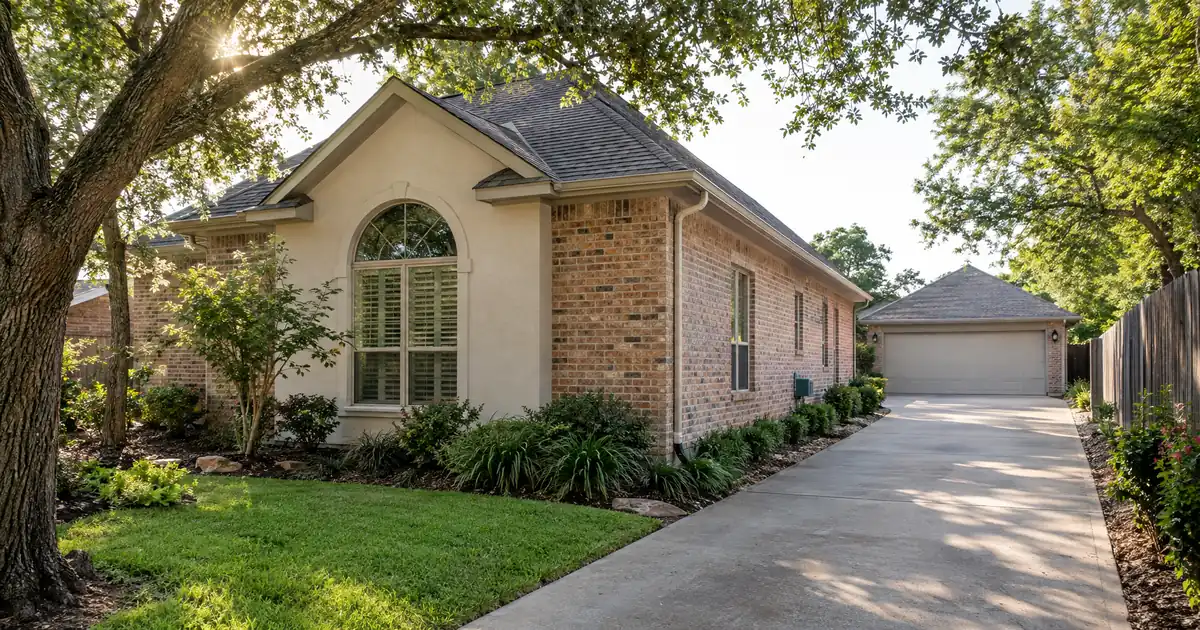
The Quick Read: On a paid-off Texas homestead, a bank statement cash-out gives you one lump sum at closing, while a HELOC gives you a line you draw from over time, and both fall under the same Texas home equity rules, so the real choice is how you want to use the money, not which product is looser.
- Combined debt against a Texas homestead tops out at 80% of the home’s appraised value, whichever product you pick.
- A bank statement file is reviewed on documented income under the applicable program, subject to lender guidelines. Deposits are reviewed, and debt-to-income still applies.
- Only one of these loans can sit on the homestead at a time, so choosing one uses up the slot.
- Texas sets a $4,000 minimum for each draw after closing on a HELOC.
- Both products are for the home you live in. Rentals and LLC-owned property need a different structure.
Here is the honest answer on who each option is for. A cash-out suits the owner with one defined, sizable need: a down payment, a payoff, or a single project. You get the money once, and the structure stays simple. A HELOC suits the owner who wants a revolving line with an interest-only draw period and can live with a variable structure. Both depend on how you document income and how much you need on day one.
How large a line the equity supports in Texas.
An equity line is sized by combined loan-to-value, occupancy, and credit — not by rental coverage. Switch the occupancy or the credit band and the ceiling moves with it.
Investment-property lines require a 700 minimum credit score; second-home lines start at a 640 minimum and primary-residence lines at 600, and the combined-LTV ceiling steps down as the credit band drops on primary-residence and second-home lines and holds on investment-property lines; the line cap steps down on primary-residence lines and holds at every tier on investment-property and second-home lines.
A debt-to-income ratio above 45% requires 680+ credit. Profiles under 640 are limited to single-family homes. At least 75% of the approved line is drawn at closing. Ceilings, floors, and caps update from Lendmire’s centralized guideline source.
Line estimate
Illustrative estimate only — not a quote, Loan Estimate, approval, or commitment to lend. The rate is an editable assumption; equity-line pricing is variable through both the draw and repayment periods and never converts to fixed. Occupancy and credit drive the ceiling together: an investment property tops out at 70% combined LTV (minimum credit 700, line cap $500,000); a second home tops out at 90% combined LTV (minimum credit 640, line cap $500,000), with the ceiling stepping down as the credit band drops (the cap holds at every tier); a primary residence tops out at 80% combined LTV (minimum credit 600), and its $750,000 maximum line is available only at 75% combined LTV or below with a 700-or-better credit profile (720 on the longer-runway program) and a full appraisal. Lines above $500,000 require a full appraisal. Credit, debt-to-income, property type, and full underwriting review all affect the final line.
That last point trips people up. The HELOC programs across our wholesale network require that at least 75% of the line be drawn at closing. So a HELOC here behaves more like a loan with a small reserve tail than a checking-account-style line. Keep that in mind as you read the rest.
Side-by-Side
The cash-out column reflects published industry norms. The HELOC column reflects guidelines across Lendmire’s wholesale network, which places both products. Every figure is subject to lender guidelines and full file review.
| Factor | Bank Statement Cash-Out (industry norms) | HELOC (network guidelines) |
|---|---|---|
| Review basis | Documented deposits, credit, DTI | Documented income, credit, DTI |
| Documentation | 12 or 24 months of statements | Varies by program |
| Funds delivered | One lump sum at closing | At least 75% drawn at closing |
| After closing | Nothing more to draw | Later draws, $4,000 minimum in Texas |
| Texas leverage cap | 80% of value, all debt combined | 80% combined on a primary residence |
| Property types | Owner-occupied homestead | SFR, 2-4 units, PUD, townhome, condo |
| Entity vesting | Individual owners and spouses | Individual or revocable living trust |
| Reserves | Lender-specific | Set at file review |
One row deserves a second look. On vesting, an LLC cannot hold title under the HELOC programs we place.
Key Terms Defined
Homestead. The home you live in as your primary residence, which Texas protects with special lending rules.
Combined loan-to-value (CLTV). All debt secured by the home, divided by its appraised value.
Seasoning. The waiting period a lender or the state requires between two events, such as two home equity loans.
Non-recourse. A loan where the lender’s remedy is the home itself rather than your other assets.
Free and clear. A home with no mortgage or other lien on it.
What Both Options Share on a Paid-Off Home
Both products are the same legal animal in Texas. The Texas Real Estate Research Center at Texas A&M explains that Section 50 of the state constitution covers cash-out refinances, home equity loans, and HELOCs together. It also notes that these loans cannot be placed on a second residence or a rental property. Documentation style does not override any of it.
A paid-off home does change one input. With no existing lien, nothing gets subtracted from your 80% capacity. The new loan becomes the only lien on the home, and the full cap is available to it.
Here are the shared mechanics you will meet on either path:
- Total secured debt may not exceed 80% of the home’s fair market value on the closing date.
- Only one of these loans can be secured by the home at a time.
- A mandatory waiting period applies before closing, set at 12 days after the lender’s written notice.
- You get a three-day right to cancel after signing, which applies to home equity loans and lines.
- Each owner and each owner’s spouse must consent.
- The loan is non-recourse. The lender’s remedy runs against the home, and foreclosure requires a court order.
- Prepayment penalties are not allowed.
On our network’s HELOC programs, a 12-month seasoning requirement and the one-lien rule bind primary residences only. Properties are also limited to 10 acres. If you want the deeper question of whether both products can ever coexist on one home, Lendmire’s piece Can a Texas Homestead Hold a Bank Statement HELOC and a Cash-Out Lien? walks through it.
How Bank Statement Qualifying Works
A bank statement file uses your deposits as the income picture. That fits self-employed owners whose traditional personal-income documentation understates cash flow after deductions.
The process runs in a predictable order:
1. You supply 12 or 24 consecutive months of personal or business statements.
2. The underwriter strips out non-income deposits, such as transfers between your own accounts, loan proceeds, and refunds.
3. Business deposits get an expense factor, because deposits are revenue, not profit. Each lender sets its own factor, and it varies by program and business type.
4. The remaining total is divided by the months reviewed to produce monthly qualifying income.
5. Credit, property, and vesting rules then apply as usual.
Nobody skips underwriting here. Across our network’s HELOC programs, debt-to-income tops out at 50%, and files with credit scores from 600 to 679 are held to 45%. A ratio above 45% requires a 680 minimum. The test uses the interest-only payment on the maximum draw, not on what you plan to borrow. The credit floor on these HELOC programs is 600, and lenders pull a single-bureau score keyed to the primary wage earner.
When a Bank Statement Cash-Out Is the Better Fit
A cash-out wins when you know the number and the purpose. Picture a self-employed owner with a free-and-clear home who needs one large sum to close on a rental. One closing, one payoff structure, nothing left to manage. For this borrower, a line they would mostly draw at closing anyway adds little.
It also fits when you want predictability. Industry norms for cash-out loans commonly include fixed-term structures, so your obligation does not float. A HELOC on our network does not convert to fixed, and its cost floats across both the draw and repayment periods. Some owners sleep better with a lump sum on a steady footing.
Cash-out is also the cleaner tool for a bigger single need. HELOC lines on our network run from $25,000 to $750,000, with the portion above $500,000 limited to primary residences and a full appraisal. A cash-out has its own sizing rules, which vary by lender. Run both against your target amount before assuming either fits.
Two honest drawbacks apply. First, you take the whole amount at once, so you pay for money you may not use right away. Second, a cash-out typically calls for a full appraisal. Lines of $500,000 or less on our HELOC programs ordinarily run an automated valuation instead, though a higher CLTV can trigger a second look.
When a HELOC Is the Better Fit
A HELOC wins when your need arrives in steps and you want an interest-only runway. Say you plan a purchase now and a renovation after that. A line that covers both can be cheaper to carry early than a full lump sum you start repaying in full.
The network offers two draw structures on primary residences. One runs a three-year interest-only draw, then a 17-year fully amortizing repayment. The other runs a five-year draw, then 25 years of repayment. The longer runway buys time, but your obligation steps up once repayment begins. Plan for that day now.
Here is the catch, and it is a real one. With at least 75% of the line drawn at closing, the leftover flexibility is the remaining slice. Each later draw must be at least $4,000 in Texas, and no card or preprinted check can pull funds. The Texas administrative rule behind this, 7 Tex. Admin. Code §153.86, fixes the line’s maximum principal on the closing date. It also tests each advance against the 80% limit. So the line does not grow if your home appreciates.
The HELOC also has stricter structural limits than many owners expect:
- Eligible property includes single-family homes, 2-4 units, PUDs, townhomes, and condos, including non-warrantable ones.
- Manufactured homes, co-ops, condotels, log homes, and agricultural zoning are not offered.
- Title must sit with you or your revocable living trust.
- A borrower can hold no more than three lines, and owning more than 15 financed properties makes you ineligible.
Your home secures the debt on any line, so a missed payment puts the home at risk.
Where Neither Works (and Where DSCR Does)
Many investors reading this want the equity for a rental. That is a fine goal. It just means the two financing questions are separate.
Neither product can sit on a rental, and neither can be held by an LLC. If your property is already deeded to an LLC, it needs a vesting change or a different structure entirely, such as a DSCR cash-out.
DSCR loans are designed for non-owner-occupied investment properties. Because they are business-purpose investor loans, they are reviewed differently from a standard owner-occupied mortgage. The loan is reviewed primarily on property-level rental income covering the payment, subject to lender guidelines. That is a different test from the income test above. Leverage, credit tiers, and coverage ratios for those loans are laid out in Lendmire’s complete DSCR loans guide.
One reminder worth repeating. DSCR compares rent to the full housing payment only. A property that clears the coverage test is not automatically cash-flow positive after repairs, vacancy, management, and utilities.
A common two-step plan is to pull homestead equity for the down payment, then finance the rental with a DSCR purchase loan. Every file is underwritten individually. Tax treatment can depend on how the funds are used and how the property is held; investors should keep clear records and speak with a qualified tax professional before relying on any deduction.
Which One Would You Choose? A Balanced Verdict
Neither product is cheaper, easier, or looser in any way the Texas rules allow for. Both sit under the same 80% ceiling, the same waiting period, and the same one-at-a-time rule. The differences come down to three questions.
How much do you need on day one? If it is nearly everything, a cash-out is the plainer fit. If a meaningful share can wait, a HELOC’s reserve tail has some value, though 75% still comes out at closing.
How do you feel about a floating structure? A HELOC floats and does not convert to fixed. A cash-out can usually be set up with a fixed term, depending on the lender.
How clean is your income picture? Both rely on documented deposits and a debt-to-income test. A thin or uneven deposit history pinches either one.
The Texas Real Estate Research Center notes that state agencies interpret these rules and that those interpretations are subject to judicial review. Confirm the details with a Texas attorney or title company before signing.
If you are weighing a home equity line against a cash-out refinance and want to see how the numbers work, Lendmire can help you compare HELOC options based on the property, the equity available, credit profile, combined leverage, and your goals. The page’s illustrative calculator gives a rough picture only.
Frequently Asked Questions
Can I have a HELOC and a cash-out loan on the same homestead?
Not at the same time. Texas allows only one of these loans to be secured by the home at once. Picking one uses the slot, so pay it off and clear the lien before planning the other.
Does a bank statement loan get around the 80% cap?
No. The 80% combined limit is a state rule, not a lender preference. Bank statement documentation only changes how your income is measured. A lender can also set a lower ceiling based on credit, property, and loan size.
Can an LLC take a HELOC or homestead cash-out?
No. HELOC title must sit with you or your revocable living trust, and LLCs, corporations, partnerships, and irrevocable, blind, or land trusts cannot hold it. A homestead loan also requires consent from each owner and spouse, which is an individual-owner structure.
Can I use homestead equity to buy a rental?
Many investors do. The money’s use does not change the homestead rules, though, because those attach to the lien on your home. The rental itself would then be financed separately, often with a DSCR loan. Confirm the details with a Texas attorney or title company.
Does a paid-off home change the math?
Yes, in one way. With no existing lien, nothing is subtracted from your 80% capacity. Your new loan becomes the only lien on the home and the only loan of its type.
For the mechanics of pulling equity out of a rental property, see Lendmire’s guide to cash-out refinance on an investment property.
About Lendmire
Lendmire is a mortgage brokerage (NMLS# 2371349) arranging home equity lines of credit — primary-residence, second-home and investment-property lines — through a wholesale lending network in its 16 full-service states. Eligibility is determined by the lender on each file. Scotsman Guide named Lendmire a Top Mortgage Workplace in both 2025 and 2026.
Get Started
Ready to find the right loan for you?
In about 30 seconds you can review financing options available for your home or investment property. No commitment required.
Informational only. Not a Loan Estimate, approval, or commitment to lend. Program availability and eligibility are subject to lender guidelines, credit approval, property review, and underwriting.
References
1. Texas Real Estate Research Center, Texas A&M: What to Know About Home Equity Loans in Texas
This article is part of Lendmire’s bank statement HELOC program — full qualification details, guidelines, and scenarios live on the program page.
Related reading: Bank Statement HELOC Requirements on a Primary Home vs. a Rental · DSCR Purchase vs Bank Statement HELOC vs Cash-Out for a Rental · How Much a Bank Statement HELOC Covers on a DSCR Rental Purchase
Guides: Bank Statement HELOC in Texas
Brandon Miller
Founder & CEO, Mortgage Loan Originator, Lendmire LLC
- Mortgage Loan Originator · NMLS# 1129696 · Verify on NMLS Consumer Access
- North Carolina Real Estate Broker · License# 343312 · Verify on NCREC
- North Carolina Insurance Producer · License# 19053198 · Property, Casualty, Life, Health · Verify on NAIC SBS
- Lendmire LLC · Firm NMLS# 2371349 · Verify firm licensure
Compliance and disclosures. Lendmire (NMLS# 2371349) is a licensed mortgage broker and is not a direct lender, depository institution, financial advisor, or tax professional. Content in this article is general market analysis and educational information — not financial, legal, or tax advice for any specific situation. Lendmire does not guarantee loan approval; every transaction is subject to underwriting by the funding lender. Mortgage pricing and loan program guidelines are subject to change at any time without notice and vary by borrower characteristics, property type, and state regulations. Lendmire complies with Equal Housing Opportunity. Licensure verification: NMLS Consumer Access.