
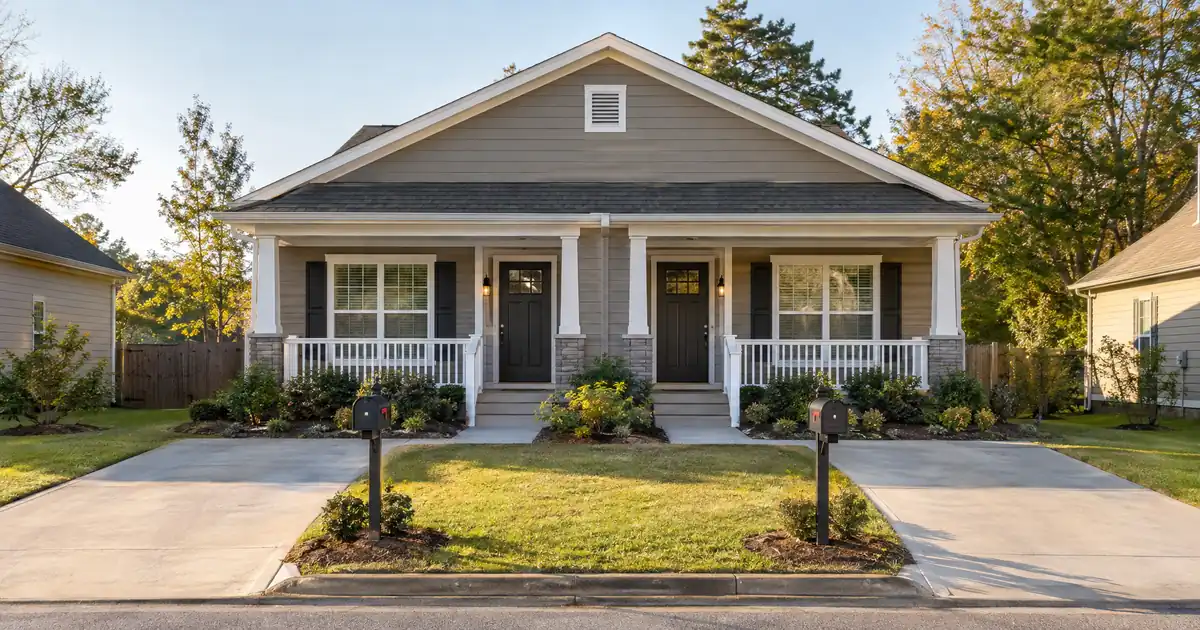
The Quick Read: A conventional cash-out refinance on a duplex you live in is allowed, but it carries a lower leverage cap than a single-family home: 75% of appraised value on a two-unit principal residence, against 80% on one unit. Two clocks also apply, a 12-month age on the loan being paid off and six months on title. There is no special “first-time equity” status. The only “first” that changes the file is whether you have landlord experience, because that decides how the other unit’s rent counts.
Everything below is how the file is built, step by step, and where the general rule breaks. Program figures are subject to lender guidelines and full file review. Nothing here is a commitment to lend.
What Is a Conventional Cash-Out on a Duplex?
A cash-out refinance replaces your current first mortgage with a new, larger one and hands you the difference after payoff and costs. On a duplex you occupy, it is a principal-residence loan, not an investment loan. Fannie Mae and Freddie Mac set the rules, and the wholesale lenders Lendmire works with follow them.
Lendmire’s cash-out refinance programs are arranged through wholesale lenders. Lendmire is a mortgage broker, not the lender.
Here is the catch for a first-timer. The label “first-time equity borrower” has no rule attached to it. Nobody gets a looser cap or a shorter clock for never having pulled equity before. What a first-timer does face is a first look at the seasoning rules, the occupancy rules and the pricing that comes with cash-out.
Key Takeaways
- Cash-out on a two-unit principal residence tops out at 75% LTV. A one-unit home reaches 80%.
- The loan you are paying off must be at least 12 months old, counted from note date to note date.
- At least one borrower must have been on title for six months.
- Rent from the unit you live in does not count. Rent from the other unit may count, depending on your landlord experience.
- A three-business-day cancellation window comes before funds are released. Every figure here varies by lender and program: guidelines, property type, leverage, and credit profile all apply.
Key Terms Defined
Cash-out refinance: A new mortgage larger than the one it pays off, with the difference paid to the borrower.
Limited cash-out (rate-and-term) refinance: A refinance that pays off the first mortgage, closing costs and any purchase-money second lien, with only incidental cash back.
LTV (loan-to-value): The new loan balance divided by the appraised value.
CLTV / HCLTV: The same test, counting every lien on the property, including a HELOC.
Seasoning: The minimum time you must have held the property or the existing loan before a new loan is allowed.
DTI (debt-to-income): Your monthly debts, including the new housing payment, divided by your gross monthly income.
PITIA: Principal, interest, taxes, insurance and any association dues on the property.
Can You Cash Out on a Duplex You Live In?
Yes, on a conventional loan, if you occupy one of the two units as your principal residence. Freddie Mac’s product page lists 1- to 4-unit primary residences as eligible and requires a new appraisal. Freddie Mac’s guide section 4301.5 also says all borrowers on a primary-residence cash-out must occupy the home.
That last point trips up co-borrower plans. A parent who lives elsewhere and co-signs to help you qualify can sink the file on that rule. Think it through before the application, not after the appraisal.
If you move out and rent both units, the file is no longer a principal-residence loan. Occupancy decides the leverage: second homes and investment property carry their own caps and their own rules. That is a different conversation and a different loan.
Why a Duplex Gets a Lower Cap Than a House
The Fannie Mae Eligibility Matrix sets the maximum LTV, CLTV and HCLTV for a principal-residence cash-out at 80% for one unit and 75% for two to four units. The agencies price extra risk into extra units. The practical effect: the same appraised value gives you less cash on a duplex. Final terms depend on lender guidelines, property type, leverage, and the borrower’s complete credit picture.
| Factor | One-unit home | Two-unit duplex |
|---|---|---|
| Cash-out max LTV | 80% | 75% |
| Limited cash-out max | 95% | 95% |
| Purchase max (principal residence) | 95% (97% first-time buyer) | 95% |
Notice the limited cash-out row. If your goal is a lower balance cost or a shorter term and you take no real cash, the leverage ceiling is much higher. Some borrowers say “cash-out” when they mean “rate-and-term.” Sort that out first, because it changes the cap by 20 points.
Another quiet trigger: a second lien that was not used to buy the home can push an otherwise limited refinance into full cash-out. If you took a HELOC to remodel and want to roll it in, expect the file to be treated as cash-out.
Some lenders set their own caps below the agency figure, so a posted lender matrix may show less than 75% for two units. That is a lender overlay, not the agency rule.
The Underwriting Steps, in Order
This is how a duplex cash-out file moves from pre-screen to disbursement.
1. Pre-screen the clocks. Check the note date on your current first mortgage. If the cash-out pays it off, it must be at least 12 months old. Confirm that at least one borrower has six months on title. Confirm the property is not listed for sale. If it was listed, it must be off the market on or before the disbursement date.
2. Confirm occupancy. You live in one unit. Every borrower on the loan lives there too.
3. Order the right appraisal. For a two- to four-unit property, Fannie Mae’s rental income guidance names the Small Residential Income Property Appraisal Report (Form 1025) for documenting rent. The appraised value sets the ceiling, and LTV, CLTV and HCLTV are all tested against the 75% cap.
4. Size the loan. The maximum new loan is 75% of appraised value. What you receive is what remains after the payoff of the first lien, any other liens being paid, closing costs and prepaids.
5. Document income and rent. This is the landlord question, covered in the next section.
6. Check DTI and reserves. On automated findings, a DTI above 45% triggers six months of reserves under the Fannie Mae Selling Guide section on cash-out refinances. Across the wholesale programs the brokerage places files with, the automated finding governs most files, with a 50% ceiling on the total ratio and a 620 decision score as the floor. Both are subject to lender guidelines.
7. Disclosures and rescission. A Loan Estimate arrives early and a Closing Disclosure before closing. Because this is a refinance on the home you live in, you then get a three-business-day right to cancel before funds are disbursed.
How the Other Unit’s Rent Is Treated
The unit you live in produces no rent used for lender review. Only the other unit can.
The Fannie Mae rental income topic says positive rental income may be used for qualifying only if the borrower has at least 12 months of property management experience. With no experience, or less than 12 months, the rent may only offset the property’s PITIA. It does not add to your overall qualifying income.
That distinction can decide the file. Picture a borrower who bought a duplex, lived upstairs, and rented the downstairs unit for the first time. The rent shows up on the appraisal’s rent schedule, but with no landlord history it only reduces the housing payment counted against income. It does not lift the income side. If the DTI sits near the 45% reserves line, that choice matters.
Fannie Mae also requires eligible monthly gross rent on the subject to be reported in loan delivery data for two- to four-unit principal residences, even if you are not using the rent to qualify. A portion of rent counts, not all of it, since a vacancy allowance is applied.
What the underwriter wants to see:
- A current signed lease for the rented unit.
- Traditional personal-income documentation with Schedule E, if you have a rental history.
- The appraiser’s rent schedule, which should agree with the lease.
- Consistency among all three. Mismatched documents cause more trouble than low rent does.
Seasoning: Two Clocks, Not One
Most borrowers know the six-month title rule and miss the second clock.
Clock one: six months on title. At least one borrower must have been on title for six months before the new loan is disbursed. Freddie Mac’s section 4301.5 carries the same six-month standard, with listed variations for leasehold, co-op and LLC or LP titling.
Clock two: 12 months on the loan being paid off. The existing first mortgage must be at least 12 months old, measured from the note date of the old loan to the note date of the new one. This is the one that catches recent buyers who refinanced early. Freddie Mac’s rules are similar, though the two agencies are aligned rather than identical on the details.
The 12-month rule does not apply to subordinate liens being paid off, or when you buy out a co-owner under a legal agreement.
Where the General Rule Breaks
These are the named edge cases. Each one bends a rule above, and each should be confirmed against the current guide text for your file.
- Delayed financing. If you bought the property for cash, an exception to the ownership requirement exists, so you can refinance without waiting six months. The original purchase must be arm’s-length, proceeds are generally limited to your documented purchase investment plus costs, and the cash-out LTV cap still applies.
- Inheritance or a court award. Earlier versions of the guide set no waiting period for property acquired by inheritance or awarded in a divorce, separation or dissolution. Confirm that the current text keeps this. The 12-month rule on an existing first mortgage still runs on its own track.
- Trust ownership. Time held by a revocable living trust can count toward the six months if you are the trust’s primary beneficiary.
- Buying out a co-owner. The 12-month first-lien rule does not apply. Freddie Mac defines a special-purpose cash-out refinance for this use.
- HELOC payoff. Freddie Mac’s 12-month first-lien rule has an exception when the first lien being refinanced is a HELOC.
- Student-loan payoff. Fannie Mae waives the cash-out pricing adjustments when proceeds pay off eligible student loans.
- Community Seconds. These are not permitted with a cash-out refinance.
- ADU income. The rental-income change for accessory dwelling units applies only to one-unit principal residences. It does not help a duplex borrower.
- Wholesale no-mortgage-insurance lane. One wholesale lane across the programs the brokerage places files with reaches 89.99% LTV with no mortgage insurance at a 680 score and a 50% ratio on a thirty-year fixed. It applies to a primary residence at a conforming balance and carries its own six months of seasoning. This lane is not a duplex cap exception; confirm unit-count eligibility before assuming it applies.
- Texas. A cash-out on a Texas homestead is also governed by limits in the state constitution, which sit on top of the agency rules and are not the same thing as the 75% duplex cap. The wholesale no-mortgage-insurance lane is not written in Texas.
What the Cash-Out Does to Your Loan
A cash-out replaces your whole mortgage. The balance is larger and the payoff horizon may be longer, so the monthly payment and total interest both change, even if the new terms look better on paper. The original mortgage’s terms are gone. Compare using the Loan Estimate.
Pricing is the part most first-timers do not see. Fannie Mae’s loan-level price adjustments depend on credit score, loan purpose, occupancy, number of units and product type. They are not a line item on the closing statement. The borrower sees them as a higher rate or as points. Cash-out carries its own grid, and unit count can add to pricing. These adjustments came out of FHFA-directed changes, described on Fannie Mae’s capital markets page.
Closing costs are paid in cash or financed into the loan. Appraisals on two- to four-unit properties often cost more than on a single-family home. Mortgage insurance is not usually the issue on a cash-out at 75%, since insurance is required above 80% LTV and the cap sits below that line.
Funds are not available at closing. The CFPB explains the right of rescission: for most refinances there is a three-business-day cancellation period after signing. The right can be waived only for a bona fide personal financial emergency. It does not apply to second homes, investment properties or purchase loans.
Tax treatment can depend on your situation; borrowers should speak with a qualified tax professional before relying on any deduction or credit.
The Decision in Practice
Say you own a duplex, live in one unit and rent the other, and you want money for a renovation. Three paths exist, and they differ in what they ask you to give up.
| Option | What you replace | What you keep |
|---|---|---|
| Conventional cash-out | Whole first mortgage | One new loan |
| HELOC (second lien) | Nothing | Your current first mortgage |
| Limited cash-out | Whole first mortgage | One new loan, little cash back |
Ask three questions in order. Is the current loan at least 12 months old? Does 75% of appraised value, less your payoff, leave enough cash to matter? Does keeping your existing first mortgage matter more than consolidating? If the answer to the second question is “barely,” the closing costs and the larger balance may outweigh the cash, and a second lien or a smaller limited cash-out may fit better.
Practitioner note: across the wholesale programs the brokerage places files with, duplex cash-out files fail on arithmetic more often than on credit. The payoff plus a rolled-in second lien eats the equity, and the borrower finds out at the appraisal. Run the 75% test against a conservative value before ordering anything.
If you are weighing a cash-out refinance against keeping the loan you have, Lendmire can help you compare the programs and the equity each one reaches.
Frequently Asked Questions
Does a first-time equity borrower get a higher limit on a duplex?
No. Fannie Mae and Freddie Mac have no first-time equity status. The cap on a two-unit principal-residence cash-out is 75% of appraised value for everyone, and any HELOC or second lien counts in that test.
Can I borrow 95% on my duplex?
Only on a purchase or a limited cash-out refinance. A two-unit principal residence reaches 95% on those, but a full cash-out is held to 75%. If you take only incidental cash back, you may fit the higher limited cash-out limit.
Does the rent from my own unit help me qualify?
No. Rent from the unit you occupy is not eligible. Only the other unit’s rent can count, and with under 12 months of property management experience it can only offset the property’s PITIA rather than add to your income.
How long must I own the duplex before a cash-out?
At least one borrower must be on title for six months, and the existing first mortgage must be at least 12 months old if the cash-out pays it off. Delayed financing, inheritance, legal awards, trust time and co-owner buyouts can change one or both clocks.
Can I add a co-borrower who does not live in the duplex?
Usually not on a cash-out. Freddie Mac requires all borrowers to occupy the property on a primary-residence cash-out, so a non-occupying co-borrower can disqualify that structure. Check with the lender before the application.
For your own numbers, request a scenario review with Lendmire.
About Lendmire
As a mortgage broker (NMLS# 2371349), Lendmire helps homeowners and home buyers in 16 states with FHA, VA, conventional and jumbo purchase and refinance loans arranged through wholesale lenders. Lendmire is never the lender; program terms are set by the lender and the agency guidelines. Scotsman Guide named Lendmire a Top Mortgage Workplace in both 2025 and 2026.
For the program’s current guidelines, see conventional loan programs.
Get Started
Ready to find the right loan for you?
In about 30 seconds you can review financing options available for your home or investment property. No commitment required.
Informational only. Not a Loan Estimate, approval, or commitment to lend. Program availability and eligibility are subject to lender guidelines, credit approval, property review, and underwriting.
References
1. Freddie Mac Guide Section 4301.5
2. Fannie Mae Eligibility Matrix
3. Fannie Mae’s rental income guidance
4. Fannie Mae Selling Guide B2-1.3-03, Cash-Out Refinance Transactions
5. Fannie Mae Selling Guide, Rental Income
6. Fannie Mae’s capital markets page
This article is part of Lendmire’s Conventional Loans series — every loan program’s qualification details, guidelines, and scenarios live on the loan options page.
Related reading: Conventional Cash-Out Seasoning Rules for a Recent Cash Buyer · Conventional Cash-Out Rules for a First-Time Borrower With a Solar Lien · Can You Cash Out Refinance a Vacation Home Under Conventional Rules?
Brandon Miller
Founder & CEO, Mortgage Loan Originator, Lendmire LLC
- Mortgage Loan Originator · NMLS# 1129696 · Verify on NMLS Consumer Access
- North Carolina Real Estate Broker · License# 343312 · Verify on NCREC
- North Carolina Insurance Producer · License# 19053198 · Property, Casualty, Life, Health · Verify on NAIC SBS
- Lendmire LLC · Firm NMLS# 2371349 · Verify firm licensure
Disclosure information. Lendmire is a state-licensed mortgage brokerage under NMLS# 2371349. Lendmire is not a depository institution, direct lender, or financial advisor — all loans referenced are placed through wholesale lender partners and are subject to each lender's underwriting standards. This article is provided for general informational purposes and is not a commitment to lend, nor does it constitute financial, legal, or tax advice. Loan programs, terms, rates, and qualification standards change without notice and depend on borrower profile, property type, and the state in which the subject property is located. Equal Housing Opportunity provider. NMLS Consumer Access: nmlsconsumeraccess.org.