
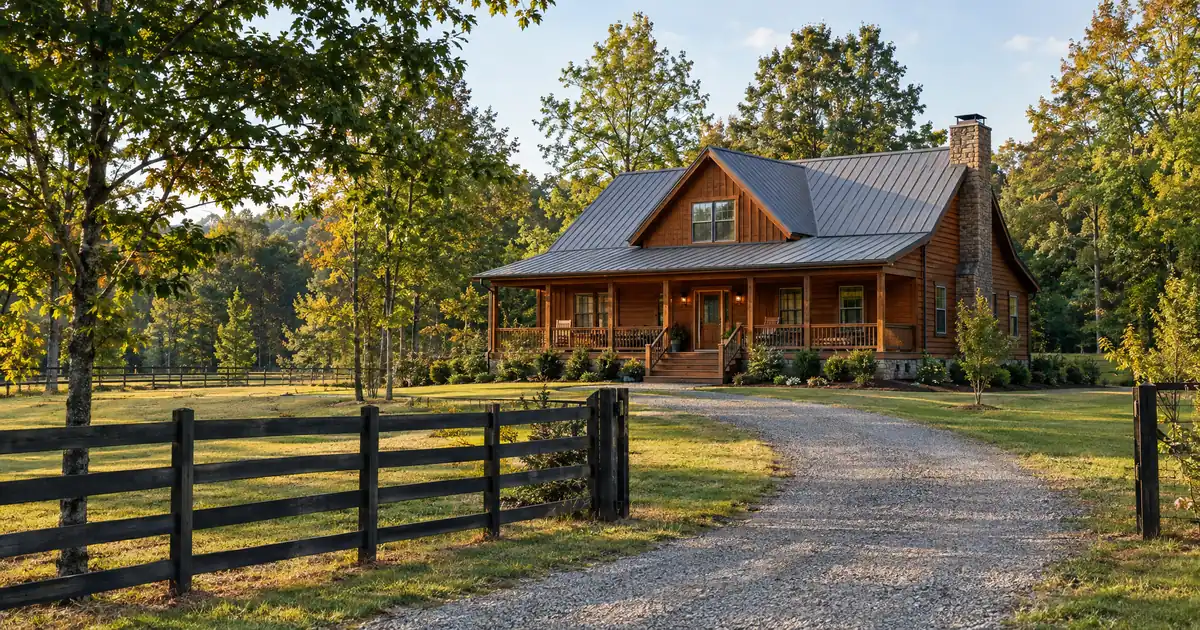
The Quick Read: Land alone does not stop a conventional cash-out refinance. What matters is whether the property is primarily a home, and what the appraisal says the home and land are worth. On a one-unit primary residence, the cash-out cap is 80% of that appraised value, subject to lender guidelines and full file review. In a state where closing costs run heavy, the cash you net is smaller than the cash you qualify for.
Key Takeaways
- Fannie Mae and Freddie Mac look at use, not acreage. A home with land passes when the property is primarily residential.
- The agency guides set no fixed acreage cap, but an individual lender may set its own.
- Cash-out is limited by appraised value, so how the appraiser values the extra land changes your cash.
- Closing costs come out of your proceeds, or get added to the balance. In a heavy-cost state, that gap is real.
- Large barns and farm income are flags the lender reviews. They are not automatic denials.
Cash-out refinance estimate
The starting figures are an example value with a balance and a cash request in proportion. Replace them with yours.
Editable benchmark: 7.40% as of October 15, 2026 · Freddie Mac 30-year average via FRED®. A conventional market reference, not a cash-out refinance quote.
Illustrative starting assumptions: a $350,000 home value, a $193,000 current balance, the agency cap on a one-unit principal residence, a thirty-year term at the current Freddie Mac benchmark, and property taxes and insurance estimated at typical national rates. Every field is editable.
Illustrative estimate only — not a Loan Estimate, approval, quote, or commitment to lend. The rate field carries the weekly Freddie Mac thirty-year conventional benchmark, a market reference and not a cash-out refinance quote; a cash-out loan is priced by the lender at lock. The cash available is the loan the program cap allows less the balances paid off, before closing costs, which are not included. The HELOC line is the program’s combined loan-to-value ceiling applied to the same value and balance. Taxes and insurance are editable estimates. Licensed in sixteen states for consumer mortgages.
What Does “Conventional Cash-Out on Acreage” Actually Mean?
It means you replace your current first mortgage with a new, larger conventional loan, and you keep the difference. The loan follows Fannie Mae or Freddie Mac rules. The home sits on more land than a typical suburban lot.
A limited cash-out (rate-and-term) refinance is the other path. It pays off the existing first mortgage, closing costs, and a purchase-money second lien, with only incidental cash back. A true cash-out lets you take real equity out. It also carries lower leverage and a seasoning wait. Those are the price of the cash.
One note on the title’s phrase. “High-cost closing state” is not an official category. This article treats it as a state where closing-cost items such as taxes and recording charges weigh more on your final numbers. That affects net cash, and it does not change the agency eligibility rules.
Lendmire arranges conventional loans through wholesale lenders in 16 states, and Lendmire’s cash-out refinance programs follow the same agency framework described here. Lendmire brokers these loans. It does not lend.
How Is a Cash-Out on Acreage Underwritten, Step by Step?
The lender runs five checks in sequence. Acreage touches the third and fourth most.
1. Loan purpose. Is this cash-out or limited cash-out? That decides the leverage cap and the waiting periods.
2. Borrower qualification. The wholesale conventional programs start at a 620 decision score. The automated finding governs most files, with a total debt-to-income ceiling of 50%. Manually underwritten loans use tighter ratios, 36% or 45%, with reserve and score factors.
3. Property eligibility. Is the property primarily residential? Does the land fit local norms?
4. Appraisal. What is the home and site worth, based on comparable sales?
5. Leverage sizing. The loan is capped as a percentage of that appraised value.
The Fannie Mae Selling Guide’s cash-out rules set the seasoning test. If an existing first mortgage is being paid off, it must be at least 12 months old, measured from the old note date to the new note date. Fannie Mae’s SEL-2023-01 announcement adds that at least one borrower must have been on title for six months before disbursement. Exceptions exist for delayed financing, inheritance, and legal awards.
Proceeds can pay off the first mortgage and finance closing costs, points, and prepaids. They can also fund real estate taxes added to the new loan. Whatever is left is your cash.
What Is the Leverage Cap, and Does It Change With Land?
The cap does not change because you own acreage. It changes with occupancy and unit count. Fannie Mae’s Eligibility Matrix lists 80% for a one-unit cash-out and 75% for two to four units. A manufactured home on land carries a lower cap still.
| Property type | Conventional cash-out cap |
|---|---|
| One-unit primary residence | 80% LTV |
| Two- to four-unit primary residence | 75% LTV |
| Second home or investment property | 75% LTV |
LTV means loan-to-value: the loan balance as a percentage of appraised value. Mortgage insurance applies on conventional loans above 80% LTV. It can be cancelled at 80% of original value and must end automatically at 78%. Standard cash-out sits at or below the 80% line.
There is one higher-leverage lane. Across the wholesale programs Lendmire places files with, one lane reaches 89.99% LTV with no mortgage insurance. It requires a 680 score, a 50% ratio, a 30-year fixed rate, a primary residence, and a conforming loan balance. It has its own six months of seasoning. Whether an acreage property fits is a lender and appraisal question. Texas is the exception: a cash-out on a Texas homestead is capped by the state constitution at the agency figure, and that wholesale lane is not written there. These specifics are subject to lender guidelines and a full review of property, leverage, and credit.
Freddie Mac publishes its own leverage tables in Guide Section 4203.1. They are separate from Fannie Mae’s, so the two agencies’ limits can differ by loan type.
Is There an Acreage Cap?
Not in the agency guides. This is the most common myth on the topic. Neither Fannie Mae nor Freddie Mac sets a maximum number of acres. They test the property’s character.
Here is how Freddie Mac frames it in its eligibility section. The property must be primarily residential and represent the highest and best use of the property as improved. It must have eligible zoning compliance, legal access, and utilities that meet community standards. Freddie Mac does not buy loans secured by vacant or undeveloped land, or by properties used primarily for farming or agriculture.
Highest and best use is the appraiser’s conclusion about the most sensible, legal use of the site as improved. For your file, that conclusion needs to read “residential.” An appraiser can conclude that the use is residential with a subordinate agricultural use. That wording usually fits a hobby-scale property.
So the answer to “how many acres is too many?” has two layers. The agencies do not draw a line. Some lenders do, and a lender’s own acreage limit can end a file the agency guides would allow. A lender-set limit is called an overlay.
Where Does Residential Turn Into Agricultural?
It turns at primary use. Freddie Mac’s rural property FAQ says silos, large barns, and farm-animal facilities may indicate a farm. The lender decides whether the property is primarily residential based on its characteristics, zoning, and land use.
When the main use is residential, outbuildings do not make the property ineligible. When it is used mainly for farming or ranching, it is ineligible. A small roadside produce stand does not disqualify a property. A neighborhood full of farms does not disqualify it either.
| What the lender sees | Likely read |
|---|---|
| Home, garage, workshop, pasture for a few animals | Residential with minor rural use |
| Home plus large barn and a modest side activity | Flag. Needs review of use and income |
| Home on a working farm, with farm income driving the property | Agricultural. Not eligible for this program |
| Home plus separate adjacent parcel | Depends on whether the land is part of the mortgaged site |
Think of it as a spectrum, not a switch. A dairy operation with a house attached is an agricultural property wearing a residential label, and Fannie Mae’s own guide treats that example as a Charter Act problem. A house with a horse paddock is a house.
Practitioner note: the files that stall are usually the ambiguous middle. A large barn the appraiser assigned no value to still raises a question. The cleanest files have a clear photo record, a plain explanation of what the buildings are for, and no farm income on the traditional personal-income documentation. Gather that before the appraiser visits.
How Does the Appraisal Change Your Cash?
It changes your cash directly, because the loan is a percentage of appraised value, not of what you paid. Rural appraisals are harder, and they swing more. Comparable sales may be scarce and far away.
Freddie Mac’s comparable-sales guidance accepts that large adjustments are normal in rural markets. It sets no limit on gross or net adjustment percentages. Its own example is a ranch home on a large parcel, with the best comps being two-story homes on smaller parcels, miles away. Fannie Mae requires the appraiser to state the distance in miles and direction for each comp.
That flexibility cuts both ways. A thin comp set can bring a low value, and the extra land may be valued modestly or at a steep discount. Here is a modeled illustration, in percentages only.
- Say your current mortgage balance equals 55% of the value you expect.
- At 80% LTV on a one-unit primary residence, the loan could reach 80% of value.
- If the appraisal matches your expectation, gross cash is about 25% of that value.
- If the appraiser values the land lower and the final value lands 10% under expectation, the 80% cap shrinks accordingly. Gross cash falls to about 17% of the original expected value. Terms depend on the lender’s guidelines, the property type, the leverage, and a full review of the credit profile.
A 10% drop in value cuts your available cash by roughly a third. That is leverage working against you. It is why the appraisal, not the acreage, is the number to watch.
If the value comes in low, you have choices. You can ask the lender about a reconsideration of value with better comps. You can take a smaller cash-out. Or you can step down to a limited cash-out, if your goal was mainly to restructure the loan.
Some files qualify for an appraisal waiver, which Fannie Mae calls value acceptance. Even then, the lender still answers for property eligibility. An acreage home with a barn does not get waved through because the automated system said yes.
What Changes in a High-Cost Closing State?
Your net proceeds change, not your eligibility. Closing costs include loan costs paid to the lender and required third parties, plus “other costs” such as taxes and recording charges. The second category is where states differ. A cash-out can finance those costs into the new balance, and costs rolled into the loan accrue interest for the life of the loan.
Read your Loan Estimate line by line. Compare the total cost to the cash you want. If a state’s costs are heavy and your cash-out is small, you may spend a large share of the cash just to receive it.
Lendmire’s piece How to Get a Conventional Cash-Out in a High-Cost Closing State Like Texas walks through that trade-off in more depth. One more practical point: a heavy-cost state does not change the 12-month or six-month tests. Those are agency rules.
Where Does the General Rule Break?
Four edge cases show up often enough to name.
- Lender overlays. An agency-eligible property can still miss a lender’s own acreage line. Another lender in the same wholesale network may accept it. This is why a broker comparing lenders can matter on a file like this.
- Manufactured homes on land. The cash-out cap is lower than for a site-built home, as the Eligibility Matrix shows.
- Separate or adjacent parcels. If the extra land is a different parcel not securing the loan, it generally does not count toward value. Expect the underwriter to ask for survey and parcel evidence.
- Condos and attached homes. They rarely come with acreage.
Occupancy matters too. A primary residence gets the best leverage. A second home or rental on acreage is typically capped at lower leverage.
What Does the Decision Look Like in Practice?
Work through it in this order. Each step is cheap compared with paying for an appraisal on a file that cannot close.
1. Check seasoning. Is your first mortgage at least 12 months old, and have you been on title for six months or more?
2. Check your qualifying numbers. A 620 decision score is the wholesale floor, and the ratio ceiling is 50% on an automated finding.
3. Describe the property honestly. Is it a home with land, or land with a home? Note any outbuildings and any income from the land.
4. Ask about the lender’s acreage line before you order anything. An overlay is a quick yes or no.
5. Size the cash conservatively. Use the 80% cap against a value you could live with at the low end, then subtract closing costs from your Loan Estimate.
6. Compare with keeping your current loan. If the cash is small after costs, a cash-out may not be worth it.
Key Terms Defined
Cash-out refinance: A new, larger mortgage that pays off the old one and gives you the difference in cash.
Limited cash-out refinance: A refinance that pays off the existing first mortgage and certain costs, with only incidental cash back.
LTV (loan-to-value): The loan balance divided by the appraised value, shown as a percentage.
Seasoning: The required waiting period, here a first mortgage at least 12 months old and six months on title.
Highest and best use: The appraiser’s finding of the most reasonable legal use of the property as improved. For these loans, it must be residential.
Overlay: A lender’s own rule, such as an acreage limit, added on top of the agency guidelines.
Next Step
If you are weighing a cash-out refinance against keeping the loan you have, Lendmire can help you compare the programs and the equity each one reaches. Every figure here is subject to lender guidelines and full file review, and nothing here is a commitment to lend.
Frequently Asked Questions
How many acres is too many for a conventional cash-out?
The agency guides set no fixed number. A home on a large parcel can qualify when the property is primarily residential and the appraisal supports the value. Individual lenders may set their own acreage limits, so ask early.
Does a barn or hobby farm disqualify my property?
Not by itself. Outbuildings are acceptable when the property is primarily residential. A large barn or animal facilities are flags, and the lender reviews use, zoning, and any farm income before deciding.
Does the land count toward how much cash I can take?
Yes, to the extent the appraiser includes it in the value of the home and site, with a residential highest and best use. The loan is capped as a percentage of that value. At 80% LTV on a one-unit primary residence, a lower land value means less available cash. The exact numbers vary by lender and program and follow a full review of property, leverage, and credit.
How long do I have to own the home before a cash-out?
Fannie Mae requires that the first mortgage being paid off be at least 12 months old, and that a borrower has been on title for six months. Exceptions apply for delayed financing, inheritance, and legal awards.
Will a high-cost closing state change the rules?
The eligibility rules stay the same. What changes is how much of your proceeds goes to taxes and recording charges. Your Loan Estimate itemizes them, so compare the total against the cash you want.
For your own numbers, request a scenario review with Lendmire.
About Lendmire
Lendmire is a mortgage brokerage (NMLS# 2371349) licensed for consumer mortgage lending in 16 states, arranging FHA, VA, conventional and jumbo purchase and refinance loans through a wholesale lending network. Eligibility is determined by the lender on each file. Scotsman Guide named Lendmire a Top Mortgage Workplace in both 2025 and 2026.
Get Started
Ready to find the right loan for you?
In about 30 seconds you can review financing options available for your home or investment property. No commitment required.
Informational only. Not a Loan Estimate, approval, or commitment to lend. Program availability and eligibility are subject to lender guidelines, credit approval, property review, and underwriting.
References
1. Fannie Mae Selling Guide B2-1.3-03, Cash-Out Refinance Transactions
3. Fannie Mae Eligibility Matrix
5. Freddie Mac Guide Section 5601.1, Eligible and Ineligible Properties
6. Freddie Mac Rural Properties FAQ
This article is part of Lendmire’s Conventional Loans series — every loan program’s qualification details, guidelines, and scenarios live on the loan options page.
Related reading: Conventional Cash-Out Refinance Requirements for a Vacation Home · Can a Trust Home Get a Conventional Cash-Out in a High-Cost Closing State? · 6 Myths About the Cost of a Conventional Cash-Out Refinance
Brandon Miller
Founder & CEO, Mortgage Loan Originator, Lendmire LLC
- Mortgage Loan Originator · NMLS# 1129696 · Verify on NMLS Consumer Access
- North Carolina Real Estate Broker · License# 343312 · Verify on NCREC
- North Carolina Insurance Producer · License# 19053198 · Property, Casualty, Life, Health · Verify on NAIC SBS
- Lendmire LLC · Firm NMLS# 2371349 · Verify firm licensure
Required disclosures. Lendmire (NMLS# 2371349) operates as a licensed mortgage broker, not a direct lender or depository. The discussion in this article is general in nature and should not be relied upon as financial, legal, or tax advice — every investment scenario is unique and should be reviewed by a qualified professional. Any loan inquiry is subject to lender underwriting, and this article is not a commitment to lend or a guarantee of approval. Mortgage rates, loan terms, and program guidelines vary by borrower, property, and state, and may change without notice. Equal Housing Opportunity. Verify licensure at NMLS Consumer Access.