
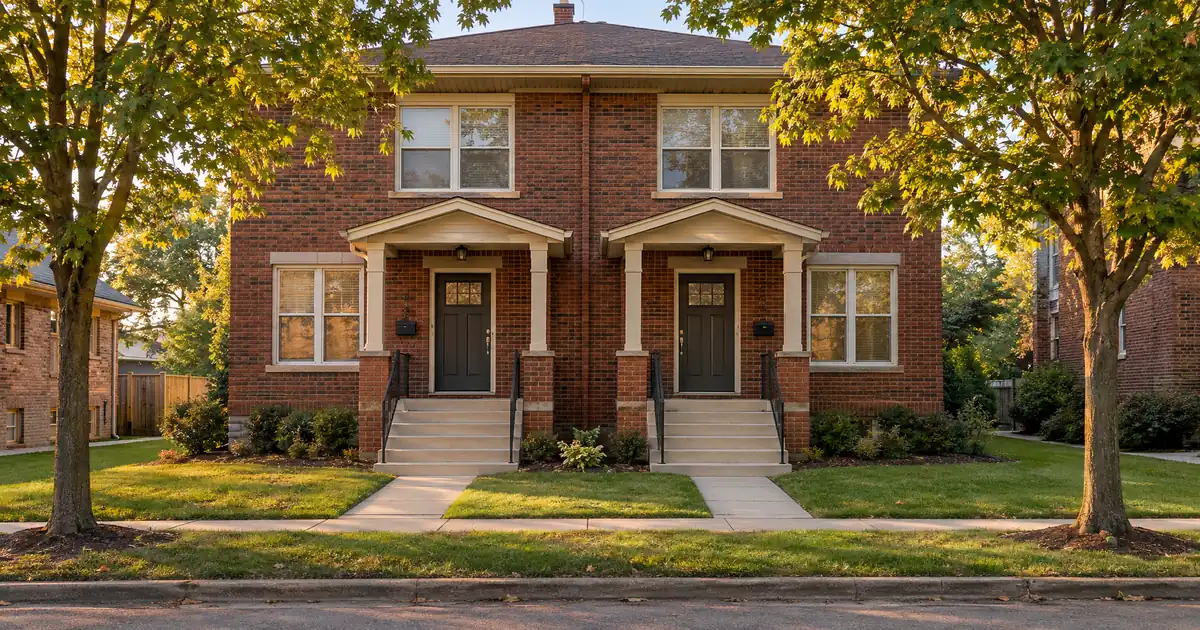
The Quick Read: Self-employed buyers get a low down payment on a two-unit property by living in one unit, because owner-occupied financing allows far less cash down than investor financing, and bank statement loans let your deposits, not your tax-return profit, prove the income that qualifies you for it.
- Occupancy is the lever. Live in one unit and you can use owner-occupied loans. Buy the property purely as a rental and you need meaningfully more equity.
- Self-employment changes the income test, not the occupancy rule. Your traditional personal-income documentation, your bank deposits, or the property’s rent can each carry the file, depending on the loan.
- FHA’s standard minimum is 3.5% down, but FHA averages your net income over two years, so heavy write-offs shrink your buying power.
- Bank statement loans on a primary residence purchase run up to 90% LTV through select lenders, subject to lender guidelines, credit, and file strength.
- A 3.5% down DSCR loan does not exist. Investor loans on rentals need more equity, and that is where the rent-based test comes in.
Key Terms Defined
2-unit property: A duplex, or any building with two separate living units under one deed and one mortgage.
Owner-occupied: You live in the property as your primary residence, usually for at least a year, per the loan program.
House hacking: Living in one unit while tenants in the other unit help pay the mortgage.
LTV (loan-to-value): The loan amount as a percentage of the property’s value. A 90% LTV means 10% down. Terms vary by lender guidelines, property type, leverage, credit profile, and full file review.
Qualifying income: The income figure a lender uses to decide how large a payment you can carry. It often differs from what your business actually earns.
Bank statement loan: A mortgage that is reviewed around documented deposits in your business or personal accounts instead of tax-return net income.
DSCR (debt service coverage ratio): The property’s monthly rent divided by its full monthly housing obligation. DSCR loans are for non-owner-occupied rentals.
PITIA: Principal, interest, taxes, insurance, and association dues. It is the full monthly obligation a lender measures rent against.
Reserves: Liquid savings, counted in months of housing payments, that a lender wants you to hold after closing.
What your deposits qualify you for.
Alt-doc programs read 12 months of business or personal bank deposits instead of tax returns. Enter your average monthly deposits and see the income a lender would credit you.
The expense factor is set by the lender from your business type and profit-and-loss statement; it is not a number you choose. This widget quotes no rate and no payment.
Program parameters shown update from Lendmire’s centralized guideline source.
Estimate
Illustrative estimate only — not a quote, Loan Estimate, approval, or commitment to lend. Deposit average, expense factor, and housing ratio are editable assumptions; the expense factor a lender applies is set from your business type and documentation. No interest rate or monthly payment is quoted here. Purchase capacity is a simplified illustration and does not account for taxes, insurance, HOA dues, or other debts. Alt-doc income documentation is available on consumer mortgages in the states where Lendmire is licensed for consumer lending; actual terms vary by lender, borrower, and property.
Occupancy Decides Which Loan You Get
The question “low down payment on a 2-unit” splits into two loan families, and the split depends on whether you will live there. Owner-occupied loans are the only route to a truly low down payment. Investor loans on a pure rental ask for more cash, because lenders treat a property you do not live in as riskier.
| Factor | You live in one unit | Pure rental purchase |
|---|---|---|
| Down payment | Lowest available | Meaningfully higher |
| Income test | Traditional personal-income documentation or bank deposits | Property rent (DSCR) |
| Occupancy rule | You must move in | Owner cannot occupy |
| Loan type | Consumer mortgage | Business-purpose loan |
Most programs across the wholesale network Lendmire works with draw this same line. A file that crosses it, such as a borrower who says they will live there but plans to rent both units, causes trouble. Occupancy is a promise you sign, and lenders treat it that way.
How Underwriting Treats a Self-Employed Borrower
Underwriting asks one question of every borrower: how much reliable income supports this payment? What changes for you is the evidence. A salaried buyer hands over a pay stub. You can hand over one of three things, and each loan family picks its own.
1. Traditional personal-income documentation. Agency-style loans such as FHA average your net income, after write-offs, over two years.
2. Bank deposits. Bank statement programs average your deposits over the statement period, then apply an expense factor.
3. Property rent. DSCR loans skip personal income and test whether the rent covers the payment.
The third path only applies to a property you do not occupy. For a 2-unit you plan to live in, you are choosing between the first two. A third option on the owner-occupied side is asset depletion. It is reviewed against liquid assets and runs up to about 80% LTV on a primary residence through select lenders. Exact terms depend on the lender’s guidelines, property type, leverage, and a full review of the borrower’s file.
The FHA Route: Lowest Down Payment, Strictest Paperwork
FHA loans are government-insured mortgages built for buyers with modest down payments. FHA’s standard minimum is 3.5% down for scores of 580 or higher, and you must occupy one unit as your principal residence. A 2-unit qualifies. That is the lowest down payment you will find on this property type. Every figure here varies by lender and program — guidelines, property type, leverage, and credit profile all apply.
Self-employment adds conditions. HUD’s handbook excerpt on self-employment sets the framework:
- Two years of self-employment is the general expectation.
- With one to two years, your income counts only if you worked the same or a related occupation for at least two years beforehand.
- A decline of more than 20% in effective income over the analysis period forces manual underwriting.
- You provide two years of personal returns with all schedules, and sometimes business returns as well.
The part that surprises people is the averaging. Income is averaged over the two years, so every write-off lowers the number the lender sees. A business that took in plenty of cash can still look thin on paper. Under FHA you pay for aggressive deductions in lost buying power, and the lower down payment does not offset that for everyone.
The Bank Statement Route: Deposits Instead of Tax Returns
Bank statement loans qualify you on documented income under the applicable program, subject to lender guidelines. The documentation is full, not light. Across the network, programs generally ask for 12 months of business or personal statements.
The lender averages your deposits, then applies an expense factor to business-account deposits, since not every deposit is profit. Scotsman Guide’s coverage of non-QM lending describes this approach, along with a third-party profit-and-loss statement as an alternative. The expense factor varies by lender, so no universal formula exists. Personal-account deposits are generally treated closer to net income.
Here is what the network offers on a primary residence:
- Purchase and rate-term refinance: up to 90% LTV on a primary residence through select lenders. Stronger files earn the top of that range.
- Asset-depletion alternative: up to about 80% LTV on a primary residence.
- Loan sizes: roughly $125,000 to $3,500,000.
- Reserves: commonly around 6 months of the housing payment.
A 90% LTV on an owner-occupied purchase means 10% down. That is more than FHA’s minimum. The trade is that your qualifying income comes from deposits rather than a two-year net average, which helps when write-offs have pushed taxable income below what the business really produces. Terms follow each lender’s program sheet, and every file is underwritten individually. Final terms depend on lender guidelines, property type, leverage, and the borrower’s complete credit picture.
The choice between the two paths looks like this:
| Your situation | Likely better fit |
|---|---|
| Returns show strong, rising net income | FHA, for the lowest cash down |
| Heavy write-offs, strong deposits | Bank statement loan |
| Under two years self-employed, no prior same-field work | Bank statement or asset depletion |
| Income dipped more than 20% year over year | Bank statement, since FHA goes manual |
How Does the Second Unit’s Rent Count?
On owner-occupied loans, whether and how much of the second unit’s rent counts toward qualifying depends on the program and the lender. Some count a portion, supported by an appraiser’s rent opinion. Others ignore it. Do not assume it offsets your income shortfall until a lender confirms in writing how it treats rent on your specific file.
On a pure rental, rent is the whole test. The lender divides monthly rent by PITIA. Rent that lands a little above the full obligation gives you a ratio around 1.2x. Rent that falls short of it gives you a ratio under 1.0. A ratio of 1.00 is the benchmark many programs build around, but it is a select-program floor, not a rule for everyone.
Programs below 1.00 are available through select lenders in the network. Leverage and terms adjust when coverage runs thin. The appraiser’s rent schedule, not the owner’s hopes, sets the number. For a vacant unit with no lease, the appraiser’s market rent opinion usually fills the gap.
A Worked Example: Same Buyer, Three Reads
Run the numbers on this modeled buyer. These are illustrative assumptions, not market data.
A self-employed contractor buys a 2-unit to live in. The business takes in solid deposits all year. After depreciation, vehicle costs, and home-office deductions, the traditional income documentation shows net income roughly a third below what the deposits suggest.
- Under FHA, the lender averages the two years of net income. Qualifying income lands low, and the buyer’s price range shrinks to match. If the second year dipped more than 20%, the file goes to manual underwriting.
- Under a bank statement loan, the lender averages 12 months of deposits and applies its expense factor. Qualifying income lands higher than the tax-return figure, though below raw deposits.
- Down payment is the trade. FHA’s standard minimum is 3.5%. The bank statement loan on a primary residence purchase runs up to 90% LTV, so at least 10% down. These specifics are subject to lender guidelines and a full review of property, leverage, and credit.
Neither path is better in the abstract. The right pick depends on how much cash you have, how much income the write-offs hide, and how strong your credit is. A borrower with plenty of cash and thin conventional personal-income paperwork often prefers the bank statement route. A borrower short on cash with clean returns often prefers FHA.
Where the General Rule Breaks
You move out after a year. That is usually allowed once you meet the program’s occupancy period. After that, the property can become a full rental. If you want to buy another property, the pure-rental purchase moves to DSCR. This is a common sequence: finance the duplex you live in with owner-occupied money, then use investor loans for later purchases.
You live in the unit but sign as an investor. This is occupancy misrepresentation, and it is the biggest risk on this type of file. An owner-occupied 2-unit is a consumer mortgage, so consumer disclosure rules apply. A bank statement loan on a non-owner-occupied rental is a business-purpose loan, and those are exempt from the consumer disclosure regime. Nolo’s explainer on ability-to-repay rules notes that carve-outs exist for several loan types. Pick the loan that matches how you will actually use the property.
Your income is falling. Under FHA, a drop of more than 20% forces manual underwriting. On a DSCR loan, your personal income is not the test, so a down year matters less to the property math.
You have a short self-employment history. FHA allows one to two years only with prior same-field work. Bank statement and asset-depletion programs have their own seasoning expectations, and these vary by lender. DSCR does not turn on personal employment history.
Thin rent coverage on the second unit. If the unit rents for less than you assumed, a rent-dependent plan strains your budget even if the loan closed fine. Size the purchase so you can carry the property while one unit sits empty.
Cash Beyond the Down Payment
A low down payment does not mean a low cash requirement. Budget for these items before you pick a price:
| Item | Why it matters |
|---|---|
| Closing costs | Lender, title, and appraisal charges |
| Reserves | About 6 months of housing payment on many programs |
| Inspection | Two units means two sets of systems |
| Maintenance cushion | Older duplexes surprise owners |
Your down payment funds also need a paper trail. Money moved in from business accounts triggers extra documentation on FHA files, and every program wants large deposits explained. Gift funds and assistance programs may help on owner-occupied loans, though the rules vary by program.
Prepare Six to Twelve Months Out
Self-employed buyers win or lose the file in the months before applying. This checklist is the part most buyers skip.
- Separate business and personal accounts so deposits are easy to trace.
- Talk to your accountant before filing about how much to write off.
- Keep 12 months of clean statements. Avoid large unexplained transfers.
- Pull your credit and clear small errors. Stronger credit earns stronger leverage.
- Build reserves, since about 6 months of housing payment is common.
- Identify the 2-unit’s likely rent from comparable listings, so you know your rent assumption before the appraiser does.
Tax treatment can depend on how the funds are used and how the property is held; investors should keep clear records and speak with a qualified tax professional before relying on any deduction.
When the Purchase Is Pure Investment
If you do not plan to live there, owner-occupied loans are off the table. DSCR loans fit here. They qualify primarily on property-level rental income covering the payment, subject to lender guidelines, with credit, reserves, sourced funds, and entity documents still required. Down payment requirements are meaningfully higher than on owner-occupied loans, and putting less down generally raises pricing and makes a 1.0 coverage ratio harder to hit.
Bank statement loans on non-owner-occupied rentals exist too, but investment purchase leverage varies by lender. For rental-specific leverage guidance, the complete DSCR loans guide covers it in full. If your down payment is the main hurdle, read this overview of DSCR down payment requirements as well.
Frequently Asked Questions
Can a self-employed buyer really put down as little as 3.5% on a duplex?
Yes, through FHA, if you occupy one unit, have a score of 580 or higher, and meet the self-employment documentation rules. Expect two years of returns with all schedules.
Do I need two years of standard personal-income documentation for a bank statement loan?
No. Bank statement programs review your file on documented income under the applicable program, subject to lender guidelines. The network typically asks for 12 months of business or personal statements. You still need credit, reserves, and an appraisal, so the file is fully documented.
Can I use a DSCR loan if I live in one of the units?
Generally no. DSCR loans are designed for non-owner-occupied investment properties. If you live in a unit, you want an owner-occupied loan. After you move out and later buy another rental, DSCR may fit that purchase.
How much cash do I need beyond the down payment?
Plan for closing costs, an inspection, a maintenance cushion, and reserves, which many programs set around 6 months of housing payment. Reserves often surprise first-time buyers more than the down payment does.
Where can I get an owner-occupied bank statement loan?
Consumer mortgage licensing for this loan type covers 16 states. Availability depends on your state, the property, and your credit profile. Reach out with your location and Lendmire can confirm whether a program fits.
Next Step
Qualification is subject to lender guidelines. This is not a commitment to lend.
About Lendmire
A non-QM mortgage broker (NMLS# 2371349), Lendmire arranges DSCR financing for real estate investors in 41 markets — 40 states plus Washington, D.C. Because deals are underwritten primarily on property cash flow rather than personal income documentation, the structure suits self-employed buyers and entity-owned portfolios. Lendmire places loans through wholesale investor lenders; it is not a direct lender. Scotsman Guide named Lendmire a Top Mortgage Workplace in both 2025 and 2026.
Get Started
Ready to find the right loan for you?
In about 30 seconds you can review financing options available for your home or investment property. No commitment required.
Informational only. Not a Loan Estimate, approval, or commitment to lend. Program availability and eligibility are subject to lender guidelines, credit approval, property review, and underwriting.
References
1. FHA.com, HUD 4000.1 explainer
2. HUD transmittal excerpt (Handbook 4000.1 self-employment)
3. Scotsman Guide, Rev Up the Engine for Non-QM Lending
4. Nolo’s explainer on ability-to-repay rules
This article is part of Lendmire’s bank statement loan program — full qualification details, guidelines, and scenarios live on the program page.
Related reading: Self-Employed vs W-2: What Changes in Mortgage Approval? · How Lenders Average Two Years of Self-Employed Income · How to Get a Mortgage When You’re Self-Employed in 2026
Brandon Miller
Founder & CEO, Mortgage Loan Originator, Lendmire LLC
- Mortgage Loan Originator · NMLS# 1129696 · Verify on NMLS Consumer Access
- North Carolina Real Estate Broker · License# 343312 · Verify on NCREC
- North Carolina Insurance Producer · License# 19053198 · Property, Casualty, Life, Health · Verify on NAIC SBS
- Lendmire LLC · Firm NMLS# 2371349 · Verify firm licensure
Compliance and disclosures. Lendmire (NMLS# 2371349) is a licensed mortgage broker and is not a direct lender, depository institution, financial advisor, or tax professional. Content in this article is general market analysis and educational information — not financial, legal, or tax advice for any specific situation. Lendmire does not guarantee loan approval; every transaction is subject to underwriting by the funding lender. Mortgage pricing and loan program guidelines are subject to change at any time without notice and vary by borrower characteristics, property type, and state regulations. Lendmire complies with Equal Housing Opportunity. Licensure verification: NMLS Consumer Access.