
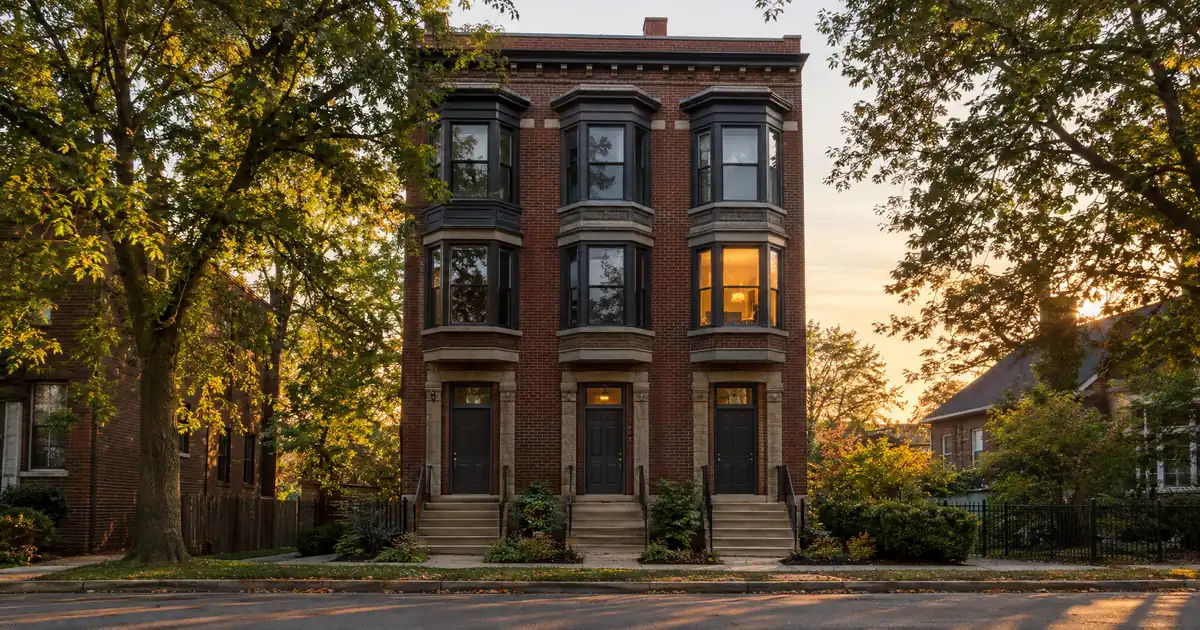
The Quick Read: Moving into one unit of a multi-unit building turns an investor purchase into an owner-occupied purchase, so a self-employed buyer is reviewed on personal documented income, often through twelve months of bank statements, instead of on the building’s rent alone. The occupancy decision sets the program menu, the leverage and the paperwork. It also decides when a rent-based loan becomes an option again.
- Occupancy sets the lane. Living in any unit moves the file out of investor lending and into owner-occupied lending.
- Your income gets documented. Bank statements, traditional personal-income documentation or assets replace the property’s rent as the main qualifying story.
- Rent from your own unit is not income. Rent from the other units may help, depending on the program.
- Leverage can rise. A primary residence purchase can reach up to 90% LTV through select lenders, subject to lender guidelines.
- The rent-based loan comes later. After the occupancy period, the next rental purchase can run on property income instead.
What Changes the Moment You Move In
The same building, bought by the same self-employed buyer, gets a different loan depending on one fact: whether you will live there. A lender sorts every file by intended occupancy before it looks at anything else.
What your deposits qualify you for.
Alt-doc programs read 12 months of business or personal bank deposits instead of tax returns. Enter your average monthly deposits and see the income a lender would credit you.
The expense factor is set by the lender from your business type and profit-and-loss statement; it is not a number you choose. This widget quotes no rate and no payment.
Program parameters shown update from Lendmire’s centralized guideline source.
Estimate
Illustrative estimate only — not a quote, Loan Estimate, approval, or commitment to lend. Deposit average, expense factor, and housing ratio are editable assumptions; the expense factor a lender applies is set from your business type and documentation. No interest rate or monthly payment is quoted here. Purchase capacity is a simplified illustration and does not account for taxes, insurance, HOA dues, or other debts. Alt-doc income documentation is available on consumer mortgages in the states where Lendmire is licensed for consumer lending; actual terms vary by lender, borrower, and property.
A DSCR loan (a debt service coverage loan) qualifies primarily on property-level rental income covering the payment, subject to lender guidelines. It is built for buildings where the owner does not live. The moment you plan to occupy a unit, that lane closes and the owner-occupied lane opens.
| Factor | Investor (no occupancy) | You live in one unit |
|---|---|---|
| Qualifying basis | Property rent vs. payment | Your documented income |
| Self-employed paperwork | Light on personal income | Statements, returns or assets |
| Leverage direction | Set by investor guidelines | Can be higher on a primary |
| Rent from your unit | Counts in the rent test | Not income to you |
| Occupancy certification | Non-occupancy | Intent to occupy |
Across the wholesale network Lendmire places files with, most DSCR programs require that neither you nor a relative lives in the property. That is a program rule set by lenders. The exact wording varies by program.
How Underwriting Treats a Self-Employed Owner-Occupant, Step by Step
Here is the order a lender works through once occupancy is on the table.
1. Classify the occupancy. The lender records whether this is your primary residence, a second home or a rental you will not occupy. Your stated intent to move in drives everything after it.
2. Pick the documentation path. A self-employed buyer usually chooses between traditional personal-income documentation and an alternative path. Alternatives include bank statements, a profit-and-loss statement or assets.
3. Build qualifying income. On a bank statement file, the lender averages twelve months of deposits, business or personal. It then applies an expense factor that varies by lender. Nobody can promise a universal formula, so ask for the factor early.
4. Treat the rent separately. Rent from the other units may offset part of the obligation, depending on the program. Rent from the unit you occupy does not count as income.
5. Test the full obligation. The whole housing payment, including taxes and insurance, is measured against your qualifying income. Rent credit only softens that test.
6. Check reserves. Many programs in the network want reserves around six months of the housing payment.
Notice what is missing: the property’s rent is no longer the star. Your income, credit and cash are. For a self-employed buyer, deductions that lower taxable income can also lower income on a returns-based file. That is why bank statements are so common here.
Where the Rent From the Other Units Fits
Rent from the units you do not live in can help, but only part of it, and never as a free addition. Lenders count a portion of the rent and keep the full payment on your side of the ledger.
Run the order of operations in words. Start with your qualifying income from deposits. Add or credit a portion of the other units’ rent, using the lender’s own treatment. Then set the full housing obligation against the total.
Picture a self-employed buyer whose deposits support the purchase of a single-family home but fall short on a duplex. The duplex’s second unit might close that gap, but only if the program counts rent from that unit. If the property has no rental history, programs often lean on an appraiser’s market-rent schedule instead of a lease.
HUD’s Mortgagee Letter 2023-17 shows how a government-insured program frames this. Subject-property rent can count as effective income on a two- to four-unit dwelling, and it points to a market-rent appraisal for properties without rental history. That letter describes FHA-insured loans, which are a different program from the bank statement files described here. It still shows the logic: rent counts as a documented, appraised figure, never as a promise.
The Bank Statement Path
Bank statement lending is the most common route for self-employed owner-occupants whose traditional personal-income documentation understates their cash flow. Lenders in the network typically work from twelve months of statements. Each qualifies the borrower on documented income under the applicable program, subject to lender guidelines.
The leverage ranges depend on what you buy and how you will use it:
- Primary residence, purchase or refinance without cash out: up to 90% LTV through select lenders. Stronger files earn the top of the range.
- Primary residence on assets instead of deposits: an asset-depletion alternative can run to about 80% LTV.
- Owner-occupied cash-out (primary or second home): up to 80% LTV with a fixed expense ratio, or 75% with an accountant-prepared ratio. It never reaches the 90% purchase ceiling.
- Investment property cash-out: tops out around 75% LTV on a standard rental.
- Investment property purchase: leverage on bank statement documentation varies by lender, so there is no single figure.
Loan sizes generally run from $125,000 to $3,500,000. Credit and loan size shape where within the range a file lands. Term length follows each lender’s program sheet. Do not assume a bank statement loan offers an extended or interest-only term, because those structures are generally a DSCR-side feature.
Consumer lending in this lane through Lendmire is available in 16 states. Every file is underwritten individually, and none of this is a commitment to lend.
If your tax return shows less than your business earns, a CPA letter can change how a lender reads the file.
Why Occupancy Decides the Paperwork
DSCR loans are designed for non-owner-occupied investment properties. Because they are business-purpose investor loans, they are reviewed differently from a standard owner-occupied mortgage.
The practical result is a split in disclosure. An owner-occupied file is a consumer mortgage, so TRID (the federal loan-disclosure framework for consumer mortgages) applies. A bank statement loan on a non-owner-occupied rental, including a short-term rental, is business-purpose and exempt from TRID. The property’s occupancy tells you which regime applies, and the two never mix on one file.
The federal test also looks at facts, not labels. Under the CFPB’s Regulation Z commentary on business-purpose credit, a rental property is treated as non-owner-occupied only if the owner does not expect to occupy it for more than 14 days in the coming year. A lender’s program rules then add their own conditions on top of that classification.
Where the General Rule Breaks
Occupancy rules look clean until a real situation arrives. These are the edge cases that move files.
The 14-day line. Periodic personal stays can reclassify a property. If you plan to use a unit more than a couple of weeks a year, treat the file as owner-occupied from the start.
Three- and four-unit buildings. For a triplex or fourplex you will live in, the federal commentary treats acquisition credit as business-purpose. That does not make the file DSCR-eligible. DSCR programs layer their own non-occupancy requirement on top of the federal classification, so the lender’s guidelines decide.
Family and LLC members. Many DSCR programs extend the non-occupancy rule to relatives and to members of the borrowing entity. Owner-occupied programs, in turn, look for your own intent to live there, and a family member cannot satisfy it for you. An LLC does not change this, because purpose follows the facts, and entity-titled loans are subject to program terms.
Short self-employment history. Bank statement programs generally want a documented business track record, and the minimum varies by lender. A buyer with a short history may find fewer programs open, so confirm history rules before you write an offer.
Mixed-use buildings. A building with a storefront and apartments may qualify as owner-occupied when most of the space is residential. The exact threshold is a lender decision.
Live/work space. Running your business from the owner unit does not by itself change the residential classification. It can change how the property is appraised and how your statements look, so tell the lender up front.
Misstating occupancy. Claiming you will live there to get better terms, when you will not, is occupancy fraud. The better path is to match the loan to the plan you actually have. If you do not plan to live there, run the file as an investor loan.
When Life Changes After You Close
Plans move, and the loan has to survive them. Here is what usually follows:
- You move out early. Most owner-occupied programs expect occupancy for about a year. BiggerPockets’ house-hacking guide says you can keep the owner-occupied loan after moving out and convert the home to a rental. Do not move out and call it a primary residence.
- A tenant leaves. The loan stays the same, but a vacant unit hurts your cash flow, which is why reserves matter.
- Business income dips. Your payment does not shrink with your deposits. Size the purchase on a conservative view of your income, not your best months.
- You want to refinance. An owner-occupied cash-out follows the 80% and 75% ceilings above. After you move out, the property is generally treated as an investment property for future financing, where the ceiling drops to around 75%.
The Exit: From Personal Income to Property Income
Here is the sequencing many self-employed investors follow. You buy an owner-occupied multi-unit building first, using bank statements, and live there through the occupancy period. Then you buy the next rental on a DSCR loan, which looks at the new property’s rent instead of your personal income documents.
That second purchase is where a pure rental belongs. The loan is reviewed primarily on property-level rental income covering the payment, subject to lender guidelines. Lender-specific details on coverage, credit and reserves are in Lendmire’s complete DSCR loans guide.
Tax treatment can depend on how the funds are used and how the property is held; investors should keep clear records and speak with a qualified tax professional before relying on any deduction.
Key Terms Defined
Owner-occupied: A property where the borrower intends to live as a primary residence or second home.
Non-owner-occupied: A rental where neither the borrower nor a relative will live, which is the basis for investor loans.
Bank statement loan: An alternative-documentation mortgage that is reviewed on documented income from twelve months of deposits, subject to lender guidelines.
LTV (loan-to-value): The loan amount as a share of the property’s value or price.
Reserves: Liquid cash left after closing, usually measured in months of the housing payment.
Asset depletion: A qualification method that converts liquid assets into usable income.
Form 1025: The appraiser’s rent schedule and operating income statement for two- to four-unit properties.
Is This Right for You? A Short Checklist
- You plan to live in the building, not just hold it.
- You can show twelve months of steady deposits.
- You can hold roughly six months of reserves.
- You can live there for about a year.
- You expect your next rental purchase to run on property income.
If you can check most of these, an owner-occupied bank statement file is worth pricing. If you cannot, the DSCR lane may fit the plan better.
Frequently Asked Questions
Can I live in one unit of a property bought with a DSCR loan?
Generally not. Most DSCR programs require that the borrower, relatives and entity members do not occupy the property. If you want to live in one unit, the deal works to owner-occupied financing, where your personal documented income is underwritten.
Does rent from my own unit count toward qualifying?
No. Rent from the unit you occupy is not income to you. Rent from the other units may help, depending on the program, and lenders usually count only a portion of it against the full housing payment.
How much can a self-employed owner-occupant borrow against the property?
On a primary residence purchase or a refinance without cash out, up to 90% LTV through select lenders. Owner-occupied cash-out goes up to 80%, or 75% with an accountant-prepared expense ratio. Eligibility depends on credit, loan size and lender guidelines. Terms depend on the lender’s guidelines, the property type, the leverage, and a full review of the credit profile.
What if I move out after a few months?
Programs generally expect about a year of occupancy. If you move out sooner, the loan was based on an intent that no longer matches the facts, which creates a problem for both lender and borrower. Talk to your loan officer before changing plans.
Does a DSCR loan work for my next purchase after I buy a duplex to live in?
Often, yes. A later rental you will not occupy can run on property-level rental income covering the payment, subject to lender guidelines. Your first property generally counts as a rental in your portfolio once you move out.
Next Steps
Lendmire is a mortgage broker that arranges financing through select lenders in its wholesale network, and loan approval is always at the lender’s discretion.
Occupancy is the first fact a lender asks about, so settle it before you shop for a building.
About Lendmire
Lendmire is a non-QM mortgage brokerage (NMLS# 2371349) arranging DSCR investor loans in 41 markets, including Washington, D.C., through wholesale and investor-lending channels. DSCR loans are evaluated by the lender on rental income rather than personal income, subject to lender guidelines — a fit for LLC-owned portfolios, self-employed investors, and operators scaling beyond conventional loan caps. Recognized as a Scotsman Guide Top Mortgage Workplace in 2025 and 2026.
Get Started
Ready to find the right loan for you?
In about 30 seconds you can review financing options available for your home or investment property. No commitment required.
Informational only. Not a Loan Estimate, approval, or commitment to lend. Program availability and eligibility are subject to lender guidelines, credit approval, property review, and underwriting.
References
1. HUD Mortgagee Letter 2023-17
2. CFPB Regulation Z, §1026.3 and commentary
3. BiggerPockets house hacking guide
This article is part of Lendmire’s bank statement loan program — full qualification details, guidelines, and scenarios live on the program page.
Related reading: Self-Employed Mortgage With a CPA Letter vs Without One · How Lenders Average Two Years of Self-Employed Income · How a Self-Employed Mortgage Works When Your Income Changes Every Year
Brandon Miller
Founder & CEO, Mortgage Loan Originator, Lendmire LLC
- Mortgage Loan Originator · NMLS# 1129696 · Verify on NMLS Consumer Access
- North Carolina Real Estate Broker · License# 343312 · Verify on NCREC
- North Carolina Insurance Producer · License# 19053198 · Property, Casualty, Life, Health · Verify on NAIC SBS
- Lendmire LLC · Firm NMLS# 2371349 · Verify firm licensure
Disclosure information. Lendmire is a state-licensed mortgage brokerage under NMLS# 2371349. Lendmire is not a depository institution, direct lender, or financial advisor — all loans referenced are placed through wholesale lender partners and are subject to each lender's underwriting standards. This article is provided for general informational purposes and is not a commitment to lend, nor does it constitute financial, legal, or tax advice. Loan programs, terms, rates, and qualification standards change without notice and depend on borrower profile, property type, and the state in which the subject property is located. Equal Housing Opportunity provider. NMLS Consumer Access: nmlsconsumeraccess.org.