
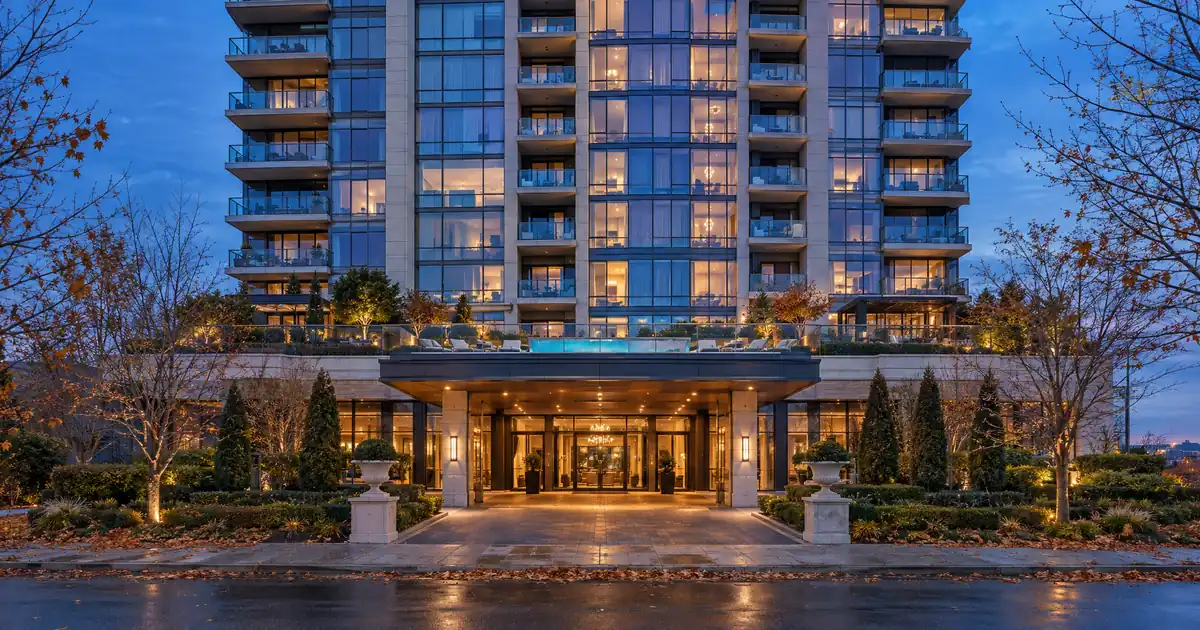
The Quick Read: Usually 20% or more, because most programs in our wholesale network cap a non-warrantable condo purchase at 80% loan-to-value (LTV, the loan as a share of the price), and the down payment is whatever the cap leaves over. Bigger loans, second homes, investment units and hotel-style buildings push that number higher. All figures are through select wholesale programs, subject to full underwriting.
- Bank statements prove your income. They do not decide which buildings are eligible.
- On a purchase, a non-warrantable condo tops out at 80% LTV, so 20% down is the usual floor, even where the loan-size ladder would allow more.
- A condotel (a condo run like a hotel) tops out at 75% on a purchase, so plan on 25% down.
- Above $2,500,000 on a second home or investment unit, the loan-size ladder, not the condo cap, sets your down payment.
- Every loan above $4,000,000 is reviewed case by case before submission. Every figure here varies by lender and program — guidelines, property type, leverage, and credit profile all apply.
Key Terms Defined
Non-warrantable condo: a condo in a building that fails the standard agency project tests, so only a portfolio or non-QM lender can take the loan.
Bank statement loan: a mortgage that is reviewed around 12 or 24 months of deposits instead of traditional personal-income documentation.
LTV: the loan amount divided by the property value. A down payment is 100% minus the LTV.
Expense ratio: the share of business deposits a lender subtracts as operating costs before counting the rest as income.
Reserves: liquid cash you hold after closing, measured in months of the housing obligation.
Condotel: a condo building that runs hotel-style operations, such as a rental desk or daily rentals.
Why the Building Changes Your Down Payment
No rule sets one down payment for this scenario. Each program sets a maximum LTV for the property type. Your down payment is the gap between that cap and 100%.
Two reviews run side by side on every file. The first is you. The lender looks at your deposits, credit, debts and reserves. The second is the building. The lender looks at the HOA budget, reserve funding, litigation, master insurance, late dues, commercial space and how many units are investor-owned.
A weak building raises your cash requirement. A strong income file cannot fix it. Statements prove you can carry the loan. They say nothing about whether the building is acceptable collateral.
That is also why the label is not an insult. Plenty of boutique and luxury buildings land here on technicalities. The project, not you.
What Makes a Building Non-Warrantable?
Common triggers are active litigation, critical repairs, thin reserves, inadequate insurance, heavy investor ownership, too much commercial space and hotel-style operations. Fannie Mae’s Condo Status Finder lists several of these, including critical repairs, insurance gaps, pending significant litigation and hotel or short-term rental management. Loans in those buildings are not eligible for sale to that agency until the problems are resolved. That is the only contrast with agency rules this article needs.
The reason matters more than the label. Here is how a broker sees the common causes.
| Building issue | Why lenders care | Effect on leverage |
|---|---|---|
| Presale shortfall in new project | Temporary, may cure | Often mild |
| Heavy investor ownership | Fewer owner-occupants | Lender overlay |
| Thin HOA reserves | Special assessment risk | Often lower cap |
| Active litigation | Unknown liability | Some decline outright |
| Critical repairs | Collateral condition | Some decline outright |
| Hotel-style operation | Income and use risk | Condotel cap applies |
Some issues move the number. Others end the conversation. A temporary problem usually leaves you at the standard non-warrantable cap. A chronic one can mean fewer lenders willing to look at the building at all.
How a Bank Statement Loan Fits
A bank statement loan changes how income is documented, not which buildings are eligible. Scotsman Guide’s non-QM coverage describes these programs as using 12 to 24 months of deposits to reflect cash flow, and notes that non-QM loans finance properties conforming lenders typically avoid, including condotels and non-warrantable condos.
Here is how the income side works across the programs we place files with:
- You provide 12 or 24 consecutive months of personal or business statements. The bank portfolio program uses 12.
- Business statements need at least 25% ownership.
- Qualifying income is eligible deposits divided by the statement months, after an expense ratio.
- Fixed ratios are 20% for a service business with no employees, 40% for 1 to 5 employees, and 50% for 6 or more employees or any product business. An accountant-provided ratio also works.
- Transfers from your own business into your personal account count in full.
- A profit-and-loss method is also available, capped at 80%.
Credit starts at a 660 floor on the portfolio non-QM program and 680 on the bank portfolio program. Debt-to-income can run to 50%. Those are floors. Higher leverage needs stronger scores.
Income also affects price indirectly. A heavy expense ratio shrinks qualifying income, which lowers the loan you can carry. A lower loan may mean a cheaper condo or more cash in.
Down Payment by Occupancy and Loan Size
Read the ladder by loan amount, never by purchase price. Work out the loan first, then find its band. The non-warrantable cap then applies on top of whatever the band allows.
Start with the property-type caps across the network.
| Property type | Purchase LTV cap | Cash-out cap |
|---|---|---|
| Warrantable condo | 85% | Per ladder |
| Non-warrantable condo | 80% | Per ladder |
| Condotel | 75% | 65% (50% bank program) |
So a non-warrantable condo purchase means at least 20% down through select wholesale programs. A condotel purchase means at least 25%. Final terms depend on lender guidelines, property type, leverage, and the borrower’s complete credit picture.
The loan-size ladder then takes over where it sits below those caps. These are purchase ceilings, subject to underwriting.
Primary residence. The ladder allows 90% to $1,000,000 and 85% to $2,000,000, so the 80% condo cap governs through $3,000,000. That means 20% down. From $3,000,000 to $4,000,000 the primary purchase ceiling is 75%, so plan on 25% down, and the top band needs 760 credit at $3.5M to $4M. Pricing and available terms vary by lender, borrower profile, property type, and full underwriting review. That is case by case on review, and a non-warrantable building may be tighter still.
Second home. The ladder allows 85% to $1,000,000, then 80% to $2,500,000. The condo cap governs again, so 20% down. From $2,500,000 to $3,000,000 the ceiling drops to 75%, so 25% down. From $3,000,000 to $4,000,000 the ceiling is 65% on a purchase, so 35% down, with 760 credit for that top cell. From $4,000,000 to $5,000,000 the ceiling is also 65% on a purchase, but everything above $4,000,000 is case by case on review. These specifics are subject to lender guidelines and a full review of property, leverage, and credit.
Investment property. The ladder allows 85% to $1,000,000, then 80% to $2,500,000, so again 20% down under the condo cap. From $2,500,000 to $3,000,000 it allows 75%, so 25% down. From $3,000,000 to $4,000,000 the bank portfolio program takes over at 60% on a purchase, so 40% down. From $4,000,000 to $5,000,000 the ceiling is 65% on a purchase, so 35% down, on review and case by case. Terms depend on the lender’s guidelines, the property type, the leverage, and a full review of the credit profile.
Yes, that last step up looks odd. Different programs own different bands, and each has its own appetite. A broker’s job is to match your loan size to the band where leverage is best.
The credit scores above are what the top cell needs, not program floors. A lower score generally lands you in a lower leverage cell inside the same band.
Cash-out sits lower. On an investment property the cash-out ceiling is 75% through $2,000,000 and steps down from there. Cash-out on a condotel is 65%, or 50% on the bank program. Cash-out above 60% LTV is capped at $1,500,000 cash-in-hand on the portfolio program. The exact numbers vary by lender and program and follow a full review of property, leverage, and credit.
Above $3,500,000 on a primary residence, and $3,000,000 on a second home or investment property, super-jumbo overlays kick in. They include a 700 credit floor, a 0x30x24 housing history, and 48 months of seasoning after any credit event. Cash-out proceeds cannot count toward reserves.
Worked Examples
These use prices and percentages only. They are modeled for illustration, not market data.
A rental condo near the loan-size sweet spot. Picture an investor buying a $900,000 non-warrantable condo as a rental. The loan sits in the $300,000-to-$1,000,000 band, where an investment purchase allows up to 85%. The non-warrantable cap trims that to 80%. The investor needs 20% down, and 700 credit supports the top cell at that band. Final terms depend on the lender’s guidelines, the property type, and the borrower’s complete credit picture.
A condotel purchase. Say you want a $700,000 condotel unit for its rental program. The purchase cap is 75%, so you need 25% down. Lenders weigh these buildings harder than ordinary condos, so expect a tighter set of options. Each figure is subject to lender guidelines and a complete review of property type, leverage, and credit.
A second home with a shortfall. Consider a buyer who wants a $1,200,000 second-home condo and has only 15% down. The loan falls in the $1,000,000-to-$1,500,000 band. A second-home purchase allows 80% there, and the non-warrantable cap is also 80%. Fifteen percent down does not fit. The buyer can add cash, choose a lower price, or look for a warrantable building where 85% may be available for that occupancy. The right move depends on the file.
A high-balance primary purchase. A founder buying a primary-residence condo in the $3,000,000-to-$3,500,000 loan band sees a 75% purchase ceiling, so 25% down. Credit of 720 or better supports that cell. Add the super-jumbo overlays above, and the file needs clean housing history and no recent credit events. Leverage, reserves, and pricing vary by lender and program; the final terms follow the full file review.
What Cash You Need Beyond the Down Payment
The down payment is not the whole check. Plan for reserves too. Across our network, reserves run 3 months of the housing obligation to $500,000, 6 months to $1,500,000, and 9 months above that. Add 2 months per additional financed property, up to 12 months. First-time investors need 12 months.
Reserves are real liquid cash. Retirement accounts count at 70%, or 80% from age 59.5. Business funds, gifts, unvested stock and crypto do not count.
Your bank statements pull double duty here. They show income and also show where your down payment came from. Large deposits that do not match your business pattern need a paper trail. A transfer from your own business into a personal account counts as income at full value, but moving it right before closing still needs a clear explanation.
What to Do If You Are Short
You have more options than raising your offer or walking away.
- Pick a different building. A warrantable condo can carry up to 85% on a purchase through select programs, which cuts your cash needs.
- Negotiate price. Non-warrantable buildings shrink the buyer pool. That is often leverage at the table.
- Wait out a temporary defect. A presale shortfall can cure as units close.
- Change the occupancy plan. Primary residence ladders run higher than second-home or investment ladders in some bands, though not all. Read each occupancy’s own ladder.
- Consider a DSCR loan if it is a rental. A DSCR loan is reviewed primarily on property-level rental income covering the payment, subject to lender guidelines. Some lenders in the network take non-warrantable condos, and sub-1.00 coverage is available through select lenders, but LTV and terms adjust. Lender appetite varies building by building. The complete DSCR loans guide explains how that path works.
- Use the asset paths. Asset allowance and assets-only options exist for primary and second homes, if your liquid assets are strong but monthly deposits are uneven.
Documents to Gather Before Contract
Ask for the building’s paperwork before you spend money on an appraisal. Scotsman Guide advises calling the HOA first to check owner-occupancy, litigation and reserves. That one call can save a deal.
For the building, ask for:
- The HOA budget and the latest reserve study
- The master insurance certificate
- A litigation disclosure
- A list of delinquent dues and special assessments
- A condo questionnaire, with unit ownership and any commercial space
For you, assemble:
- 12 or 24 consecutive months of statements (no transaction histories)
- Ownership proof for any business accounts
- An accountant’s expense ratio letter, if you want to use one
- Asset statements for reserves and funds to close
The lender’s job is to decide whether the building is acceptable collateral. A non-QM label does not skip that step.
Risks and Exit
Non-warrantable buildings shrink the pool of future buyers, because they face the same financing barriers. One Florida brokerage blog makes this point and notes the flip side: less competition and more room to negotiate at purchase. A realistic exit is a cash buyer or another non-QM loan, not an agency-backed refinance.
Status can also change. Fannie Mae’s lender letter on condo project rules retired the 50% investor-concentration limit for established projects, though other tests remain. A building could become agency-eligible, or lose eligibility, independent of your borrower profile. Non-QM lenders may also keep their own overlays.
Common Misreads
“Strong statements fix a weak building.” No. Statements prove income. The building still has to pass.
“More than half investors always means non-warrantable.” Not any more under that agency’s rule for established projects. Lenders may keep their own limits.
“A standard number applies.” No single standard does. The cap varies by program, occupancy, loan size and building issue.
“All DSCR lenders take these condos.” They don’t. Appetite varies lender by lender.
Next Step
Lendmire is a broker, not the lender, and consumer lending is licensed in AL, CA, CO, FL, GA, IN, MI, MT, NM, NC, OH, PA, TN, TX, VA and WA.
Frequently Asked Questions
Can I put less than 20% down on a non-warrantable condo with a bank statement loan?
Generally no on most programs in the network, because the purchase cap for a non-warrantable condo is 80% LTV. A warrantable building can allow up to 85% on a purchase, and some occupancies and loan sizes reach 90%, subject to underwriting. Lenders may publish different figures.
Does a bank statement loan raise or lower the down payment?
Neither. The income method decides how you qualify. The building and occupancy decide the leverage cap. Switching from traditional personal-income documentation to statements can change the loan amount you can carry, but it does not change the 80% condo cap.
Is a condotel harder than a regular non-warrantable condo?
Yes. A condotel purchase tops out at 75% LTV, so it needs at least 25% down. Cash-out is 65%, or 50% on the bank program. Fewer lenders will consider these buildings, and short-term rental rules vary by city, county, HOA and property type. Terms vary by lender guidelines, property type, leverage, credit profile, and full file review.
How much does the down payment change on an investment condo above $3,000,000?
It changes a lot. On an investment purchase the ladder drops to 60% in the $3,000,000-to-$4,000,000 band (the bank portfolio program), so 40% down. Above $4,000,000 the ladder reads 65% on a purchase, on review and case by case. Exact terms depend on the lender’s guidelines, property type, leverage, and a full review of the borrower’s file.
Can gift funds cover my down payment?
Generally not. Gifts do not count toward reserves, and the down payment needs documented sourcing. Your own statements can show the source of funds, but unexplained large deposits will draw questions.
For current guidelines and terms, see Lendmire’s super jumbo bank statement loan programs page.
Lendmire’s self-employed mortgages page presents both super jumbo programs, bank statement and DSCR, side by side.
About Lendmire
Lendmire, NMLS# 2371349, is a mortgage brokerage with consumer lending licenses in 16 states. Bank statement, P&L-only, 1099-only and asset-based mortgages are arranged through wholesale lending partners for borrowers whose tax returns understate their income, and each application is reviewed individually by the lender. Scotsman Guide named Lendmire a Top Mortgage Workplace in both 2025 and 2026.
Investors who want the broader program framework can review how DSCR loans work.
Get Started
Ready to find the right loan for you?
In about 30 seconds you can review financing options available for your home or investment property. No commitment required.
Informational only. Not a Loan Estimate, approval, or commitment to lend. Program availability and eligibility are subject to lender guidelines, credit approval, property review, and underwriting.
References
1. Fannie Mae – Condo Status Finder
2. Scotsman Guide – One out of 20 mortgages are non-QM
3. Scotsman Guide – Get in the Game
4. FL Prop – Why non-warrantable condos remain a smart investor niche
5. Fannie Mae – Lender Letter on condo project rules
This article is part of Lendmire’s super jumbo bank statement loan program — full qualification details, guidelines, and scenarios live on the program page.
Related reading: How Much Can You Borrow With a Super Jumbo Bank Statement Second-Home Loan? · How to Qualify for a Bank Statement Loan for Boat Owners · How Much Down Payment Does a Golf Community Home With a Bank Statement Loan Need?
Brandon Miller
Founder & CEO, Mortgage Loan Originator, Lendmire LLC
- Mortgage Loan Originator · NMLS# 1129696 · Verify on NMLS Consumer Access
- North Carolina Real Estate Broker · License# 343312 · Verify on NCREC
- North Carolina Insurance Producer · License# 19053198 · Property, Casualty, Life, Health · Verify on NAIC SBS
- Lendmire LLC · Firm NMLS# 2371349 · Verify firm licensure
Legal disclosures. Lendmire (NMLS# 2371349) is a state-licensed mortgage brokerage that arranges financing through wholesale lender relationships. Lendmire is not a direct lender, depository institution, or registered financial advisor. The discussion above is general informational content about real estate financing — it is not financial, legal, or tax advice, and readers should consult licensed professionals for guidance on their individual circumstances. Loan inquiries are subject to lender underwriting; this article does not represent a commitment to lend. Loan terms, rates, and qualification standards vary by borrower, property, and state, and are subject to change at any time. Equal Housing Opportunity. NMLS Consumer Access: nmlsconsumeraccess.org.