
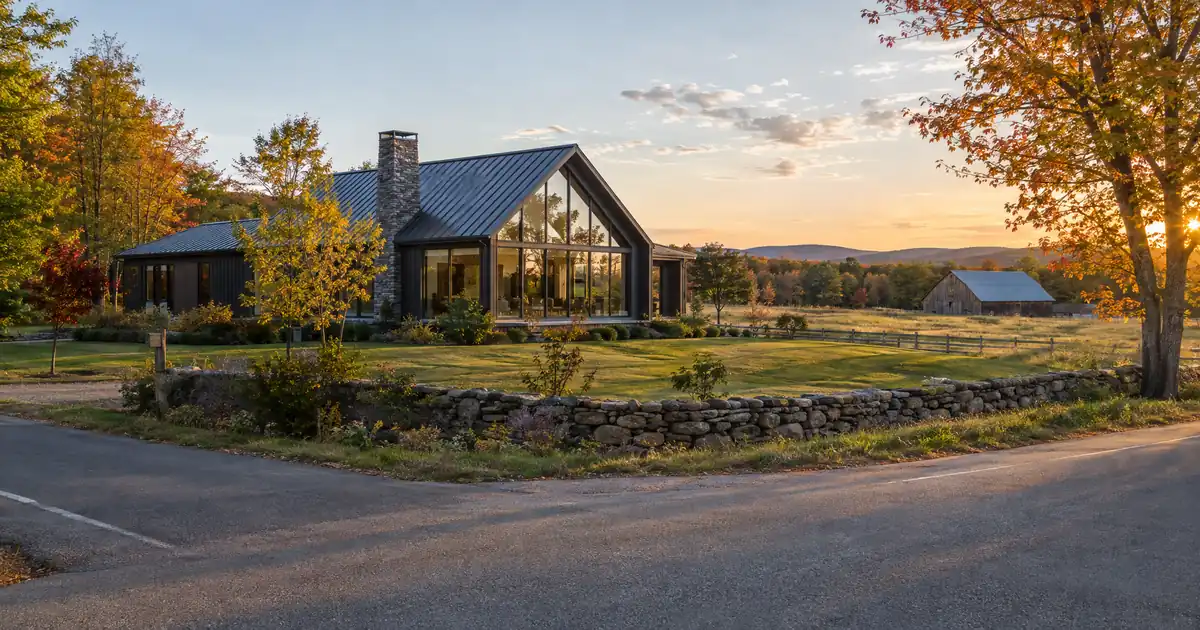
The Quick Read: Sometimes, but only when the property itself fits the program’s rural rules, because asset depletion decides how you qualify on income and says nothing about whether the land, the acreage or the way it is used is eligible. Through select programs in Lendmire’s network, a home on modest acreage that is clearly residential is the realistic fit. Farms, ranches and parcels with heavy agricultural use are the usual stopping points, and a rental purchase often belongs on a different loan altogether.
- Two separate tests. You qualify as a borrower on assets, and the property is reviewed on its own rural, acreage and appraisal rules.
- Use matters more than size. A home on extra land is treated differently from a working farm, and acreage caps are program-specific.
- Appraised value sets the ceiling. Only land the comparable sales support counts toward value.
- Rentals take a different road. Investment property is allowed on the depletion path only, at lower leverage, and business-purpose rentals usually fit DSCR better.
- Figures are ceilings, not offers. Everything below is subject to underwriting and lender guidelines.
If you want the wider picture of how investor-focused loans work, Lendmire’s complete DSCR loans guide covers it.
What Is an Asset Depletion Loan, in Plain English?
An asset depletion loan is a way to prove you can afford a mortgage when your balances are large and your paycheck is not. It is a qualification method, not a type of property. Your assets stay where they are. Nothing gets sold.
Across the wholesale network Lendmire places files with, there are two paths, and a borrower is on one at a time.
The asset qualifier path. Your eligible assets, after the credit percentages below, must equal or exceed the entire loan amount. No employment or income is documented. Brokerage accounts, certificates of deposit, money market and savings count at 100%. Retirement accounts count at 90% if you are under 59½ and 100% at 59½ or older. Loans run up to $4,000,000, subject to underwriting.
The asset depletion path. Usable assets, after haircuts, are divided by 60 months. The result is a monthly qualifying income. That income must carry the full housing payment and your other debts through the debt-to-income test, which compares your monthly debts to your monthly income. Loans on this path run from $125,000 to $3,500,000.
The haircuts on the depletion path are straightforward. Cash and certificates of deposit count at 100%. Securities count at 80%, private stock at 75%, retirement accounts at 70% at any age, and real-estate equity at 60%.
A quick picture of the depletion math: $1,500,000 in securities at 80% plus $300,000 in cash at 100% gives $1,500,000 of usable assets. Divide by 60 months and you get $25,000 of monthly qualifying income. That income then has to carry the housing payment and other debts. The lender’s own calculation governs, and this is illustration only.
Both paths document the assets themselves. “No income documentation” never means “no documentation.”
Does Asset Depletion Change What the Property Has to Satisfy?
No. This is the part most borrowers miss. Asset depletion answers one question: can you carry the payment? A second, separate question is whether the property is eligible collateral. Rural and acreage rules live entirely in that second question.
| Factor | Gate 1: The Borrower | Gate 2: The Property |
|---|---|---|
| What is tested | Assets, seasoning, credit | Use, acreage, comps, condition |
| Asset depletion helps? | Yes | No |
| Who decides | Underwriter reviews your file | Appraisal plus program rules |
| Typical failure | Assets not seasoned or eligible | Too much acreage or farm use |
You can clear the first gate with seven figures in the bank and still stall at the second. A small barn on a house lot rarely changes the answer. A working ranch will.
How Do Lenders Treat Acreage?
There is no single national acreage cap, which surprises people. Agency guidelines are the contrast case here. Freddie Mac’s own Rural Properties FAQ says it applies no site-size or acreage limits, and it separates a primarily residential property with agricultural-type outbuildings (eligible) from a property used primarily for farming or ranching (ineligible). Those are agency rules, not rules for asset-based loans placed through our network.
Acreage limits tend to come from lender overlays, which are a lender’s own added restrictions on top of baseline rules. A mortgage-insurer training deck on rural appraisals, Enact MI’s guidance for rural properties, lists no maximum acreage for the agencies but notes that many lenders set their own and tells you to check guidelines. It is an older deck, so take it as a concept, not a current rulebook.
Here is what a broker sees across many lenders. Acreage is handled in one of three ways:
- A hard eligibility line. Go past it and the file is out.
- A valuation limit. The house is eligible, but value above a threshold is excluded from the appraisal.
- Case-by-case review. The underwriter weighs use, comps and marketability.
Which one applies depends on the program, and the strictest overlays sit well below what the agencies tolerate. Ask before you order an appraisal. Asking costs nothing, and a wasted appraisal does.
Residential Land, Hobby Farm or Working Farm?
How the land is used usually matters more than how big it is. Programs sort rural properties roughly like this:
| Property type | Typical treatment | Why |
|---|---|---|
| House on a larger lot | Usually eligible | Clearly residential |
| Home with minor outbuildings | Often eligible | Outbuildings add little value |
| Hobby farm | Case by case | Depends on income and facilities |
| Working farm or ranch | Usually ineligible | Primary agricultural use |
| Vacant land | Usually ineligible | No dwelling to secure |
Large barns, silos and animal facilities push a lender to ask whether the home is the main event. A small barn or stable may be acceptable when its contributory value is minimal relative to total appraised value. Agricultural zoning is another common exclusion, and farm income can change how a file is reviewed.
If you are weighing a hobby farm, expect a conversation, not a checkbox.
Why Rural Appraisals Cause the Real Trouble
Thin comparable sales are the usual bottleneck. Rural markets have fewer sales, so appraisers widen their search radius, and the further they reach, the weaker the comparison. Land beyond what is typical for the area may be valued at little or nothing. A large parcel in an area where commercial farms are typical calls for extra analysis.
The practical lesson: more land does not automatically mean more value. Only land the comps support counts. One landowner forum post, on Tractor By Net, describes an appraiser counting the house and 5 of 25 acres. That is an anecdote, not a rule, but it shows how this can go.
Why it matters for you: the appraised value drives the maximum loan. On the asset depletion path you can borrow up to 80% on a purchase or rate-and-term refinance of a principal residence or second home, and 60% on a cash-out. If the appraisal discounts your acreage, your down payment grows.
Practitioner pattern worth knowing: files on rural land stall less over borrower strength than over appraisal surprises. Strong asset borrowers still get pulled back by a low value. Confirm the program’s rural rules first, then order the appraisal.
Wells, septic, private road access and title or mineral issues also get reviewed. They are rarely deal-killers when documented, but they add steps.
How Assets Shrink Once You Buy the Property
A larger or pricier parcel needs a bigger asset base. Your down payment and closing costs come out of the same pool you are using to qualify.
On the depletion path, qualified assets must be at least the lesser of $1,000,000 or 1.25 times the loan balance, and never below $250,000 liquid when depletion is your only income source. Cash-out proceeds never count as qualifying assets.
Seasoning matters too. A seasoned balance is money that has sat in your account long enough for the lender to trust where it came from. On the depletion path, statements must be at least 120 days old at application, plus a recent statement within 45 days. Sale-of-business, inheritance and legal-settlement funds are excused from that seasoning. On the qualifier path it is 60 days and two months of statements per account.
Crypto, precious metals, collectibles and borrowed or pledged funds are not published as eligible on either path. The documented route is converting them to a seasoned cash balance in a regulated account. Not eligible on the depletion path at all: custodial accounts, deferred compensation, escrow accounts, foreign funds, cash on hand, stock options and non-vested restricted stock units.
If you recently sold a business or property, Lendmire’s piece How to Qualify on Asset Depletion After Selling a Business or Property walks through how those funds are treated.
What If the Rural Property Is a Rental?
This is the biggest fork for an investor. Asset depletion is a personal-income method. Rentals are business-purpose loans, reviewed differently from a standard owner-occupied mortgage. The CFPB’s Regulation Z rule on exempt credit turns on whether credit is extended primarily for a business purpose, and the creditor determines that purpose transaction by transaction.
In practice, a few things follow:
- On asset depletion, investment property is allowed at lower leverage: up to 65% on a purchase or rate-and-term refinance, and 60% on a cash-out.
- On the asset qualifier path, the published program covers principal residences and second homes.
- A dedicated rental purchase often fits DSCR better. DSCR (debt service coverage ratio) qualifies primarily on property-level rental income covering the payment, subject to lender guidelines.
DSCR files on rural rentals carry their own hurdles: rents tend to run low relative to value, and thin comps hit the appraisal as well. Some programs go below 1.00 coverage through select lenders, though leverage and terms adjust. Check rural rules there too.
A first-time investor on the depletion path needs a 700 score. Credit on the depletion path follows the lender’s matrix. The qualifier path publishes a 600 minimum. Housing history is generally 0x30x12, and a housing event needs 4 years of seasoning on the depletion path.
Which Path Fits Which Rural Buyer?
| Your situation | Likely fit | Watch for |
|---|---|---|
| Retiree buying a country home to live in | Asset qualifier or depletion | Acreage cap, comps |
| Recent business seller, second home on land | Depletion (seasoning excused) | Minimum assets rule |
| Investor buying a rural rental | DSCR, often | Low rents, thin comps |
| Buyer wanting a working farm | Ag or farm lender | Primary agricultural use |
| Buyer wanting vacant acreage | Land lender | No dwelling to secure |
If you plan to live in the home, asset-based paths can work. If you plan to rent it, start with DSCR. If you want to farm it, expect a different lender entirely.
Common Misconceptions
“Agencies cap acreage at 10 acres.” They do not. Freddie Mac says it has no site-size limits. Caps are lender overlays.
“Asset depletion means the lender takes my assets.” The property is the collateral. Your assets stay invested, and the calculation is only a qualifying convention.
“Any outbuilding disqualifies me.” A minor one does not. Primary agricultural use does.
“Asset depletion works for every property.” It depends on the program, occupancy and use.
Before You Apply: A Short Checklist
- Statements for every account you plan to count, with the seasoning dates noted.
- Ownership verification and explanations for large deposits or transfers.
- Acreage, zoning, and a plain description of how the land is used.
- A list of outbuildings and their size.
- Well, septic and road access details.
- Your intended occupancy: primary, second home or rental.
Key Terms Defined
Asset depletion: a method that turns eligible assets into monthly qualifying income by dividing them over a set number of months.
Haircut: the share of an asset’s balance that does not count, because the lender discounts it for risk.
Seasoning: the time funds must sit in your account before a lender counts them.
Overlay: a lender’s own restriction added on top of baseline program rules.
Comparable sales (comps): recent nearby sales an appraiser uses to estimate value.
DSCR: debt service coverage ratio, meaning rental income compared with the property’s monthly obligation.
Frequently Asked Questions
Is there an acreage limit on an asset depletion loan?
Usually yes, but it is set by the specific program, not by a national rule. Some programs treat acreage as a hard line, others exclude value above a threshold, and others review case by case. Ask for the program’s rural rules before ordering an appraisal.
Do barns and outbuildings count against me?
Minor ones generally do not. A small barn or stable with little contributory value is typically acceptable when the property is primarily residential. Large barns, silos and animal facilities invite questions about whether the property is really a farm.
Can I buy a hobby farm?
Possibly, case by case. Lenders look at land use, facilities and whether farm income plays a role. A property used primarily for farming is usually ineligible, subject to program terms.
Can I buy vacant land on assets?
Generally not. These programs secure a dwelling, and vacant land is usually ineligible. Land lenders handle that need.
Can I use asset depletion to buy a rural rental?
The depletion path allows investment property at lower leverage, but the qualifier path covers principal residences and second homes. For a pure rental, DSCR often fits better because it looks at the property’s rent. Subject to underwriting and lender guidelines.
If you are qualifying on assets rather than income and want to see how the numbers work, Lendmire can help you compare asset-based mortgage options based on your statements, the property, credit profile, leverage, and your goals. Rural land rewards the buyer who confirms the program’s acreage rules before the appraisal, not after it.
About Lendmire
Lendmire (NMLS# 2371349) is a mortgage brokerage serving self-employed and high-net-worth borrowers in 16 states. Bank statement, P&L-only, 1099-only and asset-based mortgages are arranged through wholesale lending channels; Lendmire brokers the financing and the lender underwrites each application. Scotsman Guide named Lendmire a Top Mortgage Workplace in both 2025 and 2026.
Get Started
Ready to find the right loan for you?
In about 30 seconds you can review financing options available for your home or investment property. No commitment required.
Informational only. Not a Loan Estimate, approval, or commitment to lend. Program availability and eligibility are subject to lender guidelines, credit approval, property review, and underwriting.
References
1. Freddie Mac Seller/Servicer Guide, Rural Properties FAQ
2. Enact MI, Appraisal Review: Guidance for Rural Properties
3. Tractor By Net, Rural property appraisals
This article is part of Lendmire’s asset-based mortgage program — full qualification details, guidelines, and scenarios live on the program page.
Related reading: Asset Depletion vs Bank Statement Loan After a One-Time Property Sale · How an Asset Depletion Jumbo Loan Works · How Asset Depletion Jumbo Loan Limits Work
Brandon Miller
Founder & CEO, Mortgage Loan Originator, Lendmire LLC
- Mortgage Loan Originator · NMLS# 1129696 · Verify on NMLS Consumer Access
- North Carolina Real Estate Broker · License# 343312 · Verify on NCREC
- North Carolina Insurance Producer · License# 19053198 · Property, Casualty, Life, Health · Verify on NAIC SBS
- Lendmire LLC · Firm NMLS# 2371349 · Verify firm licensure
Important disclosures. Lendmire (NMLS# 2371349) is a licensed mortgage brokerage. Lendmire is not a direct lender, depository institution, or financial advisor. All loan inquiries are subject to lender underwriting; this article does not constitute a commitment to lend. Rates, terms, and program guidelines are subject to change without notice and vary by borrower profile, property type, and state. Information in this article is general in nature and is not financial, legal, or tax advice. Equal Housing Opportunity. NMLS Consumer Access: nmlsconsumeraccess.org.