
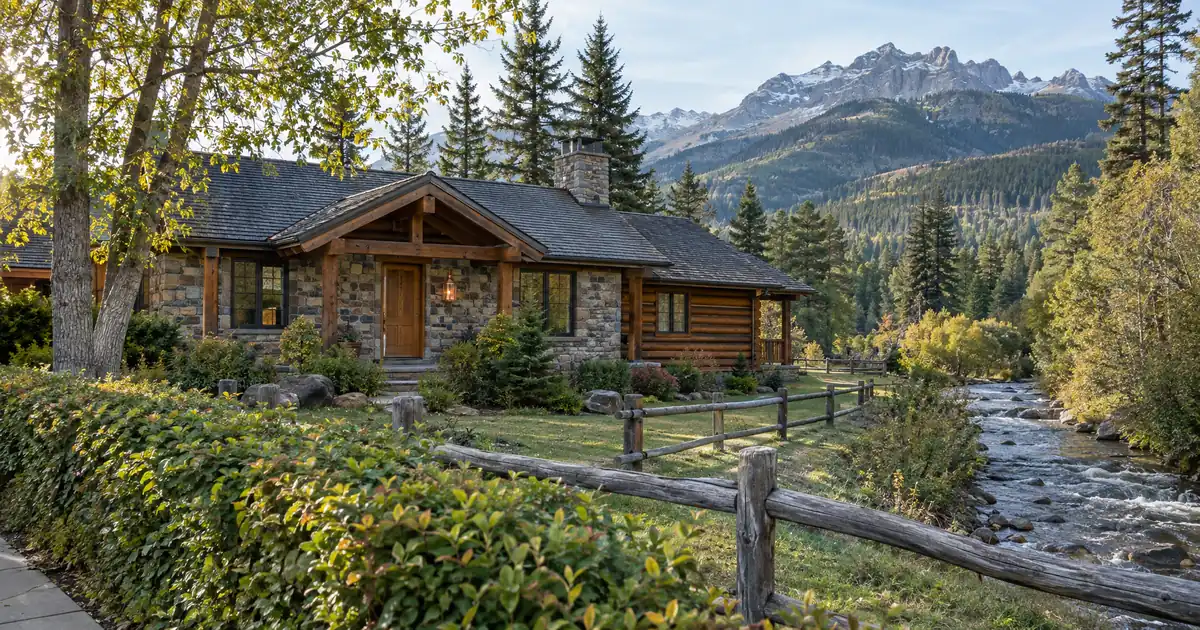
The Quick Read: It depends on what the acreage is. Acreage with a habitable home on it can often be financed through select programs in Lendmire’s network, subject to underwriting and acreage limits. Raw, vacant land usually cannot. Asset depletion only proves you can repay the loan. It does not make a property eligible.
- Home on acreage: this is the workable case, on a principal residence or second home, subject to the lender’s acreage and property-type limits.
- Raw or vacant land: a local land loan or cash is the usual route, because mortgage programs lend against homes.
- Your assets: they are fully documented. Qualification skips employment income, not paperwork.
- The property being bought: its equity never counts toward your qualifying assets.
Why the Property Decides the Answer
Asset depletion is a way to show income. It is not a property type, and it does not change what a lender will accept as collateral. The mortgage underneath still has to fit the property.
A mortgage lender wants a house it can appraise against nearby sales, insure, and resell. A habitable home on 10 or 20 acres fits that picture. A hillside parcel with no structure does not.
Redfin’s land loan explainer says you usually cannot get a traditional mortgage on land alone. It adds that lenders treat land as riskier because it may not produce income or be easy to resell. It also reports that specialized land loans commonly ask for 20% to 50% down. For a home on acreage, the network figures are different: on a principal residence or second home, the asset depletion path allows up to 80% loan-to-value (LTV) on a purchase, subject to underwriting.
Here is the working split from the brokerage side:
- Improved acreage: a livable house on rural land, often within a lender’s acreage cap. This is where asset-based mortgages fit.
- Unimproved acreage: no structure, or a structure that is not habitable. Most mortgage programs decline it, and a land loan is the normal answer.
- Working ranch or farm operations: these usually belong with agricultural lenders, not a consumer mortgage program.
Acreage caps vary a great deal from one lender to the next. Some programs in the network stay close to rural residential size. Others tolerate more land when the house is the main value. No cap is published here, so the lender’s guidelines for your specific parcel decide.
Two Ways to Qualify, and Which One Fits You
You qualify on one path at a time, and the two paths use different math. Mixing them is a common mistake in this category.
The asset qualifier path uses your assets to cover the entire loan. If your eligible assets, after the credit percentages, equal or exceed the loan amount, you qualify on assets alone. No employment or income is documented. Through select programs, loans run up to $4,000,000, with up to 80% LTV on a purchase and 75% on a refinance, on a principal residence or second home. Terms depend on the lender’s guidelines, the property type, the leverage, and a full review of the credit profile.
The asset depletion path turns assets into income. Usable assets, after haircuts, are divided by 60 months. That monthly figure must carry the housing payment and your other debts through the debt-to-income (DTI) test. Loans run from $125,000 to $3,500,000. On a principal residence or second home, leverage reaches 80% on a purchase or rate-and-term refinance and 60% on a cash-out refinance. On an investment property, it is 65% on a purchase or rate-and-term and 60% on a cash-out. Cash-out proceeds never count as qualifying assets.
Which path fits? If your balances are large compared with the loan, the qualifier path is simpler. If your balances are solid but smaller than the loan, the depletion path may work, since the assets only need to generate enough income. That path also has a floor. Qualified assets must be at least the lesser of $1,000,000 or 1.25 times the loan balance, and never below $250,000 liquid when depletion is your only income. Asset income can also supplement documented income up to a 45% DTI, and the minimum-assets rule is waived in that case.
Credit still matters. The qualifier path publishes a 600 minimum score. The depletion path follows the lender’s score and loan-amount matrix, and a first-time investor on that path needs 700. A housing payment history of 0x30x12 is the standard, and one late payment in twelve months is considered case by case. Everything is subject to underwriting.
Which Assets Count (and How Much)
Not every dollar counts at face value. The two paths apply different percentages, so keep the tables separate.
Asset qualifier path:
| Asset | Share that counts |
|---|---|
| Brokerage accounts | 100% |
| CDs, money market, savings | 100% |
| 401(k) or IRA, under age 59½ | 90% |
| 401(k) or IRA, 59½ or older | 100% |
Asset depletion path:
| Asset | Share that counts |
|---|---|
| Cash accounts and CDs | 100% |
| Securities | 80% |
| Private stock | 75% |
| Retirement accounts (any age) | 70% |
| Real-estate equity | 60% |
Several assets are not eligible on the depletion path. These include custodial accounts, deferred compensation, escrow accounts, foreign funds, cash on hand, stock options, non-vested restricted stock units, and funds from non-regulated financial companies.
Cryptocurrency, precious metals, collectibles, and borrowed or pledged funds are not published as eligible on either path. The documented route is converting them to a seasoned cash balance in a regulated account. The lender reviews the source of those funds.
Seasoning is the waiting period an asset must sit in your account. On the qualifier path, that means 60 days and two months of statements for each qualifying account. On the depletion path, statements must be at least 120 days old at application, plus a recent one within 45 days. Funds from the sale of a business, an inheritance, or a legal settlement are excused from that seasoning. Underwriters review where large deposits came from.
One rule catches acreage buyers. Equity in the parcel you are buying cannot be counted. The federal ability-to-repay framework, summarized in the CFPB’s implementation guide, has lenders weigh several underwriting factors, and assets count only when they are separate from the home securing the loan. If you own other land free and clear, it may count as real-estate equity at 60% on the depletion path. The land you are buying does not.
A Montana Acreage Purchase on Paper
Picture a retired couple buying a second home on rural acreage in Montana. They sold a business and now live off a portfolio, so documented income is thin and balances are large.
Run the numbers on the depletion path. Say they hold $1,500,000 in securities, which count at 80% for $1,200,000, plus $300,000 in cash at 100%. That is $1,500,000 of usable assets. Divided by 60 months, it produces $25,000 of monthly qualifying income. That income must then carry the full housing payment and their other debts through the DTI test. This is illustrative arithmetic, and the lender’s own calculation governs.
Now run the qualifier path. Say the loan is $800,000. Brokerage accounts of $330,000 count at 100%. A 401(k) of $300,000 under age 59½ counts at 90%, which is $270,000. Savings of $200,000 count at 100%. That totals $800,000 of usable assets, which covers the loan and is reviewed on assets alone.
Both examples assume a house on the land. If the parcel has no habitable home, neither calculation matters. The property fails before the income is ever reviewed.
Montana borrowers get the same program figures as anyone else, because they do not change by state. Lendmire holds consumer mortgage licensing in Montana, among 16 states, and arranges these loans through select lenders in its wholesale network. Lendmire is a broker, not the lender.
What Underwriters Check on Acreage
Acreage files fail on property issues far more often than on assets. A rural appraisal has fewer comparable sales, and a lender needs to see the house, the access, and the water all working.
| Item | Why it matters |
|---|---|
| Habitable home | Raw land is generally outside mortgage programs |
| Well and septic | Water and sewage must function and pass inspection |
| Legal access | A deeded road or recorded easement supports collateral value |
| Appraisal comps | Sparse rural sales can cap the value |
| Acreage and use | Size and farm use can push a file toward ag lending |
| Outbuildings | Mixed-use structures can complicate the appraisal |
| Insurance | Rural and wildfire exposure affects insurability |
Montana adds a wrinkle on carrying costs. Montana State University Extension explains that agricultural land classification requires at least $1,500 in annual gross income from agricultural products. Parcels of 160 acres or more qualify automatically unless used for non-agricultural purposes. Smaller parcels must apply. A property’s classification can change its tax bill and, in turn, the monthly obligation a lender is testing. Montana Free Press documented one pair of neighboring parcels, 19.03 and 20.09 acres, with tax bills of $942 and $482. Tax treatment varies; consult a qualified professional.
The honest read here is that the same dirt can be an easy file or a hard one depending on a recorded easement or a failing septic system. Settle access and water before you spend money on appraisals.
Raw Land or a Build: What to Do Instead
If you want raw land, plan on a separate land loan or cash. Local banks, credit unions, and farm credit lenders handle that product, usually with larger down payments and shorter terms than a home mortgage. Redfin reports typical land loan terms of 10 to 15 years.
The common two-step plan is straightforward. Buy the land with cash or a land loan, build later, then finance the finished home.
Recreational acreage usually means a second home. Lendmire’s guide How to Finance a Second Vacation Home on Asset Depletion explains how that occupancy type is reviewed.
Working ranches are a different world. If the land earns its keep from livestock or crops, an agricultural lender is the better fit. A consumer asset-based mortgage is built around a residence.
When the Acreage Is a Rental
Say you want to buy rural property to rent out, perhaps a house on several acres. Asset depletion is available for investment property, but at lower leverage: 65% on a purchase or rate-and-term refinance and 60% on a cash-out, on the depletion path only.
Rental financing is its own category. DSCR loans are designed for non-owner-occupied investment properties. Because they are business-purpose investor loans, they are reviewed differently from a standard owner-occupied mortgage. A DSCR loan is reviewed primarily on property-level rental income covering the payment, subject to lender guidelines. The appraiser documents market rent on a rent schedule form. Raw acreage has no rent to survey, so there is no DSCR path for vacant land. Lendmire’s complete DSCR loans guide walks through how that path works for rental houses. Programs below 1.00 coverage exist through select lenders in the network, with adjusted LTV and terms.
Which Loan Fits Which Acreage Scenario
| Scenario | Likely fit |
|---|---|
| Home on acreage, live there | Asset-based mortgage, if within acreage limits |
| Home on acreage, second home | Asset-based mortgage, subject to underwriting |
| Rentable house on acreage | DSCR loan, if the rent covers the payment |
| Raw land, no plans | Land loan or cash |
| Raw land, build later | Cash or a land loan, then financing on the finished home |
| Working ranch | Agricultural lender |
Key Terms Defined
Asset depletion: a method that divides usable assets by 60 months to create a monthly qualifying income.
Asset qualifier: a path where eligible assets cover the entire loan, so no income is documented.
Debt-to-income (DTI): the share of monthly income that goes to housing and other debts.
Seasoning: the time assets must sit in your account before a lender counts them.
Haircut: the discount a lender applies to an asset, so only part of the balance counts.
Improved acreage: land with a habitable home, as opposed to vacant parcels.
Steps to Take Before You Apply
1. Confirm the parcel has a habitable home, legal access, and a working well and septic.
2. Gather statements for every account you plan to use, and check each against the seasoning rules.
3. Decide which path fits: assets covering the loan, or assets becoming income.
4. Check credit against the lender’s matrix, including housing history.
5. Ask the broker to confirm the acreage limit with the lender before you pay for an appraisal.
Frequently Asked Questions
Can I use asset depletion to buy vacant land in Montana?
Usually not. Mortgage programs lend against homes, and vacant land typically needs a land loan from a bank, credit union, or farm credit lender. Asset depletion would only document your income. It would not make the parcel eligible.
Is there an acreage limit?
Yes, but it varies by lender and is not published here. Programs in the network tend to favor rural residential parcels where the house carries most of the value. Larger tracts may be steered toward agricultural lending. Your broker can check a specific parcel against a lender’s guidelines.
Can I count the land I am buying as an asset?
No. Equity in the property being financed does not count. Equity in other real estate you own may count at 60% on the depletion path.
Does asset depletion mean no documentation?
No. Your assets are fully documented on both paths, with statements, seasoning, and source review. What you skip is employment income documentation.
Is the second-home loan different from a primary residence loan?
The leverage ceilings are the same on both occupancy types on each path. Occupancy intent still matters, and underwriters review it, so be clear about how you will use the property.
If you are qualifying on assets rather than income and want to see how the numbers work, Lendmire can help you compare asset-based mortgage options based on your statements, the property, credit profile, leverage, and your goals. You can reach the team at 828-256-2183.
Montana’s rural parcels reward the buyer who settles access, water, and the house before worrying about the loan.
About Lendmire
Lendmire, NMLS# 2371349, is a mortgage brokerage with consumer lending licenses in 16 states. Bank statement, P&L-only, 1099-only and asset-based mortgages are arranged through wholesale lending partners for borrowers whose tax returns understate their income, and each application is reviewed individually by the lender. Scotsman Guide named Lendmire a Top Mortgage Workplace in both 2025 and 2026.
Get Started
Ready to find the right loan for you?
In about 30 seconds you can review financing options available for your home or investment property. No commitment required.
Informational only. Not a Loan Estimate, approval, or commitment to lend. Program availability and eligibility are subject to lender guidelines, credit approval, property review, and underwriting.
References
1. Redfin: Can You Get a Mortgage on Land?
2. CFPB Ability-to-Repay and Qualified Mortgage Implementation Guide
3. Montana State University Extension: Does My Land Qualify as Agricultural Land?
4. Montana Free Press: Montana’s Agricultural Tax Rules
This article is part of Lendmire’s asset-based mortgage program — full qualification details, guidelines, and scenarios live on the program page.
Related reading: Can You Do a Cash-Out Refinance on an Asset Depletion Loan? · Gift Funds vs Seasoned Assets on an Asset Depletion Loan · Can an LLC Hold Title on an Asset Depletion Loan?
Guides: Asset-Based Mortgage in Montana
Brandon Miller
Founder & CEO, Mortgage Loan Originator, Lendmire LLC
- Mortgage Loan Originator · NMLS# 1129696 · Verify on NMLS Consumer Access
- North Carolina Real Estate Broker · License# 343312 · Verify on NCREC
- North Carolina Insurance Producer · License# 19053198 · Property, Casualty, Life, Health · Verify on NAIC SBS
- Lendmire LLC · Firm NMLS# 2371349 · Verify firm licensure
Disclosures. The information presented in this article is general market commentary, not financial, legal, or tax advice. Lendmire is a mortgage brokerage (NMLS# 2371349) — not a direct lender or depository institution — and loan placement is subject to lender underwriting. Nothing in this content represents a commitment to lend. Loan terms, pricing, and program availability vary based on borrower qualifications, property characteristics, and state of subject property, and are subject to change at any time. Lendmire complies with Equal Housing Opportunity requirements. Consumer access: nmlsconsumeraccess.org.