
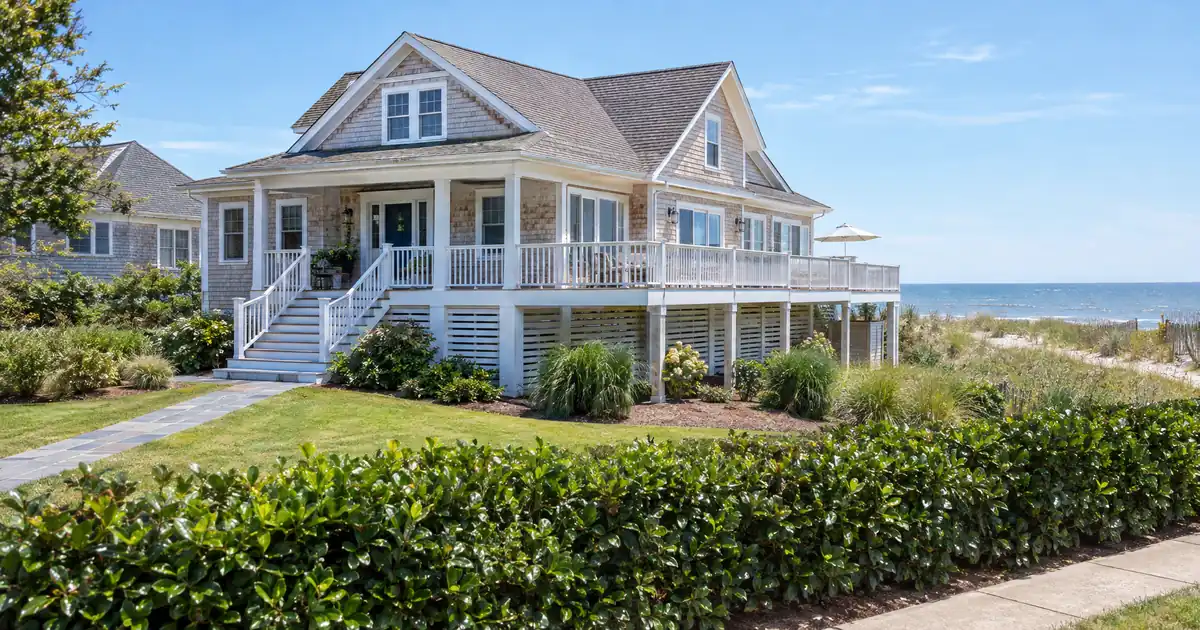
The Quick Read: Yes, through select programs in Lendmire’s network, a borrower can finance a North Carolina coastal home as a primary or second home on assets alone, with no employment or income documented. The assets are fully documented, though, and the property still has to pass review, which on the coast means insurance and flood zone.
- The asset qualifier path counts eligible assets against the whole loan, up to 80% loan-to-value on a purchase, subject to underwriting.
- The asset depletion path turns assets into income by dividing usable assets by 60 months.
- Retirement accounts count at 90% under age 59½ and 100% after that on the qualifier path.
- Wind, flood and hazard coverage all affect the monthly payment, even when no income is documented.
- Consumer mortgage lending through Lendmire is licensed in North Carolina and 15 other states.
Not a commitment to lend. Every file is underwritten individually.
Which Path Fits a Cash-Heavy, Income-Light Buyer?
Two paths exist, and a borrower is qualified on one at a time. The asset qualifier path asks whether eligible assets cover the entire loan. The asset depletion path asks whether assets, converted into monthly income, can carry the housing payment and other debts.
Picture a retiree, a business seller or someone living off a portfolio. Balances are large. Documented income is thin. That is the borrower these programs were built for.
On the qualifier path, through select programs, leverage runs up to 80% on a purchase and 75% on a refinance for a principal residence or second home. Loans reach $4,000,000. Credit starts at a 600 floor. No reserves are required at or below 75% loan-to-value, and above that the lender sets them.
On the depletion path, a principal residence or second home can go up to 80% on a purchase or rate-and-term refinance and 60% on a cash-out. Loans run from $125,000 to $3,500,000. The lender’s score matrix governs credit.
These are ceilings and floors, never offers. Our broader complete DSCR loans guide covers the investor side, which runs on a different logic.
How Do the Assets Actually Count?
Assets are counted at a percentage of balance, and the percentage differs by path. Never mix the two tables.
| Asset | Qualifier path | Depletion path |
|---|---|---|
| Brokerage / securities | 100% | 80% |
| Cash, savings, money market | 100% | 100% (cash accounts) |
| Certificates of deposit | 100% | 100% |
| 401(k) / IRA | 90% under 59½; 100% at 59½+ | 70% at any age |
| Private stock | Not published | 75% |
| Real-estate equity | Not published | 60% |
Accounts combine. Here is the shape of a qualifier-path file, illustrative only. An $800,000 loan with $330,000 in brokerage accounts (counted at 100%), $300,000 in a 401(k) under 59½ (counted at 90%, or $270,000) and $200,000 in savings (100%) counts $800,000 of usable assets. That is reviewed on assets alone, subject to underwriting.
The depletion shape works differently. $1,500,000 in securities counted at 80% is $1,200,000. Add $300,000 in cash at 100%. Usable assets total $1,500,000. Divide by 60 months and you get $25,000 of monthly qualifying income. That income then carries the housing payment and other debts through the debt-to-income test. The lender’s own calculation governs.
Some things do not count on the depletion path: custodial accounts, deferred compensation, escrow accounts, foreign funds, cash on hand, stock options, non-vested restricted stock units, and funds from non-regulated financial companies. Cryptocurrency, precious metals and collectibles are not published as eligible on either path. The documented route is converting them to a seasoned cash balance in a regulated account, with the source reviewed by the lender.
What Seasoning and Documentation Apply?
“No income documentation” never means “no documentation.” The assets are documented on both paths.
On the qualifier path, funds need 60 days of seasoning, with two months of statements for each qualifying account. On the depletion path, statements must be at least 120 days old at application, plus the most recent statement within 45 days. Funds from the sale of a business, an inheritance or a legal settlement are excused from that seasoning.
The depletion path also has asset minimums: qualified assets of at least the lesser of $1,000,000 or 1.25 times the loan balance. When assets are the only income source, liquid assets can never fall below $250,000. If asset income only supplements documented income, it can run up to a 45% debt-to-income ratio, and the minimum-assets rule is waived.
Why Is the Coast Different?
The program does not change by state. The property does. In coastal North Carolina, the borrower’s balance sheet is rarely what stops a file. Insurance and flood status are.
Beach-area homes commonly carry three separate policies: a homeowners or dwelling policy, a wind-and-hail policy, and a flood policy. A standard homeowners policy often leaves wind out on the coast. Explore Wilmington Real Estate describes this wind gap as one of the most misunderstood parts of buying near the water.
Wind coverage frequently comes from the state-created residual market, the North Carolina Insurance Underwriting Association, often called the Beach Plan. The association’s Beach Plan form lists 18 counties in the statutory Beach Area, from Brunswick, New Hanover and Onslow up through Carteret, Dare and Currituck. Some agency blogs say 20, but the association’s own form says 18. It also separates Beach and Seacoast territories.
The Beach Plan covers wind and hail only. Property People Law notes it does not cover flood. That makes flood a third line item.
Does Flood Insurance Get Required?
Often, yes, and the flood map decides it. FEMA states that homes in high-risk flood areas with mortgages from government-backed lenders are required to carry flood insurance. High-risk zones start with the letters A or V.
A private lender still reviews the flood determination. It can ask for coverage outside high-risk areas, too. The trigger is the mapped zone, not whether the home ever flooded.
Private flood policies can count. The FDIC interagency flood Q&A says regulated lenders must accept qualifying private flood insurance. Whether a given program accepts a given policy is a lender-guideline question, so get the declarations page in front of the loan team early.
How Insurance Moves Your Payment (and Your Approval)
Premiums sit inside the monthly housing payment. On the qualifier path, no income is documented, so the lender’s ability-to-repay review rests on the assets and the loan size. On the depletion path, wind, hazard and flood premiums land in the same debt-to-income test as taxes and principal. A policy that doubles can quietly push a file past the line.
Take a depletion-path borrower with $1,500,000 of usable assets, producing $25,000 of monthly qualifying income. If a coastal purchase carries heavy wind and flood premiums, the housing payment grows while the income stays fixed. The debt-to-income ratio rises, and the maximum loan can shrink.
Wind deductibles work differently. Coastal named-storm deductibles are typically a percentage of the insured dwelling value, commonly described as 1% to 5%. Harbor Insurance gives an illustration: an $800,000 insured value at a 2% deductible equals $16,000. That is not a monthly cost, so it does not enter the payment. It is cash at risk, and it argues for keeping liquid funds above the program minimum.
Treat any quote as perishable and get binding quotes for wind and flood before you go under contract.
Primary, Second Home or Rental? Occupancy Decides
The occupancy you intend decides which product applies.
| Intended use | Asset-based mortgage | DSCR loan |
|---|---|---|
| Primary residence | Yes, both paths | No |
| Second home | Yes, both paths | No |
| Investment property | Depletion path only, lower leverage | Yes, built for it |
| Short-term rental | Depends on use and program | Select programs |
On the depletion path, an investment property tops out at 65% on a purchase or rate-and-term refinance and 60% on a cash-out. The qualifier path is for principal residences and second homes only.
If you plan to live in the home or use it as a true second home, an asset-based mortgage is a consumer mortgage reviewed on you and your assets. If the plan is to rent it as a business, a DSCR loan is reviewed primarily on property-level rental income covering the payment, subject to lender guidelines. Some DSCR programs go below 1.00 coverage through select lenders, but leverage and terms adjust.
Short-term rental rules can vary by city, county, HOA, and property type, so investors should confirm local rules before relying on projected rental income. Not every lender will finance a short-term rental at all.
For assets that need to stay invested, Lendmire’s piece Do You Have to Liquidate Assets to Reserve an Asset Qualifier Mortgage? covers the mechanics.
What Can Still Sink a Coastal Asset-Based File?
Strong assets do not rescue an uninsurable or unreviewable property. Across the wholesale network, these issues cause the most trouble on coastal files:
- Wind coverage that cannot be bound, or a premium the payment cannot absorb.
- A flood zone or elevation problem that makes flood coverage costly.
- A remapping after closing. A lender may require coverage going forward if FEMA moves the property into a high-risk zone.
- Assets that look large but fail on seasoning, sourcing or eligibility. A recent transfer from an ineligible account is the classic example.
- Credit issues. Housing history of 0x30x12 is the standard, with one 30-day late in the last twelve months considered case by case. Multiple bankruptcies are not eligible, and a housing event needs four years of seasoning on the depletion path.
- Condo or HOA restrictions that limit occupancy, or an appraisal that struggles in a thin barrier-island market.
First-time investors on the depletion path need a 700 score. That matters if the coastal home is meant to be a rental.
Key Terms Defined
Asset qualifier path: A path where eligible assets, after credit percentages, must equal or exceed the entire loan amount.
Asset depletion path: A path that divides usable assets by 60 months to create monthly qualifying income.
Seasoning: The length of time funds have sat in your account before they count.
Beach Plan: The state-created residual market that supplies wind-and-hail coverage in coastal territories.
Special flood hazard area: A mapped high-risk zone, in the A and V zone families, where flood coverage is commonly required.
PITIA: Principal, interest, taxes, insurance and association dues, the full monthly housing payment.
Who Should Use This, and Who Shouldn’t?
An asset-based mortgage fits when balances are large, documented income is light, and you want the portfolio to stay invested. It is a weaker fit when you have strong traditional employment income, because a conventional or jumbo loan may serve you better. It is also the wrong tool for a pure rental purchase. That belongs with DSCR.
If you are qualifying on assets rather than income and want to see how the numbers work, Lendmire can help you compare asset-based mortgage options based on your statements, the property, credit profile, leverage, and your goals. Reach the team at 828-256-2183.
The coast’s real gatekeeper is not your portfolio. It is whether the house can be insured and what that coverage does to the monthly payment.
Frequently Asked Questions
Can I use an asset qualifier mortgage for a vacation rental?
Only if the occupancy fits. The qualifier path covers principal residences and second homes. A property rented as a business moves to DSCR, or to the depletion path at lower leverage, subject to underwriting.
Do I have to sell stocks to qualify?
No. On the qualifier path, brokerage accounts count at 100% of balance. On the depletion path, securities count at 80%. The assets stay in place and remain documented.
Does retirement money count?
Yes. On the qualifier path, 401(k) and IRA balances count at 90% under age 59½ and 100% at 59½ or older. On the depletion path, retirement accounts count at 70% at any age.
Is flood insurance required on a coastal home?
Commonly, when the flood determination places the home in a mapped high-risk zone. A lender can also ask for it outside those zones. The flood determination and the program guidelines settle it.
How is this different from a DSCR loan?
An asset-based mortgage is a consumer loan reviewed on your assets. A DSCR loan is a business-purpose investor loan that qualifies primarily on the property’s rental income covering the payment. Occupancy decides which one fits.
Lendmire’s asset-based mortgage in North Carolina page presents the program for North Carolina borrowers.
About Lendmire
Lendmire (NMLS# 2371349) is a mortgage brokerage serving self-employed and high-net-worth borrowers in 16 states. Bank statement, P&L-only, 1099-only and asset-based mortgages are arranged through wholesale lending channels; Lendmire brokers the financing and the lender underwrites each application. Scotsman Guide named Lendmire a Top Mortgage Workplace in both 2025 and 2026.
Get Started
Ready to find the right loan for you?
In about 30 seconds you can review financing options available for your home or investment property. No commitment required.
Informational only. Not a Loan Estimate, approval, or commitment to lend. Program availability and eligibility are subject to lender guidelines, credit approval, property review, and underwriting.
References
1. Explore Wilmington Real Estate – Wind & Hail guide
2. NCIUA – Beach Plan form BP16
3. Property People Law – NCIUA Beach Plan
6. Harbor Insurance – Beach Home Insurance NC
This article is part of Lendmire’s asset-based mortgage program — full qualification details, guidelines, and scenarios live on the program page.
Related reading: Asset Qualifier Mortgage vs Bank Statement Mortgage · What Counts as an Asset Statement for a Mortgage? · Asset Qualifier vs Asset Depletion for a Tech Employee
Guides: Asset-Based Mortgage in North Carolina
Brandon Miller
Founder & CEO, Mortgage Loan Originator, Lendmire LLC
- Mortgage Loan Originator · NMLS# 1129696 · Verify on NMLS Consumer Access
- North Carolina Real Estate Broker · License# 343312 · Verify on NCREC
- North Carolina Insurance Producer · License# 19053198 · Property, Casualty, Life, Health · Verify on NAIC SBS
- Lendmire LLC · Firm NMLS# 2371349 · Verify firm licensure
Important disclosures. Lendmire (NMLS# 2371349) is a licensed mortgage brokerage. Lendmire is not a direct lender, depository institution, or financial advisor. All loan inquiries are subject to lender underwriting; this article does not constitute a commitment to lend. Rates, terms, and program guidelines are subject to change without notice and vary by borrower profile, property type, and state. Information in this article is general in nature and is not financial, legal, or tax advice. Equal Housing Opportunity. NMLS Consumer Access: nmlsconsumeraccess.org.