
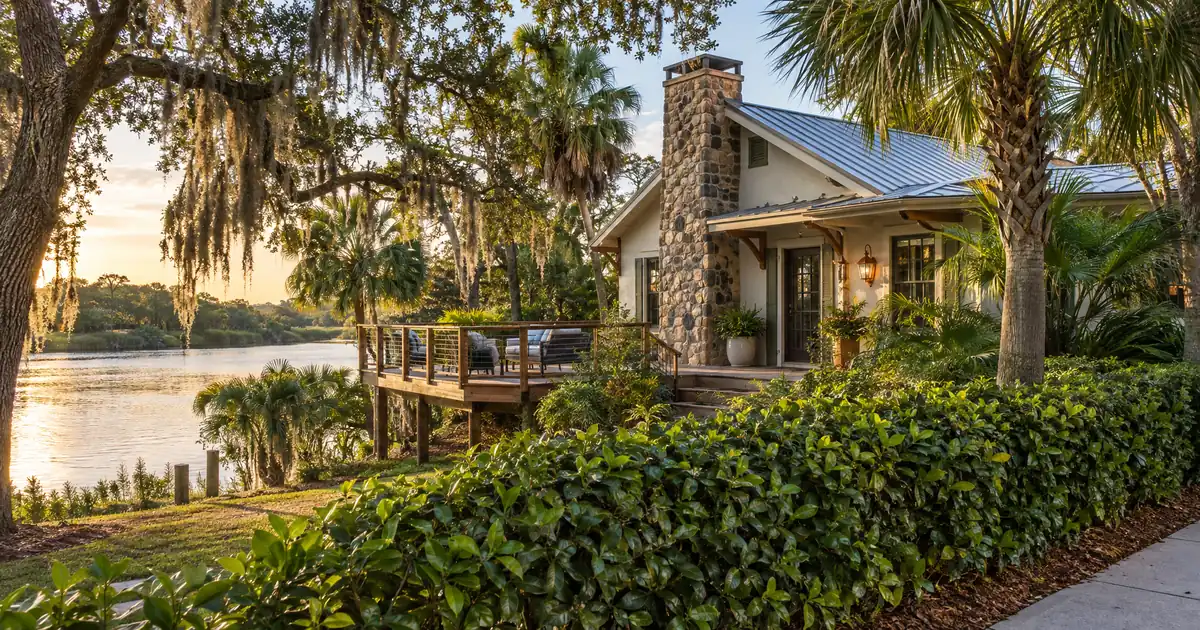
The Quick Read: Yes, when your eligible assets cover the entire loan amount and the home passes the lender’s property review, subject to underwriting and select programs in Lendmire’s network. Waterfront is not a prohibited property type. The water changes the property review, mainly flood and wind insurance, the appraisal, and the condo project if the home is a condo.
- On the asset qualifier path, eligible assets must equal or exceed the full loan, and no employment or income is documented.
- Leverage on that path runs up to 80% on a purchase and 75% on a refinance, with loans up to $4,000,000.
- Brokerage, CD, money market and savings balances count at 100%. Retirement accounts count at 90% under age 59½ and 100% after.
- Flood insurance is the most common gate on waterfront files, and it is also a cost to plan for.
- Lendmire is a broker. It arranges these loans through select lenders and does not lend or approve.
Which Path Fits a Waterfront Buyer?
Two paths exist, and a borrower is qualified on one at a time. The asset qualifier path asks one question: do your eligible assets, after the credit percentages, equal or exceed the whole loan? If yes, no income is documented. The asset depletion path turns assets into monthly income and runs that income through a debt-to-income test.
Most waterfront buyers who ask this question are retirees, business sellers, or households living on a portfolio. Balances are large. Paychecks are not. For a buyer like that, the qualifier path is usually the cleaner fit, because the loan is sized against assets rather than income.
Here is the catch. “No income documented” never means “no documentation.” Every qualifying account is documented. Across Lendmire’s wholesale network, the asset file is the file.
How Do Assets Cover the Loan on the Qualifier Path?
Each asset counts at a set share of its balance, and the total must reach the loan amount. Take a modeled loan of $800,000. Brokerage accounts of $330,000 count at 100%, or $330,000. A 401(k) of $300,000 held by a borrower under 59½ counts at 90%, or $270,000. Savings of $200,000 count at 100%. Total usable assets: $800,000. That is reviewed on assets alone. The lender’s own calculation governs.
| Asset | Qualifier path credit |
|---|---|
| Brokerage accounts | 100% |
| Certificates of deposit | 100% |
| Money market and savings | 100% |
| 401(k) and IRA, under 59½ | 90% |
| 401(k) and IRA, 59½ or older | 100% |
Accounts combine. Seasoning is 60 days, with two months of statements for each qualifying account. Credit starts at a 600 minimum score, subject to underwriting. Reserves are not required at or below 75% loan-to-value. Above that, the lender sets them.
Crypto, precious metals, collectibles, pledged funds and borrowed funds are not published as eligible. The documented route is converting them to a seasoned cash balance in a regulated account, with the source reviewed by the lender.
What Changes When the Home Is on the Water?
The loan mechanics stay the same. The collateral review gets heavier. Lenders look at flood zone, insurance, appraisal support, and, for condos, the building’s condition and finances. On most files we place, these are the items that slow a waterfront deal, not the asset math.
Waterfront also changes carrying cost. Even on the qualifier path, where income is not documented, the lender still reviews the full housing cost, and a premium surprise late in the file can change the outcome. Get real quotes early, not averages.
Is Flood Insurance Required?
Often, yes. Federal rules attach flood insurance to loans from regulated or insured lenders on buildings in a high-risk flood area. The FDIC says a lender may require flood insurance when a home sits in a designated flood hazard area. A special flood hazard area is one with a one percent or greater annual chance of flooding, per an FDIC archive document.
Two practical points. First, a lender can require coverage by contract even where the federal mandate is silent, so a favorable map does not end the question. Second, flood risk is about probability, not distance from the water. Condition of coverage on your file is set by the program and underwriting.
The flood policy itself has limits worth knowing. Many waterfront rebuild costs can run well past the limits of a standard federal policy, so excess or private flood coverage may be a separate decision. Private coverage may be available outside the federal program.
Timing matters too. Federal flood coverage normally takes effect 30 days after purchase. There is no wait when the policy is bought with a mortgage. Bind it at or before closing. Also, most homeowners policies do not cover flood damage.
Florida Insurance Adds a Second Layer
Florida’s state-created insurer has its own flood rule, and it is separate from any lender rule. Citizens Property Insurance says most new and renewing residential policies with wind coverage must carry flood insurance by January 1, 2027. The requirement phases in by rebuild cost. Condo unit-owner policies were exempted.
This is an insurer rule, not a lending rule. Private carriers are not required to ask for flood coverage. So a Citizens quote that looks cheaper can be more expensive once flood is added. Compare complete quotes, wind and flood together.
Where Do Waterfront Files Get Stuck?
Five failure points show up again and again.
1. Stale or incomplete insurance quotes. Wind and flood quotes that arrive late change the housing cost. Quote both before going under contract.
2. Asset seasoning gaps. A large deposit inside the 60-day window needs a documented source. Funds moved between accounts need both statements.
3. Down payment that drains the qualifying pool. The assets that pay the down payment cannot also count toward the loan. Size the loan against what remains.
4. Condo project issues. The unit may be fine while the building is not eligible. More on that below.
5. Appraisal gaps. Waterfront comparable sales are thin. Seawall and dock condition can also draw review.
An appraisal reconsideration with recent nearby sales and condition adjustments is a routine step, not an emergency. Build it into the plan.
What About a Waterfront Condo?
A condo changes the review from the unit to the building. Florida’s post-collapse safety law requires milestone inspections and structural reserve studies for condo and co-op buildings of three or more stories, as summarized by Thornton Tomasetti.
For your file, that means project documents, reserve funding and special assessments can decide the outcome. Dues and assessments enter the housing cost. HOA questionnaire completeness matters. Single-family and canal homes avoid the project review but carry their own seawall and dock questions.
Short-term rental rules can vary by city, county, HOA, and property type, so investors should confirm local rules before relying on projected rental income.
Which Occupancy Fits?
Principal residences and second homes are the core of the asset-based consumer program. Investment property is available only on the depletion path, at lower leverage.
| Use | Qualifier path | Depletion path |
|---|---|---|
| Principal residence | Yes, 80% purchase | Yes, 80% purchase |
| Second home | Yes, 80% purchase | Yes, 80% purchase |
| Investment property | Not offered | 65% purchase |
If the waterfront home is a pure rental, business-purpose financing is DSCR, which qualifies primarily on property-level rental income covering the payment, subject to lender guidelines. Programs below 1.00 coverage are available through select lenders in the network, though leverage and terms adjust. Lendmire’s complete DSCR loans guide covers that route.
When Does Depletion Make More Sense?
Pick depletion when your assets are large but do not equal the whole loan, or when you hold securities and want them counted as income. Depletion divides usable assets by 60 months. Cash and CDs count at 100%, securities at 80%, private stock at 75%, retirement accounts at 70% at any age, and real-estate equity at 60%.
Run a modeled case. $1,500,000 in securities counts $1,200,000 at 80%. Add $300,000 in cash at 100%. Usable assets are $1,500,000. Divided by 60 months, that is $25,000 of monthly qualifying income, which then carries the housing payment and other debts through the debt-to-income test.
Depletion has minimums. Qualified assets must be at least the lesser of $1,000,000 or 1.25 times the loan, and never below $250,000 liquid when it is the only income source. Loans run $125,000 to $3,500,000. Statements must be at least 120 days old, plus one within 45 days. Leverage on a principal residence or second home is 80% on a purchase and 60% on a cash-out, subject to underwriting. Cash-out proceeds never count as qualifying assets.
Why Finance If You Could Pay Cash?
A buyer with a large portfolio can pay cash. Many choose not to. Financing keeps balances invested and liquid, and assets are counted, not sold. On the qualifier path they still sit in your accounts. The tradeoff is real: assets used to qualify must stay seasoned and documented through the file, so plan transfers before you apply.
Key Terms Defined
- Asset qualifier: a path where eligible assets, after credit percentages, equal or exceed the whole loan and no income is documented.
- Asset depletion: a path that divides usable assets by 60 months to create qualifying income.
- Special flood hazard area: a zone with a one percent or greater annual chance of flooding.
- Seasoning: the time funds must sit in an account before they count.
- Structural reserve study: a Florida condo building review of the funding needed for major structural repairs.
Frequently Asked Questions
Do I have to sell assets to buy the home?
No. On both paths assets are counted and documented, not liquidated. Keep in mind that funds used for the down payment cannot also count toward the loan.
Can I use retirement funds?
Yes. On the qualifier path, 401(k) and IRA balances count at 90% under age 59½ and 100% at 59½ or older. On the depletion path they count at 70% at any age. Terms are subject to underwriting.
Is flood insurance required on a waterfront purchase?
Often. Lenders may require it in a flood hazard area, and the requirement can be contractual even outside one. Florida’s state-created insurer is also phasing in a flood requirement for most wind-covered policies.
Can I buy a waterfront condo this way?
Possibly. Eligibility turns on the building’s documents, reserves and assessments, not just the unit. Program condo guidelines decide.
Can I combine assets with other income?
On the depletion path, asset-derived income may supplement documented income up to a 45% debt-to-income ratio, and the minimum-assets rule is waived when it does. A borrower is on one path at a time.
If you are qualifying on assets rather than income and want to see how the numbers work, Lendmire can help you compare asset-based mortgage options based on your statements, the property, credit profile, leverage, and your goals. Program terms change, every file is underwritten individually, and nothing here is a commitment to lend. Tax treatment varies; consult a qualified professional.
Lendmire’s asset-based mortgage in Florida page presents the program for Florida borrowers.
About Lendmire
Lendmire, NMLS# 2371349, is a mortgage brokerage with consumer lending licenses in 16 states. Bank statement, P&L-only, 1099-only and asset-based mortgages are arranged through wholesale lending partners for borrowers whose tax returns understate their income, and each application is reviewed individually by the lender. Scotsman Guide named Lendmire a Top Mortgage Workplace in both 2025 and 2026.
Get Started
Ready to find the right loan for you?
In about 30 seconds you can review financing options available for your home or investment property. No commitment required.
Informational only. Not a Loan Estimate, approval, or commitment to lend. Program availability and eligibility are subject to lender guidelines, credit approval, property review, and underwriting.
References
2. FDIC archive – flood regulation text
3. Citizens Property Insurance – Flood
4. Thornton Tomasetti – Florida SB 4-D
This article is part of Lendmire’s asset-based mortgage program — full qualification details, guidelines, and scenarios live on the program page.
Related reading: How a Margin Balance Is Treated on an Asset Depletion Mortgage · Does Real Estate Equity Count on an Asset Qualifier Mortgage? · Asset Qualifier vs Asset Depletion for a Snowbird
Guides: Asset-Based Mortgage in Florida
Brandon Miller
Founder & CEO, Mortgage Loan Originator, Lendmire LLC
- Mortgage Loan Originator · NMLS# 1129696 · Verify on NMLS Consumer Access
- North Carolina Real Estate Broker · License# 343312 · Verify on NCREC
- North Carolina Insurance Producer · License# 19053198 · Property, Casualty, Life, Health · Verify on NAIC SBS
- Lendmire LLC · Firm NMLS# 2371349 · Verify firm licensure
Compliance and disclosures. Lendmire (NMLS# 2371349) is a licensed mortgage broker and is not a direct lender, depository institution, financial advisor, or tax professional. Content in this article is general market analysis and educational information — not financial, legal, or tax advice for any specific situation. Lendmire does not guarantee loan approval; every transaction is subject to underwriting by the funding lender. Mortgage pricing and loan program guidelines are subject to change at any time without notice and vary by borrower characteristics, property type, and state regulations. Lendmire complies with Equal Housing Opportunity. Licensure verification: NMLS Consumer Access.