
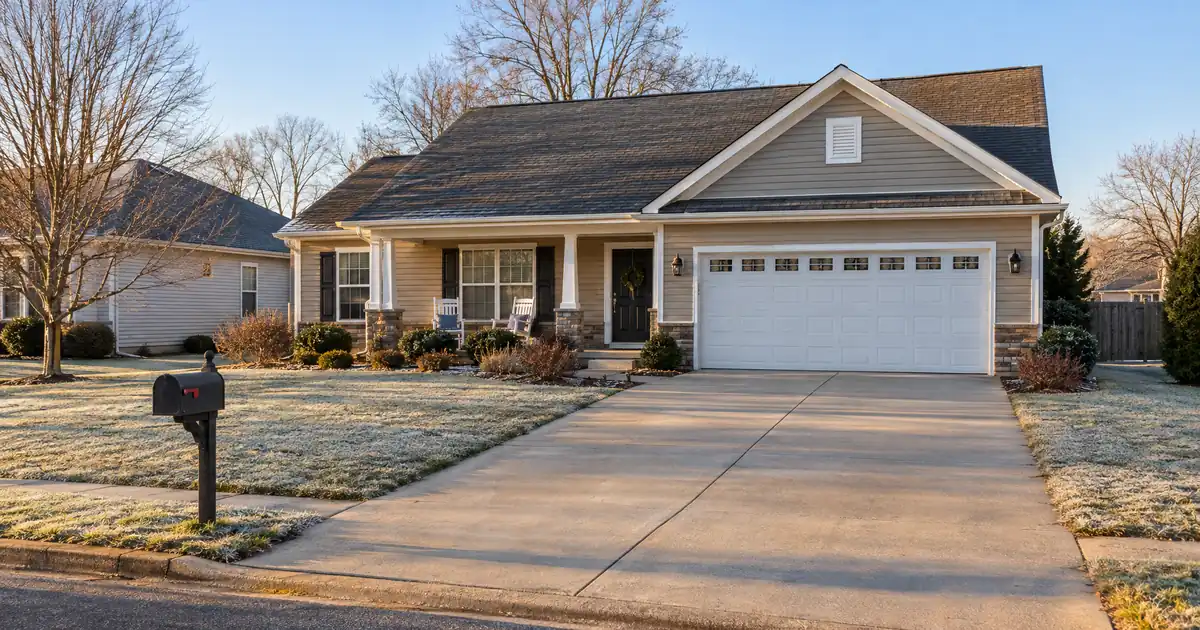
The Quick Read: The VA appraisal does two jobs at once. It estimates the home’s market value, and it checks that the property meets VA’s Minimum Property Requirements. It is not a home inspection. An active-duty buyer on the purchase path should expect both tests to be passed before VA guarantees the loan.
What Is a VA Appraisal, and Why Does It Exist?
A VA appraisal is a value opinion plus a safety-and-soundness screen, ordered through the lender and performed by a VA-assigned fee appraiser. The VA Lenders Handbook, Chapter 12 on Minimum Property Requirements says MPRs exist to protect Veterans, lenders, servicers and VA, and that a property must meet them before VA guarantees the loan. A Federal Register notice on VA’s minimum property requirements adds that these standards are a legal requirement. They also work as a safeguard by exposing defects that could affect value.
VA payment estimate
Starting assumptions reflect an example price with no down payment and a first-use funding fee. Replace them with your own figures.
Editable benchmark: 7.32% as of October 22, 2026 · Freddie Mac 30-year average via FRED®. A conventional market reference, not a VA loan quote.
Illustrative starting assumptions: a $350,000 price, no down payment with full entitlement, a first-use funding fee financed into the loan, a thirty-year term at the current Freddie Mac benchmark, and property taxes and insurance estimated at typical national rates. Every field is editable.
Illustrative estimate only — not a Loan Estimate, approval, quote, or commitment to lend. The rate field carries the weekly Freddie Mac thirty-year conventional benchmark, a market reference and not a VA loan quote; your rate is set by the lender at lock. The funding fee follows VA’s published table for the use and down payment entered; the residual-income figure is VA’s guideline for the region and family size, and the rough residual shown subtracts only the housing payment and the debts entered, while VA also deducts taxes, maintenance and utilities. Taxes, insurance and dues are editable estimates; closing costs are not included. Licensed in sixteen states for consumer mortgages. Lendmire is not affiliated with or acting on behalf of the Department of Veterans Affairs.
The value side matters because the program’s headline benefit depends on it. Across the wholesale programs Lendmire places VA loans with, a purchase can reach 100% financing with no down payment, no mortgage insurance, and no VA loan limit with full entitlement. That holds as long as the price is not above the appraised value. The appraisal is the checkpoint that decides whether the contract price clears that line. Every figure here is subject to lender guidelines and full file review, and nothing here is a commitment to lend.
Purchases and cash-out refinances use an appraisal. A first-time active-duty buyer is on the purchase path, so the appraisal applies. The streamlined refinance (the VA streamline refinance) is a different loan and skips the VA appraisal.
Key Terms Defined
Minimum Property Requirements: VA’s standards that a home be safe, structurally sound and sanitary before the loan can be guaranteed.
Notice of Value (NOV): The document stating VA’s reasonable value for the home and any repairs required.
Tidewater: The step where the appraiser tells the requester a value below the sales price is coming, so comparable sales can be submitted before the value is final.
Reconsideration of Value (ROV): A written request, after the NOV, asking VA to take another look at the value.
Certificate of Eligibility (COE): VA’s document confirming you qualify for the benefit.
Residual income: What remains of your monthly income after the mortgage and your other obligations.
How the Process Works, Step by Step
The sequence below runs from eligibility to guaranty. Some details of the appraisal stage come from summaries of the VA Handbook rather than the primary chapters, so confirm them on VA’s KnowVA site.
1. Confirm eligibility and get your COE. For active duty, VA accepts a current statement of service signed by the adjutant, personnel office or commander. Per the VA Home Loan Guaranty Buyer’s Guide, you must be currently on active duty and have served at least 90 continuous days.
2. Sign a purchase contract. Write the contract with the appraisal in mind (see the contract section below).
3. The lender orders the appraisal. VA assigns a fee appraiser. You do not pick one.
4. The appraiser values the home. The method is sales comparison: recent closed sales of similar homes nearby.
5. The appraiser checks MPRs. The appraisal is written “subject to” any required repairs, and the repairs’ contributory value is included in the estimated value.
6. Tidewater, if value looks short. If the appraiser expects a value below the sales price, the requester is notified first. Summaries of the Handbook describe a two-business-day window to submit additional comps. Verify that against the Handbook.
7. The NOV is issued. It states VA’s reasonable value and any required repairs.
8. Reconsideration, if needed. Summaries of the Handbook describe a written request, a VA staff review within five business days and an optional field review. Treat those day counts as unverified.
9. Repairs, re-inspection, guaranty. MPRs must be satisfied before the guaranty issues.
10. You receive a copy of the appraisal. More on that below.
Early in the process, a good loan officer will map this sequence against your orders. The VA loan programs Lendmire arranges follow it step for step.
What Do the Minimum Property Requirements Actually Check?
MPRs ask whether the home is safe, structurally sound and sanitary. In practice, the appraiser looks at visible conditions, not hidden ones.
| Area | What the appraiser looks for | Typical red flag |
|---|---|---|
| Roof | Keeps moisture out, reasonable future utility | Active leaks, failed surface |
| Site | Drainage away from the dwelling | Water pooling at the foundation |
| Legal | Zoning compliance, legal access, utilities | No legal road access |
| Health and safety | No hazards to occupants | Exposed wiring, hazardous conditions |
| Marketability | One readily marketable property | Parcel that can’t be sold as a unit |
The Handbook also says the appraiser should not recommend repairs for cosmetic items, minor deferred maintenance or normal wear and tear. Scuffed paint and worn carpet are not MPR failures.
One note on lender behavior. Some lenders add their own rules on top of VA’s, such as roof-life minimums. Those are lender overlays, not VA requirements, and they vary from one lender to the next.
Appraisal vs. Home Inspection
The two are not interchangeable, and it helps to keep them distinct.
| Factor | VA appraisal | Home inspection |
|---|---|---|
| Main purpose | Value and MPR compliance | Condition of the home |
| Who it protects | Lender, VA, buyer | Buyer |
| Tests systems and appliances | No | Yes |
| Who orders it | Lender, through VA | You |
Appraisers also may not make an appraisal subject to inspections. For a condition that doesn’t appear to meet MPRs, they recommend repairs, not inspections. The NOV itself suggests the buyer may wish to get a home inspection.
Hire an inspector. An appraisal that passes tells you the home met VA’s minimum standard. It does not tell you the furnace works.
Where the General Rule Breaks
Several situations change how the appraisal plays out.
Dual-use property. A home with some non-residential use can still be eligible if it is primarily residential, the other use doesn’t impair that character, there is no more than one business unit, and zoning is conforming or legally non-conforming.
Legal non-conforming zoning. The appraiser must label it and comment on marketability, including whether the dwelling could be legally rebuilt.
Acreage. VA itself sets no limit on acres. A lender may set its own cap.
Non-vented heaters. The older Handbook text conditions the NOV on the Veteran’s written acknowledgment and a contractor certification.
Hazard zones. Coastal barrier, subsidence and topographic hazards have their own MPR rules.
Chapter 12 revisions. KnowVA labels the current Chapter 12 as effective after a May revision. Read the primary page before relying on any older checklist, including this one.
Occupancy. Active duty doesn’t change the owner-occupancy rule. The eligibility page says the home must be for your own personal occupancy. A purchase for a rental or second home doesn’t fit this program. You must certify intent to occupy. Some lenders treat deployment or spousal occupancy differently, so ask before you rely on either.
Reading the Result: Value, Repairs and Your Options
Two outcomes can slow the file: value below the contract price, or required repairs. They behave differently.
Value comes in low. The Buyer’s Guide lists the options: request a reconsideration of value, renegotiate the price, or bring cash to closing to cover the gap. Walking away under an appraisal contingency is the fourth path, if your contract preserves it. VA’s route to challenge a value is submitting comps through Tidewater or ROV, not ordering a second appraisal. Lendmire’s piece Does a VA Loan Fall Through More for a First-Time Active-Duty Buyer? covers the wider deal-risk picture.
Repairs are required. MPR repairs must be completed and verified before the guaranty issues. The seller may do them, or the parties may negotiate. A failed MPR can hold up the guaranty until it is fixed.
Two scenarios show the difference. In the first, a home appraises below the contract price. The buyer submits comps during Tidewater, the value moves a little but not fully, and the parties split the remaining gap through a price reduction. In the second, an older home appraises at price but the report requires a roof repair. The seller completes it, the repair is verified, and the deal works on. Both are illustrations, not predictions.
Value also interacts with qualification. The loan amount is capped by value, and VA’s residual income test still has to be met. Residual income is the controlling test. The 41% debt-to-income figure is a guideline rather than a cap. A ratio above it needs residual income well above the table.
Protecting Yourself in the Contract
Write the appraisal into the purchase agreement. Ask your agent to include a VA-specific clause that lets you cancel without losing earnest money if the home appraises below the price or fails to meet MPRs and the seller won’t fix it. Ask for a repair deadline, and for a plan if the seller refuses.
Keep the offer attractive. Sellers worry about VA appraisals more than they should. A clean pre-offer screen helps: check the roof, look for drainage problems, and notice obvious safety hazards at showings. Homes with visible problems are more likely to stall.
Buying on Orders
Orders compress your calendar. Tell your loan officer your report date at the start. Ask about your options if you can’t attend the appraisal in person, and ask what a power of attorney can and can’t do on your lender’s side. Under Regulation B, a lender must send written notice of your right to a copy of all appraisals promptly after receiving your application. The CFPB’s Regulation B § 1002.14 sets that rule. Delivery is due promptly upon completion of the appraisal or before closing, whichever is earlier, and the Federal Register’s ECOA valuations rule notes that applicants may waive the timing requirement. Don’t waive it casually. Read your copy.
What the Funding Fee and Credit Floor Mean Here
Two program facts sit next to the appraisal. VA sets no minimum credit score, and the wholesale programs Lendmire places VA loans with start at a 580 decision score, subject to lender guidelines. The funding fee runs from 1.25% to 3.3% depending on use and down payment: for first use, 2.15% with less than five percent down, 1.5% with five to under ten percent down, and 1.25% with ten percent or more down. The fee is waived for veterans receiving compensation for a service-connected disability and other exempt groups. If the value comes in low, the mechanics of these fees don’t change, but your price and loan amount might.
Frequently Asked Questions
Can I order a second VA appraisal if the first one is low?
Generally no. The answer is to submit comparable sales through Tidewater or request a reconsideration of value. Confirm the current rule with your loan officer and KnowVA.
Does the VA appraiser test the furnace, appliances and plumbing?
No. The appraiser notes readily apparent problems but does not run mechanical systems or appliances. A home inspection is how you find those problems.
Who pays for repairs the appraisal requires?
It is negotiated. The seller may complete them, or the parties may agree on a price change or another arrangement. The repairs must be done and verified before the guaranty issues.
Do I get to see the appraisal?
Yes. Regulation B gives applicants the right to a copy of the appraisal, and lenders must notify you of that right after you apply.
Can an active-duty buyer use a VA loan for a rental or second home?
No. The home must be for your own personal occupancy, so occupancy decides which financing fits.
If you are buying a home and want to see whether a VA loan fits your file, Lendmire can help you compare the options and what each one asks of the file.
For your own numbers, request a scenario review with Lendmire.
About Lendmire
As a mortgage broker (NMLS# 2371349), Lendmire helps homeowners and home buyers in 16 states with FHA, VA, conventional and jumbo purchase and refinance loans arranged through wholesale lenders. Lendmire is never the lender; program terms are set by the lender and the agency guidelines. Scotsman Guide named Lendmire a Top Mortgage Workplace in both 2025 and 2026.
Get Started
Ready to find the right loan for you?
In about 30 seconds you can review financing options available for your home or investment property. No commitment required.
Informational only. Not a Loan Estimate, approval, or commitment to lend. Program availability and eligibility are subject to lender guidelines, credit approval, property review, and underwriting.
References
1. VA Lenders Handbook (VAP26-7), Chapter 12: Minimum Property Requirements Overview
2. Federal Register, Minimum Property Requirements for VA-Guaranteed and Direct Loans
3. VA Home Loan Guaranty Buyer’s Guide
4. CFPB Regulation B § 1002.14
5. Federal Register, ECOA Valuations final rule
This article is part of Lendmire’s VA loan program — full qualification details, guidelines, and scenarios live on the program page.
Related reading: Can an Active-Duty First-Time VA Loan Buyer Get Repairs Fixed? · Can a First-Time VA Borrower on Active Duty Skip the IRRRL Appraisal? · VA Loan Appraisal and Minimum Property Requirements for a New Build
Brandon Miller
Founder & CEO, Mortgage Loan Originator, Lendmire LLC
- Mortgage Loan Originator · NMLS# 1129696 · Verify on NMLS Consumer Access
- North Carolina Real Estate Broker · License# 343312 · Verify on NCREC
- North Carolina Insurance Producer · License# 19053198 · Property, Casualty, Life, Health · Verify on NAIC SBS
- Lendmire LLC · Firm NMLS# 2371349 · Verify firm licensure
Required disclosures. Lendmire (NMLS# 2371349) operates as a licensed mortgage broker, not a direct lender or depository. The discussion in this article is general in nature and should not be relied upon as financial, legal, or tax advice — every investment scenario is unique and should be reviewed by a qualified professional. Any loan inquiry is subject to lender underwriting, and this article is not a commitment to lend or a guarantee of approval. Mortgage rates, loan terms, and program guidelines vary by borrower, property, and state, and may change without notice. Equal Housing Opportunity. Verify licensure at NMLS Consumer Access.