
The Quick Read: Yes, in most cases, as long as the home is genuinely yours to occupy. Deployment does not disqualify you. VA cares about your intent to live there and about who actually occupies it, not whether you are standing there at closing. A spouse or dependent child can satisfy occupancy while you are away. Rent from the other units helps you qualify only if you meet extra conditions.
What Does “House Hacking” Mean on a VA Loan?
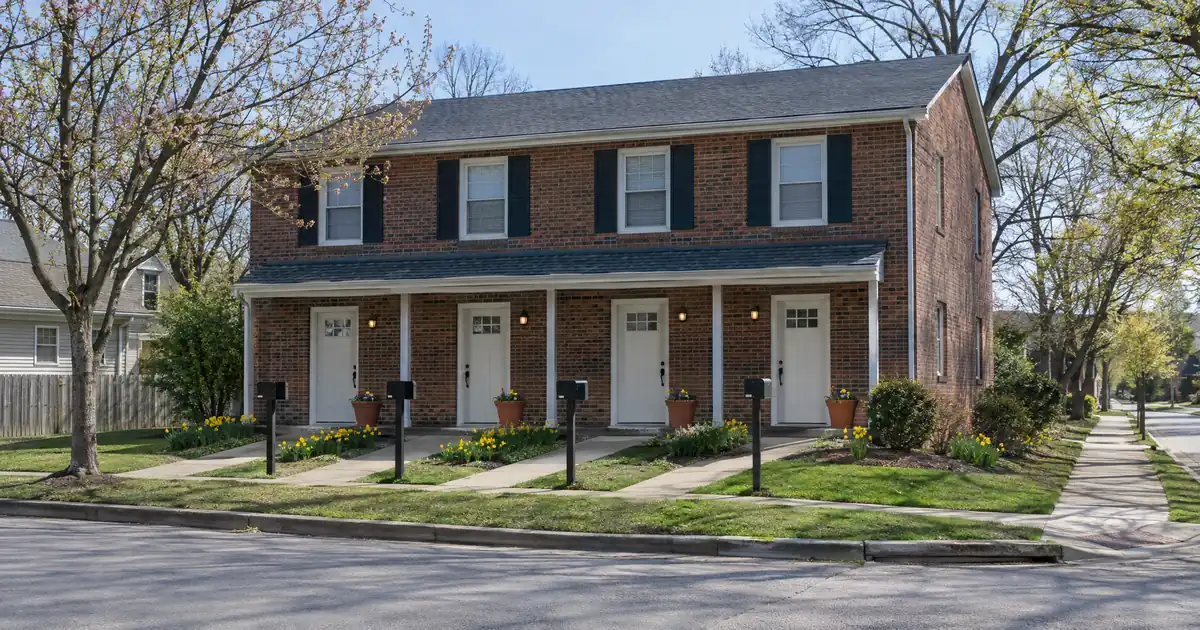
House hacking means you live in one unit and rent the others. The rent offsets your housing cost. On a VA loan, that works for buildings of two to four units. A fifth unit puts the building outside the program.
VA payment estimate
Starting assumptions reflect an example price with no down payment and a first-use funding fee. Replace them with your own figures.
Editable benchmark: 7.32% as of October 22, 2026 · Freddie Mac 30-year average via FRED®. A conventional market reference, not a VA loan quote.
Illustrative starting assumptions: a $350,000 price, no down payment with full entitlement, a first-use funding fee financed into the loan, a thirty-year term at the current Freddie Mac benchmark, and property taxes and insurance estimated at typical national rates. Every field is editable.
Illustrative estimate only — not a Loan Estimate, approval, quote, or commitment to lend. The rate field carries the weekly Freddie Mac thirty-year conventional benchmark, a market reference and not a VA loan quote; your rate is set by the lender at lock. The funding fee follows VA’s published table for the use and down payment entered; the residual-income figure is VA’s guideline for the region and family size, and the rough residual shown subtracts only the housing payment and the debts entered, while VA also deducts taxes, maintenance and utilities. Taxes, insurance and dues are editable estimates; closing costs are not included. Licensed in sixteen states for consumer mortgages. Lendmire is not affiliated with or acting on behalf of the Department of Veterans Affairs.
The key point is that a VA loan is a home loan, not an investment loan. It cannot buy a pure rental. You are buying a place to live that happens to produce rent.
The program is generous for this. With full entitlement (the amount of VA guaranty you have available), the loan can be 100% financing, with no down payment as long as the price is not above the appraised value. There is no mortgage insurance of any kind. There is also no VA loan limit with full entitlement. If you have only partial entitlement left, a down payment may be required, so speak with a loan officer about your situation.
VA sets no minimum credit score. The wholesale lenders Lendmire works with start at a 580 decision score, and each file gets a full review. You can read more about VA loan programs on Lendmire’s site.
Residual income is the controlling test. That is the money left each month after your debts and living costs. A 41% debt-to-income ratio is a guideline, not a cap. A higher ratio just needs residual income well above the table.
Rent from the other units can help you qualify, but it is not automatic. That is covered below.
Who Can Occupy the Home While You Are Deployed?
Someone has to occupy the home, or you must have a documented plan to. The answer depends on your situation. Here is how it breaks down on the files we arrange.
| Your situation | Who satisfies occupancy | What the lender wants |
|---|---|---|
| Married, spouse home | You (intent) and spouse | Occupancy certification, orders |
| Married, spouse also away | Depends on the plan | Written plan and a firm move-in event |
| Single with a dependent child | Dependent child, in many files | Extra certification from the lender |
| Single, no dependents | You, by intent to occupy | Orders showing temporary duty |
| Dual-military couple | Whoever returns first | Dates for each member’s return |
Two points stand out. First, lenders do not always agree on whether a spouse must physically move in on day one. Some accept the spouse’s intent to occupy. Others want move-in proof. Ask early.
Second, a single member with no dependents has the least room. The plan has to be believable: a deployment that ends, then a move-in.
Deployment is generally treated as temporary duty away from your permanent duty station. You are still the occupant in intent. Your lender will want your orders to show it.
How Do You Buy While Deployed? Step by Step
Here is the sequence, with your role at each stage.
1. Get your certificate of eligibility. The COE comes from VA and shows your entitlement. Active-duty status shows on the request.
2. Pick the “home” unit. Decide which unit is yours. Decide who occupies it and when.
3. Get pre-approved. The lender reviews credit, residual income and your reserves. Tell the loan officer about the deployment up front.
4. Make the offer and inspect. A trusted person can attend the inspection. You can review the report remotely.
5. Appraisal. VA sets the value on the appraisal, and the property must meet VA’s minimum property standards. The appraiser’s opinion of fair monthly rent also feeds the income math when no lease history exists.
6. Sign the occupancy certification. You certify intent to occupy at closing.
7. Close. Signing by power of attorney is up to the lender and the title company. Ask both before you rely on it.
8. Move-in and tenants. Your spouse or dependent moves in, or you do on return. Tenants take the other units.
What Does VA Actually Say About Occupancy?
Now the rulebook. Per the VA Lenders Handbook’s occupancy rules (a text reproduction of VA Pamphlet 26-7, Chapter 3, Topic 5), you certify that you intend to personally occupy the property as your home. You either live there already or plan to move in within a reasonable time after closing. You make that certification on VA Form 26-1802a.
For an active-duty veteran who cannot occupy within a reasonable time, the same text says a spouse or dependent child’s occupancy, or intent to occupy, satisfies the requirement. This is the basis for the spouse answer above.
Delayed occupancy is allowed with conditions. More than 60 days can be reasonable only if you certify a specific future move-in date and a particular future event makes it possible. A deployment ending is the classic example. Waiting a long time with no event is not.
The handbook text we reviewed sets no fixed minimum stay. That does not mean occupancy can be loose. Intent must be real at closing. Lenders may add their own expectations, which are not VA rules.
One exception to know about: an IRRRL, VA’s streamlined refinance of an existing VA loan, only requires that you previously occupied the home. That matters if you later refinance your house hack after the deployment.
Does the Rent Help You Qualify?
Sometimes. This is the step that decides most deployed-buyer files.
Per Chapter 4 of the VA Lenders Handbook, projected rent from the other units counts as income only when two things are true:
- You have a reasonable likelihood of success as a landlord.
- You have cash reserves equal to at least six months of the full mortgage payment (principal, interest, taxes and insurance).
The reserve rules are strict. Equity cannot count as reserves. Gift funds cannot count. Cash-out refinance proceeds cannot count. The money must be yours and sit in your account before closing. If each unit carries its own mortgage, reserves are verified per unit.
Landlord experience is documented with a track record of managing rentals, a property management company, or both. The handbook says “the borrower,” so ask your underwriter whether a spouse’s experience counts. Do not assume.
Only part of the rent counts. VA’s home loan training materials describe using 75% of prior rents collected or of the appraiser’s fair rent opinion. The other 25% covers vacancy and upkeep. That training deck is older, so treat it as background and confirm the current treatment with your lender.
If you cannot meet the reserve and experience conditions, the lender cannot use the rent. You may still buy if you qualify without it. That is lender-dependent, so ask.
What Cash Does a “No Down Payment” Loan Still Need?
Plan for more than zero. Three things take cash or add to the loan.
Reserves. The six-month reserve requirement for using rent is the big one. For a no-down-payment buyer, it can exceed what a down payment would have been. The rent itself does not count toward it. Terms depend on the lender’s guidelines, the property type, the leverage, and a full review of the credit profile.
The funding fee. This is VA’s one-time fee. It can be financed. Veterans receiving compensation for a service-connected disability, and other exempt groups, are exempt from the fee. Whether the fee applies and how it is structured depends on the loan program and the lender’s guidelines.
Your vacancy cushion. The underwriting credit is discounted, but real life is not. A vacant unit, a broken water heater, a tenant who stops paying: those hit you while you are overseas. Test your budget with one unit empty.
Two Scenarios
Run the logic on these two hypothetical borrowers. No dollar figures are needed.
The married sergeant. She is deployed at closing and buys a fourplex at 100% financing. Her husband moves into the home unit and certifies occupancy. She has years of rental management in her past and holds the six months of reserves in her own savings. The lender counts a discounted share of projected rent. The file turns on her reserves and a clean occupancy plan. Whether his intent alone suffices depends on the lender’s overlay.
The single airman on temporary duty. He buys a duplex before a long temporary assignment. His orders show an end date, and he certifies a specific move-in date tied to returning. He has no landlord history, so he hires a property manager. If he cannot show the reserves, the lender may refuse to count the rent. He then has to qualify on his own income, using the residual income test. This file is thinner. It is not dead, but it is less forgiving.
What Happens When Plans Change?
Orders change. Deployments get extended. Here is how to think about it.
- Extension before closing. Tell the lender. Your move-in date may need to shift, and the delayed-occupancy conditions apply.
- Early return. You move in sooner. That helps, not hurts.
- PCS after you’ve lived there. You can often keep the property and rent your unit, since you met occupancy at the start. Still, buying with the plan to leave right away is a problem.
- Retirement. A veteran retiring within about a year can buy near the retirement location, with the lender verifying retirement eligibility.
- Your entitlement. The house uses some of it. Whatever remains affects your next VA purchase. Ask a loan officer how much stays available.
Where House Hackers Go Wrong
Misstating your plans. Certifying occupancy you do not intend is fraud. Tell your lender your real plans, including the deployment. Honest timing can be documented. A false certification cannot be fixed.
Counting on all the rent. Only part of the rent counts, and only after the reserve and experience tests.
Using gift money for reserves. It does not count. Neither does equity.
Assuming lender rules are VA rules. Some lenders ask for more reserves or experience than VA does. That is a lender overlay, not the program. A different lender may handle the same file differently.
Skipping the paperwork conversation. Ask early about power of attorney, remote signing and who can sign what. Also ask your installation’s legal assistance office. Tax treatment can depend on your situation. Borrowers should speak with a qualified tax professional before relying on any deduction or credit.
A friend who is self-employed on the side? Lendmire’s piece How to Qualify for a House-Hack Loan for a 1099 Contractor on a 2-4 Unit covers a different income path, though it is not a VA program.
Key Terms Defined
Entitlement: the amount of VA guaranty you have available. It determines whether you can borrow with no down payment.
Certificate of Eligibility (COE): the VA document confirming you qualify for the program and showing your entitlement.
Residual income: the money left each month after debts and living costs. It is VA’s controlling test.
Reserves: your own cash on hand after closing. For using rent, VA looks for six months of the full payment.
Funding fee: VA’s one-time fee. It can be financed and is waived for exempt veterans.
Notice of Value (NOV): the document that sets the property’s reasonable value from the appraisal.
Frequently Asked Questions
Can my spouse satisfy the occupancy rule while I’m deployed?
Yes, in most cases. A spouse’s occupancy, or intent to occupy, can satisfy the requirement for an active-duty veteran who cannot occupy in a reasonable time. Lenders differ on documentation. Some want the spouse to move in at closing, so confirm yours before you write an offer.
Can a single service member with no dependents do this?
Often yes, but the plan matters more. You certify your intent to occupy and document when you will. Your orders showing the end of the duty help. A specific move-in date tied to a specific event is what makes a delay reasonable. A vague “someday” does not.
Do I have to live in every unit?
No. You occupy one unit as your home. The others can be rented. Remember that the rent counts toward qualifying only if you meet the landlord and reserve tests.
What if my deployment gets extended after I’m under contract?
Tell your lender right away. Delayed occupancy can be reasonable past 60 days, but only with a certified move-in date and a specific event that makes it possible. A new end date may need a new certification.
Can I use a VA loan to buy a pure rental while deployed?
No. The loan requires you to occupy the home. A building with five or more units is also outside the program. Occupancy decides the leverage, so a non-owner-occupied purchase is a different loan.
Next Step
If you are buying a home and want to see whether a VA loan fits your file, Lendmire can help you compare the options and what each one asks of the file. Program details are subject to lender guidelines and full file review, and nothing here is a commitment to lend. Mention your deployment dates and who will occupy the home on your first call. Those two facts shape everything else.
For your own numbers, request a scenario review with Lendmire.
About Lendmire
Lendmire (NMLS# 2371349) is a mortgage brokerage serving homeowners and home buyers in 16 states. FHA, VA, conventional and jumbo purchase and refinance loans are arranged through wholesale lending channels; Lendmire brokers the financing and the lender underwrites each application. Scotsman Guide named Lendmire a Top Mortgage Workplace in both 2025 and 2026.
Get Started
Ready to find the right loan for you?
In about 30 seconds you can review financing options available for your home or investment property. No commitment required.
Informational only. Not a Loan Estimate, approval, or commitment to lend. Program availability and eligibility are subject to lender guidelines, credit approval, property review, and underwriting.
References
1. VA Pamphlet 26-7, Chapter 3, Topic 5, Occupancy (text reproduction)
2. VA Lenders Handbook (VA Pamphlet 26-7), Chapter 4, Credit Underwriting
3. VA Home Loan Guaranty training deck (benefits.va.gov)
This article is part of Lendmire’s VA loan program — full qualification details, guidelines, and scenarios live on the program page.
Related reading: How to Clear a Private Second With a VA Cash-Out on Your VA Loan · VA Cash-Out Lender Questions for Veterans With an Existing VA Loan · Can You Remodel With a VA Cash-Out on an Existing VA Loan?
Brandon Miller
Founder & CEO, Mortgage Loan Originator, Lendmire LLC
- Mortgage Loan Originator · NMLS# 1129696 · Verify on NMLS Consumer Access
- North Carolina Real Estate Broker · License# 343312 · Verify on NCREC
- North Carolina Insurance Producer · License# 19053198 · Property, Casualty, Life, Health · Verify on NAIC SBS
- Lendmire LLC · Firm NMLS# 2371349 · Verify firm licensure
Disclosures. The information presented in this article is general market commentary, not financial, legal, or tax advice. Lendmire is a mortgage brokerage (NMLS# 2371349) — not a direct lender or depository institution — and loan placement is subject to lender underwriting. Nothing in this content represents a commitment to lend. Loan terms, pricing, and program availability vary based on borrower qualifications, property characteristics, and state of subject property, and are subject to change at any time. Lendmire complies with Equal Housing Opportunity requirements. Consumer access: nmlsconsumeraccess.org.