
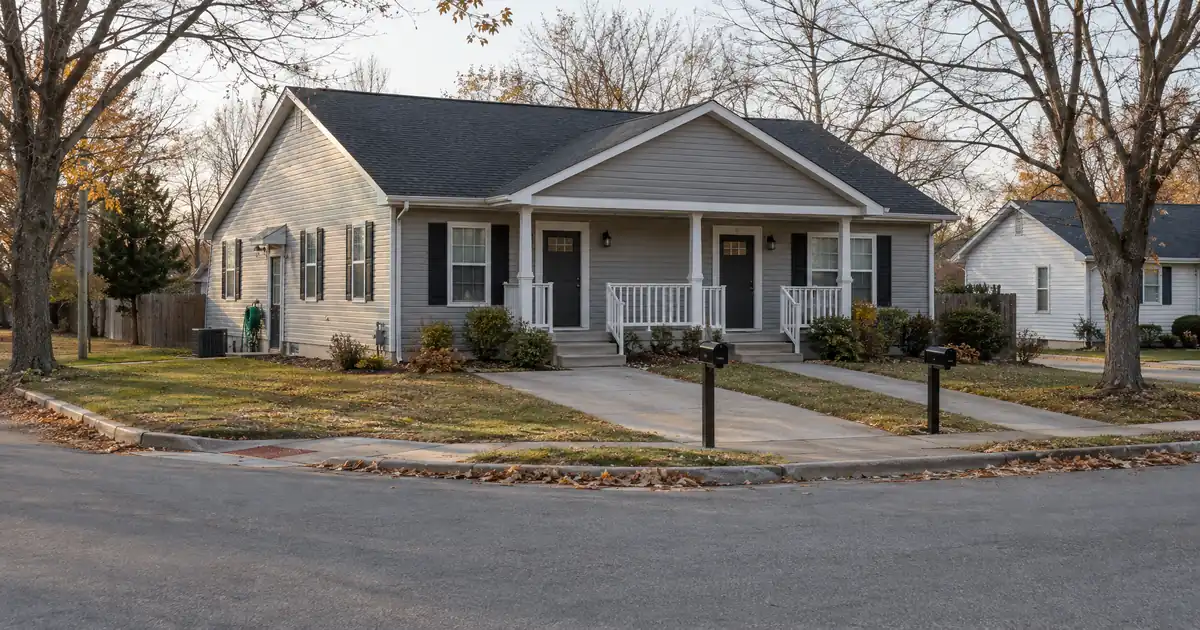
The Quick Read: It can be worth it, but only when three things line up. You must be able to leave FHA insurance, which usually means moving to a conventional loan. The savings from dropping mortgage insurance premium (MIP) must outlast your closing costs. And your building must clear conventional equity, credit, and occupancy rules. Refinancing into another FHA loan does not remove MIP. It restarts it.
Why Is MIP the Problem on a 2–4 Unit?
MIP is the insurance FHA charges on every loan. It comes in two parts: an upfront premium of 1.75% of the base loan, usually financed, and an annual premium that is billed monthly. Across the wholesale programs Lendmire places FHA files with, the annual premium runs between 0.15% and 0.75% of the balance. The exact level depends on term, loan amount, and loan-to-value (LTV), which is your loan balance as a percentage of the home’s value.
Refinance savings and break-even estimate
The starting figures are an example value with a balance in proportion and a placeholder for costs. Replace them with yours, and enter the current rate from your statement.
Editable benchmark: 7.32% as of October 22, 2026 · Freddie Mac 30-year average via FRED®. A conventional market reference, not a refinance quote.
Illustrative starting assumptions: a $350,000 home value, a $245,000 current balance, a current rate you enter and a remaining term seeded at twenty-five years, closing costs seeded at $5,000 as an editable placeholder (not a fee quote) and rolled into the new loan, a thirty-year term at the current Freddie Mac benchmark, and property taxes and insurance estimated at typical national rates. Every field is editable.
Illustrative estimate only — not a Loan Estimate, approval, quote, or commitment to lend. The new rate field carries the weekly Freddie Mac thirty-year conventional benchmark, a market reference and not a refinance quote; a refinance is priced by the lender at lock, and the current rate, the remaining term and the closing costs are figures you enter. The current payment is estimated from the balance, the current rate and the remaining term; the break-even divides the closing costs by the monthly saving and ignores the interest effect of a longer term. On the VA IRRRL the funding fee is added to the loan unless the veteran is exempt. Taxes and insurance are editable estimates. Licensed in sixteen states for consumer mortgages; Lendmire is a broker, never the lender.
Duration is what hurts. On a thirty-year loan above 90% LTV, the annual premium lasts for the full term. At or below 90%, it ends after eleven years. HUD set that structure in Mortgagee Letter 2013-04, which applies to case numbers assigned on or after June 3, 2013. Most owner-occupants who bought a duplex, triplex, or fourplex with a low down payment therefore carry MIP for the life of the loan. Terms depend on the lender's guidelines, the property type, the leverage, and a full review of the credit profile.
Here is the part people miss. Home appreciation does not end it. HUD says it does not consider new appraised values when testing whether a loan has reached the LTV needed to cancel annual MIP. Hitting 20% equity through market gains changes nothing on a newer loan. A new loan is the usual exit.
Do Older FHA Loans Need a Refinance at All?
Maybe not. Loans closed on or after January 1, 2001, with case numbers assigned before June 3, 2013, follow an older rule. HUD cancels annual MIP automatically at 78% of the lesser of the original price or appraised value, once you have paid it for at least five years, per the HUD FHA Answers page.
So the first step is simple. Find your FHA case number date on your closing paperwork. If it falls before that cutoff, you may be paying for a refinance you don't need.
Which Refinance Paths Keep MIP, and Which Drop It?
Only a conventional refinance gets you out of FHA insurance. The FHA options all keep you in the program. Here is how the three paths compare.
| Path | Removes MIP? | Appraisal | Credit review |
|---|---|---|---|
| FHA Streamline | No, premium continues | None | Limited |
| FHA rate-and-term | No, restarts | Yes | Full |
| Conventional refinance | Yes (PMI may apply) | Yes | Full |
FHA Streamline. This refinances an existing FHA loan with no appraisal and a limited credit review. It needs a net tangible benefit, meaning the change must measurably help you. HUD's streamline page says the loan must already be FHA-insured and current. It also says closing costs cannot be rolled into the new loan amount. A streamline can lower your payment, but it won't drop MIP.
FHA rate-and-term. With an appraisal, this reaches 97.75% LTV on a principal residence you have occupied for the previous twelve months. MIP restarts under current rules. It makes sense if you want a different term or note and don't qualify elsewhere. The exact numbers vary by lender and program and follow a full review of property, leverage, and credit.
Conventional refinance. This is the real exit. You go through fresh underwriting and a new appraisal, and the new loan must fit conventional limits on your unit count.
Note the cost of leaving, too. Some of your upfront premium can be credited back if you refinance FHA-to-FHA within three years. A conventional refinance earns no such credit.
Does a Conventional Loan Really Mean No Mortgage Insurance?
Not automatically. Conventional lenders typically require private mortgage insurance (PMI) when your new LTV is above 80%. The difference is that PMI can be cancelled later, while FHA MIP on your loan may not.
Multi-unit properties raise the bar. Fannie Mae's Eligibility Matrix sets maximum LTV by unit count and transaction type. Cash-out refinances on 2–4 unit principal residences carry a lower cap than one-unit homes. Lenders differ in what else they add, so some set tighter terms than the agency minimum.
In practice, a duplex or fourplex needs more equity to refinance into conventional than a single-family home does. A fresh appraisal is the only way to prove your current value, since HUD ignores appraisals for cancellation.
Is It Worth It? The Break-Even Test
Run one comparison. Add up your total closing costs on the new loan. Then work out your monthly savings: the MIP you stop paying, minus any increase in the rest of your payment. Divide costs by monthly savings. That is your break-even in months.
The CFPB's home loan toolkit frames it the same way: consider how long monthly savings take to pay for the refinance. It mentions breaking even in about two years as a common rule of thumb. That is a rule of thumb, not a requirement. Your own holding period matters more.
Three scenarios show how the answer shifts, in plain terms:
| Scenario | Likely result |
|---|---|
| Enough equity for no PMI, long hold | Strongest case |
| Under 80% equity, PMI that can cancel | Works if costs are modest |
| New note costs more than your current one | Often fails |
The third row catches people. Dropping MIP while taking on a costlier note can wipe out the savings. Your existing note is the benchmark, and only you can compare it to a new Loan Estimate.
Newer loans shift this too. HUD cut annual MIP for loans with case numbers assigned on or after March 20, 2023, through Mortgagee Letter 2023-05. If your loan is that new, there is less MIP to drop. Borrowers deep into an older FHA loan often have more to gain.
What About Occupancy and the Rental Units?
Occupancy decides the leverage, and that is the whole answer for a former owner-occupant. If you live in one unit, the building is priced as a principal residence. If you have moved out and rent every unit, conventional treats it as an investment property with tighter terms. Check your occupancy before you shop.
For FHA, a 2–4 unit purchase is for owner-occupants only, and the same occupancy logic follows you into refinancing. A cash-out reaches 80% LTV on a home you have owned and occupied for 12 months before the case number. Final terms depend on the lender's guidelines, the property type, and the borrower's complete credit picture.
Rental income from the other units is counted differently by each program. Underwriters generally want leases or a rent history for those units. Treat any rule you read online as a question for your loan officer, because the details sit in the program guidelines.
When Does the Streamline Make Sense Instead?
A streamline fits a narrower borrower. You want a lower payment, you don't have the equity or credit for conventional, or you don't want an appraisal. It is simple and cheaper than a full refinance.
It just doesn't touch MIP. And "no cost" streamlines deserve a careful read. HUD notes some "no cost" refinances charge a higher interest rate than if you had paid costs in cash. The costs don't vanish. They move into the note or the balance.
Risks and What You Give Up
Leaving FHA has real downsides:
- Appraisal shortfall. If the building appraises low, your new LTV may miss the conventional cap, and the plan stops there.
- Requalification. Conventional underwriting is a fresh review of credit, debt ratios, and reserves. Your approval on the original FHA loan does not carry over.
- Lost FHA flexibility. FHA can allow higher debt-to-income ratios when a borrower has documented compensating factors, and it can work with lower credit scores. Conventional is often stricter.
- Closing costs. The CFPB says refinancing costs can be about the same as your original loan's closing costs. Costs may rise at closing, though generally by no more than 10% over the final Loan Estimate.
This is not for you if you plan to sell within a couple of years, if your equity is thin, or if you can only get a costlier note than the one you have now.
Key Terms Defined
MIP (mortgage insurance premium): FHA's insurance charge, made up of an upfront premium and an annual premium billed monthly.
LTV (loan-to-value): Your loan balance divided by the home's appraised value, shown as a percentage.
Net tangible benefit: HUD's test that a streamline must measurably help you, such as a lower combined payment.
PMI (private mortgage insurance): Insurance on conventional loans above 80% LTV that can be cancelled later.
Break-even: The point where monthly savings have paid back your closing costs.
Frequently Asked Questions
Does an FHA Streamline remove MIP?
No. A streamline keeps the loan inside FHA, so the premium continues. Its purpose is a net tangible benefit, not leaving FHA insurance. Only a conventional refinance, or a pre-2013 loan reaching automatic cancellation, ends FHA MIP.
Can I refinance if I've moved out and the building is now a rental?
Yes, in some cases, but terms change. An FHA Streamline requires no appraisal, which is how it can work for a property that is no longer owner-occupied. Conventional treats a fully rented building as an investment property with tighter leverage. Confirm your options with a loan officer before you plan around either path.
Will I get any upfront premium back?
Only if you refinance FHA-to-FHA within three years, and the credit shrinks as months pass. A conventional refinance earns no credit. HUD's refund overview points to its Handbook for the schedule.
What if my duplex doesn't appraise high enough?
Then your new LTV may exceed the conventional cap, or force PMI. Your options are to wait and pay down the balance, accept PMI that can cancel later, or consider an FHA Streamline if the goal is a lower payment. A low appraisal also tells you not to pay for a refinance that can't close.
Does paying extra principal drop MIP?
Not on loans with case numbers on or after June 3, 2013. The duration is set by your original LTV and term. Extra payments shorten your payoff but don't end the premium early.
If you are weighing a refinance and want the break-even run on your own numbers, Lendmire can help you compare the programs on the same home. Start with Lendmire's FHA loan programs overview, then bring your closing paperwork, because your case number date decides which MIP rule applies. Program figures here are subject to lender guidelines and full file review, and nothing here is a commitment to lend.
For your own numbers, request a scenario review with Lendmire.
About Lendmire
Lendmire (NMLS# 2371349) is a mortgage broker licensed for consumer lending in 16 states. Lendmire arranges FHA, VA, conventional and jumbo purchase and refinance loans through wholesale lenders; every file is underwritten by the lender under the applicable program guidelines. Scotsman Guide named Lendmire a Top Mortgage Workplace in both 2025 and 2026.
Get Started
Ready to find the right loan for you?
In about 30 seconds you can review financing options available for your home or investment property. No commitment required.
Informational only. Not a Loan Estimate, approval, or commitment to lend. Program availability and eligibility are subject to lender guidelines, credit approval, property review, and underwriting.
References
1. HUD Mortgagee Letter 2013-04 (copy hosted by FHFA)
2. HUD FHA Answers: MIP collection for loans with case numbers before June 3, 2013
3. HUD: Streamline Refinance Your Mortgage
4. Fannie Mae's Eligibility Matrix
5. CFPB: Your home loan toolkit
6. HUD Mortgagee Letter 2023-05
7. HUD Upfront Premium Payments and Refunds
This article is part of Lendmire’s FHA loan program — full qualification details, guidelines, and scenarios live on the program page.
Related reading: Can a Homeowner With an FHA Loan Use an FHA Cash-Out for Any Purpose? · How Annual MIP Changes the Payment on an FHA-to-FHA Cash-Out · FHA Cash-Out LTV Limit When Refinancing an Existing FHA Loan
Brandon Miller
Founder & CEO, Mortgage Loan Originator, Lendmire LLC
- Mortgage Loan Originator · NMLS# 1129696 · Verify on NMLS Consumer Access
- North Carolina Real Estate Broker · License# 343312 · Verify on NCREC
- North Carolina Insurance Producer · License# 19053198 · Property, Casualty, Life, Health · Verify on NAIC SBS
- Lendmire LLC · Firm NMLS# 2371349 · Verify firm licensure
Compliance and disclosures. Lendmire (NMLS# 2371349) is a licensed mortgage broker and is not a direct lender, depository institution, financial advisor, or tax professional. Content in this article is general market analysis and educational information — not financial, legal, or tax advice for any specific situation. Lendmire does not guarantee loan approval; every transaction is subject to underwriting by the funding lender. Mortgage pricing and loan program guidelines are subject to change at any time without notice and vary by borrower characteristics, property type, and state regulations. Lendmire complies with Equal Housing Opportunity. Licensure verification: NMLS Consumer Access.