
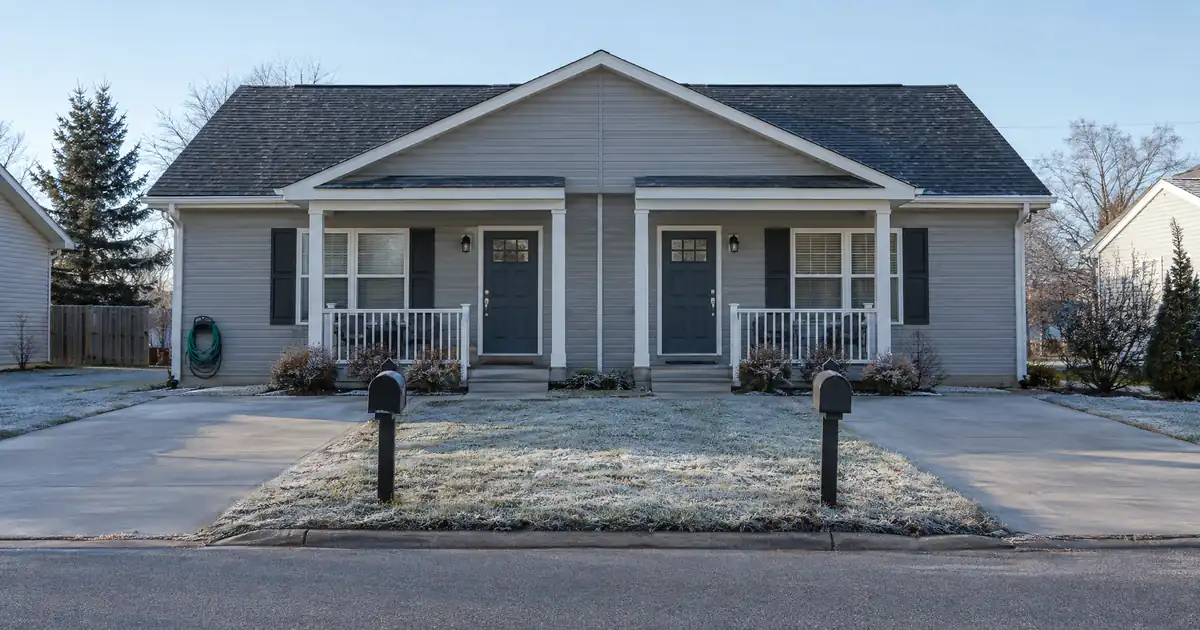
The Quick Read: A debt-to-income ratio above 41% does not end a VA purchase on a duplex, triplex, or fourplex. The 41% figure is a guideline, and residual income, the cash left after your bills, is the controlling test. A file above 41% needs residual income well above the VA table, plus strong compensating factors. Rent from the units you don’t live in can help, but only at a discount, and lender rules can still say no.
Many buyers see “41%” and stop. Don’t. Here is how the loan is actually read, and where a high ratio can still work.
VA payment estimate
Starting assumptions reflect an example price with no down payment and a first-use funding fee. Replace them with your own figures.
Editable benchmark: 7.32% as of October 22, 2026 · Freddie Mac 30-year average via FRED®. A conventional market reference, not a VA loan quote.
Illustrative starting assumptions: a $350,000 price, no down payment with full entitlement, a first-use funding fee financed into the loan, a thirty-year term at the current Freddie Mac benchmark, and property taxes and insurance estimated at typical national rates. Every field is editable.
Illustrative estimate only — not a Loan Estimate, approval, quote, or commitment to lend. The rate field carries the weekly Freddie Mac thirty-year conventional benchmark, a market reference and not a VA loan quote; your rate is set by the lender at lock. The funding fee follows VA’s published table for the use and down payment entered; the residual-income figure is VA’s guideline for the region and family size, and the rough residual shown subtracts only the housing payment and the debts entered, while VA also deducts taxes, maintenance and utilities. Taxes, insurance and dues are editable estimates; closing costs are not included. Licensed in sixteen states for consumer mortgages. Lendmire is not affiliated with or acting on behalf of the Department of Veterans Affairs.
What Does “Above the DTI Guideline” Actually Mean?
Debt-to-income (DTI) is your monthly housing payment plus your long-term debts, divided by your gross monthly income. VA sets the standard at 41% or less. The regulation says a ratio over 41% triggers extra steps, and it does not call that a cap. You can read the text in 38 CFR 36.4340 at eCFR.
The rule has two standards: DTI and residual income. A veteran ordinarily meets both. The published CFR text says failing one is not automatic disqualification. Passing both doesn’t guarantee approval either. The lender weighs everything in the file.
That is why “can I qualify?” rarely has a one-line answer. Across the wholesale programs Lendmire places VA files with, residual income is the controlling test, and a ratio above 41% needs residual income well above the table.
Key Terms Defined
Debt-to-income (DTI): Your monthly housing payment plus long-term debts, divided by gross monthly income.
Residual income: The cash left each month after taxes, the housing payment, debts, and estimated maintenance and utilities.
Compensating factors: Strengths in your file that offset a weak spot, such as reserves or a long record of good credit.
Entitlement: The amount of VA backing you have available. Your certificate of eligibility (COE) confirms it.
Funding fee: A one-time VA charge that can be financed into the loan. Some veterans are exempt.
Overlay: A rule a lender adds on top of VA’s own rules.
How Is a 2-4 Unit VA Loan Underwritten, Step by Step?
The lender works through the file in a set order. A VA loan on a multi-unit follows the same sequence as a single-family loan, with a few extra rent-related checks.
1. Eligibility. The lender confirms your entitlement through the COE. VA decides eligibility, and service requirements are VA’s rules.
2. Occupancy. You must live in one of the units as your primary home. This is an owner-occupied loan.
3. Appraisal. A multi-unit appraisal includes an opinion of fair market rent. The property must also meet VA’s minimum property requirements.
4. Income and DTI. The lender adds the new payment, taxes, insurance, any HOA dues, and your long-term debts. It divides by gross income. The regulation rounds to the nearest whole number, so a ratio of 35.6% counts as 36%.
5. Residual income. The lender compares your leftover cash to VA’s table. The table varies by loan amount, region, and family size. Larger families get a higher minimum.
6. Reserves and rent documentation. If rent from the other units is needed to qualify, extra conditions apply (more on those below).
7. Decision. An automated system or an underwriter reviews the whole picture.
Lendmire is a mortgage broker, not a lender. It arranges these loans through wholesale lenders, and the lender makes the final call. You can see how the program fits your goals on Lendmire’s VA loan programs page.
Why Is Residual Income the Test That Matters Most?
Residual income asks a plain question: after the bills, is there enough cash left for a household your size to live on? DTI is a ratio. Residual income is real dollars.
Here is the rule that matters most when you’re over 41%. If your ratio is above the guideline and your residual income beats the table by at least 20%, the second-level review and the signed justification are not required. That is in the same eCFR section.
If you don’t clear that 20% cushion, the loan can still be approved. The underwriter’s supervisor must sign a statement justifying it. That is an extra gate, and some lenders would rather not open it.
VA’s table amounts differ by region and family size, so there is no single number to memorize. Your loan officer pulls the line that fits your file. One detail to know: a larger household raises the minimum, and VA counts every household member as family.
How Does Rent From the Other Units Help?
Rent can count as income, but it is discounted. A VA lender training deck puts the standard at 75% of rents collected on the units. The haircut covers vacancy and upkeep. Counting 100% of rent is a common misconception.
The same deck lists the conditions that come with using rent to qualify. They include cash reserves equal to six months of the full housing payment, and experience managing rentals or a background in property maintenance. The deck is older, so lenders may apply the conditions differently today.
Three points trip up buyers:
- Rent before purchase doesn’t count. The training deck addresses a borrower who collected rent for months on a different property before buying. That rent was not included in effective income.
- Rent helps the DTI picture more than it helps residual income. Rent raises your qualifying income, but the unmodeled costs of vacancy, repairs, and utilities are real expenses the analysis doesn’t fully capture.
- If you qualify without the rent, the extra conditions may not apply. If you need the rent to qualify, expect the reserve and experience requirements.
Here is a way to picture it. Say you buy a duplex and live in one side. The other side’s rent counts at a discount toward your income. Your DTI drops, but not by the full rent amount. That is the whole lever.
A Worked Picture: Two Files, Same Price, Different Outcomes
These are hypothetical files, described without dollar figures.
File one: Over 41%, thin cushion. A buyer buys a duplex at full price with 100% financing. The ratio lands in the mid-40s. Residual income clears the table, but only by a little. The file needs the supervisor’s signed justification. The lender asks for compensating factors: steady employment, low use of consumer credit, and some cash in the bank.
File two: Over 41%, wide cushion. A second buyer has the same ratio. This buyer has fewer debts and a smaller household, so residual income beats the table by more than 20%. The justification step falls away, and the file reads as a normal approval path.
Same property, same DTI, different residual income. That gap is why veterans with high ratios shouldn’t self-reject. It is also why a lender’s quick “no” on DTI alone deserves a second question: is that VA’s rule, or yours?
Which Compensating Factors Carry Weight?
The regulation lists them, and no single factor decides the outcome. They include:
- Little or no increase in your shelter expense
- Military benefits
- Satisfactory homeownership experience
- High residual income
- Low DTI on the other side of the file
- Continuing tax credits and the tax benefits of home ownership
- Excellent long-term credit
- Conservative use of consumer credit and minimal consumer debt
In practice, the factors an underwriter leans on for a multi-unit are cash reserves, a clean credit history, steady employment, and a small jump from your current housing cost. Show them with documents: bank statements, a pay history, and your credit report. A factor you can’t document doesn’t help.
Tax treatment can depend on your situation; borrowers should speak with a qualified tax professional before relying on any deduction or credit.
What Are the Edge Cases?
Tax-free income. VA disability compensation and other tax-free income can push DTI past 41%. The regulation allows the lender to note that in the file. The gross-up applies to the DTI calculation only. Residual income uses actual dollars.
Lender overlays. VA sets no minimum credit score. The wholesale programs Lendmire works with start at a 580 decision score, and some lenders set a higher floor on multi-unit loans. Some also set their own DTI caps and reserve rules. Overlays, not VA rules, are a common reason a high-DTI file fails. The practical fix is to ask which lender’s rule you are hitting.
Entitlement. With full entitlement, there is no VA loan limit and no down payment as long as the price is not above the appraised value. With remaining entitlement, a down payment may be required. Speak with a loan officer about your own entitlement.
Refinancing later. If you already hold a VA loan on a multi-unit, an Interest Rate Reduction Refinance Loan (IRRRL) is a streamlined refinance of that loan. It doesn’t need a new appraisal. A VA cash-out refinance goes through full underwriting, so the residual income and DTI tests apply again.
Unit count. VA reaches up to four units, and you must live in one. A five-unit building is outside this lane.
What Does It Cost to Close the Loan?
A VA purchase has no mortgage insurance of any kind. The cost is the funding fee, which can be financed into the loan. VA publishes the tiers on VA News.
| Use | Down payment | Funding fee |
|---|---|---|
| First use | Under 5% | 2.15% |
| First or later use | 5% to under 10% | 1.5% |
| First or later use | 10% or more | 1.25% |
| Later use | Under 5% | 3.3% |
Veterans receiving compensation for a service-connected disability, and certain other groups, are exempt. This describes how the fee works and is not a price quote. The fee on your own loan depends on your use of the benefit, your down payment, and whether you are exempt.
The budget side deserves honesty. A 2-4 unit raises your total payment. Rent offsets part of it, but only part, and the reserve requirement means cash must stay in the bank instead of going toward closing costs or furniture. Plan for vacancy, repairs, and utilities, because the loan analysis doesn’t pay for them. Each figure is subject to lender guidelines and a complete review of property type, leverage, and credit.
What If You’re Still Over?
Run through these fixes in order:
1. Pay down installment debts. Removing a monthly obligation lowers DTI and raises residual income.
2. Add documented strengths. Reserves, a clean credit record, and employment history all support a justification.
3. Check for tax-free income. Make sure it is documented and noted in the file.
4. Switch the property. A duplex with a smaller payment may clear where a fourplex doesn’t.
5. Ask about the overlay. If one lender says no, a different wholesale lender may apply different rules. All of it is subject to lender guidelines and full file review.
6. Consider a different loan path. Lendmire’s piece Can a 2–4 Unit Buyer With a High DTI Qualify for an FHA Loan? covers the alternative.
What Should You Gather Before You Apply?
- Your certificate of eligibility
- Pay stubs, tax documents, and any benefit award letters
- Bank and retirement statements showing reserves
- A list of monthly debts
- Any lease or rent history on the units you won’t occupy
- Proof of landlord or property-maintenance experience, if you have it
Bring the rent documents up front. A multi-unit file with clean paperwork is easier to read, and the lender can tell you early whether the 20% cushion is within reach.
Common Misconceptions
- “VA has a 41% DTI cap.” It doesn’t. 41% is the standard that triggers justification.
- “VA has a minimum credit score.” VA sets none. Lenders do.
- “All the rent counts.” Only a discounted share does.
- “Pass both tests and you’re approved.” The regulation says the lender weighs all factors.
- “Any investment property works.” You must live in one unit.
Frequently Asked Questions
Can I get a VA loan on a duplex with a DTI over 41%?
Yes, it can work. The 41% figure is a guideline. A file above it needs residual income well above VA’s table, or a supervisor’s signed justification, plus compensating factors. Final approval depends on the lender’s guidelines and a full file review.
Does VA count all the rent from the other units?
No. A VA training deck describes counting 75% of rents collected on the units. The discount allows for vacancy and upkeep. Some lenders apply a smaller share, so ask which percentage your lender uses.
Do I need reserves to use rent income?
If you need the rent to qualify, expect to show reserves of about six months of the housing payment and some landlord or maintenance experience. If you qualify without the rent, those conditions may not apply. Lender rules vary.
Does rent I collected before buying count?
No. Rent collected on a different property before the purchase is not included in effective income. Only the rent from the units in the property you are buying is used.
Is there a minimum credit score for a 2-4 unit VA loan?
VA sets none. The wholesale programs Lendmire places VA loans with start at a 580 decision score, and some lenders set a higher floor on multi-unit homes. Your score is reviewed with the rest of the file.
If you are buying a home and want to see whether a VA loan fits your file, Lendmire can help you compare the options and what each one asks of the file. For a related path on the refinance side, see Lendmire’s piece How to Qualify for a 2-4 Unit VA Cash-Out on Residual Income Over DTI.
For your own numbers, request a scenario review with Lendmire.
About Lendmire
Lendmire (NMLS# 2371349) is a mortgage broker licensed for consumer lending in 16 states. Lendmire arranges FHA, VA, conventional and jumbo purchase and refinance loans through wholesale lenders; every file is underwritten by the lender under the applicable program guidelines. Scotsman Guide named Lendmire a Top Mortgage Workplace in both 2025 and 2026.
Get Started
Ready to find the right loan for you?
In about 30 seconds you can review financing options available for your home or investment property. No commitment required.
Informational only. Not a Loan Estimate, approval, or commitment to lend. Program availability and eligibility are subject to lender guidelines, credit approval, property review, and underwriting.
References
2. GovInfo CFR, 38 CFR 36.4340
This article is part of Lendmire’s VA loan program — full qualification details, guidelines, and scenarios live on the program page.
Related reading: How a VA Loan Counts Reserves on a 2–4 Unit House Hack · How Much a VA Loan Lends With Zero Down Above the Conforming Limit · How to Get a VA Loan Certificate of Eligibility After Prior Use
Brandon Miller
Founder & CEO, Mortgage Loan Originator, Lendmire LLC
- Mortgage Loan Originator · NMLS# 1129696 · Verify on NMLS Consumer Access
- North Carolina Real Estate Broker · License# 343312 · Verify on NCREC
- North Carolina Insurance Producer · License# 19053198 · Property, Casualty, Life, Health · Verify on NAIC SBS
- Lendmire LLC · Firm NMLS# 2371349 · Verify firm licensure
Disclosure information. Lendmire is a state-licensed mortgage brokerage under NMLS# 2371349. Lendmire is not a depository institution, direct lender, or financial advisor — all loans referenced are placed through wholesale lender partners and are subject to each lender's underwriting standards. This article is provided for general informational purposes and is not a commitment to lend, nor does it constitute financial, legal, or tax advice. Loan programs, terms, rates, and qualification standards change without notice and depend on borrower profile, property type, and the state in which the subject property is located. Equal Housing Opportunity provider. NMLS Consumer Access: nmlsconsumeraccess.org.