
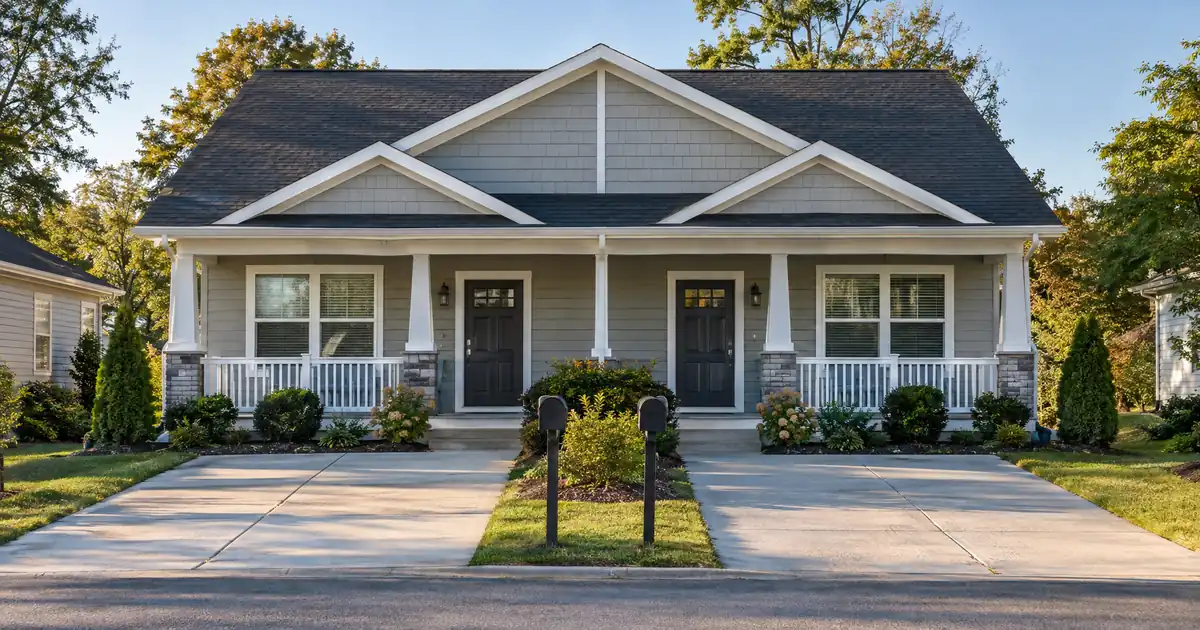
The Quick Read: Rent from the unit you don’t live in can raise your qualifying income, but only part of it counts. When you have no rental history on the property, the lender takes 75% of the lesser of two numbers: the appraiser’s market rent or the rent in the lease. That rent is added to your income. It does not shrink your payment, and it does not replace your job income.
Key Takeaways
- You must live in one unit. The other unit is the one whose rent can count.
- The lender uses 75% of the lesser of lease rent and appraiser’s market rent. The 25% haircut is an allowance for vacancy and upkeep, not a fee.
- The rent goes on the income side of your ratios. The full mortgage payment stays on the housing side.
- A duplex generally skips the extra self-sufficiency test that applies to three- and four-unit homes.
- The rent your lender counts is a coverage figure. It is not a forecast of your cash flow.
Can You Really Buy a Duplex With an FHA Loan?
Yes. FHA financing covers one- to four-unit homes, and a duplex is a common way for a first-time buyer to own something bigger than a single-family house. The catch is occupancy. It has to be your principal residence, which means you live in one side.
FHA payment estimate
Starting assumptions reflect an example price and the FHA minimum investment. Replace them with your own figures.
Editable benchmark: 7.32% as of October 22, 2026 · Freddie Mac 30-year average via FRED®. A conventional market reference, not an FHA loan quote.
Illustrative starting assumptions: a $350,000 price, the FHA minimum investment as the down payment, a thirty-year term at the current Freddie Mac benchmark, and property taxes and insurance estimated at typical national rates. Every field is editable.
Illustrative estimate only — not a Loan Estimate, approval, quote, or commitment to lend. The rate field carries the weekly Freddie Mac thirty-year conventional benchmark, a market reference and not an FHA loan quote; your rate is set by the lender at lock. FHA mortgage insurance follows HUD’s published schedule for the term, leverage and loan size entered; taxes, insurance and dues are editable estimates; closing costs are not included; county loan limits are not checked here. Licensed in sixteen states for consumer mortgages. Lendmire is not affiliated with or acting on behalf of FHA, HUD, or the federal government.
Across the wholesale programs Lendmire places FHA files with, the headline terms are the same as on any FHA purchase. Maximum financing is 96.5%, with a 3.5% minimum investment from a 580 decision score. The ratio guideline starts at 31/43 (housing payment over income, then total debts over income) with no compensating factors. Documented compensating factors can stretch that to 40/50 at the top tier. Every figure is subject to lender guidelines and full file review.
That 96.5% applies to a duplex just as it does to a single-family home. What changes is the income side. You can read more about FHA loan programs.
Here is the practical picture. Two buyers earn the same salary. One wants a single-family house. The other wants a duplex. The duplex buyer may qualify for more house, because part of the other unit’s rent joins the income the lender counts. Part of it. Not all.
How the Lender Works the Number, Step by Step
The lender builds the rent figure in a fixed order. FHA’s rule for this sits in HUD Mortgagee Letter 2023-17, which updates the agency’s rental income policy. HUD’s consolidated policy source for lenders is Handbook 4000.1. Rental income from the subject property can count when the property is a two- to four-unit home. Income from commercial space cannot.
1. Occupancy. You live in one unit and plan to stay. The other unit is the rent source. Your own unit’s rent is not income on a duplex.
2. Lease check. If the other unit is leased, the lender compares the lease rent with the appraiser’s market rent. If it is vacant, the market-rent opinion governs. Where available, the lender also looks at prospective leases.
3. The 75% step. With no rental history on the property since the last tax filing, the lender takes 75% of the lesser of market rent or lease rent.
4. Add to income. That reduced figure joins your gross income. Your payment is not reduced by it.
5. Run the ratios. The lender tests the full payment, including FHA mortgage insurance, taxes and insurance, against your new income. Your other debts, credit and the automated underwriting findings still decide the outcome.
The step most people miss is the fifth. Rent does not offset the payment dollar for dollar. It makes the income number bigger, and the payment stays whole.
Lease or Appraisal: Which Rent Gets Used?
The lesser of the two controls. If the lease says less than market, the lease controls. If the lease says more than market, the appraiser’s opinion controls. A lender will not give you credit for rent the market doesn’t support.
| Situation | Rent figure used |
|---|---|
| Other unit leased at below market | Lease rent |
| Other unit leased at above market | Appraiser’s market rent |
| Other unit vacant | Appraiser’s market rent |
| Lease and market rent about equal | Either, since they match |
In every row, the lender then takes 75% of that figure. Picture a lease at 90% of the appraiser’s market rent. The lease controls, and the lender counts 75% of it. That works out to about 67.5% of market rent. Same unit, same tenant, a noticeably smaller number than the rent on the lease.
This is why a landlord’s asking rent matters less than you’d think. Neither the listing nor the seller’s claim sets the number. The lease and the appraisal do. If a seller says the unit could “easily rent for more,” that statement carries no weight with the lender.
A Modeled Example Carried Through the Ratios
These are modeled assumptions, not market data. Say your base income is 100 units and your proposed housing payment is 34 units, which is 34% of income. Your other monthly debts add 6 units, so total debt is 40%.
Without rent, your housing ratio is 34% and your total ratio is 40%. The housing ratio sits above the 31% base guideline. The file would need compensating factors, and the automated findings would weigh in.
Now add the other unit. Say the lender’s counted rent, after the 75% step, equals 10 units of monthly income. Income rises to 110. The housing ratio becomes about 31% (34 over 110). The total ratio becomes about 36% (40 over 110). The payment didn’t change. The income did.
That is the whole mechanism. Rent makes the ratios look better. It does not make the payment smaller. Whether the file clears is still up to the lender’s review, your credit, and the automated findings.
One more modeled case. Suppose the appraiser’s rent comes in low. The counted rent drops, income rises less, and the ratios land closer to where they started. A duplex that pencils at the asking rent may not pencil at the appraised rent. Before you make an offer, ask what happens to your ratios if the counted rent is smaller than you hoped.
Why a Duplex Skips the Three- and Four-Unit Test
A duplex does not generally face the self-sufficiency test, which applies to three- and four-unit homes. That test is a separate check. It asks whether the property’s own net rental income covers the mortgage payment. HUD’s archived reference guide on rental income describes net rental income there as the appraiser’s market rent from all units, including the borrower’s own, less vacancy and maintenance factors.
Notice what that does. In the three- and four-unit test, your own unit’s rent is part of the calculation. In the duplex income calculation, it is not. The same rent figure plays two different roles, and people blur them all the time.
| Item | Duplex | Three- or four-unit |
|---|---|---|
| Other units’ rent in qualifying income | Yes, reduced share | Yes, reduced share |
| Property must cover its own payment | Generally no | Yes |
| Your own unit’s rent used | No | In the coverage test |
| Reserves | Lighter | Often more is asked |
Reserves for three- and four-unit homes are a lender-file question, so ask about them early. Check the current Handbook text for the exact requirement. It gets revised often, and the 75% treatment is worth confirming against the version in force when you apply.
What About the Rent From Your Own Unit?
Your own unit doesn’t earn rent, so it doesn’t count. The lender isn’t going to treat you as your own tenant. If you picture the duplex as “two rent checks,” only one of them exists on paper.
This also explains a common surprise. A buyer sees both units listed at a given rent and assumes half the property’s income helps. It doesn’t work that way. One unit’s rent is in play, reduced by the haircut.
Edge Cases Where the General Rule Bends
Rental history on the property. If you already have rental income history from the subject property, the treatment differs. The lender averages net income from the tax return’s rental schedule, adds depreciation back, and adds positive net rental income to your income. Negative net rental income counts as a debt. HUD places that passage in its “other real estate holdings” rules, so it doesn’t cleanly describe a first-time duplex buyer. Your loan officer sorts out which path your file takes.
The home you’re moving out of. If you’re keeping your current home as a rental, the rules ask for more. With limited or no rental history, including a property you’re vacating, HUD requires an appraisal showing market rent and at least 25% equity. That appraisal need not be done by an FHA roster appraiser. The lender must also obtain a lease of at least one year after closing, plus proof of the security deposit or first month’s rent. That rule is about the home you leave. It is separate from the duplex you’re buying.
A house with a rental suite. The same HUD letter extends rental treatment to a one-unit home with an accessory dwelling unit. A plain single-family home with no such unit has no rent to count.
Commercial space. A storefront below the apartments doesn’t count. Only residential rent does.
A shorter ownership period. The letter includes a 50% treatment for one ownership scenario. Don’t assume it applies to you. Ask your lender which rule fits.
The program you pick. Conventional and VA treat rent differently. In some cases rent is netted against the payment instead of added to income. That contrast matters if you’re comparing programs, so ask for each treatment in writing before you pick.
Qualifying Rent Is Not the Same as Cash Flow
Rent used for lender review is a lender convention. Real life has vacancies, repairs, turnover and the occasional broken water heater. The 75% haircut is a rough allowance for those costs. It is not a budget.
Practical advice from the files Lendmire arranges: buyers who treat the counted rent as spare money get squeezed first. The strongest duplex buyers could carry the payment on their own income in a bad month and treat the rent as a cushion. That is a safer way to read the math.
Also remember what rent can’t do. It supports your ratios. It doesn’t replace job income, fix a thin credit file, or cover your down payment. FHA mortgage insurance applies to the loan either way: an upfront premium of 1.75% of the base loan, financed, plus an annual premium between 0.15% and 0.75% of the balance, depending on term, loan amount and LTV. The rent just helps carry a bigger payment through the ratios.
Rent that gets counted also has to be real. Under the federal ability-to-repay rule, a lender may consider rental income, but the amounts it relies on must be verified. That is why leases, deposits and the appraiser’s schedule show up in your file. Tax treatment can depend on your situation; borrowers should speak with a qualified tax professional before relying on any deduction or credit.
Documents to Expect
- Signed leases for any occupied unit
- Proof of the security deposit or first month’s rent, where a lease applies
- The appraiser’s rent schedule from the income property report
- Your usual income, asset and credit documents
- If you’re keeping a prior home as a rental, a one-year lease and the equity appraisal
A two- to four-unit appraisal generally costs more and takes more work than a single-family one. Ask your lender what to expect, since the figure varies by market.
Common Mistakes and Myths
“All the rent counts.” Only 75% of the lesser of lease rent and market rent. Not the asking rent, and not the full lease.
“Rent cancels the payment.” It adds to income. The full payment stays in the ratio.
“My side counts too.” Not on a duplex.
“A single-family home can use rent.” Not unless it has an accessory dwelling unit.
“Occupancy is a technicality.” It isn’t. FHA requires you to live there, and misrepresenting occupancy on a file creates serious trouble. If you plan to rent the whole building, this is the wrong program.
“The federal rule caps my debt ratio.” The federal ability-to-repay rule requires lenders to consider debt-to-income or residual income. It does not set one fixed limit for you. FHA’s own guidelines, and the automated findings, do most of that work.
“A lease in hand fixes everything.” A lease above market rent doesn’t help, because the lesser figure controls.
Key Terms Defined
Market rent: What the appraiser says the unit would rent for, based on comparable rentals nearby.
Qualifying rental income: The part of the rent the lender allows into your income for ratio purposes. For a first-time duplex buyer, that is 75% of the lesser of lease rent and market rent.
PITI: Principal, interest, taxes and insurance, the basic monthly cost of the loan before mortgage insurance and any association dues.
Debt-to-income ratio (DTI): Your monthly debts divided by your gross monthly income. FHA looks at it two ways, housing alone and all debts together.
Rent schedule: The part of the appraiser’s report that lists each unit’s current and market rent.
Self-sufficiency test: The extra check on three- and four-unit homes that asks whether the property’s net rent can cover its own payment.
What to Do Before You Make an Offer
Ask the seller for the leases and the deposit details. Ask your lender how it will treat the rent and which figure it expects. Then run your own numbers using only 75% of the lower rent figure, and check whether you’d still be comfortable if the counted rent came in low. For a closer look at the rent math on two- to four-unit homes, see Lendmire’s explainer How Much Rent an FHA Loan Counts on a 2-4 Unit. If you ever plan to tap equity later, Lendmire’s piece Does Rent From Other Units Help You Qualify for an FHA Cash-Out? covers that separate rule.
If you are buying a home and want to see whether an FHA loan fits your file, Lendmire can help you compare the options and what each one asks of the file. Nothing here is a commitment to lend, and every program detail is subject to lender guidelines and full file review.
Frequently Asked Questions
Can I count the rent before I find a tenant?
Yes, in the sense that a vacant unit still gets a rent figure. The appraiser’s market-rent opinion governs, and the lender takes 75% of it. A signed lease isn’t required for a vacant unit, though prospective leases help where they exist.
Does the lender count the full lease rent?
No. The lender uses 75% of the lesser of the lease rent and the appraiser’s market rent. The missing 25% is an allowance for vacancy and upkeep. A lease above market doesn’t raise the figure.
Will rent lower my monthly payment on the loan?
No. Rent is added to your qualifying income. The full payment, including mortgage insurance, taxes and insurance, stays in the ratio. Rent can help you meet the ratios, but it doesn’t reduce what you owe each month.
Does a duplex have to pass the rent self-sufficiency test?
Generally no. That test applies to three- and four-unit homes, where the property’s net rent has to cover its own payment. A duplex buyer is judged on income, credit and ratios, with the other unit’s reduced rent added to income.
What if the appraiser’s rent is lower than the seller promised?
The appraiser’s number controls whenever it is lower than the lease. Your counted income drops, and your ratios move up. Ask your lender to test the file at the lower figure before you commit to a price.
For your own numbers, request a scenario review with Lendmire.
About Lendmire
Lendmire is a mortgage brokerage (NMLS# 2371349) licensed for consumer mortgage lending in 16 states, arranging FHA, VA, conventional and jumbo purchase and refinance loans through a wholesale lending network. Eligibility is determined by the lender on each file. Scotsman Guide named Lendmire a Top Mortgage Workplace in both 2025 and 2026.
Get Started
Ready to find the right loan for you?
In about two minutes you can review financing options available for your home or investment property. No commitment required.
Informational only. Not a Loan Estimate, approval, or commitment to lend. Program availability and eligibility are subject to lender guidelines, credit approval, property review, and underwriting.
References
1. HUD Mortgagee Letter 2023-17
2. HUD Single Family Handbook 4000.1
3. HUD Archives, Rental Income Reference Guide
4. CFPB Ability-to-Repay and Qualified Mortgage Small Entity Compliance Guide
This article is part of Lendmire’s FHA loan program — full qualification details, guidelines, and scenarios live on the program page.
Related reading: FHA Loan Requirements for a Second Loan After Payoff · Can You Get an FHA Loan With Less Than Two Years of Employment? · Can You Get an FHA Loan and What Decides Approval?
Brandon Miller
Founder & CEO, Mortgage Loan Originator, Lendmire LLC
- Mortgage Loan Originator · NMLS# 1129696 · Verify on NMLS Consumer Access
- North Carolina Real Estate Broker · License# 343312 · Verify on NCREC
- North Carolina Insurance Producer · License# 19053198 · Property, Casualty, Life, Health · Verify on NAIC SBS
- Lendmire LLC · Firm NMLS# 2371349 · Verify firm licensure
Disclosures. The information presented in this article is general market commentary, not financial, legal, or tax advice. Lendmire is a mortgage brokerage (NMLS# 2371349) — not a direct lender or depository institution — and loan placement is subject to lender underwriting. Nothing in this content represents a commitment to lend. Loan terms, pricing, and program availability vary based on borrower qualifications, property characteristics, and state of subject property, and are subject to change at any time. Lendmire complies with Equal Housing Opportunity requirements. Consumer access: nmlsconsumeraccess.org.