
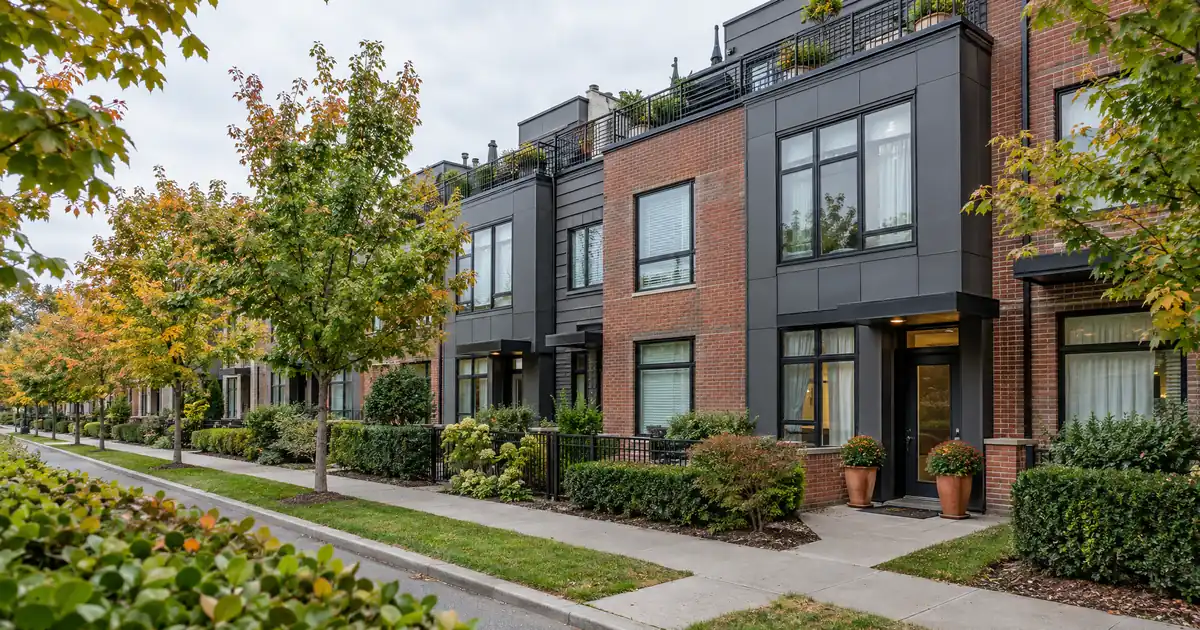
The Quick Read: A single-family home is judged on the property alone, while a condo is judged on the whole project before the unit even gets an appraisal. A house suits the buyer who wants the fewest moving parts. A condo suits the buyer who values the location or the lower upkeep and is willing to check the project’s status first. Both use the same VA benefit, subject to lender guidelines and full file review.
Side-by-Side
The VA benefit itself does not change with the property type. What changes is the number of gates between the offer and the closing table.
VA payment estimate
Starting assumptions reflect an example price with no down payment and a first-use funding fee. Replace them with your own figures.
Editable benchmark: 7.32% as of October 22, 2026 · Freddie Mac 30-year average via FRED®. A conventional market reference, not a VA loan quote.
Illustrative starting assumptions: a $350,000 price, no down payment with full entitlement, a first-use funding fee financed into the loan, a thirty-year term at the current Freddie Mac benchmark, and property taxes and insurance estimated at typical national rates. Every field is editable.
Illustrative estimate only — not a Loan Estimate, approval, quote, or commitment to lend. The rate field carries the weekly Freddie Mac thirty-year conventional benchmark, a market reference and not a VA loan quote; your rate is set by the lender at lock. The funding fee follows VA’s published table for the use and down payment entered; the residual-income figure is VA’s guideline for the region and family size, and the rough residual shown subtracts only the housing payment and the debts entered, while VA also deducts taxes, maintenance and utilities. Taxes, insurance and dues are editable estimates; closing costs are not included. Licensed in sixteen states for consumer mortgages. Lendmire is not affiliated with or acting on behalf of the Department of Veterans Affairs.
| Factor | Single-Family Home | Condo |
|---|---|---|
| Leverage | Up to 100% on a purchase | Same, up to 100% |
| Mortgage insurance | None | None |
| Credit floor | Same 580 wholesale decision score | Same 580 wholesale decision score |
| Occupancy | Primary residence | Primary residence |
| What VA reviews | Appraisal and property condition | Project approval, then the unit appraisal |
| Documentation | Standard file plus appraisal | Standard file plus association documents |
| Who can derail it | Appraisal or title issue | Unapproved project, HOA documents, appraisal |
| Ongoing costs | Taxes, insurance, upkeep | Same, plus association dues |
Leverage and mortgage insurance are identical because they belong to the VA program, not the building. Across the wholesale programs where Lendmire places VA loans, a purchase can run at 100% financing with no down payment as long as the price is not above the appraised value. There is no mortgage insurance of any kind. With full entitlement there is no VA loan limit. With remaining entitlement a down payment may be required, so speak with a loan officer about your own situation. VA sets no minimum credit score. The wholesale programs here start at a 580 decision score, and lenders may set a higher floor.
The VA funding fee applies to both property types the same way. For a first-use purchase it is 2.15% with less than five percent down, 1.5% with five to under ten percent down, and 1.25% with ten percent or more down. It can be financed, and it is waived for veterans receiving compensation for a service-connected disability and the other exempt groups.
Underwriting treats both properties alike too. Residual income is the controlling test. The 41% debt-to-income figure is a guideline, not a cap. One difference does show up in the budget, though: condo dues.
Why VA Looks at the Whole Condo Project
VA approves the project, not the unit. Federal regulation lets VA guarantee a loan on a one-family unit in a condominium project on the same terms as other VA loans, and it ties that to approval of the project’s legal documentation. The text is in 38 CFR § 36.4360.
The logic is collateral risk. A condo buyer owns a unit but shares the roof, the grounds, the insurance and the association’s finances with everyone else. If the association is poorly run or its documents contain problem provisions, the value of every unit suffers. VA reviews that structure up front.
VA’s Buyer’s Guide says VA keeps a list of approved condos, and a project that is not on it must be submitted to VA for review. The official lookup is the VA Condo Report. The lender, not the buyer or seller, submits an unlisted project. The association is not obligated to hand over the documents the review needs, and review can take months.
A single-family detached home has no such step. It is not limited to a list. It goes through the appraisal, where a VA-approved appraiser sets a reasonable value and the Notice of Value shows whether the home appears to meet basic property requirements. Then come the lender’s title and underwriting checks.
Key Terms Defined
Project approval: VA’s review of a condominium’s legal documents and structure, done at the project level before any unit is eligible for the guaranty.
Notice of Value (NOV): The document that comes out of the VA appraisal, showing the value and whether the home appears to meet basic property requirements.
Minimum Property Requirements: VA’s baseline standards for safety, soundness and sanitation that apply to every property type.
PUD (planned unit development): A neighborhood with shared common areas where you own the lot and home. It is not a condo.
Residual income: What is left of monthly income after major obligations and living costs, VA’s controlling underwriting test.
When the Single-Family Home Is the Better Fit
A house is the better fit when predictability matters most. There is no project to approve, no association documents to chase, and no status that can change between offer and closing. The property’s own condition and value decide the outcome.
It also fits a buyer on a tight offer timeline or in a market where sellers push back on VA offers. A secondary pattern worth knowing: sellers sometimes resist VA offers on condos because of approval uncertainty. A house avoids that friction.
Budget is the other reason. A house has no association dues in the monthly picture. The trade-off is that upkeep falls entirely on you.
Watch the labels, though. Many townhomes and “villas” look like houses but are legally condominiums, and project approval applies by legal form, not building style. A PUD is different, because only condominiums need VA project approval. Lots or units in a PUD must still meet VA title and lien requirements, and the lender confirms that on each loan. Ask the agent or title company which legal form you are buying.
When the Condo Is the Better Fit
A condo is the better fit when the location, price tier or lifestyle is the point and you will do the homework first. The VA benefit carries over in full: the same leverage, no mortgage insurance, the same credit floor, the same residual-income test.
The homework is short if done in the right order. Check the VA Condo Report for the project and the specific phase before you make an offer. Statuses can change between offer and closing, so the lender should re-verify before ordering the appraisal. One phase may be accepted while a later phase is pending or missing.
If the project is not listed, it may only mean it has not been reviewed. Ask the lender whether a review is realistic, and be clear that a “rejected” status is a different case. Do not assume FHA approval carries over. The lists are separate, and the lender must verify current status.
Be careful with claims of a single-unit or “spot” approval. VA’s regulation and handbook describe project-level approval. Some sites say otherwise, but treat any claimed exception as unconfirmed until your lender gives it to you in writing.
Budget the dues. The Consumer Financial Protection Bureau notes that condo and HOA dues are usually paid directly to the association rather than through the mortgage servicer, and they vary widely. They count when you judge affordability, and because residual income is the controlling test, dues weigh on the file.
For a deeper look at the rules, Lendmire’s piece VA Loan Condo Approval Rules for a Veteran Buying a Primary Home walks through the project side.
A Few Edge Cases Worth Knowing
Michigan treats detached “site condominiums” like single-family detached homes under a state-specific VA circular, so VA does not review their legal documents there. The unit must still be held in fee simple with the VA loan in first position. See VA Circular 26-20-36.
Side-by-side villa and townhome-style condos in heavy termite zones may need a termite inspection noted on the NOV unless the association shows evidence of treatment. A single-family property with a small business use may still work if it is primarily residential and legally zoned, but that is a file-by-file call.
How the Two Paths Run, Step by Step
Single-family: offer, appraisal and NOV against the property requirements, underwriting and title review, closing.
Condo: check project status, confirm the phase, offer, lender re-verifies status, appraisal and NOV, clear any project conditions, underwriting, closing.
Approval can come with conditions, such as recording documents or completing common areas, and the lender must confirm those are met before closing. The condo path adds a layer; it does not replace the house path’s checks. The unit still has to pass the appraisal.
Which Should You Choose?
If your top priority is certainty, choose the house. If your priority is the specific location or building and you can check status before you commit, the condo is a sound choice. Protect yourself by asking your agent about contingency language tied to project status, and by confirming status before spending on an appraisal.
If you are weighing a condo bought with non-VA financing, Lendmire’s comparison of a bank statement loan on a condo versus a single-family home shows how project rules play out in a different program.
For a veteran who hasn’t picked a property type yet, the practical answer is to shop both with the same pre-approval. Lendmire’s VA loan programs are the same either way, and the property decides how many steps stand between you and the closing table.
If you are buying a home and want to see whether a VA loan fits your file, Lendmire can help you compare the options and what each one asks of the file. Lendmire is a mortgage broker arranging VA loans through wholesale lenders in 16 states, and all terms are subject to lender guidelines and full file review.
Frequently Asked Questions
Does VA approve the condo unit I want to buy?
No. VA approves the project, not the individual unit. The unit still has to pass its own appraisal and property requirements after the project clears.
Can I use a VA loan on a townhome?
Often yes, but the legal form decides the path. A condo-form townhome needs project approval, while a fee-simple townhome or PUD unit is treated more like a house. Ask your agent or title company how the property is held.
What if the condo isn’t on VA’s list?
It may only mean the project has not been reviewed. The lender, not you or the seller, would submit it with association documents, and review can take months. Ask your lender whether pursuing it makes sense or whether another property is the better route.
Does FHA approval of a condo count for VA?
Not automatically. The FHA and VA lists are separate, so the lender must verify the project’s current VA status.
Are condo dues part of my VA mortgage payment?
Usually not. Dues typically go straight to the association, and you should count them in your monthly budget even though they sit outside the loan payment.
For your own numbers, request a scenario review with Lendmire.
About Lendmire
Lendmire, NMLS# 2371349, is a mortgage brokerage with consumer lending licenses in 16 states. FHA, VA, conventional and jumbo purchase and refinance loans are arranged through wholesale lending partners, and each application is reviewed individually by the lender. Scotsman Guide named Lendmire a Top Mortgage Workplace in both 2025 and 2026.
Get Started
Ready to find the right loan for you?
In about two minutes you can review financing options available for your home or investment property. No commitment required.
Informational only. Not a Loan Estimate, approval, or commitment to lend. Program availability and eligibility are subject to lender guidelines, credit approval, property review, and underwriting.
References
2. VA Home Loan Guaranty Buyer’s Guide
4. Consumer Financial Protection Bureau
This article is part of Lendmire’s VA loan program — full qualification details, guidelines, and scenarios live on the program page.
Related reading: VA Loan Homeowners Insurance Requirements for a Home Purchase · Can a VA Loan Finance a Second Home or Investment Property? · VA Condo Approval Requirements for a VA Loan Purchase
Brandon Miller
Founder & CEO, Mortgage Loan Originator, Lendmire LLC
- Mortgage Loan Originator · NMLS# 1129696 · Verify on NMLS Consumer Access
- North Carolina Real Estate Broker · License# 343312 · Verify on NCREC
- North Carolina Insurance Producer · License# 19053198 · Property, Casualty, Life, Health · Verify on NAIC SBS
- Lendmire LLC · Firm NMLS# 2371349 · Verify firm licensure
Legal disclosures. Lendmire (NMLS# 2371349) is a state-licensed mortgage brokerage that arranges financing through wholesale lender relationships. Lendmire is not a direct lender, depository institution, or registered financial advisor. The discussion above is general informational content about real estate financing — it is not financial, legal, or tax advice, and readers should consult licensed professionals for guidance on their individual circumstances. Loan inquiries are subject to lender underwriting; this article does not represent a commitment to lend. Loan terms, rates, and qualification standards vary by borrower, property, and state, and are subject to change at any time. Equal Housing Opportunity. NMLS Consumer Access: nmlsconsumeraccess.org.