
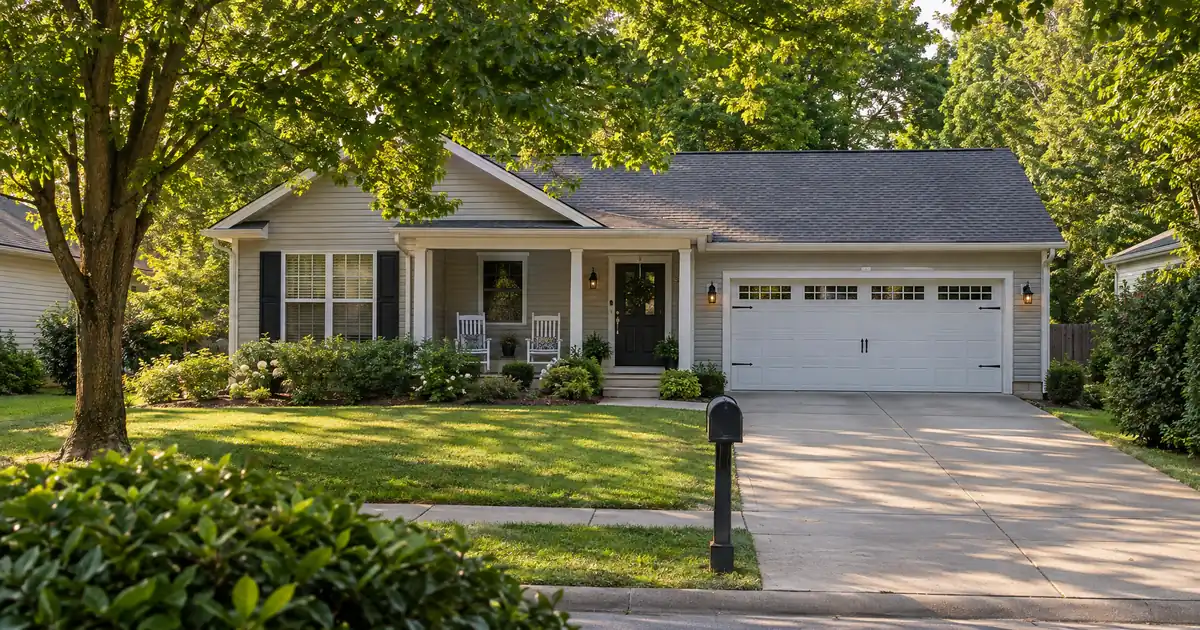
The Quick Read: Inheriting a home removes the usual waiting period before a cash-out refinance, but nothing else. You still need to be on title, live in the home for primary-residence terms, qualify on your own income and credit, and pass an appraisal. A paid-off inherited house is still treated as a cash-out loan. Everything below is subject to lender guidelines and full file review, and none of it is a commitment to lend.
What a Cash-Out Refinance Means on an Inherited Home
A cash-out refinance replaces your current mortgage, or a home with no mortgage, with a new, larger first mortgage. You keep the difference in cash. On an inherited house, the lender sizes that loan against the appraised value today, because no purchase price exists.
Cash-out refinance estimate
The starting figures are an example value with a balance and a cash request in proportion. Replace them with yours.
Editable benchmark: 7.24% as of October 29, 2026 · Freddie Mac 30-year average via FRED®. A conventional market reference, not a cash-out refinance quote.
Illustrative starting assumptions: a $350,000 home value, a $193,000 current balance, the agency cap on a one-unit principal residence, a thirty-year term at the current Freddie Mac benchmark, and property taxes and insurance estimated at typical national rates. Every field is editable.
Illustrative estimate only — not a Loan Estimate, approval, quote, or commitment to lend. The rate field carries the weekly Freddie Mac thirty-year conventional benchmark, a market reference and not a cash-out refinance quote; a cash-out loan is priced by the lender at lock. The cash available is the loan the program cap allows less the balances paid off, before closing costs, which are not included. The HELOC line is the program’s combined loan-to-value ceiling applied to the same value and balance. Taxes and insurance are editable estimates. Licensed in sixteen states for consumer mortgages.
Here is the part that surprises heirs. A home with no mortgage on it still counts as a cash-out refinance. Freddie Mac’s Seller/Servicer Guide §4301.5 says a mortgage placed on a property previously owned free and clear is a cash-out loan. So a paid-off house is not a “no-cash-out” loan, and it does not get the lighter treatment a rate-and-term refinance gets.
That distinction matters because a rate-and-term refinance (what the industry calls a limited cash-out) only lets you pay off the old loan and closing costs, with a sliver of cash back. It is the wrong tool when your goal is to pull equity out. A cash-out loan is priced and capped as cash-out, which usually means less favorable terms than a limited cash-out. Lendmire’s cash-out refinance programs page lays out the program family, and Lendmire arranges these loans as a broker through wholesale lenders in the 16 states where it is licensed for consumer lending.
Does Inheriting Waive the Waiting Period?
Yes, for the title clock. No, for everything else.
The standard conventional test says at least one borrower must be on title for a minimum period before the new loan closes. Fannie Mae’s Selling Guide B2-1.3-03 carves out an exception: no waiting period applies if the lender documents that you acquired the property through inheritance or were legally awarded it, as in a divorce. Freddie Mac has the same exception for an inheritance or legal award under a final judgment.
Seasoning is a lender’s word for how long you have owned something or how old a loan is. Two seasoning clocks exist, and people mix them up:
- The title clock: six months on title. Inheritance waives it.
- The loan-age clock: the mortgage being paid off must be at least 12 months old, counted from note date to note date. If the inherited home still carries a mortgage, ask the lender whether inheritance changes that test. The agency pages do not spell it out clearly, so do not assume it does.
If there is no mortgage at all, the loan-age clock has nothing to measure. That is one reason a free-and-clear inherited home is often the cleanest file.
Delayed financing is a different exception. It is for cash buyers who refinance soon after purchase, and it caps the new loan at what the buyer documented paying. It is not the inheritance exception, and the two should not be confused.
How the Loan Is Underwritten, Step by Step
Across the wholesale programs Lendmire places files with, a cash-out on an inherited home moves through the same sequence. Missing a step early creates trouble late.
1. Establish title. You need to be on title, usually through a recorded deed or a probate transfer. The inheritance exception removes a clock. It does not remove the ownership requirement. If the estate is still open and the deed has not moved to your name, you generally are not ready to apply. A lender will want documents showing how you acquired the property.
2. Classify the loan. No lien on the home means cash-out. A remaining mortgage means the file is a cash-out that also pays off that loan.
3. Confirm occupancy. Occupancy sets the leverage. A conventional cash-out can be written on a primary residence, a second home, or an investment property. Primary residence gets the highest limits, and you must actually live there for those terms.
4. Appraise the home. With no purchase, the lender relies on the current appraised value. The cash you can reach depends on that number.
5. Qualify on your own. Inheritance does not replace income. The lender reviews your credit, your income, and your other debts. Across the wholesale conventional programs, the credit floor starts at a 620 decision score. The automated finding governs most files, with a total debt-to-income ratio ceiling of 50%.
6. Close. You receive a Closing Disclosure, then sign. A right to cancel applies after signing, so cash is typically released after that window ends. More on that below.
How Much Cash Can You Reach?
Leverage depends on occupancy and unit count. Those are the figures that apply across the programs Lendmire works with, subject to lender guidelines:
| Property use | Maximum cash-out LTV |
|---|---|
| Primary residence, one unit | 80% |
| Primary residence, two to four units | 75% |
| Second home | 75% |
| Investment property | 75% |
LTV is loan-to-value: the new loan as a percentage of the appraised value. Fannie Mae publishes the same structure in its Eligibility Matrix, which changes from time to time, so the live version governs.
Mortgage insurance is required above 80% on the agency path, except in the wholesale no-MI cash-out lane described next. A cash-out is capped at 80% on a one-unit primary home, so mortgage insurance rarely enters a standard conventional cash-out.
One wholesale lane reaches 89.99% LTV with no mortgage insurance. It requires a 680 score, a 50% ratio, a thirty-year fixed rate, a primary residence and a conforming loan balance, plus its own six months of seasoning. It is the one exception to the 80% pattern. Texas borrowers should know that a cash-out on a Texas homestead is capped at 80% of the home’s value by the state constitution, and that wholesale lane is not written there. Final terms depend on the lender’s guidelines, the property type, and the borrower’s complete credit picture.
Picture an heir who inherits a paid-off one-unit house and lives in it. On a standard conventional cash-out, the new first mortgage can reach up to 80% of the appraised value. Closing costs come out of those proceeds or out of pocket, so the check you receive is smaller than the headline equity. A lender’s Loan Estimate shows the net figure before you commit.
Where the General Rule Breaks
The clean story above has real exceptions. These are the ones that trip heirs up.
You rented the home after inheriting
Rental history can change the lane. On FHA cash-out, the handbook text says an inheriting borrower need not occupy the home for a minimum period first, provided it was never treated as an investment property since the inheritance. If the home was rented, a 12-month occupancy period applies before cash-out is available. Have the lender confirm the current handbook language before you plan around it. Exact terms depend on lender and investor guidelines, credit profile, reserves, and property review.
You are buying out a sibling or co-heir
Buying out a co-owner under a written agreement is a limited cash-out transaction at both Fannie Mae and Freddie Mac. That is different from a true cash-out. The usual twelve months of joint ownership must be documented, except in the case of a recent inheritance, per Fannie Mae’s limited cash-out guide. Because it is limited cash-out, the keeping heir generally should not expect to take extra cash home. Ask the lender exactly what is allowed. Practically, every co-owner needs to sign off on the deal, and the buyout is paid from the new loan at closing.
The title is not clean
Informal or unresolved ownership blocks a loan. Fannie Mae says heirship issues affect an estimated total assessed value of over $32 billion across 44 states and D.C., per its heirs’ property page. If title passed without a probate or recorded transfer, sort that out first. A lender cannot close on a house the borrower cannot prove they own.
Gifted is not inherited
The inheritance exception covers inheritances and legal awards. A gifted property is a different situation. Confirm with the lender before assuming a gift qualifies the same way.
You want an FHA Streamline or VA IRRRL
Neither works for pulling inherited equity. The FHA Streamline refinances an existing FHA-insured loan and allows no cash back beyond minor closing adjustments, per HUD’s Streamline handbook chapter. The VA IRRRL is likewise only for an existing VA loan. An heir who inherited a paid-off house, or a non-government loan, has nothing to streamline.
You are a veteran heir
A veteran who has entitlement and will live in the home can look at a VA cash-out. The VA cash-out page says you need a Certificate of Eligibility and must live in the home you are refinancing. VA does not lend directly, so you go through a private lender. Entitlement belongs to the veteran personally, so a non-veteran heir cannot borrow against someone else’s. Surviving spouses may have separate options, which a VA-experienced lender can confirm.
Probate, Deeds and the Right Order of Events
Timing of paperwork trips more heirs than any rate or program rule. Three things are easy to blur:
- Court authority. A personal representative may be appointed to manage the estate.
- Estate ownership. While the estate is open, the estate may technically hold the home.
- Recorded title. The deed that puts the home in your name.
A lender wants the third one. Until the deed or probate order is recorded in your name, you generally cannot refinance in your own right. If other heirs share ownership, each is a co-owner, and every owner’s signature matters at closing.
Trusts add another layer. A home held in a trust may follow different rules on who can sign and borrow. A lender will usually need the trust documents. Bring them early.
Qualifying: What the Lender Actually Looks At
An inheritance does not count as income. The lender qualifies you the way it qualifies anyone:
- Credit. Scores and history, with the wholesale conventional floor starting at a 620 decision score.
- Income and debts. Your total debt-to-income ratio, with the 50% ceiling mentioned above on files that the automated finding supports. Manually underwritten loans run tighter, at 36% or 45% depending on reserves and score.
- Assets. Cash you inherited can help as reserves. Lenders want to see where funds came from.
- Credit events. Agency waiting periods apply after a bankruptcy or foreclosure: four years from a chapter 7 discharge, seven from a foreclosure, and four from a short sale or deed-in-lieu. Documented extenuating circumstances can shorten them.
- Appraisal. The home has to appraise.
Self-employed heirs document income differently, but the principle holds. The loan stands on your finances, not the estate’s.
A new first mortgage on a previously paid-off home also adds a monthly payment to your budget where none existed. That is the real cost of cash-out equity, and worth sitting with before you sign.
Your Decision in Practice
Weigh the cash-out against the alternatives with a plain list of what each costs you.
| Option | What you get | Tradeoff |
|---|---|---|
| Cash-out refinance | Lump sum from a new first mortgage | New payment, closing costs |
| Rate-and-term / limited cash-out | Pay off old loan or buy out a co-heir | Little or no cash back |
| Keep the existing loan | No new loan | No cash access |
| Sell | Full proceeds | You lose the home |
If you inherited with a mortgage still on the home, a servicer may let a confirmed successor in interest keep paying the loan without first assuming it. That is a servicing protection under Regulation X. It gives you information and standing with the servicer. It does not promise you a new loan.
A short word on timing after you sign. A refinance on your home carries a three-business-day right to cancel, and Saturdays count while Sundays and legal holidays do not. If you rescind, the original loan stays in place. Funds generally release after that window.
Common Myths
- “Inherited means I can refinance right away.” Only the title clock is waived. You still need title, an appraisal, income, credit and occupancy.
- “No mortgage means it is not a cash-out.” A loan on a free-and-clear home is cash-out.
- “I can rent it and keep the exception.” Not on FHA cash-out. Treating the home as an investment property can start a 12-month occupancy requirement.
- “A buyout lets me pocket cash.” A buyout is limited cash-out, so extra cash back is generally restricted.
- “The successor-in-interest rule hands me the loan.” It protects your servicing rights. A new loan is still underwritten.
Key Terms Defined
Cash-out refinance: A new, larger first mortgage that pays off the old loan, if any, and gives you the difference in cash.
Limited cash-out (rate-and-term) refinance: A refinance that pays off the old loan and closing costs, with only incidental cash back.
Seasoning: How long you have owned the home or how old the loan being paid off is before a lender accepts it.
LTV (loan-to-value): The loan amount as a percentage of the home’s appraised value.
Successor in interest: A person who gets ownership of a mortgaged home through inheritance and is recognized by the servicer.
Right of rescission: Your three-business-day window to cancel a refinance on your home after signing.
Frequently Asked Questions
Can I cash-out refinance a house I just inherited?
Usually yes, once you are on title and the lender documents the inheritance. The six-month title wait does not apply. You still need to qualify on your own income and credit and have the home appraised. Program terms are subject to lender guidelines and file review.
Is a paid-off inherited house a cash-out or a rate-and-term refinance?
Cash-out. A new loan on a home owned free and clear is treated as cash-out under Freddie Mac’s guide. Limited cash-out is for paying off an existing loan, not for taking equity from a house with none.
Do I have to live in the inherited home?
For primary-residence cash-out terms, yes, you live there. Occupancy sets the leverage, and second homes and investment property carry lower limits. FHA adds a 12-month occupancy requirement if the home was rented after inheritance.
Can I use the money to buy out my siblings?
Yes, in a structured way. Buying out a co-owner under a written agreement is limited cash-out at both agencies, and joint ownership is documented unless the inheritance is recent. Extra cash back to the keeping heir is generally limited, so ask the lender.
Can an FHA Streamline or VA IRRRL pull cash out of an inherited home?
No. Both are streamlines of an existing government-backed loan, and the FHA version allows no cash back beyond minor adjustments. An inherited home with no FHA or VA loan has nothing to streamline.
If you are weighing a cash-out refinance against keeping the loan you have, Lendmire can help you compare the programs and the equity each one reaches.
For your own numbers, request a scenario review with Lendmire.
For current guidelines and terms, see Lendmire’s refinance programs page.
About Lendmire
Lendmire — NMLS# 2371349 — is a mortgage broker that arranges FHA, VA, conventional and jumbo home purchase and refinance financing in 16 states through wholesale lenders. Every option is subject to the lender’s guidelines and full underwriting. Scotsman Guide named Lendmire a Top Mortgage Workplace in both 2025 and 2026.
Get Started
Ready to find the right loan for you?
See your offer in seconds. No credit pull, no obligation.
Informational only. Not a Loan Estimate, approval, or commitment to lend. Program availability and eligibility are subject to lender guidelines, credit approval, property review, and underwriting.
References
1. Freddie Mac Seller/Servicer Guide §4301.5
2. Fannie Mae Selling Guide B2-1.3-03, Cash-Out Refinance Transactions
3. Fannie Mae Eligibility Matrix
4. Fannie Mae Selling Guide B2-1.3-02, Limited Cash-Out Refinance Transactions
5. Fannie Mae
6. HUD’s Streamline handbook chapter
7. VA.gov, Cash-Out Refinance Loan
This article is part of Lendmire’s cash-out refinance program — full qualification details, guidelines, and scenarios live on the program page.
Related reading: Best Cash-Out Refinance Program to Cover the Down Payment on Your Next Home · Best Cash-Out Refinance Program on a Home Gifted to You
Brandon Miller
Founder & CEO, Mortgage Loan Originator, Lendmire LLC
- Mortgage Loan Originator · NMLS# 1129696 · Verify on NMLS Consumer Access
- North Carolina Real Estate Broker · License# 343312 · Verify on NCREC
- North Carolina Insurance Producer · License# 19053198 · Property, Casualty, Life, Health · Verify on NAIC SBS
- Lendmire LLC · Firm NMLS# 2371349 · Verify firm licensure
Legal disclosures. Lendmire (NMLS# 2371349) is a state-licensed mortgage brokerage that arranges financing through wholesale lender relationships. Lendmire is not a direct lender, depository institution, or registered financial advisor. The discussion above is general informational content about real estate financing — it is not financial, legal, or tax advice, and readers should consult licensed professionals for guidance on their individual circumstances. Loan inquiries are subject to lender underwriting; this article does not represent a commitment to lend. Loan terms, rates, and qualification standards vary by borrower, property, and state, and are subject to change at any time. Equal Housing Opportunity. NMLS Consumer Access: nmlsconsumeraccess.org.