
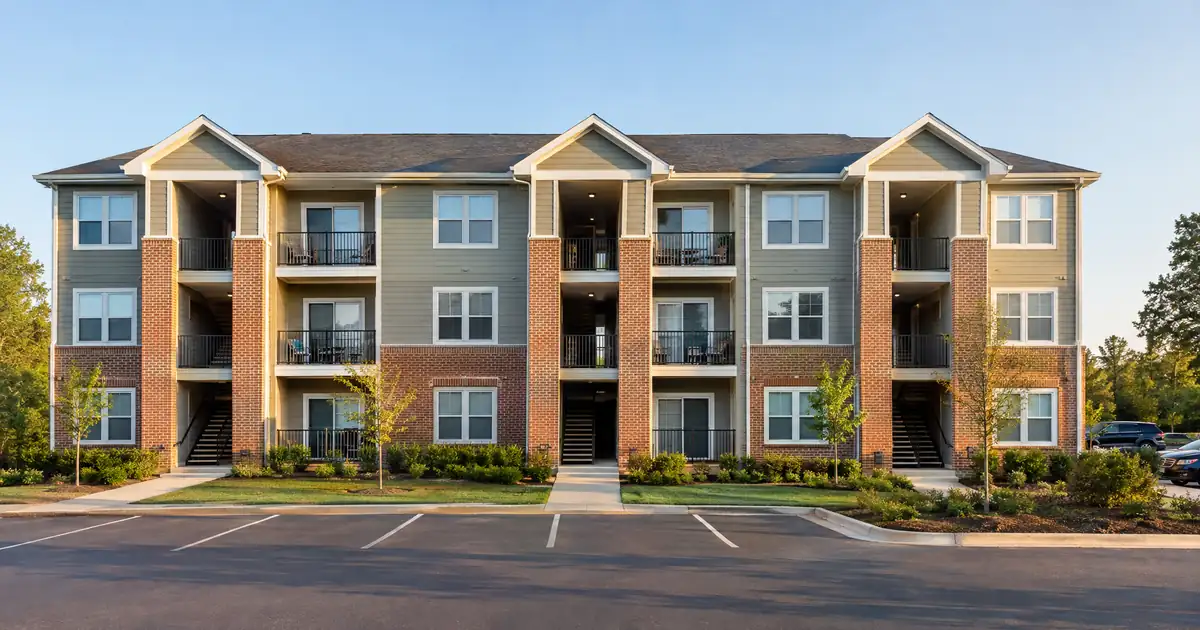
Multifamily 5+ 12-Month Bank Statement Loan Complete Guide — The Quick Read: A true 12-month bank statement loan doesn’t exist for a five-unit-plus apartment building. That’s not because lenders refuse to finance these deals. It’s because the paperwork tool itself was built for a different kind of loan. Bank statement underwriting solves a consumer-mortgage problem tied to a four-unit ceiling. Cross into five units, and the file becomes business-purpose. Qualification shifts from the borrower’s deposits to the property’s rental income. What actually finances the deal is a DSCR or commercial non-QM loan, not a bank statement program.
Key Takeaways
- Bank statement loans qualify borrowers using 12 (or 24) months of deposits. It’s a documentation method, not a property-type program.
- The “dwelling” definition that makes bank statement underwriting possible tops out at four units. That’s the real line, not a lender’s internal policy.
- Once a property hits five units, financing becomes business-purpose. Underwriting shifts to the property’s own income.
- A few non-QM shelves blend documentation styles on smaller 5-8 unit buildings. This varies lender to lender.
- Coverage requirements on 5+ unit files typically sit above the familiar 1.00x floor used on smaller rentals.
Key Terms Defined
Bank statement loan — a mortgage that qualifies a borrower using 12 or 24 months of bank deposits, instead of traditional personal-income documents or W-2s.
What your deposits qualify you for in your market.
Alt-doc programs read 12 months of business or personal bank deposits instead of tax returns. Enter your average monthly deposits and see the income a lender would credit you.
The expense factor is set by the lender from your business type and profit-and-loss statement; it is not a number you choose. This widget quotes no rate and no payment.
Program parameters shown update from Lendmire’s centralized guideline source.
Estimate
Illustrative estimate only — not a quote, Loan Estimate, approval, or commitment to lend. Deposit average, expense factor, and housing ratio are editable assumptions; the expense factor a lender applies is set from your business type and documentation. No interest rate or monthly payment is quoted here. Purchase capacity is a simplified illustration and does not account for taxes, insurance, HOA dues, or other debts. Alt-doc income documentation is available on consumer mortgages in the states where Lendmire is licensed for consumer lending; actual terms vary by lender, borrower, and property.
Dwelling — the federal definition covering residential buildings with one to four units. It’s the line separating consumer mortgages from business-purpose loans.
Business-purpose loan — financing meant to generate income from real estate, not to live in it. It sits outside standard consumer-mortgage rules.
DSCR (debt-service coverage ratio) — a ratio that compares a property’s rental income to its full monthly housing cost. It’s the main underwriting number on investor loans.
NOI (net operating income) — a property’s rental income after operating expenses. Lenders lean on this number once a building moves into commercial-style underwriting.
Non-QM — mortgage financing outside the Qualified Mortgage documentation box. It describes the paperwork, not the borrower’s risk level.
What a 12-Month Bank Statement Loan Actually Is
A bank statement loan swaps traditional income documents for deposit history. Across the wholesale lenders in Lendmire’s network, the process works the same way anywhere it’s used on 1-4 unit and owner-occupied properties. A lender pulls 12 (sometimes 24) months of personal or business bank statements. The lender averages the deposits, then applies an expense factor to land on a qualifying income figure. Scotsman Guide describes this as standard practice for self-employed borrowers without a W-2.
That qualifying income feeds a personal debt-to-income calculation, the same way tax-return income would on a full-doc file. On primary residences, purchase and rate-term leverage on these programs commonly runs up to 80% LTV. An asset-depletion option — qualifying from liquid assets instead of deposits — is also capped at up to 80% LTV. On investment-property cash-out, leverage tops out closer to 75% LTV. Loan sizes on these files typically run from $125,000 to $3,500,000. Reserves commonly land around six months of the housing payment.
These are consumer mortgages, full stop. Lendmire brokers this bank statement lane across a 16-state consumer-mortgage footprint. Its DSCR and other business-purpose investor loans move through a separate 40-market footprint, including Washington, D.C. Investors comparing this documentation method on a single-family rental versus a condo can see the mechanics laid out in Lendmire’s single-family 12-month bank statement loan guide and condo 12-month bank statement loan guide. The underwriting logic doesn’t change up to four units. It’s the fifth unit that breaks it.
Why Everything Changes at Five Units
The bank statement product exists because of a rule, and that rule stops hard at four units. Consumer mortgages secured by a “dwelling” fall under the repayment-capacity rule. This rule requires lenders to verify income through a reliable method. The federal truth-in-lending rulebook defines a dwelling as a residential structure with one to four units. Bank deposits, used alone, don’t meet the reliability standard that rule expects for a true consumer mortgage. That gap is exactly why the bank statement category exists in the first place. Once a property has five or more units, it stops being a dwelling under that definition. Rental-property credit on a building that size gets treated as business-purpose by default — not by lender election.
DSCR loans are built for non-owner-occupied investment properties. Because they’re business-purpose investor loans, they get reviewed differently from a standard owner-occupied mortgage. They also fall outside the consumer-disclosure framework built around dwelling-secured lending.
That’s the whole mechanism in one line: bank statement documentation exists to work around the tax-return standard on a consumer, dwelling-secured loan. That reason simply doesn’t apply to a loan that was never going to be a consumer mortgage. A 5+ unit acquisition sits outside that framework by definition. So the file isn’t underwritten on what the borrower’s bank account shows. It’s underwritten on what the building produces.
How Does Underwriting Actually Treat a 5+ Unit File?
Step one is the property, not the person. Once a deal crosses into five-plus units, the underwriting conversation opens with a rent roll and a trailing operating statement, not a stack of bank statements. Most files move through the same general sequence. Because these are business-purpose loans, they’re exempt from TRID’s consumer-disclosure requirements under Regulation Z (12 CFR 1026.3). Rate and payment figures still live in a quote, never in a blog post.
1. Rent roll and lease review — current in-place rents, unit mix, and lease terms.
2. Trailing operating statement (T12) — actual income and expenses over the preceding 12 months, used to build a real net operating income figure.
3. DSCR calculation — rental income measured against the property’s full housing obligation, expressed as a coverage ratio rather than a personal debt-to-income number.
4. Income-based appraisal — the standard single-unit rent schedule used on a one-unit rental purchase doesn’t extend past four units; appraisers on 5+ unit files switch to income and cap-rate-based commercial reporting, a shift Realvals’ appraisal form reference lays out across the unit-count tiers.
5. Credit, reserves, and experience review — weighed alongside the property numbers; specific thresholds vary by lender and by file.
6. Entity and closing structure — most 5+ unit purchases close in an LLC or similar entity, subject to lender program eligibility.
Across the files that move through Lendmire’s network, coverage requirements on 5+ unit deals typically run above the familiar 1.00x floor common on smaller rentals. The property has to clear its payment with real room to spare, not just meet it. That’s a select-program floor, set lender by lender — not a fixed industry number. It moves with leverage, property condition, and borrower experience.
The Financing Paths That Actually Exist at This Size
DSCR and commercial non-QM loans are the main lane for a straight cash-flow acquisition. There’s no personal income documentation. Qualification runs mainly on the property’s rental income covering the payment, subject to lender guidelines. Lendmire’s complete DSCR loans guide covers how that qualification actually works. For a direct side-by-side on how it differs from bank statement underwriting, this comparison walks through both mechanics.
A federally insured path exists too. HUD’s multifamily programs, including Section 223(f), use the same five-unit floor. HUD’s own regulatory definition sets a multifamily project at five or more units. But that lane runs through FHA insurance, MAP-lender processing, and seasoning requirements that private DSCR capital doesn’t carry. Investors sometimes assume “HUD multifamily” describes the same product as private non-QM financing, simply because both trigger on the same unit count. They don’t.
Portfolio and community bank loans round out the field. These get underwritten case by case, with heavier weight on borrower relationship and property condition than either DSCR or HUD paths carry.
| Financing Path | Reviewed on | Typical Fit |
|---|---|---|
| DSCR / non-QM commercial | Property rental income vs. payment | Straight cash-flow acquisition or refinance |
| HUD-insured (223(f), etc.) | FHA-insured commercial underwriting | Stabilized, longer-hold buildings |
| Portfolio / community bank | Relationship + property performance | Local investors, mixed-use, unique assets |
| Bank statement loan | Borrower’s deposit history | 1-4 unit consumer-purpose properties only |
Where the General Rule Breaks
A few non-QM shelves still label a 5-8 unit file “alt-doc eligible.” They structure it more like a residential non-QM loan than a full commercial deal. It’s a fair argument on paper — a small 6-unit building really does feel closer to residential than a 40-unit complex. But this is a lender-by-lender program design choice, not an industry standard, and terms vary widely from one shelf to the next. It’s worth confirming directly against the specific program guidelines being quoted, rather than assuming it carries over between lenders.
It’s also worth killing a persistent myth here: non-QM doesn’t mean high-risk. Scotsman Guide’s coverage of quality non-QM borrowers makes the point directly. These loans are often used by creditworthy borrowers with strong assets. The “non-qualified” label describes the documentation approach, not the borrower’s risk. That matters here, because it’s tempting to assume a 5+ unit non-QM file is some exotic, riskier hybrid. Usually it’s just standard commercial-style underwriting wearing an unfamiliar name.
One more break in the pattern: leverage on a straight bank-statement-documented investment property purchase — where it’s still offered at all — varies a lot by lender. There’s no consistent ceiling across the market the way there is on primary-residence purchases. That inconsistency is itself part of why most investors scaling past four units end up on DSCR paper instead. It’s the more standardized, more widely available path once the property crosses that line.
So What Does the Investor Decision Actually Look Like?
For an investor moving from a fourplex into a small apartment building, the decision isn’t which documentation to use. It’s which financing lane fits the deal. Say self-employment income makes traditional documents understate cash flow, and the target property still has four units or fewer. A bank statement program remains a fair route here — Lendmire’s complete guide to 12-month bank statement loans breaks down that mechanic in full. Once the target crosses into five units, the whole conversation moves to the property: rent roll, trailing operating statement, and a coverage ratio.
Investors weighing a specific deal can talk it through directly. Lendmire can be reached at 828-256-2183, or investors can request a quote to compare financing paths based on the property’s income, leverage, and their own credit and experience profile.
Frequently Asked Questions
Can I use a 12-month bank statement loan to buy a 5-unit apartment building?
Not as a bank-statement-qualified consumer mortgage — that product’s underlying rule stops at four units. A 5-unit purchase gets financed on the property’s own rental income through a DSCR or commercial non-QM loan instead, though a few lenders still market alt-doc-style commercial options on smaller 5-8 unit buildings.
What documentation replaces bank statements once a property has five or more units?
A rent roll, a trailing 12-month operating statement, current lease copies, and the resulting DSCR calculation replace them. Personal bank statements usually aren’t part of the core qualification file on a straight property-income deal, though lenders may still ask for them for reserves or general underwriting context.
Does a 12-month bank statement loan still work on a fourplex?
Yes — four units is the top of the range for this documentation method, and it’s treated the same as a single-unit rental for underwriting purposes. Investors financing a 1-4 unit property with complicated tax-return income are exactly who this product is built for.
Why do coverage requirements on 5+ unit deals run higher than on smaller rentals?
Larger buildings get a closer look at trailing operating performance, so lenders generally want a bigger income cushion above the payment before approving leverage on a commercial-style asset. Exact minimums are set lender by lender and move with leverage, property condition, and borrower experience.
Can a 5+ unit purchase close in an LLC using only the property’s income?
In most cases, yes, subject to lender program eligibility. Most 5+ unit acquisitions in the non-QM and DSCR space are structured this way. Entity documentation, property review, and credit still factor into the file even though personal income isn’t the qualifying basis.
About Lendmire
Lendmire (NMLS# 2371349) is a mortgage brokerage focused on DSCR investor financing. It helps arrange programs through wholesale and investor-lending channels in 40 markets, including Washington, D.C. DSCR loans are evaluated by the lender on property cash flow rather than personal income, subject to lender guidelines. These loans can support LLC closings and can accommodate investors with four or more financed properties. Lendmire earned Scotsman Guide Top Mortgage Workplace honors in both 2025 and 2026.
Get Started
Ready to find the right loan for you?
In about 30 seconds you can review financing options available for your home or investment property. No commitment required.
Informational only. Not a Loan Estimate, approval, or commitment to lend. Program availability and eligibility are subject to lender guidelines, credit approval, property review, and underwriting.
References
1. Scotsman Guide — Rev Up the Engine for Non-QM Lending
2. eCFR — Regulation Z, 12 CFR 1026.2
3. Realvals — Real Estate Appraisal Forms
4. Cornell Law — 24 CFR § 290.3 (HUD Multifamily Project Definition)
5. Scotsman Guide — Don’t Shut the Door on Quality Borrowers
Brandon Miller
Founder & CEO, Mortgage Loan Originator, Lendmire LLC
- Mortgage Loan Originator · NMLS# 1129696 · Verify on NMLS Consumer Access
- North Carolina Real Estate Broker · License# 343312 · Verify on NCREC
- North Carolina Insurance Producer · License# 19053198 · Property, Casualty, Life, Health · Verify on NAIC SBS
- Lendmire LLC · Firm NMLS# 2371349 · Verify firm licensure
Disclosure information. Lendmire is a state-licensed mortgage brokerage under NMLS# 2371349. Lendmire is not a depository institution, direct lender, or financial advisor — all loans referenced are placed through wholesale lender partners and are subject to each lender's underwriting standards. This article is provided for general informational purposes and is not a commitment to lend, nor does it constitute financial, legal, or tax advice. Loan programs, terms, rates, and qualification standards change without notice and depend on borrower profile, property type, and the state in which the subject property is located. Equal Housing Opportunity provider. NMLS Consumer Access: nmlsconsumeraccess.org.


