
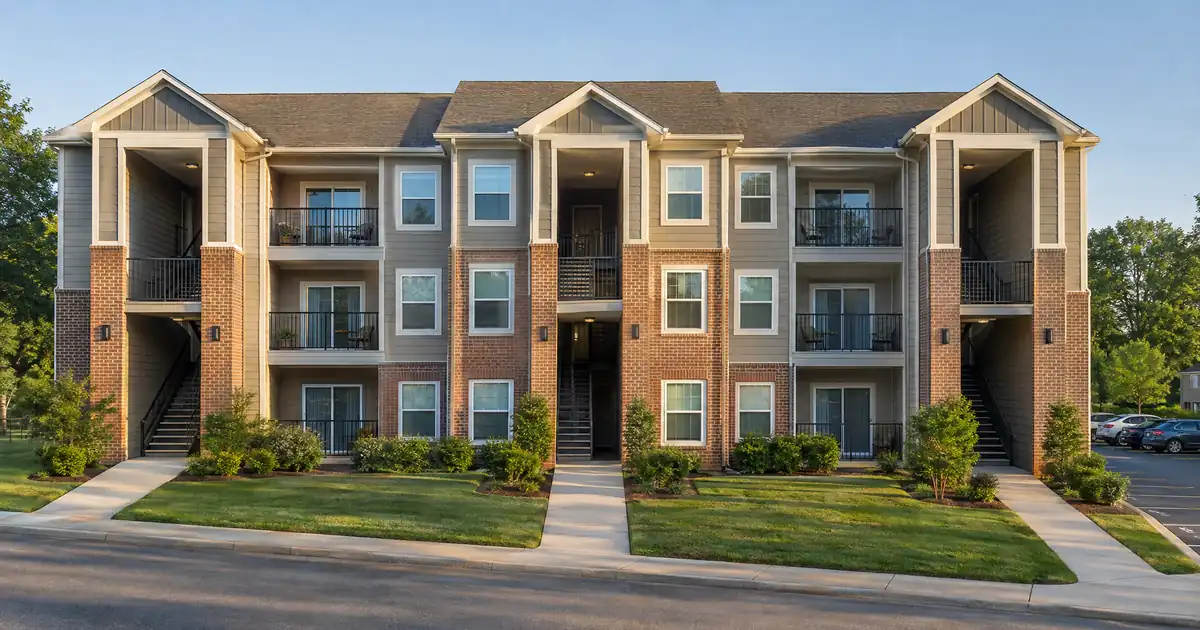
Multifamily 5+ Bank Statement Loan Complete Guide — The Quick Read: A property with five or more units doesn’t fit the underwriting world that classic bank statement loans were built for. Once a building crosses that line, the main qualifying test changes. It shifts from the sponsor’s personal bank deposits to the property’s own rental income measured against its debt. Bank-statement-style income analysis doesn’t disappear at 5+ units. It gets layered onto a property-level DSCR or NOI test instead of replacing it. How that layering actually works is the part almost nobody explains clearly.
Key Takeaways
- The 1-4 unit vs. 5+ unit line is a unit-count threshold, not a price or experience threshold — it applies the same way to a $400,000 fiveplex and a $4 million apartment building.
- Standard bank statement programs — typically 12 months of deposits, up to 90% LTV on a primary residence, up to 75% LTV on an investment cash-out, depending on the lender — are built around residential-style, 1-4 unit collateral.
- Once a property has 5+ units, property-level income (DSCR or NOI) becomes the primary qualifying test in most non-QM and portfolio lending, with bank-statement-style sponsor income layered on top rather than standing alone.
- A 5-8 unit “gray zone” exists where some lenders extend DSCR-style qualification because the building is too small for efficient commercial/CMBS execution but too large for standard 1-4 unit residential programs.
- Lookback period — commonly a 12-month or 24-month statement review — is one of the biggest variables separating hybrid multifamily bank statement programs from each other.
What Actually Changes at 5 Units
The number of units on the deed decides which underwriting world a property lives in. The loan officer’s product menu doesn’t decide it. The borrower’s income level doesn’t decide it. The loan amount doesn’t decide it either. A duplex, triplex, or fourplex gets treated as residential-style collateral almost everywhere in the mortgage system. A building with five or more units generally does not.
What your deposits qualify you for in your market.
Alt-doc programs read 12 months of business or personal bank deposits instead of tax returns. Enter your average monthly deposits and see the income a lender would credit you.
The expense factor is set by the lender from your business type and profit-and-loss statement; it is not a number you choose. This widget quotes no rate and no payment.
Program parameters shown update from Lendmire’s centralized guideline source.
Estimate
Illustrative estimate only — not a quote, Loan Estimate, approval, or commitment to lend. Deposit average, expense factor, and housing ratio are editable assumptions; the expense factor a lender applies is set from your business type and documentation. No interest rate or monthly payment is quoted here. Purchase capacity is a simplified illustration and does not account for taxes, insurance, HOA dues, or other debts. Alt-doc income documentation is available on consumer mortgages in the states where Lendmire is licensed for consumer lending; actual terms vary by lender, borrower, and property.
That distinction matters here because bank statement loans are, by design, a borrower-income verification method. The lender takes 12 months of business or personal deposits. Then the lender applies an expense factor to strip out estimated business costs. That leaves a qualifying income number, much like a tax return would produce in a conventional file. That math was built for the 1-4 unit residential lane. It still lives mostly there today. In that lane, the appraisal, the loan-to-value caps, and the qualification test are all built around one owner and one occupied or rented small property.
Cross into five units and the property itself starts carrying more of the underwriting weight. Rent roll, trailing operating expenses, and a debt-service coverage ratio move to the center of the file. The sponsor’s personal deposits don’t vanish from the conversation. They just stop being the only thing the file leans on.
Key Terms Defined
DSCR (debt service coverage ratio): the property’s rental income divided by its full debt obligation — a ratio above 1.00 generally means the rents cover the payment, though the exact bar varies by lender and program.
NOI (net operating income): the property’s rental income minus its operating expenses — management, maintenance, utilities, taxes, insurance — before debt service is factored in; the core number used to test a 5+ unit building’s ability to carry its financing.
T-12 (trailing twelve-month operating statement): a twelve-month history of a property’s actual rental income and operating expenses, used in place of a borrower’s traditional personal-income documentation to establish how the building performs.
SREO (schedule of real estate owned): a summary of every property a sponsor owns, along with its financing, used to evaluate portfolio-wide exposure and experience.
PFS (personal financial statement): a snapshot of a sponsor’s assets, liabilities, and net worth, typically required alongside — not instead of — bank statement or property-income documentation on larger multifamily files.
Expense factor: the percentage a lender subtracts from gross bank deposits to estimate a self-employed borrower’s actual usable income; it’s a lender-set convention, not a fixed rule, and it can shift materially with documented support such as a CPA letter.
How Bank Statement Underwriting Actually Works
The mechanics stay fairly consistent across the non-QM market, even though the exact numbers vary lender to lender. Across files placed through Lendmire’s wholesale network, the review usually starts the same way. It looks at 12 consecutive months of statements from the same business or personal account. Large or one-time deposits get explained, and they’re typically excluded from the income calculation.
On a business account, the lender applies an expense factor. That’s a percentage assumption for the cost of running that type of business, and it turns gross deposits into usable income. On a personal account, deposits are often treated closer to face value. The reasoning is simple: the funds are assumed to already sit on the post-expense side of the ledger. Neither approach is standardized by regulation. Scotsman Guide’s coverage of the non-QM toolbox describes the common 50% expense-factor figure as an industry default. Individual lenders can — and do — adjust that default with documentation, such as a CPA or enrolled agent letter certifying a business’s actual cost structure.
That documentation flexibility is the whole game on a marginal file. The same twelve months of deposits can lead to two very different income conclusions. It depends on whether the default expense factor stands or gets replaced with a documented, lower one. On a 1-4 unit file, that number usually decides approval or denial outright. On a 5+ unit file, it becomes one input among several. It can help strengthen a guarantor’s profile, but it rarely decides the outcome once the property’s own income enters the picture.
Occupancy also decides which disclosure rules apply, and that’s a separate question from unit count. A loan on a non-owner-occupied 5+ unit building — short-term rental units included — is a business-purpose loan. It’s exempt from TRID’s consumer disclosure timeline. A bank statement loan on an owner-occupied 1-4 unit home works differently: it’s a consumer mortgage, and TRID applies. Getting that classification right at the start of a file avoids paperwork surprises later.
The Regulatory Line, In Plain English
The unit-count boundary isn’t just a lending custom that happened to stick. It’s built into two separate federal frameworks, and both land on the same number. The Consumer Financial Protection Bureau’s Ability-to-Repay/Qualified Mortgage compliance guide defines the “dwelling” covered by consumer mortgage rules as a residential structure with one to four units. Anything larger falls outside that consumer-mortgage framework — safe harbor and all.
HUD’s multifamily program descriptions draw an identical line from the housing-finance side. HUD describes its Section 207/223(f) refinance insurance as covering properties of five or more units. Picture a five-unit building in an inexpensive market next to a fifty-unit building in an expensive one. Both land in the same regulatory category for this purpose. Only the execution channel tends to differ by size within that category — the underlying classification doesn’t.
Standard residential appraisal tools reflect the same divide. The standardized small residential income property appraisal form covers two-to-four-unit collateral. It simply stops applying above that range. There’s no equivalent standardized residential form for a five-unit building. That’s part of why 5+ unit files lean on operating statements and NOI instead of comparable-rent appraisal math.
The 5-8 Unit Gray Zone
This is where most of the confusion — and most of the opportunity — actually lives. Buildings in the five-to-eight-unit range often sit in an awkward spot. They’re frequently too small to justify the cost and complexity of full commercial or CMBS execution. Yet they’re too large for the standardized 1-4 unit residential toolkit that a fourplex or triplex enjoys. A meaningful share of non-QM lenders have built DSCR-style programs to serve this gap. These programs test the property’s own rents against its debt service, rather than requiring the full commercial underwriting apparatus a 50-unit apartment deal would demand.
On these files, the property qualifies primarily on property-level rental income covering the payment, subject to lender guidelines. Bank-statement-derived sponsor income supports that test rather than replacing it. Even inside the gray zone, a pure bank-statement-only path for the property itself is uncommon. What shows up instead is a hybrid. DSCR or NOI carries the property-level qualification. Bank-statement analysis on the sponsor’s accounts backs up the guarantor side. This is particularly useful when a self-employed investor’s traditional personal-income documentation understate real cash flow — a common situation among small-portfolio landlords and short-term rental operators alike.
Programs below a 1.00 coverage ratio are available through select lenders in Lendmire’s network for stronger files. Leverage and terms adjust accordingly when a property’s rents don’t fully cover its payment on paper. That’s a structural tradeoff, not a workaround, and it plays out differently in the 5-8 unit gray zone than it does on a straightforward fourplex.
The Hybrid Structure in Practice
Picture a seven-unit building where trailing rents test out to roughly 0.95x coverage against the payment on a straight NOI basis. That’s thin, but it’s not disqualifying on its own. The sponsor runs a small property management business through an LLC. That sponsor can document 12 months of business deposits showing consistent cash flow — well beyond what their traditional personal-income documentation reflect after depreciation and write-offs.
In a hybrid structure, the lender tests the property first. Does the rent roll and T-12 support a coverage ratio the program can work with, even below 1.00x? Then the sponsor’s bank-statement-derived income gets layered in as a compensating factor. It’s evidence that the guarantor has independent cash flow to backstop the property if a unit turns over or an expense spikes. Neither leg replaces the other. The property’s numbers set the baseline. The sponsor’s deposits either strengthen the file toward better leverage and terms, or they don’t move the needle much if the coverage ratio already clears comfortably on rents alone.
This works differently than a 1-4 unit bank statement file. There, the sponsor’s deposits are the qualification, full stop, and the property’s rental income — if any — plays a secondary role.
| Factor | 1-4 Unit Bank Statement Loan | 5+ Unit Hybrid/DSCR Structure |
|---|---|---|
| Primary qualification | Sponsor’s bank deposits | Property’s DSCR/NOI |
| Bank statements’ role | Core qualifying document | Compensating factor |
| Appraisal basis | Comparable-rent residential forms | Operating statement / T-12 |
| Typical leverage ceiling | Higher leverage generally available for purchase or rate-and-term transactions, with cash-out proceeds capped at a meaningfully lower level | Varies by lender; generally lower |
| Regulatory framework | Consumer mortgage rules if owner-occupied | Business-purpose, TRID-exempt |
Two Lookback Windows Change the Math
Unit count isn’t the biggest variable separating multifamily bank statement programs from each other. The bigger variable is how many months of deposits the lender wants to see. A shorter 12-month bank statement review captures a more recent snapshot of a sponsor’s cash flow. That helps a business that’s grown quickly, but it hurts one coming off a slow stretch. A 24-month lookback smooths that volatility out by averaging two years of deposits. That tends to favor stable, established operators over newer ones.
Neither window is uniformly better. Take a sponsor whose property management business doubled its client base in the trailing year — that sponsor usually prefers the 12-month version. Take one whose income dipped temporarily because of a vacancy cycle or a one-time capital expense — that sponsor often does better with the smoother 24-month average. Lenders differ meaningfully on which window they offer and how they treat inter-account transfers within it. Because of that, the choice of lookback period can matter as much as the DSCR test itself in a marginal file.
Where This Path Makes Sense — and Where It Doesn’t
A hybrid bank-statement/DSCR structure tends to fit a specific kind of deal. Picture a self-employed sponsor whose traditional income documentation understate real cash flow. That sponsor is buying or refinancing a building in the five-to-eight-unit range, and the coverage ratio is close but not comfortably clear on rents alone — that’s the sweet spot. It fits less well for a W-2 borrower with clean, straightforward income. That file usually qualifies faster on a pure DSCR basis, without adding a second documentation stream, per Lendmire’s complete DSCR loans guide.
It also fits less well the further a building moves past eight units. Once a deal reaches a size where agency, CMBS, or institutional commercial financing becomes efficient, sponsor bank statements tend to matter far less than they do in the small-multifamily gray zone. The deal gets underwritten almost entirely on property performance and sponsor experience.
Investors weighing this path against a straight single-family bank statement loan or a pure DSCR structure should size up the property first. Ask two questions: how close does it come to clearing on rents alone, and does the sponsor’s deposit history actually add anything a lender would credit? If the property clears comfortably on its own, layering in bank statement documentation adds paperwork without adding approval odds. If it’s borderline, that documentation can be the difference between a marginal file and one that clears.
Tax treatment can depend on how the funds are used and how the property is held. Investors should keep clear records and speak with a qualified tax professional before relying on any deduction.
If you are buying or refinancing a small multifamily property and want to see how the numbers work, Lendmire can help. Lendmire is a mortgage broker arranging financing through select lenders across a wholesale network spanning 40 markets, including Washington, D.C. Lendmire’s team can help compare bank statement and DSCR structures based on the property’s income, the sponsor’s documentation, credit profile, leverage, and investor goals. Investors can reach Lendmire’s team at 828-256-2183 or request a quote directly to start that comparison.
Frequently Asked Questions
Does a bank statement loan work on a 5+ unit apartment building? Not as a standalone qualification method in most cases. Once a property has five or more units, the primary test shifts to the property’s own DSCR or NOI. Bank-statement-derived sponsor income gets used as a supporting factor, not the sole basis for approval, subject to lender guidelines.
Why can’t a 5-unit building use the same bank statement program as a fourplex? Because the underlying frameworks that define residential mortgage collateral stop at four units. That includes consumer mortgage rules and standardized residential appraisal forms. A fifth unit moves the property into a different classification entirely, regardless of price or the sponsor’s experience.
Can bank statements still help a sponsor qualify for a 5+ unit purchase? Yes, as a compensating factor layered on top of the property’s coverage ratio. Say a sponsor’s conventional personal-income paperwork understate real cash flow due to depreciation or write-offs. Documented bank deposits can strengthen the file’s overall profile in that case, even though they don’t replace the property-level test.
What’s the difference between the 12-month and 24-month multifamily bank statement programs? The lookback window. A 12-month review reflects recent cash flow more heavily, which favors sponsors whose income has grown. A 24-month review averages a longer period, which favors sponsors with more stable, established deposit histories.
Is a loan on a 5+ unit rental subject to the same disclosure timeline as a home loan? No. A loan on a non-owner-occupied 5+ unit rental property is business-purpose, and it’s exempt from TRID’s consumer disclosure requirements. A bank statement loan on an owner-occupied 1-4 unit home works differently — TRID applies there.
About Lendmire
Lendmire is a non-QM mortgage brokerage (NMLS# 2371349) arranging DSCR investor loans in 40 markets, including Washington, D.C. DSCR eligibility is generally reviewed around property-level rental income rather than personal income, subject to lender and program guidelines. That makes it a fit for self-employed investors and LLC-owned portfolios. Lendmire was recognized as a Scotsman Guide Top Mortgage Workplace in 2025 and 2026.
Lendmire’s Top Mortgage Workplace recognition is documented by Scotsman Guide 2025 Top Mortgage Workplace and Scotsman Guide 2026 Top Mortgage Workplace.
Get Started
Ready to find the right loan for you?
In about 30 seconds you can review financing options available for your home or investment property. No commitment required.
Informational only. Not a Loan Estimate, approval, or commitment to lend. Program availability and eligibility are subject to lender guidelines, credit approval, property review, and underwriting.
References
1. Scotsman Guide — Rev Up the Engine for Non-QM Lending
2. U.S. Department of Housing and Urban Development — Multifamily Programs
Brandon Miller
Founder & CEO, Mortgage Loan Originator, Lendmire LLC
- Mortgage Loan Originator · NMLS# 1129696 · Verify on NMLS Consumer Access
- North Carolina Real Estate Broker · License# 343312 · Verify on NCREC
- North Carolina Insurance Producer · License# 19053198 · Property, Casualty, Life, Health · Verify on NAIC SBS
- Lendmire LLC · Firm NMLS# 2371349 · Verify firm licensure
Legal disclosures. Lendmire (NMLS# 2371349) is a state-licensed mortgage brokerage that arranges financing through wholesale lender relationships. Lendmire is not a direct lender, depository institution, or registered financial advisor. The discussion above is general informational content about real estate financing — it is not financial, legal, or tax advice, and readers should consult licensed professionals for guidance on their individual circumstances. Loan inquiries are subject to lender underwriting; this article does not represent a commitment to lend. Loan terms, rates, and qualification standards vary by borrower, property, and state, and are subject to change at any time. Equal Housing Opportunity. NMLS Consumer Access: nmlsconsumeraccess.org.


