
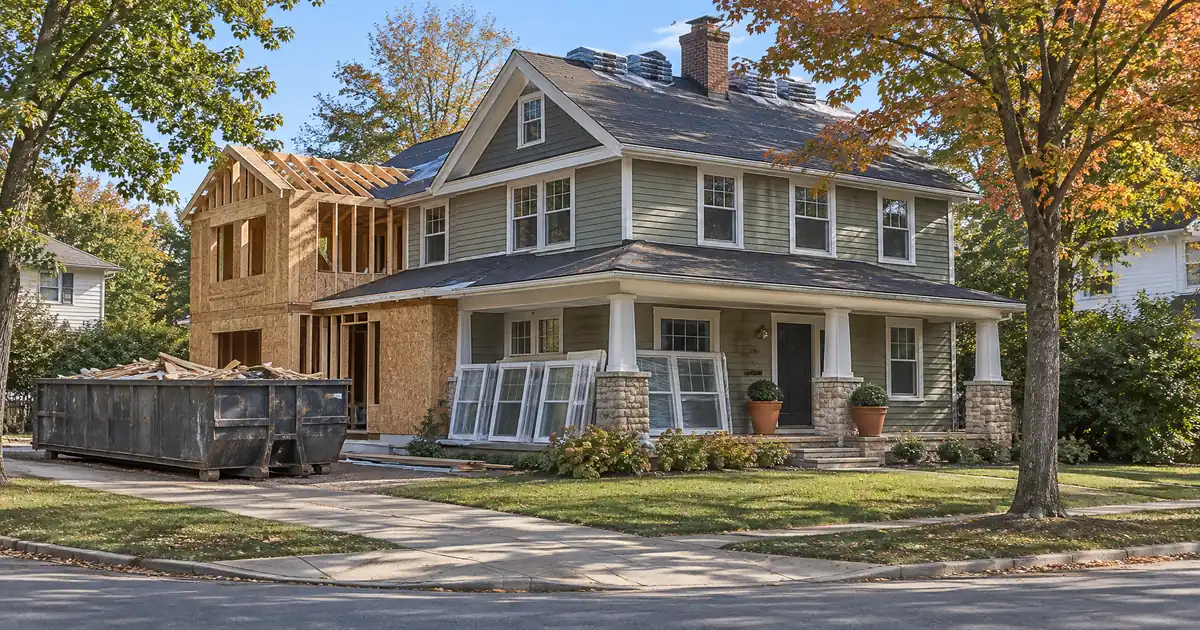
The Quick Read: Usually less than you hoped, because the line is sized from the value the lender recognized, not from what you spent, and on an investment property the combined loan-to-value ceiling is 70% with a $500,000 maximum line, subject to lender guidelines. The rehab only becomes borrowable equity once a valuation counts it.
- Formula: value × the combined loan-to-value (CLTV) cap, minus the balances already on the property.
- A corrected value raises the line only up to that cap, never past it.
- Permits, invoices, before-and-after photos, and renovated comps are what move a number.
How Does the Valuation Set Your Line Size?
The valuation sets the ceiling, and your spending does not. A lender takes the value it accepts, applies a percentage cap, and subtracts every lien already on the property. What is left is the most the line can be.
How large a line the equity supports.
An equity line is sized by combined loan-to-value, occupancy, and credit — not by rental coverage. Switch the occupancy or the credit band and the ceiling moves with it.
Investment-property lines require a 700 minimum credit score; second-home lines start at a 640 minimum and primary-residence lines at 600, and the combined-LTV ceiling steps down as the credit band drops on primary-residence and second-home lines and holds on investment-property lines; the line cap steps down on primary-residence lines and holds at every tier on investment-property and second-home lines.
A debt-to-income ratio above 45% requires 680+ credit. Profiles under 640 are limited to single-family homes. At least 75% of the approved line is drawn at closing. Ceilings, floors, and caps update from Lendmire’s centralized guideline source.
Line estimate
Illustrative estimate only — not a quote, Loan Estimate, approval, or commitment to lend. The rate is an editable assumption; equity-line pricing is variable through both the draw and repayment periods and never converts to fixed. Occupancy and credit drive the ceiling together: an investment property tops out at 70% combined LTV (minimum credit 700, line cap $500,000); a second home tops out at 90% combined LTV (minimum credit 640, line cap $500,000), with the ceiling stepping down as the credit band drops (the cap holds at every tier); a primary residence tops out at 90% combined LTV (minimum credit 600), and its $750,000 maximum line is available only at 75% combined LTV or below with a 700-or-better credit profile (720 on the longer-runway program) and a full appraisal. Lines above $500,000 require a full appraisal. Credit, debt-to-income, property type, and full underwriting review all affect the final line.
The federal consumer-finance regulator’s HELOC booklet describes the same logic. The credit limit starts as a percentage of the home’s appraised value, then the balance on the existing mortgage comes off. The lender also weighs your repayment-capacity and your credit history.
That is why a missed rehab hurts twice. The value is too low, so the cap is applied to a smaller base. The same percentage then leaves less room after the first mortgage comes off.
Bank statement income does not change any of this. It is a way of documenting what you earn. It does not touch what the property is worth.
Why Did the Valuation Miss Your Rehab?
Usually because of what the valuation was built to do. An appraisal or an automated valuation model (AVM, a computer estimate of value) reports value as of a certain date and in the condition the property was found. Work finished after that date, or work the model cannot see, is simply not in the number.
Authority Appraisals, an appraiser’s blog, draws a useful line. An as-is appraisal values the property in its actual condition on the effective date. An as-repaired or subject-to appraisal values a specified completed condition. The same source notes that when an appraisal looks back to an earlier date, later improvements don’t automatically become part of the property’s condition.
Here is how the common valuation types stack up on a rehab.
| Valuation type | Sees the rehab? | Typical remedy |
|---|---|---|
| Automated valuation (AVM) | Rarely, no interior view | Request a full appraisal |
| Full appraisal, as-is | Yes, if finished and comparable | Supply permits and comps |
| Appraisal dated before the work | No | Ask for a new effective date |
| Full appraisal, as-repaired | Values the completed work | Needs a lender that orders one |
A bank statement HELOC is not a rehab loan. Fix-and-flip lenders size on after-repair value (ARV). A HELOC is sized on current value.
What Is the Network’s Ceiling on an Investment Property?
On an investment property, the ceiling across our wholesale network is 70% CLTV, with a 700 minimum credit profile and a $500,000 maximum line. Every figure here is subject to lender guidelines and full file review.
Occupancy changes the answer a lot. On a primary residence, the network’s ceiling reaches 90% CLTV, but only at a 720-or-better credit profile and up to $500,000. At 700 or better, a primary residence reaches 85% up to $500,000. A line above $500,000 is primary-residence only, needs a 700 or better credit profile (720 on the longer-runway structure, the second of the two wholesale programs we place these lines with), and caps at 75% CLTV with a full appraisal. Second homes reach 90% at 720 or better, also up to $500,000.
If your rehabbed property is a rental, plan around 70%.
How Do You Calculate CLTV and the Maximum Line?
Maximum line = (value × cap) − existing liens. Then the line cap applies. CLTV counts all liens, including the new line, divided by value. Experian explains it by adding the primary mortgage balance to the desired HELOC limit, then dividing by the home’s value. Its example is $400,000 against a $500,000 home, which gives 80%.
Now see what a miss costs. Say your first mortgage equals 50% of the property’s true value. Say the cap is 70%. Here is the line room, expressed as a share of true value, at three valuations.
| Valuation recognized | Combined debt allowed | Room for the line |
|---|---|---|
| 100% of true value | 70.0% | 20.0% |
| 95% of true value | 66.5% | 16.5% |
| 90% of true value | 63.0% | 13.0% |
These are modeled assumptions, not program terms. They show the shape of the problem. A valuation that misses 10% of the property’s worth cuts the room for the line by about a third, from 20.0% of value to 13.0%.
The loss is bigger than the missed value because the first mortgage does not shrink. The whole shortfall comes out of the line. Run your own numbers before you order anything. Plug in your first mortgage balance, the value you were given, and the value you can support with comps.
Cost Is Not Value
Your rehab budget is not an appraisal input. Authority Appraisals gives a $300,000 as-is value plus $30,000 of repairs and says the result is not automatically $330,000. A renovation can be correctly noticed and still valued below what it cost.
Several things drive that gap. Appraisers work from comparable sales. BiggerPockets investors point out that in a rising market, an appraiser cannot state a value that the comps do not support. Some repairs add little appraised value, such as code-violation fixes like wiring, as another BiggerPockets thread on appraisal value versus ARV discusses. One investor there also describes an appraisal value well below the cost-approach figure, with the ARV unclear.
Another BiggerPockets post describes a rental purchase where the appraiser rated a fully renovated unit as average condition. In short, a rehab can be seen and still under-credited.
An improvement may support a higher appraised value, depending on comps and underwriter review. It never adds a fixed percentage or a dollar amount you can count on.
Ignored, Under-Credited, or Unpermitted?
Before you fight a number, work out which problem you have. The fix differs for each.
- Ignored. The valuation never saw the work. This is typical of an AVM or an appraisal with an effective date before completion. A full appraisal with documentation is the usual answer.
- Under-credited. The appraiser saw the work but valued it low. Look at the comps used. The fix is stronger, closer comps showing renovated sales, not more receipts.
- Unpermitted or unfinished. The work may not be counted at all, or may cut value. Close out permits before you ask anyone to look again.
Check the report. It states whether the value is as-is or subject to completion. A standard residential appraisal form carries that choice, and a BiggerPockets thread names the Fannie Mae Form 1004 as an example of it. That is contrast only, since the form governs the report’s format, not this loan’s terms.
What Goes in the Evidence Packet?
Lenders in the network can’t credit what they can’t verify. Bring these in one organized set:
1. Permits and final inspection sign-offs.
2. Contractor invoices and proof of payment.
3. Before-and-after photos, dated and labeled by room.
4. A scope-of-work summary listing what changed.
5. Three or four recent sales of renovated, similar properties nearby.
6. A short note on what the report got wrong, naming the comp or the condition rating.
Ask the lender whether you can request a full appraisal, because on lines of $500,000 or less you can, though an AVM is the ordinary default. Every line above $500,000 needs a full appraisal, but that tier belongs to primary residences. Investment lines stop at $500,000, so on a rental the full appraisal is a request you make, not a requirement.
On a full appraisal, a physical inspection is how the interior work gets seen. Have the property clean, accessible, and the paperwork in hand. Being present is usually fine and lets you point out upgrades, but the appraiser decides what to credit.
Can You Challenge the Value?
Sometimes. A lender may have a reconsideration-of-value (ROV) process, where you submit better comps or corrections for the appraiser to review. No public data shows how often an ROV changes the outcome, so treat it as a possible step, not a promise. The brokerage’s role is to ask the wholesale lender what review route exists on that file.
A new appraisal costs money and can come back lower, too. Run the math first. If the missed value is small, the cost of ordering may eat the gain in line room.
Plan conservatively either way. Size your project around the value a lender can verify today, not the after-repair number in your spreadsheet.
What Else Gates the Line Besides Value?
Value is one test. The rest of the file still matters, and a better appraisal does not erase any of it.
Income. Bank statement is a documentation method, not a separate product. On this network it commonly means 12 months of statements as a program choice, and some programs ask for 24. Deposits are still reviewed and adjusted. The borrower is reviewed on documented income under the applicable program, subject to lender guidelines.
Credit and debt. Investment lines need at least a 700 credit profile. Maximum debt-to-income is 50%, and 45% for credit from 600 to 679, with anything above 45% needing 680 or better. The lender reviews the file on the interest-only payment at the maximum draw.
Title. The line must be held by you personally or by a revocable living trust. An LLC, corporation, or partnership cannot hold title on these lines, so a rental already deeded to an LLC needs a vesting change or a different product, per program requirements.
Property. Single-family, 2-4 units, PUDs, townhomes, and condos, including non-warrantable condos, are eligible. Manufactured homes, co-ops, condotels, log homes, commercial, mixed-use, and agricultural zoning are not offered.
Exposure. A borrower is limited to three lines, and a borrower with more than 15 financed properties is not eligible.
Location. These HELOC programs run only in Lendmire’s 16 full-service states, narrower than its 41-market DSCR footprint. Some states add listing-status rules.
Strong rent does not raise a bank statement line. The line is sized from your personal file and equity, not from the property’s rental income.
If the Value Still Won’t Move
You have several paths. Which fits depends on your numbers.
| Option | How it works | Best when |
|---|---|---|
| Smaller line | Borrow what the recognized value supports | You need less than the cap allows |
| Wait, then re-value | Let comps catch up or finish permits | The gap is temporary |
| Full appraisal request | Pay to have the work seen | The AVM clearly missed it |
| DSCR cash-out refinance | Appraisal-based, rent-tested loan | The property is leased and rent covers the payment |
A DSCR cash-out refinance is a separate loan. It qualifies primarily on property-level rental income covering the payment, subject to lender guidelines. The network’s cash-out tops out around 75% LTV on standard rentals, with 70% on short-term-rental collateral, and about 6 months of seasoning is the common expectation. Most programs want around a 660 score, with a 620 floor in parts of the network.
A DSCR loan also clears LLC-held properties, per lender program requirements, where the HELOC does not. It compares rent to PITIA (principal, interest, taxes, insurance, and any association dues) only. Clearing 1.00 is not the same as positive cash flow, since repairs, vacancy, and management sit outside the ratio. Coverage below 1.00 is available through select lenders in the network, with leverage and terms adjusted. For more, see our complete DSCR loans guide.
Our piece on comparing a bank statement HELOC with a cash-out refinance when the appraisal ignored your rehab covers that choice in full. Here the point is simpler: if the leased property’s rent supports the payment, a rent-tested loan may use a different valuation path than a HELOC.
Key Terms Defined
CLTV (combined loan-to-value): All loans secured by the property, including the new line, divided by its value.
AVM (automated valuation model): A computer estimate of value built from data, with no interior inspection.
As-is value: What the property is worth in its actual condition on the appraisal’s effective date.
As-repaired value: What the property would be worth with specified work completed.
ROV (reconsideration of value): A request asking the lender to review an appraisal using new evidence.
Draw period: The stretch when you can borrow and pay interest only, before repayment begins. Investment lines here run a 5-year draw followed by a 25-year repayment, and pricing floats.
Frequently Asked Questions
Does bank statement income change how the property is valued?
No. Bank statements document your income for qualification. The valuation is a separate step based on the property’s condition and comparable sales. A strong income file cannot raise a low value.
Can I get a full appraisal on a line under $500,000?
Yes. Lines at or below $500,000 ordinarily run an automated valuation, but a borrower may request a full appraisal in any case. A higher CLTV may also trigger a secondary valuation. Request it before the valuation is finalized if you know the rehab is recent.
Will a better appraisal raise my line past 70% on a rental?
No. A corrected value fixes the base the percentage applies to. It cannot lift an investment line past the 70% CLTV ceiling or the $500,000 maximum, and credit must still reach at least 700.
Does my rehab spending count as equity?
Not automatically. Equity is value minus liens, and value comes from comps and condition, not receipts. The work may support a higher appraised value, depending on comps and underwriter review.
My property is in an LLC. Can I still use this?
Not as is. Title must be held by you personally or in a revocable living trust. A deed change may be possible, or a DSCR cash-out refinance may fit better, subject to lender program eligibility.
Next Step
If you are considering a home equity line and want to see how the numbers work, Lendmire can help you compare HELOC options based on the property, the equity available, credit profile, combined leverage, and your goals. Lendmire is a mortgage broker, not a lender, and every figure is subject to lender guidelines and full file review. Reach the team at 828-256-2183 or request a quote.
Test the line against the value you can prove, not the value you built.
About Lendmire
As a mortgage broker (NMLS# 2371349), Lendmire helps homeowners and real estate investors in its 16 full-service states open home equity lines of credit arranged through wholesale lenders. Lendmire is never the lender; line amounts, ceilings and terms are set by the lender under its guidelines. Scotsman Guide named Lendmire a Top Mortgage Workplace in both 2025 and 2026.
Get Started
Ready to find the right loan for you?
See your offer in seconds. No credit pull, no obligation.
Informational only. Not a Loan Estimate, approval, or commitment to lend. Program availability and eligibility are subject to lender guidelines, credit approval, property review, and underwriting.
References
2. Authority Appraisals: As-Is vs. As-Repaired Appraisals
3. Experian
5. BiggerPockets: Appraisal Value vs ARV
This article is part of Lendmire’s bank statement HELOC program — full qualification details, guidelines, and scenarios live on the program page.
Related reading: Can You Get a Bank Statement HELOC for Landlords Declined by Their Bank? · Can You Get a Bank Statement HELOC With a Tenant Mid-Lease? · Can You Get a Bank Statement HELOC Approval Before an Appraisal?
Brandon Miller
Founder & CEO, Mortgage Loan Originator, Lendmire LLC
- Mortgage Loan Originator · NMLS# 1129696 · Verify on NMLS Consumer Access
- North Carolina Real Estate Broker · License# 343312 · Verify on NCREC
- North Carolina Insurance Producer · License# 19053198 · Property, Casualty, Life, Health · Verify on NAIC SBS
- Lendmire LLC · Firm NMLS# 2371349 · Verify firm licensure
Legal disclosures. Lendmire (NMLS# 2371349) is a state-licensed mortgage brokerage that arranges financing through wholesale lender relationships. Lendmire is not a direct lender, depository institution, or registered financial advisor. The discussion above is general informational content about real estate financing — it is not financial, legal, or tax advice, and readers should consult licensed professionals for guidance on their individual circumstances. Loan inquiries are subject to lender underwriting; this article does not represent a commitment to lend. Loan terms, rates, and qualification standards vary by borrower, property, and state, and are subject to change at any time. Equal Housing Opportunity. NMLS Consumer Access: nmlsconsumeraccess.org.