
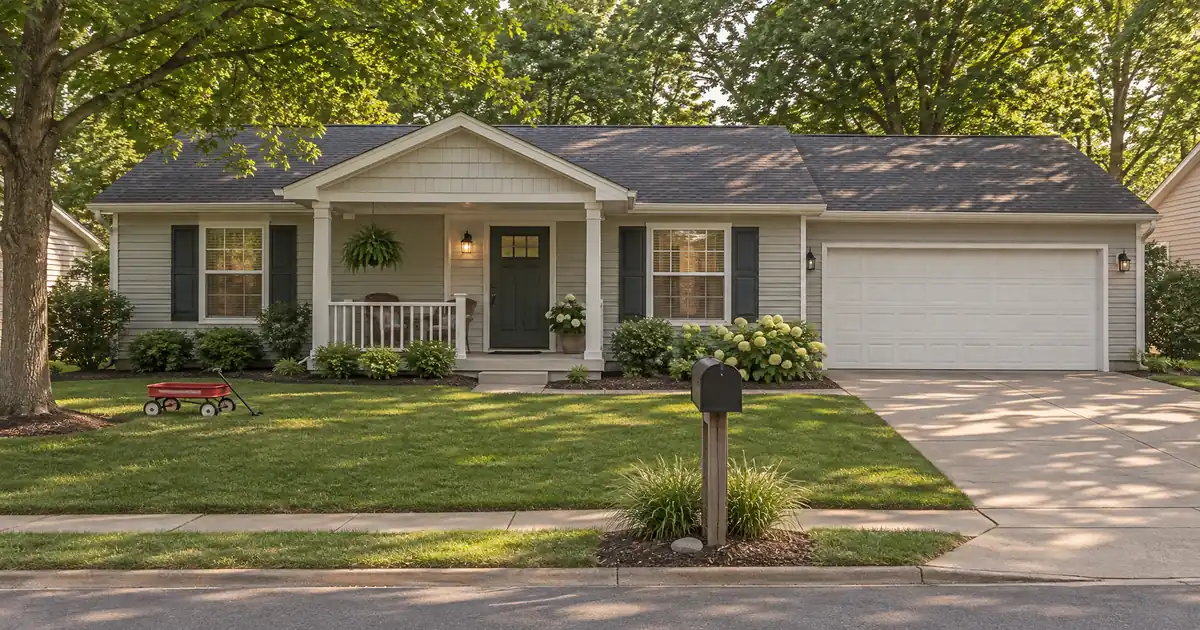
The Quick Read: The appraisal sets a single number, called reasonable value, and every equity calculation on a VA cash-out refinance is measured against it. The new loan, including any financed funding fee, can reach 100% of that value and no further. Your own estimate, an online valuation, or last year’s appraisal does not count. Whatever the payoff, closing costs, and fee consume inside that ceiling is gone before you see any cash.
What Is “Reasonable Value,” and Why Does It Control Everything?
Reasonable value is the figure VA’s appraisal process assigns to the home, and it is the denominator in every loan-to-value test on the file. Under 38 CFR 36.4306, the new loan cannot exceed 100% of the reasonable value of the home securing it. Congress set that ceiling in statute, and VA’s rulemaking explained it when it replaced the older, lower cap. The Federal Register notice walks through that change.
VA cash-out estimate
Seeded with an example value, a typical balance, and a round cash request at the first-use fee; change any field.
Editable benchmark: 7.18% as of November 5, 2026 · Freddie Mac 30-year average via FRED®. A conventional market reference, not a VA cash-out refinance quote.
Illustrative starting assumptions: a $350,000 home value, a $193,000 current balance, the full-value VA cap with the first-use funding fee financed, a thirty-year term at the current Freddie Mac benchmark, and property taxes and insurance estimated at typical national rates. Every field is editable.
Illustrative estimate only — not a Loan Estimate, approval, quote, or commitment to lend. The rate field carries the weekly Freddie Mac thirty-year conventional benchmark, a market reference and not a VA cash-out refinance quote; a VA loan is priced by the lender at lock. The total loan, funding fee included, is capped at the program leverage on the reasonable value; the fee follows the tier chosen. The cash available is what the cap allows less the balances paid off and the fee, before closing costs, which are not included. The HELOC line is the line program’s combined loan-to-value ceiling applied to the same value and balance. Taxes and insurance are editable estimates. The debt-to-income figure is a guideline; residual income decides a VA file. Licensed in sixteen states for consumer mortgages.
The value reaches the lender on a document called the Notice of Value. A reviewer issues it after the appraisal is submitted. It states the reasonable value and lists any repairs the property must have. That document, not a listing price, a neighbor’s sale, or an app estimate, is the ceiling.
When a homeowner says, “I think I have a lot of equity,” the Notice of Value is where that belief gets tested. The equity you believe you have and the equity the Notice of Value supports can be different numbers.
Key Terms Defined
Reasonable value: The value VA’s appraisal process assigns to the home. It is the figure the loan ceiling is measured against.
Notice of Value (NOV): The document that states reasonable value and any required repairs.
Loan-to-value (LTV): The total loan amount divided by reasonable value, shown as a percentage.
Equity: The home’s value minus what you owe. It is a starting point, not the amount you can withdraw.
Net tangible benefit (NTB): A test showing the new loan is in the borrower’s financial interest. The lender must give you this comparison.
Funding fee: A one-time VA fee, often financed into the loan. Exempt veterans, such as those receiving compensation for a service-connected disability, do not pay it.
How Does a Lender Turn the Appraisal Into a Cash Figure?
The lender multiplies reasonable value by the cap, then subtracts everything the new loan must cover. What remains is the cash available. Here is the sequence, step by step:
1. Start with the Notice of Value. Take the reasonable value stated there.
2. Apply the ceiling. The maximum loan is that value times the cap. For VA cash-out, the program reaches 100% of the appraised value, financed fee included.
3. Subtract the payoff. The existing loan must be paid in full. Any other lien that has to clear, such as a second mortgage, comes out here too.
4. Subtract financed costs. Closing costs you choose to roll in use up part of the ceiling.
5. Subtract the financed funding fee. VA Circular 26-19-05 says LTV is the total loan amount, financed fee included, divided by reasonable value. The fee sits inside the cap. It is not added on top.
6. Apply any lender cap. Some lenders set a lower ceiling than the program allows.
7. What remains is your cash.
The funding fee is a percentage of the loan amount. For a cash-out refinance across the wholesale programs we use, it is 2.15% on first use and 3.3% on subsequent use, and it is waived for exempt veterans. Because the fee is a percentage of a larger loan, a repeat user feels it more in the cash figure.
Gross Equity vs. Net Cash
| Step | What it measures | Effect on cash |
|---|---|---|
| Reasonable value | Appraised ceiling base | Starting point |
| Times the cap | Maximum total loan | Sets the limit |
| Minus payoff and liens | What you owe | Reduces cash |
| Minus financed costs | Rolled-in closing costs | Reduces cash |
| Minus financed fee | Funding fee inside the cap | Reduces cash |
| Remainder | Cash to you | The real number |
Everything between the top line and the bottom line is a subtraction. A borrower who looks only at value minus payoff is looking at gross equity. The net figure is smaller.
What Happens When the Appraisal Comes In High, As Expected, or Low?
Because value is the multiplier, any change in the appraisal moves the ceiling by the same proportion, and the cash moves by more than the value does. The payoff, costs, and fee are roughly fixed, so each percentage point of value difference lands almost entirely on the cash.
| Appraisal result | Ceiling | Cash available |
|---|---|---|
| Higher than expected | Rises | Grows by more than the value change |
| As expected | Matches plan | Matches the estimate |
| Lower than expected | Falls | Shrinks, possibly to nothing |
Picture a homeowner whose estimate puts the value comfortably above the payoff, and whose appraisal then arrives a few percent lower. The payoff and the financed fee have not changed, so the entire shortfall comes out of the cash. On a thin-equity file, a modest miss can erase the cash-out altogether and leave only a refinance of the existing balance.
Why Do Some Lenders Stop Short of 100%?
The program permits 100%, but a lender or investor may set a lower limit of its own. Many borrowers hear “VA cash-out goes to 90%” and assume it is a VA rule. It is not.
Ninety percent is a leftover from the older cap, and it now appears in two narrow places. The first is one of the listed ways to pass the net tangible benefit test: a new loan at or below 90% of reasonable value. VA treats that 10% equity preservation as one criterion out of many, so meeting a different criterion also passes. The second is a fixed-to-adjustable case with more than one discount point, where the regulation ties the LTV test to the number of points.
So a lender that stops below the program ceiling is applying its own overlay. Wholesale lenders differ here, and some set a lower leverage cap on certain files. A broker who shops several wholesale lenders can match a high-leverage request to a lender whose overlays allow it. Lendmire’s VA cash-out refinance program page lays out the program envelope the wholesale lenders work within.
Where the General Rule Breaks
Type I and Type II. VA’s circular defines two kinds. In a Type I, the loan amount, including the funding fee, does not exceed the payoff of the loan being refinanced. In a Type II, it exceeds the payoff, and the borrower takes cash. The 100% ceiling applies to both.
Refinancing a non-VA loan. A VA cash-out can pay off any loan type and convert it into a VA loan. The net tangible benefit test still applies. A borrower can even do this with no cash out, simply to move into VA terms.
Liens other than the first mortgage. A second mortgage or a past-due obligation secured by the home has to be cleared at closing. It comes out of the same ceiling, so it reduces cash dollar for dollar.
Repairs on the Notice of Value. Condition issues can also affect the value assigned, which is why a home in poor shape may produce a lower ceiling than a similar one in good repair.
Seasoning. The VA cash-out carries seasoning of the later of 210 days from the first payment and the sixth payment. The net tangible benefit is a separate requirement. Seasoning is a timing test, apart from the equity count, but it can delay a refinance when equity is not the problem.
State limits. Some states add their own limits on cash-out lending. A general note is enough here: confirm with a loan officer whether your state adds one.
Rate-reduction tests do not apply. The half-percent rate-reduction and fee-recoupment tests belong to the IRRRL, VA’s streamline. They do not apply to the VA cash-out.
What If the Appraisal Comes In Low?
You have options, and none of them require accepting the number as final. In practice, borrowers weigh the following:
- Ask for reconsideration of value. After the NOV, the veteran can request that VA reconsider the value. A VA regional office guide confirms reconsideration requests are permitted after the Notice of Value. The request works best with new, relevant comparable sales or a documented error, not just disagreement.
- Take a smaller cash-out. If the equity supports less cash, the loan can be sized down to fit the new ceiling.
- Bring cash to closing. A borrower who wants a specific amount may cover part of the payoff or costs out of pocket.
- Wait and reapply. If the market or the home’s condition is the issue, waiting can change the outcome. Seasoning and file details matter here.
The process VA built for disputing a value was designed mainly with purchases in mind. On a refinance, the stakes are different: a low value shrinks your cash rather than breaking a contract. That makes the reconsideration decision a cost-benefit call, not an emergency.
Does the Appraisal Decide Approval on Its Own?
No. The appraisal sets the ceiling, but the loan still needs full underwriting. Residual income is the controlling test on a VA file. The 41% debt-to-income figure is a guideline, not a cap, so a ratio above it simply needs residual income well above the table. Credit matters too. VA sets no minimum score, while the wholesale programs we place VA files with start at a 580 decision score. Your Certificate of Eligibility from VA decides eligibility, and service requirements are VA’s rules.
The net tangible benefit test also has to pass. The lender must give you the comparison of your old and new loan within three business days of your application, and again at closing. VA lists eight benefits, and passing the test takes one of them; that is a separate question from how much leverage the loan carries. Leverage, reserves, and pricing vary by lender and program, and the final terms follow the full file review.
One more point on the borrower’s side: the lender must give you a free copy of the appraisal and notify you in writing of that right, under the CFPB’s rule on appraisal copies. A lender can charge a reasonable fee for the appraisal itself, but not for the copy. Read the appraisal when you get it, and look for errors in square footage, room counts, or comparable sales that could support a reconsideration request.
How Do You Estimate Cash Before the Appraisal Arrives?
Work backward from a conservative value. Take a value a few percent below your best estimate, apply the cap, subtract your payoff, then subtract the financed fee and any costs you plan to roll in. If the result still covers your need, the plan is sturdy. If it only works at your highest estimate, the plan is fragile.
Think about two homeowners with the same payoff. One needs a modest amount of cash and has a wide cushion above the payoff. A lower appraisal barely changes the outcome. The other needs close to the maximum, and a small miss removes the margin. The second homeowner should treat the first number a loan officer gives as a range, not a promise.
Be honest about the budget side as well. A larger balance means a larger monthly obligation and more total interest over time. And at a very high LTV, a decline in home prices can leave a borrower owing more than the home is worth. Pulling the maximum is allowed. Whether it is wise depends on what the cash is for and how much room the household budget has.
Common Misconceptions
- “VA caps cash-out at 90%.” The cap is 100% of reasonable value. Ninety percent is one benefit test and one narrow discount-point case. Any lower cap on your file is a lender overlay.
- “My online estimate is my value.” The Notice of Value decides.
- “The funding fee goes on top of 100%.” It counts inside the cap.
- “A cash-out needs an existing VA loan.” A VA cash-out can refinance a conventional, FHA or other loan into VA.
- “Anything under 100% qualifies.” The net tangible benefit test and full underwriting still apply.
- “I have to pay for my copy of the appraisal.” You do not.
Frequently Asked Questions
Is an appraisal required on a VA cash-out refinance?
Yes. A VA appraisal is part of the cash-out process, which is one of the main differences from the IRRRL streamline, where no VA appraisal is required. The appraisal produces the reasonable value that caps your loan.
Can I choose the appraiser?
No. The appraisal is ordered through the lender and assigned through VA’s process. What you can do is review the report and, if you find errors or have better comparable sales, request reconsideration of value after the Notice of Value.
Does the financed funding fee count toward the 100% limit?
Yes. VA’s circular measures LTV using the total loan amount, financed fee included. The fee cannot push the loan above reasonable value, so a larger fee means less cash. Exempt veterans do not pay it.
Why does my lender cap me below 100%?
The program permits 100%, but individual lenders can set lower limits as an overlay. The lenders that write the highest leverage depend on your credit, property, and file details. A broker that works with several wholesale lenders can compare overlays and match your scenario to a program, subject to lender guidelines and full file review.
What happens if the appraisal is lower than I expected?
The ceiling drops, and your cash shrinks by more than the value does, because payoff, costs, and fee stay about the same. You can request reconsideration, take less cash, bring money to closing, or wait.
Next Steps
If you are weighing a cash-out refinance against keeping the loan you have, Lendmire can help you compare the programs and the equity each one reaches. All program figures are subject to lender guidelines and full file review, and none of this is a commitment to lend.
For your own numbers, request a scenario review with Lendmire.
About Lendmire
Lendmire, NMLS# 2371349, is a mortgage brokerage with consumer lending licenses in 16 states. FHA, VA, conventional and jumbo purchase and refinance loans are arranged through wholesale lending partners, and each application is reviewed individually by the lender. Scotsman Guide named Lendmire a Top Mortgage Workplace in both 2025 and 2026.
Get Started
Ready to find the right loan for you?
See your offer in seconds. No credit pull, no obligation.
Informational only. Not a Loan Estimate, approval, or commitment to lend. Program availability and eligibility are subject to lender guidelines, credit approval, property review, and underwriting.
References
2. Federal Register, VA cash-out refinance rule
4. VA Denver Regional Loan Center appraiser guide
5. VA
This article is part of Lendmire’s VA cash-out refinance program — full qualification details, guidelines, and scenarios live on the program page.
Related reading: How to Qualify and Apply for a VA Cash-Out Refinance When the Appraisal Is Low · How to Get the Most Cash From a VA Cash-Out After Payoff and Costs
Brandon Miller
Founder & CEO, Mortgage Loan Originator, Lendmire LLC
- Mortgage Loan Originator · NMLS# 1129696 · Verify on NMLS Consumer Access
- North Carolina Real Estate Broker · License# 343312 · Verify on NCREC
- North Carolina Insurance Producer · License# 19053198 · Property, Casualty, Life, Health · Verify on NAIC SBS
- Lendmire LLC · Firm NMLS# 2371349 · Verify firm licensure
Disclosure information. Lendmire is a state-licensed mortgage brokerage under NMLS# 2371349. Lendmire is not a depository institution, direct lender, or financial advisor — all loans referenced are placed through wholesale lender partners and are subject to each lender's underwriting standards. This article is provided for general informational purposes and is not a commitment to lend, nor does it constitute financial, legal, or tax advice. Loan programs, terms, rates, and qualification standards change without notice and depend on borrower profile, property type, and the state in which the subject property is located. Equal Housing Opportunity provider. NMLS Consumer Access: nmlsconsumeraccess.org.