
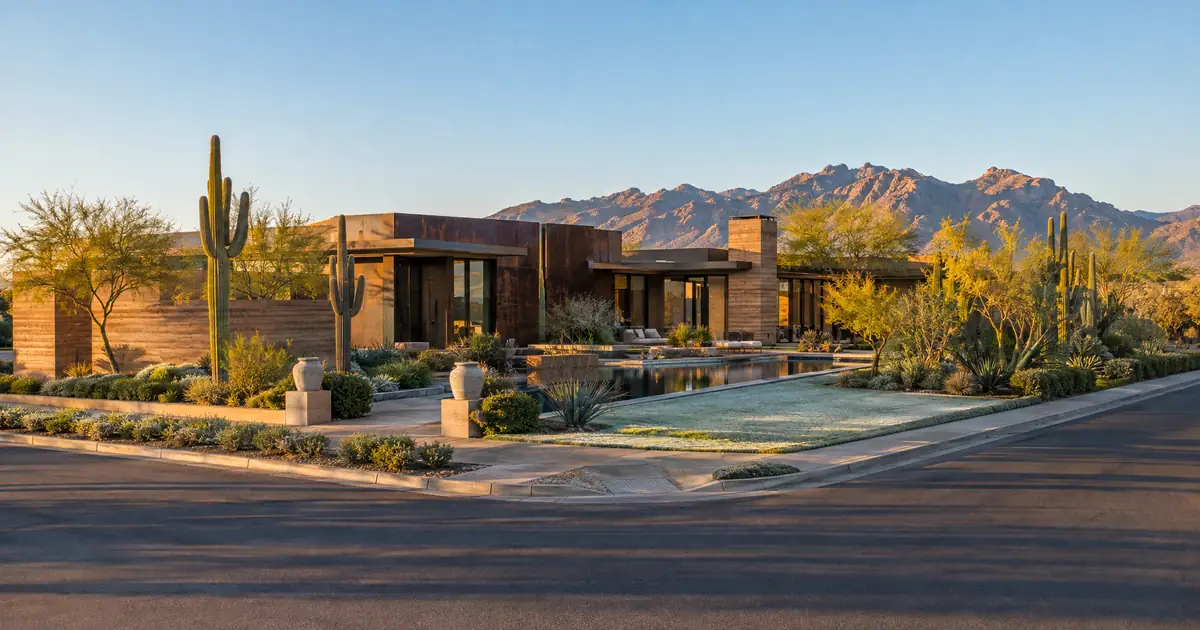
The Quick Read: On a super jumbo bank statement loan, your deposits qualify you and a separate appraisal values the property, and for a rural estate that appraisal usually decides whether the file fits a program at all, how much leverage it supports, and whether a second review is ordered.
- Deposits set income; the appraisal sets value. The two tracks never overlap.
- The lender orders the appraisal, usually through a management company. You typically pay for it.
- Options run from one full appraisal to a rural-experienced appraiser, a second appraisal, or a review of the first.
- Through select wholesale programs, rural collateral has hard limits: ten acres or less and never above $3,000,000.
- Every file above $4,000,000 is reviewed case by case before submission, subject to full underwriting.
How Does the Appraisal Fit a Bank Statement File?
The appraisal fits as a second, independent track. Bank statements prove the borrower can repay. The appraisal proves the collateral is worth the loan. A strong deposit history never raises a weak property value, and a strong property never fixes thin deposits.
Here is how the two tracks compare.
| Factor | Income track | Collateral track |
|---|---|---|
| What it tests | Borrower’s repayment ability | Property value and use |
| Evidence | 12 or 24 months of statements | Lender-ordered appraisal |
| Who controls it | Borrower supplies records | Lender picks the appraiser |
| What it sets | Qualifying income, DTI | Loan size and leverage |
On the income side, most programs in Lendmire’s wholesale network use 12 or 24 consecutive months of personal or business statements. Qualifying income is eligible deposits divided by the statement months, after an expense ratio. Business statements need at least 25% ownership. Fixed expense ratios vary by business type and staffing, with lower ratios for a service business with no employees and higher ratios for businesses with more employees or any product business. An accountant-provided ratio or a profit-and-loss method are also options. Transfers from your own business into a personal account count in full. This is reviewed on documented income under the applicable program, subject to lender guidelines. It is not a skip-the-paperwork loan.
That income work finishes before the appraisal matters. Then the property gets its own scrutiny.
What Are the Appraisal Options on a Rural Estate?
You have four main options, and the lender chooses which apply. A standard full appraisal is the base case. A rural-experienced appraiser is the most useful upgrade. A second appraisal or a review is a lender choice at larger balances. A rent schedule is added only if the property is rented.
| Option | When it applies | What it adds | Main risk |
|---|---|---|---|
| Full appraisal | Every file | Value opinion | Thin comps |
| Rural-experienced appraiser | Acreage, outbuildings | Better comp logic | Narrow pool |
| Second appraisal or review | Larger balances, odd features | Cross-check on value | Extra cost |
| Rent schedule | Rented property | Market rent estimate | Few rental comps |
The first option is a single full appraisal on the residential form. The lender orders it through an appraisal management company, so you cannot pick the appraiser. You can still ask that the assignment go to someone who works rural markets, and it helps to say so at the start.
The second option matters more as the estate gets less ordinary. McKissock Learning, which trains appraisers, describes the usual rural problems: thin sales data, large acreage, unconventional designs and outbuildings. It adds that distance, dated sales and property differences must be explained in the report. An appraiser who has not done that work before will struggle to explain those choices.
The third option is the one borrowers ask about most. Experian notes that lenders often want two appraisals on jumbo loans because high-priced homes are hard to value from comparable sales. It is a lender policy, not a rule. Across the network, some programs always order a second appraisal at larger sizes. Where two values exist, the lower one typically drives loan sizing. Ask your broker which approach the program uses before you pick it.
The fourth option applies only to rented estates. A rent schedule estimates monthly market rent, not nightly short-term rates. Rural rental comps are scarce, so the schedule can be thin. If the property is mainly a rental, the property’s income may carry the loan on its own. Lendmire’s complete DSCR loans guide covers that route, and an estate you live in or use occasionally often fits the bank statement path better.
How Does the Appraiser Value a Rural Estate?
The appraiser builds value from comparable sales, then adjusts for every difference between those sales and your estate. In a rural market, sales are few and far apart. The appraiser widens the search, explains why each sale was chosen, and adjusts for acreage, buildings, wells, septic and utilities.
Acreage does not add value by simple multiplication. The market pays for land through what buyers actually spend, not a per-acre formula. So an estate with more land is not automatically worth more.
The appraiser also splits the property into parts. The home and the land it needs to function are the residential site. Land beyond that is excess land, and it is valued differently. Programs size the loan on the lower of the appraised value and the price. If much of the value sits in excess acreage, the lender may not give it full credit.
The appraiser’s main tools are three approaches to value. Each answers a different question.
- Sales comparison: what similar properties sold for.
- Cost approach: what it would cost to rebuild the improvements, plus land value.
- Income approach: what the property earns, which mostly matters for rented collateral.
For a custom rural home, the cost approach often serves as a cross-check when comparable sales are weak.
One brief contrast helps here. Agency eligibility rules do not govern these loans. Program limits come from the wholesale lenders themselves.
Where Do Acreage and Rural Classification Break the Rule?
Rural classification and acreage are different tests, and both matter. Acreage is a number. Rural is a judgment the appraiser and lender make about the market, the access and the use. An estate with eight acres in a thin market can be rural. An estate with twenty acres near a town may not be.
Through select wholesale programs, rural collateral is limited, subject to full underwriting. Rural property is typically capped at 80% leverage on ten acres or less. It does not go above $3,000,000. Above the super jumbo line, which sits at $3,500,000 on a primary residence and $3,000,000 on a second home or investment property, the overlays say no rural property and ten acres maximum. Those overlays also add a 700 credit floor and a 0x30x24 housing history.
Put together, a rural estate above $3,000,000 usually lands outside these programs. Above $4,000,000, everything is reviewed case by case before submission. Assume rural property above those lines is not accepted, and check eligibility first. If your estate runs beyond ten acres, Lendmire’s piece on whether a twenty-acre estate can qualify for a super jumbo bank statement loan covers that edge in detail.
Three other edge cases come up often.
Agricultural indicators. Enact MI’s rural appraisal training says large barns, silos or livestock facilities can signal an agricultural property. Agency eligibility does not bind these lenders. A working farm, though, may fail the residential-use test a program applies.
Unusual features. Wells, septic, timber, shops, arenas, guest houses and multiple tax lots may each be analyzed on their own. Give the appraiser a list.
Leverage on rented or second-home estates. Second homes and investment property run about five points lower than a primary residence at every size. A second-home or rental estate therefore carries a lower leverage ceiling than the 80% primary-residence cap.
What Does the Leverage Ladder Look Like at These Sizes?
Leverage steps down as the loan grows, and the appraised value feeds that math directly. On a primary residence purchase, ceilings run 90% to $1,000,000, 85% to $2,000,000, 80% to $3,000,000, and 75% to $4,000,000 at the top credit tier. These figures come through select wholesale programs, subject to full underwriting. Above $4,000,000 each file is reviewed case by case.
Credit floors rise with the balance. Programs typically want 660 on the portfolio program, 680 on the bank program, and 700 above the super jumbo line. Debt-to-income can reach 50%. Reserves run 3 months to $500,000, 6 months to $1,500,000, and 9 months above that, with extra reserves for each additional financed property.
Cash-out is tighter. On a primary residence cash-out, the ceiling is 80% from $300,000 to $1,500,000, then falls as the loan grows. Because rural collateral is capped at 80% at best, a rural cash-out will usually sit well below that.
How Does a Low Appraisal Change the Loan?
A low appraisal changes the loan before it changes anything else. Take a modeled estate under contract at $2,400,000 on ten acres, bought as a primary residence at 80% leverage on a purchase. Assume the appraisal comes in 5% under the contract price. The program sizes the loan on the lower value, so the loan shrinks and you fund the difference in cash on top of your original down payment. This example is illustrative only and not a quote. Each figure is subject to lender guidelines and a complete review of property type, leverage, and credit.
When that happens, the decision path usually looks like this:
1. Read the comps. Check whether the appraiser used sales in the right market area and explained the adjustments.
2. Ask for reconsideration. Send better comparable sales and the facts the report missed, such as a recent permit or a finished outbuilding.
3. Renegotiate the price. If the market data does not support the contract price, that is your leverage with the seller.
4. Bring more cash or shrink the loan. Either keeps the file inside the program.
5. Consider a different program. The network has several, and their appraisal policies differ.
The worst move is to assume the purchase price equals value. On a rural estate, the price and the appraisal can sit far apart.
What Should You Hand the Appraiser?
You can help the appraiser without touching the outcome. The lender controls the order, and you do not contact the appraiser to push a number. You can give the lender facts to pass along:
- Survey and legal description
- List of outbuildings with size and use
- Well and septic records
- Land-use history and any easements
- Recent improvements and permits
- Suggested comparable sales, if you know the market
Under federal appraisal-delivery rules, you are entitled to a free copy of the report. The CFPB’s valuations rule summary covers first-lien dwelling loans. Read it when you get it. Errors on the report are much easier to fix early.
Common Mistakes
- Assuming strong deposits will outweigh a weak appraisal. They will not.
- Treating acreage as value. The market prices land by what buyers pay.
- Overlooking the rural limits until after a contract is signed.
- Assuming jumbo always means two appraisals. That is a lender choice.
- Assuming a bank statement loan skips appraisal or verification. It does neither.
Key Terms Defined
Excess land: acreage beyond what the home needs, valued apart from the residential site.
Rural classification: a lender or appraiser judgment about the market and use, separate from the acreage figure.
Comparable sale: a recent sale of a similar property that the appraiser adjusts to estimate value.
Review appraisal: a second appraiser’s check of the first report, often exterior-only.
Highest and best use: the legal, practical use that produces the most value for the site.
Appraisal management company: the third party a lender uses to order and manage appraisals.
Next Step
Lendmire is a broker that shops multiple wholesale programs. It is not the lender. Its consumer mortgage lending is licensed in 16 states, so confirm your property’s state before you build a plan around it. For a closer look at the review step, see Lendmire’s piece How to Navigate the Estate Appraisal on a Super Jumbo Bank Statement Loan.
This article is general information, not legal or tax advice, and every file is underwritten individually. Tax treatment can depend on how the funds are used and how the property is held; investors should keep clear records and speak with a qualified tax professional before relying on any deduction. Readers should consult an attorney or CPA about their own situation.
Frequently Asked Questions
Does a super jumbo bank statement loan on a rural estate always need two appraisals?
No. It is a lender choice that often depends on loan size. Some programs order a second appraisal at larger balances, some order a lighter review, and some accept one report. Ask which approach the program uses before you choose it.
Can I choose my own appraiser?
Not usually. The lender orders the appraisal, typically through a management company, to keep the work independent. You can ask for a rural-experienced appraiser and supply property records. You should not contact the appraiser to discuss value.
Does a distant comparable sale make the appraisal weak?
Not by itself. Rural markets have few sales, so appraisers often reach farther. Enact MI’s rural training says distant or dissimilar sales are acceptable when the appraiser supports them. The report has to explain the choice and adjust for differences.
How many acres can the estate have?
Through select wholesale programs, rural property typically runs ten acres or less and never above $3,000,000, with 80% as the leverage ceiling. Above the super jumbo line, rural property is not accepted. Every file above $4,000,000 is reviewed case by case before submission.
What happens if the appraisal comes in below the price?
The loan is sized on the lower value, so the gap becomes your cash. You can send better comps for reconsideration, renegotiate the price, bring more cash, or look at another program. Eligibility review depends on lender guidelines and full underwriting.
For current guidelines and terms, see Lendmire’s super jumbo bank statement loan programs page.
Lendmire’s self-employed mortgages page presents both super jumbo programs, bank statement and DSCR, side by side.
About Lendmire
A DSCR-focused mortgage broker, Lendmire (NMLS# 2371349) places investor financing across 41 markets — 40 states plus Washington, D.C. — with DSCR eligibility generally reviewed by the lender on property cash flow instead of tax returns, subject to lender guidelines. Scotsman Guide named Lendmire a Top Mortgage Workplace in 2025 and 2026.
Get Started
Ready to find the right loan for you?
In about 30 seconds you can review financing options available for your home or investment property. No commitment required.
Informational only. Not a Loan Estimate, approval, or commitment to lend. Program availability and eligibility are subject to lender guidelines, credit approval, property review, and underwriting.
References
1. McKissock Learning: Appraising Rural Properties
2. Experian: What Is a Jumbo Loan?
3. Enact MI: Rural Appraisal Training
4. CFPB ECOA Valuations Rule summary
This article is part of Lendmire’s super jumbo bank statement loan program — full qualification details, guidelines, and scenarios live on the program page.
Related reading: How to Qualify as a Real Estate Agent for a Super Jumbo Bank Statement Loan · How to Get a Super Jumbo Bank Statement Loan With a Law Practice · DSCR vs Bank Statement Loan for a Jumbo Cabin or Rural Property
Brandon Miller
Founder & CEO, Mortgage Loan Originator, Lendmire LLC
- Mortgage Loan Originator · NMLS# 1129696 · Verify on NMLS Consumer Access
- North Carolina Real Estate Broker · License# 343312 · Verify on NCREC
- North Carolina Insurance Producer · License# 19053198 · Property, Casualty, Life, Health · Verify on NAIC SBS
- Lendmire LLC · Firm NMLS# 2371349 · Verify firm licensure
Disclosures. The information presented in this article is general market commentary, not financial, legal, or tax advice. Lendmire is a mortgage brokerage (NMLS# 2371349) — not a direct lender or depository institution — and loan placement is subject to lender underwriting. Nothing in this content represents a commitment to lend. Loan terms, pricing, and program availability vary based on borrower qualifications, property characteristics, and state of subject property, and are subject to change at any time. Lendmire complies with Equal Housing Opportunity requirements. Consumer access: nmlsconsumeraccess.org.