
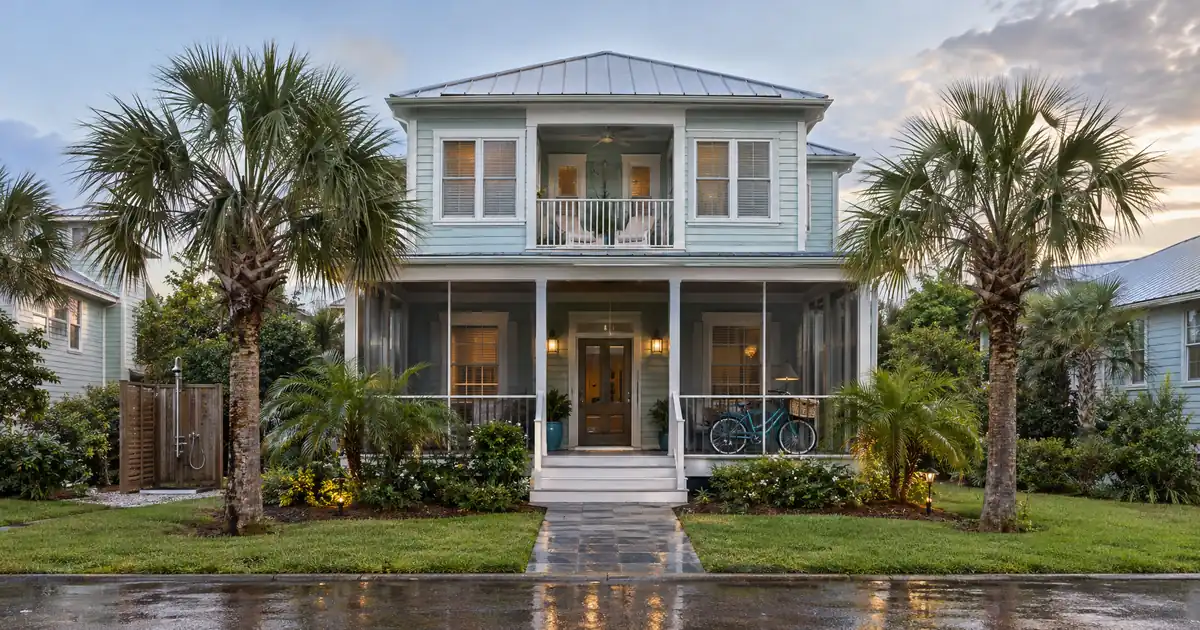
The Quick Read: A bank statement loan on an oceanfront home is reviewed around documented deposits instead of traditional personal-income documentation, then tests the house on a separate track for value, flood exposure, and insurance, so the loan only works when both the borrower file and the property file hold up under review. Strong deposits do not rescue a weak property, and a strong property does not rescue thin deposits. Every figure below is a ceiling through select wholesale programs, subject to full underwriting.
- Income: 12 or 24 consecutive months of personal or business statements. Business deposits take an expense ratio first.
- Leverage: on a primary residence purchase, 90% for loans to $1,000,000, stepping down as the loan grows. Above $4,000,000, every file is reviewed case by case.
- Credit and debt: a 660 credit floor on the portfolio program, 700 above the super jumbo line, and debt-to-income up to 50%.
- The house: appraisal support, flood zone, and insurability decide whether the deal closes, however good the deposits look.
- Occupancy: a primary or second home fits this loan well. A pure rental often fits a DSCR loan better.
What Is a Bank Statement Loan, and Why Do Oceanfront Buyers Use It?
A bank statement loan is a mortgage that reads your deposits as income. It suits founders, physicians, attorneys, entertainers, athletes, and investors whose traditional personal-income documentation shows far less than they actually earn. Write-offs shrink the number on the return. The deposits tell a different story.
Oceanfront buyers lean on this loan for a simple reason. These homes are expensive, and the people who buy them often have complicated income. A standard file asks for W-2s and returns. A bank statement file asks for the money itself, month by month.
It is not a loan without paperwork. The loan is reviewed on documented income under the applicable program, subject to lender guidelines. You still supply consecutive statements, credit, assets, and a full property review. Many first-time applicants expect a lighter process. They get a different one, not an easier one.
Across the wholesale network Lendmire works with, two things shape every oceanfront file. One is how your deposits convert to income. The other is whether the house can be appraised and insured. The rest of this piece walks through both.
Key Terms Defined
Bank statement loan: a mortgage that is reviewed around deposits in personal or business accounts instead of traditional personal-income documentation.
Non-QM: short for non-qualified mortgage, a loan that follows a lender’s own documentation rules rather than the standard consumer-mortgage template.
Expense ratio: the share of business deposits the lender treats as operating costs, not income.
Super jumbo: a loan large enough to trigger extra program overlays. In this network that starts above $3,500,000 on a primary residence and above $3,000,000 on a second home or investment property.
Flood zone determination: the lender’s check of which flood-map zone the home sits in. Zones starting with A or V are the high-risk ones.
DSCR loan: a loan that qualifies primarily on property-level rental income covering the payment, subject to lender guidelines.
Reserves: liquid funds you hold after closing, counted in months of the housing payment.
How Do Deposits Become Qualifying Income?
The lender averages your eligible deposits over the statement window, applies an expense ratio if the account is a business account, and treats what is left as monthly income. Personal-account deposits are read much closer to face value. Business deposits are trimmed first.
Programs in the network use 12 or 24 consecutive months. The bank portfolio program uses 12. Statements must be consecutive. A transaction history printout does not substitute for statements.
Business statements require at least 25% ownership of the business. Here is how the ratio typically works through select wholesale programs:
| Business profile | Typical expense ratio |
|---|---|
| Service business, no employees | 20% |
| Service business, 1-5 employees | 40% |
| 6+ employees, or any product business | 50% |
| Accountant-provided ratio | Set by the letter |
A profit-and-loss method is also available, capped at 80%. Transfers from your own business into your personal account count at 100%. That matters if you pay yourself regularly from the company.
Think of it with ratios, not dollars. Say your business deposits average a steady amount each month and you run a business with six employees. The lender keeps half of that average as qualifying income. If you own 60% of the company, the lender prorates to your share. Add a personal account that receives owner transfers, and those transfers count in full.
Underwriters also screen the deposits. Moves between your own accounts, refunds, and loan proceeds come out. Large unexplained deposits get a letter request or get excluded. This is why clean statements matter more than big statements.
Two other paths exist for high-net-worth borrowers. An asset allowance divides liquid assets by 36, 60, or 84 months to create income. Assets-only qualification skips debt-to-income entirely when U.S. liquid assets equal the loan amount plus closing costs plus sixty months of any net loss on other residential property. Retirement accounts count at 70%, or 80% at age 59.5 and up. Business funds, gifts, and cryptocurrency never count.
How Underwriting Treats the Borrower, Step by Step
The borrower side moves in a fixed order. Each step narrows the file before the property review begins.
1. Pick the window and account type. Twelve or twenty-four months, personal or business. Choose the one that shows the stronger, steadier picture.
2. Screen the deposits. Transfers, refunds, and loan proceeds come out.
3. Average and apply the ratio. Eligible deposits divided by the statement months, after the expense ratio for business accounts.
4. Test debt-to-income. Programs allow up to 50%. Your other mortgages and the new housing cost all count. This is where an expensive oceanfront insurance bill starts to bite.
5. Check credit. The portfolio program has a 660 floor, with 700 required above the super jumbo line. The bank portfolio program keeps a 680 floor at every size. Higher leverage in a band asks for a higher score.
6. Count reserves. Typically 3 months for loans to $500,000, 6 months to $1,500,000, and 9 months above that. Add 2 months per additional financed property, up to 12 months. First-time investors carry 12 months.
Past the super jumbo line, extra overlays apply on top of those steps. They include a 700 credit floor, a clean housing history, 48-month seasoning on any credit event, and U.S. citizen or permanent resident status. No rural property, no more than ten acres, and cash-out proceeds cannot satisfy reserves.
What Does the Oceanfront Change?
The property track runs in parallel with the income track, and on an oceanfront home it usually carries more of the risk. Three things decide it: the appraisal, the flood determination, and whether you can actually insure the house.
Appraisal. Oceanfront homes are unique, and good comparable sales are scarce. Waterfront appraisers weigh water access, shoreline quality, flood risk, and view corridors, according to one waterfront appraisal firm. That same discussion notes that mandatory flood coverage in high-risk zones can dampen buyer appeal and value. If the appraisal lands below the contract price, leverage applies to the lower number. You bring the difference in cash.
Flood zone. The lender orders a determination. High-risk zones begin with A or V, including AE and VE. Where coverage is mandatory, it must be in place at closing. Do not assume a low-risk zone lets you skip it. FEMA says a lender can still require flood insurance in Zone X. The federal mandate binds federally regulated or insured lenders. In practice, most programs in the network treat flood coverage as a condition wherever the maps call for it.
Insurance. This is the piece buyers underestimate. The federal flood program caps building coverage at a fraction of many oceanfront values, as the Environmental Law Institute points out in its coastal insurance briefing. Excess or private flood coverage often fills the gap. Wind exposure adds higher premiums, tighter underwriting, and larger deductibles, according to Million Luxury’s oceanfront versus bayfront analysis. That piece frames the real question as insurability at closing and again at renewal. Standard homeowners policies typically exclude flood, and Homes.com’s waterfront buyer guide advises getting insurance quotes before you finalize the budget.
The premium flows straight into your debt-to-income test. A bid that works on paper at one premium can fail at another.
| Oceanfront factor | Who it affects | What you do |
|---|---|---|
| Thin comparable sales | Appraiser, lender | Expect extra review; allow cash for a low value |
| High-risk flood zone | Lender, insurer | Line up flood coverage before closing |
| Wind and storm deductibles | Insurer, your budget | Get quotes before you commit |
| Map changes | Lender, you | Expect a notice and required coverage if remapped |
How Much Can You Borrow, and at What Leverage?
Leverage steps down as the loan grows, and it depends on how you will use the home. Every figure here is a ceiling through select wholesale programs, subject to full underwriting. The bands are loan amounts, not purchase prices. Multiply price by leverage first, then read the band.
On a primary residence purchase, the ceiling is 90% to $1,000,000, 85% to $2,000,000, 80% to $3,000,000, and 75% to $4,000,000. The top cell in each band needs the higher credit score for that band, so a lower score lands you in a lower cell. Above $4,000,000, the bank portfolio program takes over, and files are reviewed case by case before submission. On review, its ladder reads 65% to $5,000,000, 60% to $10,000,000, and 55% to $30,000,000.
On a second home purchase, the ceiling is 85% to $1,000,000 and 80% through $2,500,000. It drops to 75% from $2,500,000 to $3,000,000, then 65% above $3,000,000 under the super jumbo overlays. Above $4,000,000, case-by-case review applies. Second homes are one-unit only.
On an investment property purchase, the ceiling is 85% to $1,000,000 and 80% through $2,500,000. It is 75% from $2,500,000 to $3,000,000. The next band, $3,000,000 to $4,000,000, steps to 60% on the bank portfolio program. From $4,000,000 to $5,000,000 it is 65% on review, case by case.
Not every oceanfront home is a house. On a condo, a warrantable one can reach 85% and a non-warrantable one 80%, as ceilings. A condotel takes 75% on a purchase and 65% on a cash-out, or 50% on the bank program.
Cash-out has its own, lower ladder. On a primary residence, the best cash-out cell is 80%, available to $1,500,000. Proceeds are unlimited at or below 60% LTV. Above 60% on the portfolio program, cash-in-hand is capped at $1,500,000. Tax treatment can depend on how the funds are used and how the property is held; borrowers should keep clear records and speak with a qualified tax professional before relying on any deduction. Final terms depend on lender guidelines, property type, leverage, and the borrower’s complete credit picture.
Interest-only is a structure, not a bigger ceiling. On purchase and rate-and-term files, the portfolio program allows it to 85% LTV with a 700 floor, using a 40-year term with a 10-year interest-only period. The bank program allows it to 60%. It never raises a cash-out ceiling. These specifics are subject to lender guidelines and a full review of property, leverage, and credit.
Primary, Second Home, or Rental? Occupancy Picks the Product
How you plan to use the house decides which loan fits. Get this wrong and you shop the wrong product.
A primary residence or a second home that you actually use fits the bank statement path cleanly. Lenders read your deposits, and the house is tested as a personal housing cost. If you plan to rent it out to cover costs, you are in different territory.
For a house that functions as a rental, the lender may offer a bank statement file on investment property, or may route you to a DSCR loan. Lendmire’s complete DSCR loans guide covers how that product works. In short, a DSCR loan is reviewed primarily on property-level rental income covering the payment, subject to lender guidelines.
DSCR loans are designed for non-owner-occupied investment properties. Because they are business-purpose investor loans, they are reviewed differently from a standard owner-occupied mortgage, and the final federal rule treats investment-purpose loans as business-purpose loans.
Oceanfront prices tend to be high relative to the rent they produce. That weakens the rental coverage ratio. Select lenders in the network do offer programs below 1.00 coverage, but leverage and terms adjust. When rent coverage is thin and your deposits are strong, the bank statement path may be the stronger number. When deposits are uneven and the house rents well, DSCR may win. Many self-employed investors legitimately qualify either way, so the choice comes down to which number is stronger.
The hybrid case needs care. A vacation home with occasional rental use sits between a second home and an investment. Occupancy intent changes the program. Short-term rental rules can vary by city, county, HOA, and property type, so investors should confirm local rules before relying on projected rental income.
For a deeper look at large balances, see Lendmire’s article How a Super Jumbo Bank Statement Second-Home Loan Works.
Where the General Rule Breaks
The standard process described above holds for most files. These are the places it bends.
Declining deposits. A weak stretch inside the window pulls the average down. If your deposits fell recently, a shorter or longer window can help, or a different path may fit better. Twenty-four months can smooth a bad quarter. Twelve months can hide an old one.
Unexplained deposits. A large deposit with no source gets excluded or questioned. Moving money between accounts right before you apply creates the same problem. Keep accounts steady and explain transfers before the lender asks.
Map changes. Flood maps get redrawn. If a revision pulls the home into a high-risk zone, coverage becomes required and the carrying cost changes. A buyer who modeled the file on a low-risk zone can see the numbers move.
Zone differences. Coastal high-hazard VE zones carry stricter building and insurance rules than many bayfront X-zone sites, as Million Luxury notes. Oceanfront does not mean one risk profile.
Partial structures. If any part of the building sits in a high-risk zone, the requirement applies to the whole loan.
Condo versus house. Condo and condotel ceilings are lower, and association insurance and dues enter the housing cost. A warrantable condo can lend higher than a non-warrantable one.
Texas home-equity loans. A Texas 50(a)(6) loan takes a 5-point LTV reduction and stops at $3,000,000 on the portfolio program.
Above $4,000,000. Everything is reviewed case by case before submission. A leverage figure at that size is a starting point for discussion, not a quote.
What Does the Decision Look Like in Practice?
Picture a founder with a service business and 1-5 employees buying an oceanfront second home. The loan lands in the $2,000,000 to $2,500,000 band. The second-home purchase ceiling there is 80%, with 720+ credit needed for that top cell. The lender averages 24 months of deposits and keeps 60% after the 40% expense ratio. It tests the full housing cost, including flood and wind coverage, against that income.
If the insurance quote comes in higher than expected, debt-to-income rises. The fix is usually more cash down, a lower price, or a different structure. It is rarely a better argument to the lender.
Now run the opposite file. Say an investor buys an oceanfront house to rent seasonally. Deposits are strong, but rent covers well under the full payment. That file leans toward bank statement qualification, or toward a sub-1.00 DSCR program from a select lender with adjusted leverage and terms. Both routes are reviewed on lender guidelines, credit, reserves, and the property.
A practical order for any oceanfront buyer:
1. Pull 12 and 24 months of statements and see which window reads stronger. 2. Get flood and wind insurance quotes on the specific address. 3. Decide primary, second home, or rental, and be honest about the use. 4. Read the leverage cell for your loan band and occupancy. 5. Hold enough cash for a low appraisal and for reserves.
Frequently Asked Questions
Can I use a bank statement loan to buy an oceanfront home as a rental?
Sometimes. Availability on investment property varies by program. Where it is offered, the ceiling is 85% to $1,000,000 and 80% through $2,500,000 on a purchase, through select wholesale programs, subject to full underwriting. Many pure rentals fit a DSCR loan better, because rent supports the payment directly.
Does strong income make up for a hard-to-insure house?
No. Income and property are separate tests. If the house cannot be insured as the program requires, the deposits do not matter. Insurance is also part of the housing cost in the debt-to-income test, so a high premium can push a borderline file over the 50% ceiling.
Does flood insurance only apply in A and V zones?
No. High-risk zones carry the strictest rule. A lender can still require flood coverage in Zone X, and standard homeowners policies typically exclude flood. Get a flood quote on any coastal address regardless of the zone.
What credit score do I need?
The portfolio program has a 660 floor, rising to 700 above the super jumbo line. Higher leverage inside a band needs a higher score, so a lower score takes a lower leverage cell.
How many months of statements do I need?
Twelve or twenty-four consecutive months of personal or business statements. The bank portfolio program uses twelve. Business statements need at least 25% ownership.
Next Step
Lendmire is a broker that shops multiple wholesale programs, and its consumer mortgage lending is licensed in 16 states. Nothing here is a commitment to lend.
Coastal buyers who price insurance before they price the offer tend to see the fewest surprises at underwriting.
About Lendmire
As a mortgage broker (NMLS# 2371349), Lendmire helps self-employed and high-net-worth borrowers in 16 states qualify on bank statements, a profit-and-loss statement, 1099s or liquid assets instead of tax returns, through wholesale lenders. Lendmire is never the lender; program terms are set by the lender and its guidelines. Scotsman Guide named Lendmire a Top Mortgage Workplace in both 2025 and 2026.
Get Started
Ready to find the right loan for you?
In about 30 seconds you can review financing options available for your home or investment property. No commitment required.
Informational only. Not a Loan Estimate, approval, or commitment to lend. Program availability and eligibility are subject to lender guidelines, credit approval, property review, and underwriting.
References
1. Gold Rush Appraisal: Waterfront Property Appraisal Factors
2. FEMA: Real Estate, Lending and Insurance Professionals
3. Environmental Law Institute: Coastal Property Insurance Read-Ahead
4. Million Luxury: Oceanfront vs Bayfront Insurance Questions
5. Homes.com: What to Know Before Buying Waterfront Property
6. Federal Register: Ability-to-Repay and Qualified Mortgage Standards Final Rule
This article is part of Lendmire’s super jumbo bank statement loan program — full qualification details, guidelines, and scenarios live on the program page.
Related reading: How a Bank Statement Jumbo Loan Works in Jupiter · How Much Can You Borrow With a Super Jumbo Bank Statement Second-Home Loan? · How a Bank Statement Jumbo Loan Works in Santa Fe
Brandon Miller
Founder & CEO, Mortgage Loan Originator, Lendmire LLC
- Mortgage Loan Originator · NMLS# 1129696 · Verify on NMLS Consumer Access
- North Carolina Real Estate Broker · License# 343312 · Verify on NCREC
- North Carolina Insurance Producer · License# 19053198 · Property, Casualty, Life, Health · Verify on NAIC SBS
- Lendmire LLC · Firm NMLS# 2371349 · Verify firm licensure
Important disclosures. Lendmire (NMLS# 2371349) is a licensed mortgage brokerage. Lendmire is not a direct lender, depository institution, or financial advisor. All loan inquiries are subject to lender underwriting; this article does not constitute a commitment to lend. Rates, terms, and program guidelines are subject to change without notice and vary by borrower profile, property type, and state. Information in this article is general in nature and is not financial, legal, or tax advice. Equal Housing Opportunity. NMLS Consumer Access: nmlsconsumeraccess.org.