
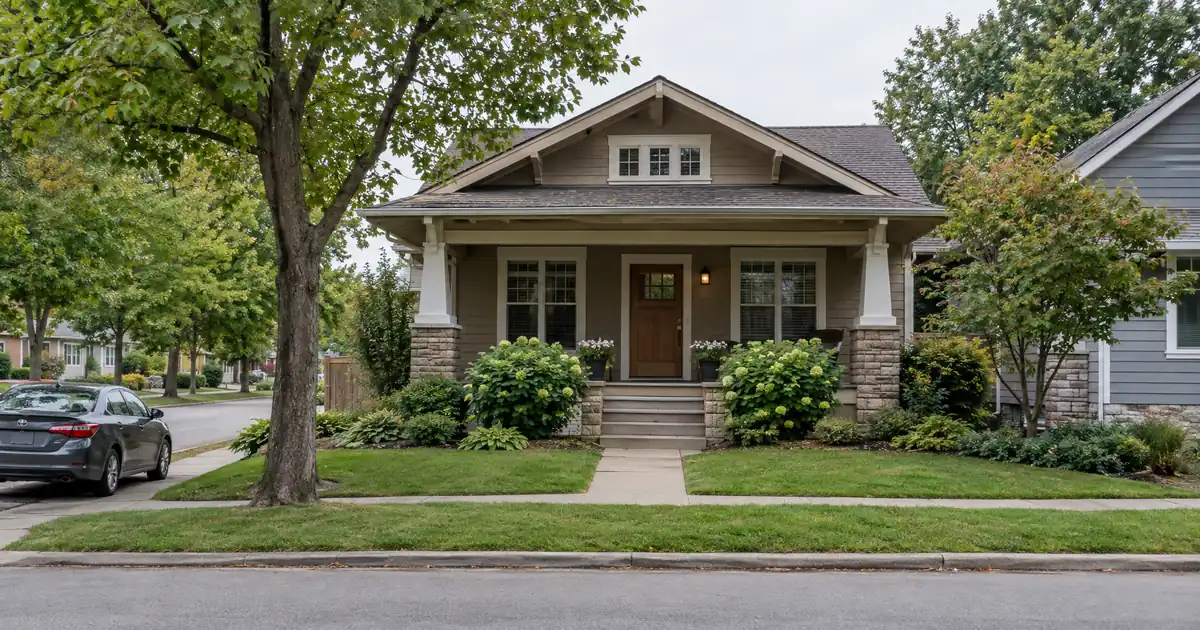
Bank Statement Only HELOC — The Quick Read: A bank statement only HELOC lets a borrower qualify for a home equity line using deposit history instead of traditional personal-income documentation or W-2s. Leverage, credit floors, and line size all shift by occupancy — investment property caps out well below what a primary residence can reach. Title has to sit in a person’s name or a revocable trust, which is the one rule that trips up LLC-owned rentals every time.
Key Takeaways
- Qualifying income comes from a 12- or 24-month average of bank deposits, not a tax return.
- Leverage is occupancy-tiered: investment property caps at 70% CLTV; primary residences and second homes can reach 90% CLTV, but only at a 720+ credit profile.
- Title must sit in an individual’s name or a revocable living trust — LLCs and corporations cannot hold title on this product.
- Line sizes run $25,000 to $750,000, with anything above $500,000 restricted to primary residences and a full appraisal.
- A borrower is capped at three lines total, with combined exposure limits and a 15-property ownership ceiling.
What Is a Bank Statement Only HELOC?
This product stacks two things together — it isn’t just one. The documentation piece swaps traditional personal-income documents and W-2s for bank statements, so deposits become the proof of income. The credit piece is a standard home equity line. It’s secured by a lien on the property, and it usually runs interest-only during a draw period before it starts to amortize.
How large a line the equity supports in your market.
An equity line is sized by combined loan-to-value, occupancy, and credit — not by rental coverage. Switch the occupancy or the credit band and the ceiling moves with it.
Investment-property lines require a 700 minimum credit score. Second-home tiers reach 640; primary-residence tiers reach 600.
A debt-to-income ratio above 45% requires 680+ credit. Profiles under 640 are limited to single-family homes. At least 75% of the approved line is drawn at closing. Ceilings, floors, and caps update from Lendmire’s centralized guideline source.
Line estimate
Illustrative estimate only — not a quote, Loan Estimate, approval, or commitment to lend. The rate is an editable assumption; equity-line pricing is variable through both the draw and repayment periods and never converts to fixed. Occupancy and credit drive the ceiling together: investment property runs to 70% combined LTV with a 700 credit floor and a $500,000 cap; a second home runs to 90% at a 640 floor with a $500,000 cap; a primary residence reaches up to 90% at a 600 floor, and its $750,000 maximum line applies only at 75% combined LTV or below with 720+ credit and a full appraisal. Lines above $500,000 require a full appraisal. Credit, debt-to-income, property type, and full underwriting review all affect the final line.
Self-employed borrowers, gig workers, and real estate investors gravitate here because a tax return often understates real cash flow. Deductions that lower a tax bill also lower the income a conventional lender sees on paper. Deposits don’t have that problem — money that hit the account is money that hit the account.
Investment-property HELOCs are business-purpose loans, not owner-occupied mortgages, so lenders review them differently than a standard consumer mortgage from the outset. That distinction is part of why documentation can flex more here than on a typical purchase loan.
How Underwriting Actually Turns Deposits Into Qualifying Income
Step one is picking a lookback window. Most programs pull either 12 or 24 months of statements. A 12-month window can produce a higher number if income has grown recently. A 24-month window smooths out a slow stretch and often reads as more stable to underwriting.
Step two splits personal deposits from business deposits. Personal-account deposits generally count close to dollar-for-dollar, since there’s no business overhead behind them. Business-account deposits typically get reduced by an expense factor — often starting near 50 percent — to strip out payroll, inventory, and supplier costs that never reached the borrower’s pocket. A CPA-prepared profit-and-loss statement can sometimes support a lower factor, but the lender has to agree to accept it first.
Step three screens the deposits themselves. A single oversized deposit usually just needs a short explanation letter or a paper trail — it rarely sinks a file alone. A pattern of overdrafts in the two or three most recent months is a different conversation, and it’s the kind of thing an underwriter raises directly.
Step four is where the number stops being special. Once a monthly income figure comes out of the deposits, it runs through the file like any other income source — weighed against credit, reserves, and debt-to-income the same way a W-2 figure would be. On this network, DTI tops out at 50 percent, though a 600-679 credit profile is held to 45 percent, and anything above 45 percent requires at least a 680 score. The math gets qualified against the interest-only payment on the full drawn amount, not a partial balance.
Key Terms Defined
Combined Loan-to-Value (CLTV): the total of every loan against a property, including the new HELOC, divided by the property’s value — the number that sets the leverage ceiling.
Draw Period: the window when a borrower can pull funds from the line, typically paying interest-only on what’s drawn.
Repayment Period: the phase after the draw period ends, when the balance amortizes to zero on a set schedule.
Expense Factor: the share of business-account deposits a lender assumes went to operating costs before counting the remainder as income.
Revocable Living Trust: a trust the borrower can change or cancel during their lifetime — one of only two acceptable ways to hold title on this product besides an individual’s own name.
How Much Leverage Does Occupancy Actually Buy?
Occupancy decides the ceiling before credit ever gets a vote. Investment property never crosses 70% CLTV, regardless of how strong the file looks. Primary residences and second homes can reach 90% CLTV, but only for a 720-or-better credit profile — that pairing isn’t optional. It works because a HELOC is open-end credit, not the closed-end mortgage that ability-to-repay rules were built around, so lenders get more room to set their own income standards.
| Occupancy | Program Ceiling | Credit for Top Tier | Max Line |
|---|---|---|---|
| Investment property | 70% CLTV, flat | 700+ | $500,000 |
| Second home | 90% CLTV | 720+ (steps down to 75% at 640) | $500,000 |
| Primary residence | 90% CLTV or 75% CLTV | 720+ for 90%; 700+ for 75%/$750K | $750,000 |
A primary residence actually has two paths. A 720+ borrower can take 90% CLTV capped at $500,000, or step down to 75% CLTV and unlock the full $750,000 ceiling — a 700+ score qualifies for that second path too, just not the 90% tier. Anything above $500,000 is restricted to primary residences, needs at least a 700 credit profile (720 on the longer-runway structure), caps at 75% CLTV, and requires a full appraisal instead of an automated valuation. Investment property has no such menu: 70% CLTV is the number whether the score sits at 700 or 780.
Line sizes run from $25,000 to $750,000 across the network, with a $10,000 floor in Michigan. Below $500,000, most files run on an automated valuation with no traditional appraisal, though a higher CLTV request can trigger a secondary check.
Draw Periods, Repayment, and the Paperwork This Product Skips
Every HELOC in the market works in two phases. First comes the draw period: the borrower can pull funds and typically pays interest-only. Then comes the repayment period: the lender sets a schedule to pay down the balance, often over ten or twenty years, according to the CFPB.
On this network, primary residences and second homes choose between two structures: a 3-year interest-only draw followed by 17 years of amortizing repayment, or a 5-year draw followed by 25 years of repayment. Tennessee runs shorter versions of both — 3-year draw/12-year repayment, and 5-year draw/10-year repayment. Investment property gets no choice: it’s the 5-year draw and 25-year repayment structure only. At least 75% of the approved line has to be drawn at closing on both programs, and pricing floats through both the draw and repayment periods on either structure — it never converts to fixed later. Subsequent draws after closing carry their own floor on the longer-runway program, typically $1,000, or $4,000 in Texas.
This process skips the rent-schedule form entirely. Conventional agency underwriting relies on a form an appraiser fills out — Fannie Mae’s Single-Family Comparable Rent Schedule, known as Form 1007. It documents an estimated market rent for a single-family investment property. A bank statement HELOC skips that step completely. Deposits and credit carry the file instead, because this line doesn’t qualify based on the property’s rental income the way a DSCR loan does.
Where the LLC Title Rule Breaks the Model
This is the sharpest structural break from a standard investor loan, and it catches people off guard constantly. Title has to sit in the individual borrower’s name or an inter vivos revocable living trust. LLCs, corporations, partnerships, and irrevocable, blind, or land trusts cannot hold title on this product — regardless of credit score or leverage requested.
If a rental is deeded to an LLC, the owner isn’t automatically blocked from tapping its equity. It just means this specific product is off the table until the title changes to a person’s name or a qualifying trust. For an LLC-titled rental, the more common move is a DSCR cash-out refinance instead, since that option accommodates entity title far more often, subject to lender program eligibility. Lendmire’s complete DSCR loans guide explains how that qualification works off the property’s rental income rather than a personal deposit history.
Credit, Derogatories, and the Portfolio Ceiling
Six hundred is the program floor for credit, but that floor only reaches primary residences — second homes need at least 640, and investment property needs at least 700 just to open the file. Scoring runs off a single bureau pulled for the primary wage earner, the report can’t be more than 90 days old at closing, and there’s no rescoring a file to a better tier.
Tradeline history matters too. The longer-runway program wants two tradelines seasoned 12 months, or one seasoned 24 months, plus a housing-history standard assessed across every financed property the borrower holds: no more than one 30-day late in the trailing 12 months and none in the trailing six at 640 and above, tightening to zero 30-day lates in the trailing 12 months from 600 to 639.
Lenders look closely at past derogatory events. On either program, bankruptcy needs four years of seasoning from discharge or dismissal. Foreclosure history works differently between the two programs. One program will approve a foreclosure seasoned seven years, plus a deed-in-lieu, pre-foreclosure, or short sale seasoned four years. The other program declines any foreclosure history outright, no matter how old it is. For investment properties, the seven-and-four-year path applies.
Portfolio size limits how far scaling investors can grow. A borrower can hold at most three of these lines at once. Combined exposure is capped at $2,000,000 under the higher-leverage program, or $750,000 under the longer-runway program. Anyone who already holds more than 15 financed properties can’t get a new line, period. Credit score and available equity don’t change that ceiling.
Property rules follow their own map. Single-family homes qualify. So do 2-4 unit properties (this needs a 640 minimum credit score on the longer-runway program). PUDs, townhomes, and condos qualify too — including non-warrantable condos. Modular, factory-built homes only qualify on the longer-runway program. This product does not offer manufactured homes, co-ops, condotels, log homes, commercial property, mixed-use property, or agriculturally zoned parcels at all.
A few states add their own rules. Texas applies additional requirements to primary-residence transactions under the state’s homestead lending framework, and second homes and investment properties in Texas are treated differently under that framework; Texas properties are also limited to 10 acres. Homestead classification is a state legal question that can shift by transaction, so Texas borrowers should confirm current requirements with the lender and, where needed, a qualified local professional rather than relying on a general summary. New Mexico and Ohio don’t use one flat CLTV cap — they scale it to the borrower’s credit profile. A property can’t qualify if it’s currently listed for sale, or was pulled from listing within the past 60 days, in Indiana, North Carolina, Pennsylvania, Tennessee, Texas, or Washington. And you can only get this product through Lendmire’s 16 full-service states — Alabama, California, Colorado, Florida, Georgia, Indiana, Michigan, Montana, New Mexico, North Carolina, Ohio, Pennsylvania, Tennessee, Texas, Virginia, and Washington. That’s a smaller footprint than Lendmire’s DSCR investor-loan platform, which covers 40 markets: 39 states plus Washington, D.C.
The Investor Decision: Bank Statement HELOC or DSCR Loan?
A line of credit against equity, or a term loan on the property’s rental income — the right pick depends on what the investor needs and how the property is titled.
| Factor | Bank Statement HELOC | DSCR Loan |
|---|---|---|
| Title | Individual name or revocable trust only | Commonly accommodates LLC title |
| Income basis | Personal/business bank deposits | Property’s rental income |
| Structure | Revolving line, draw then repayment | Closed-end term loan |
| Best fit | Tapping equity without disturbing an existing first mortgage | Purchase or cash-out on an LLC-held rental |
An investor who already owns a paid-down primary residence or second home and wants access to equity without touching the existing mortgage tends to lean toward the bank statement HELOC — assuming title sits in a person’s name or a revocable trust. An investor buying or refinancing a rental already deeded to an LLC, or one who wants underwriting built entirely around the property’s rent rather than personal deposits, usually lands on a DSCR structure instead. Lendmire’s team can walk through what a bank statement HELOC actually is alongside the DSCR alternative before an investor picks a lane — reach the team at 828-256-2183.
Frequently Asked Questions
What is a bank statement only HELOC?
A bank statement only HELOC lets a borrower qualify for a home equity line using deposit history instead of traditional personal-income documentation or W-2s. It combines flexible income documentation with a standard home equity line secured by a lien on the property, typically running interest-only during a draw period before it amortizes down.
How does underwriting turn bank deposits into qualifying income?
Underwriting picks a 12- or 24-month lookback window, then separates personal deposits, which generally count close to dollar-for-dollar, from business deposits, which typically get reduced by an expense factor often starting near 50 percent. The resulting monthly figure then runs through the file like any other income source, weighed against credit, reserves, and debt-to-income.
How does occupancy affect how much leverage a borrower can get?
Occupancy sets the ceiling before credit matters. Investment property caps at 70% CLTV regardless of credit strength. Primary residences and second homes can reach 90% CLTV, but only for a 720-or-better credit profile. Primary residences also have a lower-leverage path allowing a larger maximum line size, subject to lender guidelines.
Why can’t an LLC-owned rental use this product?
Title must sit in an individual borrower’s name or a revocable living trust; LLCs, corporations, partnerships, and irrevocable, blind, or land trusts cannot hold title, regardless of credit score or leverage requested. A rental already deeded to an LLC would typically need to change vesting first, or the owner could consider a DSCR cash-out refinance instead.
What credit score and portfolio limits apply to this HELOC?
Six hundred is the program floor for credit, though that applies only to primary residences — second homes need at least 640 and investment property needs at least 700. A borrower can hold at most three of these lines at once, and anyone already holding more than 15 financed properties isn’t eligible for a new line.
About Lendmire
Lendmire (NMLS# 2371349) is a mortgage brokerage focused on DSCR investor financing, helping arrange programs through wholesale and investor-lending channels in 40 markets, including Washington, D.C. DSCR loans are evaluated by the lender on property cash flow rather than personal income, subject to lender guidelines, supporting LLC closings and accommodating investors with four or more financed properties. Scotsman Guide Top Mortgage Workplace in both 2025 and 2026.
Investors who want the broader program framework can review how DSCR loans work, or call 828-256-2183 to discuss a specific file.
Get Started
Ready to find the right loan for you?
In about 30 seconds you can review financing options available for your home or investment property. No commitment required.
Informational only. Not a Loan Estimate, approval, or commitment to lend. Program availability and eligibility are subject to lender guidelines, credit approval, property review, and underwriting.
References
1. CFPB
2. Form 1007
Brandon Miller
Founder & CEO, Mortgage Loan Originator, Lendmire LLC
- Mortgage Loan Originator · NMLS# 1129696 · Verify on NMLS Consumer Access
- North Carolina Real Estate Broker · License# 343312 · Verify on NCREC
- North Carolina Insurance Producer · License# 19053198 · Property, Casualty, Life, Health · Verify on NAIC SBS
- Lendmire LLC · Firm NMLS# 2371349 · Verify firm licensure
Compliance and disclosures. Lendmire (NMLS# 2371349) is a licensed mortgage broker and is not a direct lender, depository institution, financial advisor, or tax professional. Content in this article is general market analysis and educational information — not financial, legal, or tax advice for any specific situation. Lendmire does not guarantee loan approval; every transaction is subject to underwriting by the funding lender. Mortgage pricing and loan program guidelines are subject to change at any time without notice and vary by borrower characteristics, property type, and state regulations. Lendmire complies with Equal Housing Opportunity. Licensure verification: NMLS Consumer Access.


