
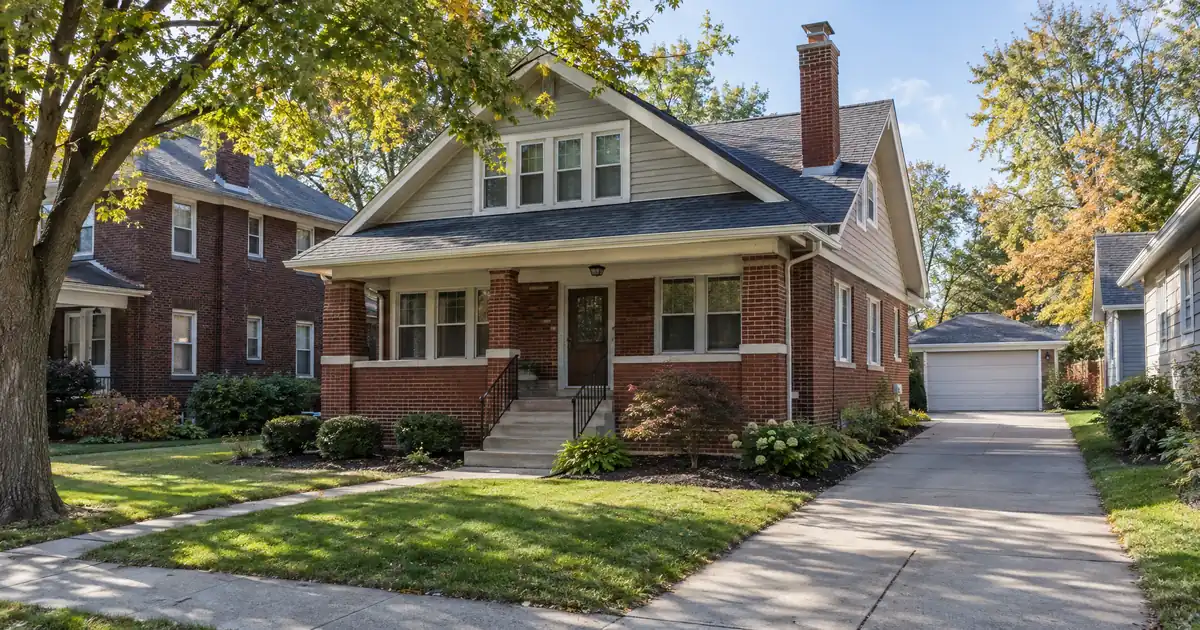
The Quick Read: An asset qualifier mortgage lets an Ohio homeowner qualify for the next home on verified liquid assets instead of paycheck income, so the old home’s payment and sale timing do not decide the approval. Through select programs in Lendmire’s wholesale network, eligible assets must cover the entire loan amount, and no employment or income is documented. The old home’s equity does not count as an asset, but its sale proceeds do once they sit in your account.
- Asset qualifier path: loans up to $4,000,000, up to 80% loan-to-value on a purchase, subject to underwriting.
- Assets that count: brokerage, CDs, money market and savings at 100%; retirement accounts at 90% under age 59½ and 100% after.
- Seasoning: 60 days, with two months of statements per qualifying account.
- Occupancy: this is a consumer program for a principal residence or second home, not a rental purchase.
- Your Ohio contract can usually go in without a home-sale contingency, because the approval does not depend on the old home selling.
What Is an Asset Qualifier Mortgage?
Think of two ways to measure a borrower. One counts the money that arrives each month. The other counts the money already sitting in the account. An asset qualifier mortgage uses the second.
Under this structure, verified assets, after the credit percentages below, must equal or exceed the whole loan. The file documents the assets. It does not document employment or income. That distinction matters: “no income documentation” never means “no documentation.” Every balance is traced and reviewed.
Lenders and trade writers use several names for the same family of ideas: asset depletion, asset dissipation, asset utilization. The OCC’s Bulletin 2019-36 describes the underlying practice as using an applicant’s assets to calculate a hypothetical cash annuity stream, often for high-net-worth applicants with large liquid holdings but little cash flow. That bulletin is guidance to banks, so treat it as a clear definition, not a rule that binds every lender.
Two paths exist in Lendmire’s network, and a borrower is qualified on one at a time:
- Asset qualifier path. Assets cover the loan outright. No income is calculated.
- Asset depletion path. Usable assets are divided by 60 months to create a monthly qualifying income, which then runs through the debt-to-income test.
This article centers on the qualifier path because it solves the buy-first problem most directly. The depletion path gets its own section below.
Why Does Buying First Create a Qualification Problem?
Buying first is hard because two housing payments can break an income test even when your net worth is large. A lender that measures income against debt sees the old mortgage and the new one stacked together.
Standard income-based underwriting often counts the departing home’s payment unless a sale is pending and documented. Retirees, business owners with heavy write-offs, and people who just sold a company often show low income on paper, so the second payment pushes the ratio past its limit.
The usual workarounds all have a catch:
- A home-sale contingency keeps you off the hook but weakens your offer, since sellers read it as risk.
- A bridge loan or HELOC borrows against the old home’s equity, which adds debt and still has to be repaid.
- A cash-out refinance on the old home adds a new loan before you move.
- A rent-back depends on the buyer of your old home agreeing to it.
An asset qualifier mortgage attacks the problem from a different angle. It does not borrow against anything to get you into the new home. It qualifies the new loan on assets you already hold.
How Does Underwriting Treat Your Assets, Step by Step?
Underwriting follows a plain sequence: inventory the accounts, apply the credit percentages, confirm seasoning, then run the file’s other checks. Here is how it works on the qualifier path.
1. Inventory the accounts. List every brokerage, CD, money market, savings and retirement account you want counted. Accounts combine.
2. Apply the credit percentages. Each balance counts for a share of its value (see the table below).
3. Compare usable assets to the loan. The total must equal or exceed the entire loan amount, subject to underwriting.
4. Check seasoning. Funds need 60 days in place, with two months of statements for each qualifying account.
5. Review everything else. Credit (600 minimum on this path), mortgage history, the appraisal and the property are still examined. The method changes how capacity is measured. It does not turn underwriting off.
On the old mortgage: with no debt-to-income test on the qualifier path, the departing home’s payment is not run as a monthly obligation in a ratio. The file still shows the debt, and the lender’s ability-to-repay review rests on your assets. The CFPB’s ATR/QM compliance guide notes the general standard sets no specific debt-to-income or residual-income thresholds, and that the amounts a lender relies on must be verified. That is why the verification is thorough.
A worked example (illustrative)
Say you are buying a primary residence with an $800,000 loan. Your assets are $330,000 in brokerage accounts, $300,000 in a 401(k) and you are under age 59½, and $200,000 in savings.
| Account | Balance | Credit | Usable |
|---|---|---|---|
| Brokerage | $330,000 | 100% | $330,000 |
| 401(k), under 59½ | $300,000 | 90% | $270,000 |
| Savings | $200,000 | 100% | $200,000 |
Usable assets total $800,000, which equals the loan. On the qualifier path, that file is reviewed on assets alone, subject to underwriting and the lender’s own calculation. Notice what the example leaves out: the old home. Its equity is not in the table.
What Counts as an Asset, and What Doesn’t?
On the qualifier path, cash-type and investment accounts count in full, and retirement accounts count at a discount if you are under 59½. Real-estate equity does not count at all on this path, and several other asset types are not published as eligible.
| Asset | Qualifier path credit | Depletion path credit |
|---|---|---|
| Brokerage / securities | 100% | 80% |
| Certificates of deposit | 100% | 100% |
| Money market / savings | 100% | 100% (cash accounts) |
| 401(k) / IRA | 90% under 59½, 100% at 59½+ | 70% at any age |
| Private stock | Not published | 75% |
| Real-estate equity | Not counted | 60% |
Never blend these columns. A file is on one path or the other.
Other asset classes, including cryptocurrency, precious metals, collectibles, business accounts beyond your ownership share, and pledged or borrowed funds, are not published as eligible on either path. The documented route is converting them to a seasoned cash balance in a regulated account, with the source reviewed by the lender. Gifts of convenience and last-minute deposits invite questions, so move money early.
Here is the catch for sellers. Your old home’s equity helps nothing until you sell. Once the sale closes and cash proceeds land in an account, they become assets, subject to the seasoning rules. Plan the sequence.
How Does the Depletion Path Change the Math?
The depletion path turns assets into income instead of matching them to the loan. Usable assets are divided by 60 months, and that monthly figure must carry the housing payment and other debts through the debt-to-income test.
The sanctioned example: $1,500,000 in securities counts at 80%, or $1,200,000. Add $300,000 in cash at 100%. Usable assets are $1,500,000. Divide by 60 months and you get $25,000 of monthly qualifying income.
Three features set this path apart:
- Leverage. On a principal residence or second home, up to 80% on a purchase or rate-and-term refinance and 60% on a cash-out refinance. On an investment property, up to 65% on a purchase or rate-and-term refinance and 60% on a cash-out.
- Loan size. $125,000 to $3,500,000.
- Minimums. Qualified assets of at least the lesser of $1,000,000 or 1.25 times the loan balance, and never below $250,000 liquid when depletion is the only income source.
Because the old mortgage is a debt here, it enters the ratio. That makes this path a weaker fit for buying before selling unless the pool is large. Asset-derived income can also supplement documented income up to a 45% debt-to-income ratio, and the minimum-assets rule is waived when it does. Everything remains subject to lender guidelines.
How Does This Compare With the Other Ways to Buy First?
An asset qualifier mortgage differs from the alternatives mainly in what it measures and whether it adds debt. The table compares the usual options as general structures, not as any single program’s terms.
| Option | is reviewed around | Non-contingent offer? | Main risk |
|---|---|---|---|
| Asset qualifier mortgage | Assets covering the loan | Usually yes | Assets must stay seasoned |
| Bridge loan | Old home’s equity | Yes | Added short-term debt |
| HELOC on old home | Equity plus income | Yes | Added debt; income test |
| Sale contingency | Income, after the sale | No | Weaker offer |
| Conventional, two payments | Income and DTI | Yes, if DTI passes | DTI may fail |
Federal rules treat temporary bridge loans differently from standard mortgages. If you are weighing a bridge loan, read the exemption wording in Regulation Z § 1026.43 with your attorney or lender, because the details matter.
One distinction deserves emphasis. Borrowing against your portfolio is not the same as qualifying on it. A securities-backed line pledges the portfolio and creates a debt. An asset qualifier mortgage counts the portfolio as proof of capacity. In general, the assets are not sold or pledged. The calculation is a qualifying convention.
Where Does the General Rule Break?
The approach has real limits. These are the edge cases to know before you plan around it.
- Rentals. Asset-based consumer programs are for a principal residence or second home. The depletion path is the only one that allows investment property, at the lower leverage shown above. For a pure rental purchase, DSCR is the relevant product, because DSCR loans are designed for non-owner-occupied investment properties and qualify primarily on property-level rental income covering the payment, subject to lender guidelines. Lendmire’s complete DSCR loans guide covers that lane. Buying a new primary home with an asset qualifier while keeping the old one as a rental works, with the rental financed separately.
- Qualifier-path cash-out. Whether cash-out proceeds are allowed on the qualifier path is set by the lender and not published. Plan as if it is unavailable. On the depletion path, cash-out proceeds never count as qualifying assets.
- Ineligible assets. Depletion-path exclusions include custodial accounts, deferred compensation, escrow accounts, foreign funds, cash on hand, stock options, non-vested restricted stock units, and funds from non-regulated financial companies.
- Credit events. Multiple bankruptcies are not eligible. A housing event needs four years of seasoning on the depletion path. One 30-day late in the last twelve months is considered case by case.
- First-time investor. On the depletion path, a first-time investor needs a 700 score.
- Depleted pools. Every dollar used for the down payment, closing costs or reserves comes out of the pool. Run the total after those uses, not before.
For the reserve question specifically, Lendmire’s piece Do You Have to Liquidate Assets to Reserve an Asset Qualifier Mortgage? goes deeper. In short, none are required on the qualifier path at or below 75% loan-to-value, and the lender sets them above that.
What Does the Ohio Side Look Like?
Ohio does not regulate asset qualifier loans separately, so the local angle is mostly your purchase contract. The offer you write is where this structure pays off.
Ohio REALTORS introduced a statewide residential purchase contract in 2023, and the Ohio Land Title Association describes it as drawing on forms from Cleveland, Columbus and Cincinnati. Local forms still differ. A Northwest Ohio REALTORS form lists a Real Property Sale Contingency Addendum as an optional attachment, which is the clause an asset-qualified buyer is trying to avoid.
Because qualification does not hinge on the old home’s sale proceeds, you can usually write an offer with no sale contingency. Sellers tend to read a contingent offer as riskier, so removing it is the edge. Your offer still carries the ordinary inspection, financing and appraisal contingencies.
A practical observation from placing these files: strong asset files stall most often on paperwork, not wealth. A transfer made three weeks before application, an account opened recently, or a retirement statement missing a page can reset the seasoning clock. Gather two clean months of statements per account before the first lender conversation.
Consumer mortgage lending through Lendmire is licensed in 16 states, and Ohio is one of them. This is a consumer mortgage, so consumer disclosures apply. The program figures here do not change by state, and every file is underwritten individually.
Who Fits, and Who Should Look Elsewhere?
The fit depends on how your wealth is held. The honest flip points are below.
- Fits well: a retiree living on a portfolio, someone who sold a business, an heir with a recent inheritance, an early-retired professional, or a household whose balances are large and documented income is small.
- Fits poorly: a W-2 earner whose income comfortably clears the two-payment test. Conventional underwriting may carry simpler terms there.
- Fits poorly: a borrower whose wealth is mostly home equity or a private business. Equity and business funds do not count the way cash does.
- Wrong product: an investor buying a rental. Look at DSCR instead.
A tradeoff to weigh: non-QM structures are priced and documented differently from agency loans, and using assets in this way ties up the money while you hold the loan. If the old home sells fast and income qualifies you anyway, the simpler route may win.
A Step-by-Step Sequence
1. List accounts, balances and ages of funds. Flag any funds that have not been seasoned long enough to meet the lender’s requirements. 2. Apply the credit percentages and compare usable assets to your target loan. 3. Decide the path: assets cover the loan, or assets become income. 4. Gather two months of statements per account (qualifier path), or statements at least 120 days old plus one within 45 days (depletion path). 5. Write the Ohio offer without a sale contingency. 6. Provide the purchase contract, appraisal, and existing mortgage statements. 7. List the old home, and plan where its proceeds will land.
What if the old home sits? Stress-test that before you sign. Count the carrying costs of two homes against your remaining pool, since the old mortgage can still pressure your liquidity even when it is not in a ratio. If your cushion cannot absorb several months of overlap, size the purchase down or sell first.
Myths Worth Dropping
“You have to liquidate the assets.” No. The assets are documented, not sold or pledged.
“It means no underwriting.” Credit, appraisal, mortgage history and the property are still reviewed.
“Home equity counts.” It does not on the qualifier path.
“Federal rules cap debt-to-income.” The general standard sets no bright-line threshold.
Key Terms Defined
Asset qualifier path: qualification where eligible assets must equal or exceed the whole loan, with no income documented.
Asset depletion path: qualification where usable assets divided by 60 months become monthly income for the debt-to-income test.
Seasoning: the period funds must sit in an account before they count.
Credit percentage (haircut): the share of an account balance that counts toward qualifying.
Loan-to-value (LTV): the loan amount as a percentage of the property’s value.
Non-contingent offer: a purchase offer that does not depend on selling your current home.
Frequently Asked Questions
Can I buy a new home in Ohio before my current one sells?
Yes, if your assets or income support it. With an asset qualifier mortgage, eligible assets cover the whole new loan, so the old home’s sale does not decide approval. Everything is subject to underwriting and lender guidelines.
Does my old home’s equity count toward qualifying?
Not on the qualifier path, where real-estate equity is not counted. On the depletion path it counts at 60%. Sale proceeds count once they are cash in your account and meet seasoning rules.
Do I have to sell my stocks or drain my retirement account?
No. The assets are documented for ownership and value, not liquidated or pledged. Retirement accounts count at 90% if you are under 59½ and 100% after, on the qualifier path.
Can I use this to buy a rental property?
Generally not. Asset qualifier programs serve principal residences and second homes, and only the depletion path allows investment property, at lower leverage. A rental purchase usually fits DSCR better.
What credit score do I need?
The qualifier path publishes a 600 minimum. The depletion path follows the lender’s matrix, and a first-time investor there needs 700. Final eligibility rests on underwriting.
If you are qualifying on assets rather than income and want to see how the numbers work, Lendmire can help you compare asset-based mortgage options based on your statements, the property, credit profile, leverage, and your goals. Reach the team at 828-256-2183.
Ohio’s contract forms put the sale contingency on the page as an option, and the buyer who does not need it is the one sellers tend to favor.
Lendmire’s asset-based mortgage in Ohio page presents the program for Ohio borrowers.
About Lendmire
Lendmire is a mortgage brokerage (NMLS# 2371349) licensed for consumer mortgage lending in 16 states, arranging bank statement and other alternative-documentation mortgages — P&L-only, 1099-only and asset-based paths — through a wholesale lending network. Eligibility is determined by the lender on each file. Scotsman Guide named Lendmire a Top Mortgage Workplace in both 2025 and 2026.
Get Started
Ready to find the right loan for you?
In about 30 seconds you can review financing options available for your home or investment property. No commitment required.
Informational only. Not a Loan Estimate, approval, or commitment to lend. Program availability and eligibility are subject to lender guidelines, credit approval, property review, and underwriting.
References
2. CFPB ATR/QM Compliance Guide
3. Ohio Land Title Association
4. Northwest Ohio REALTORS purchase agreement form
This article is part of Lendmire’s asset-based mortgage program — full qualification details, guidelines, and scenarios live on the program page.
Related reading: Joint vs Individual Accounts on an Asset Depletion Mortgage · What Counts as an Asset Statement for a Mortgage? · Asset Qualifier vs Asset Depletion for a Tech Employee
Guides: Asset-Based Mortgage in Ohio
Brandon Miller
Founder & CEO, Mortgage Loan Originator, Lendmire LLC
- Mortgage Loan Originator · NMLS# 1129696 · Verify on NMLS Consumer Access
- North Carolina Real Estate Broker · License# 343312 · Verify on NCREC
- North Carolina Insurance Producer · License# 19053198 · Property, Casualty, Life, Health · Verify on NAIC SBS
- Lendmire LLC · Firm NMLS# 2371349 · Verify firm licensure
Legal disclosures. Lendmire (NMLS# 2371349) is a state-licensed mortgage brokerage that arranges financing through wholesale lender relationships. Lendmire is not a direct lender, depository institution, or registered financial advisor. The discussion above is general informational content about real estate financing — it is not financial, legal, or tax advice, and readers should consult licensed professionals for guidance on their individual circumstances. Loan inquiries are subject to lender underwriting; this article does not represent a commitment to lend. Loan terms, rates, and qualification standards vary by borrower, property, and state, and are subject to change at any time. Equal Housing Opportunity. NMLS Consumer Access: nmlsconsumeraccess.org.