
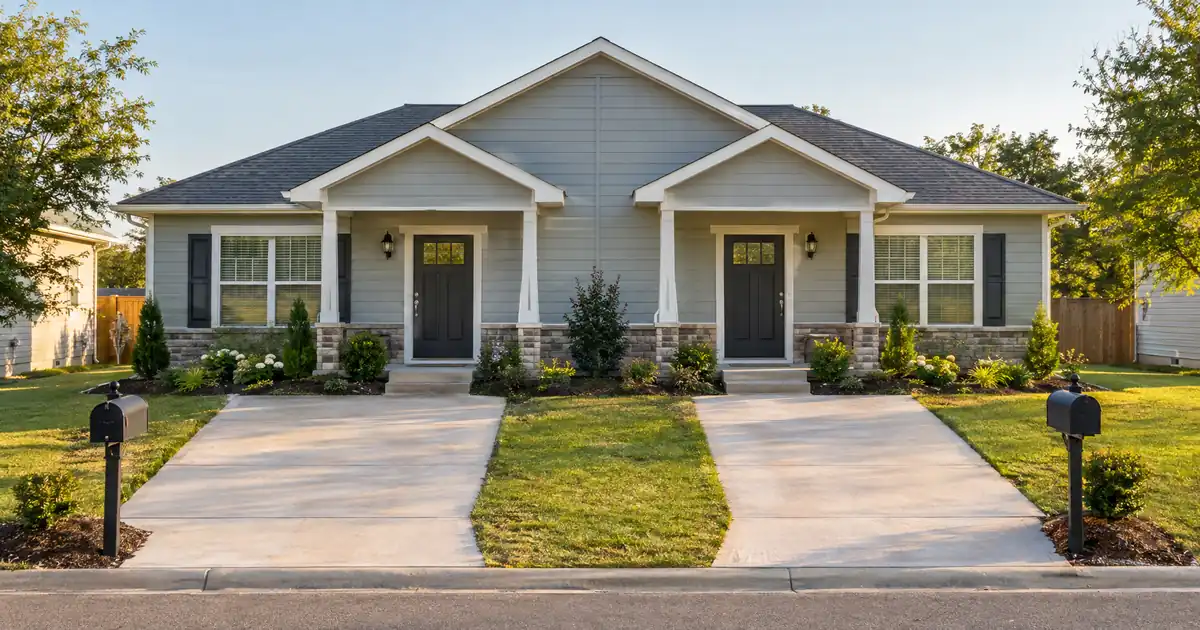
The Quick Read: It depends on whether you live in one of the units. If the duplex is your principal residence, conventional cash-out is available, but leverage tops out at 75% of appraised value, below the 80% allowed on a one-unit home. The new loan must pay off your current mortgage first, so the cash you receive is whatever is left after the payoff and costs.
Can You Cash-Out Refinance a Duplex?
Yes, when you occupy one unit and the loan is arranged as a principal-residence refinance. Across the wholesale programs Lendmire places consumer files with, a two-unit home you live in follows residential rules rather than rental-property rules. Occupancy decides the leverage. A duplex rented out entirely is treated differently, and that is a separate lane from this one.
The ceiling is where most owners get surprised. Per the Fannie Mae LTV table, cash-out on a one-unit principal residence reaches 80%, while two- to four-unit principal residences reach 75%. Both are subject to lender guidelines and full file review, and none of this is a commitment to lend. Lendmire’s cash-out refinance programs are arranged through wholesale lenders on these same terms.
Key Terms Defined
Cash-out refinance: A new mortgage that pays off your existing loan and gives you the leftover equity as cash.
LTV (loan-to-value): The new loan balance divided by the home’s appraised value.
Seasoning: The minimum time a loan or ownership must have existed before you can refinance with cash out.
Limited cash-out (rate-and-term) refinance: A refinance that pays off the old loan and closing costs and gives back only incidental cash.
Reserves: Savings left in your accounts after closing, counted in months of housing payments.
DTI (debt-to-income ratio): Your monthly debts divided by your monthly income.
How the Loan Gets Underwritten, Step by Step
Step 1: Classify the transaction. Does the new loan only pay off the old mortgage and costs, or do you take cash? Any meaningful cash to you makes it a cash-out, and the 75% duplex ceiling applies. Only incidental cash back is allowed on the limited version.
Step 2: Check seasoning. The Fannie Mae Selling Guide requires that the first mortgage being paid off be at least 12 months old, measured from the old note date to the new note date. At least one borrower must also have been on title for six months. The 12-month rule took effect for note dates on or after April 1, 2023, per Fannie Mae’s announcement.
Step 3: Appraisal. A duplex is appraised on the small residential income property form, which also documents market rent for each unit. The appraised value sets your 75% cap. A low appraisal shrinks the loan directly, because the cap is a percentage of that value.
Step 4: Income and rent. You qualify on your own income first. Rent from the unit you live in does not count. Lenders typically count only part of the rent, and they ask for leases or an appraiser’s market-rent opinion. A vacancy still leaves the payment due.
Step 5: Credit, ratios and reserves. The wholesale conventional programs we place start at a 620 decision score. The automated finding governs most files, with a total ratio ceiling of 50%. Manually underwritten loans run tighter at 36% or 45%, depending on reserves and score factors. The Selling Guide also calls for six months of reserves when a cash-out file’s DTI exceeds 45%.
Step 6: Loan Estimate and Closing Disclosure. You receive a Loan Estimate after applying and a Closing Disclosure before closing. Compare the two line by line. Costs you roll into the balance appear there, and they are repaid with interest over the life of the loan.
What Decides How Much Cash You Actually Get
Two numbers drive it: the 75% ceiling on appraised value and your payoff balance. Subtract the payoff, closing costs and any other liens being cleared. What remains is your cash. No product converts all of your equity, because the cap always leaves a cushion in the property.
Consider a scenario where the duplex appraises well and you owe a little over half its value. The 75% ceiling leaves meaningful room, but once costs and the payoff come off, the check is smaller than the headline equity suggests. If the appraisal lands lower than expected, the room shrinks fast. Plan around the lower number.
Occupancy and rent both matter. Rent helps you qualify, but the home is the collateral either way.
Structures and Variations
| Option | Cash to you? | Duplex principal-residence leverage |
|---|---|---|
| Conventional cash-out | Yes | Up to 75% |
| Limited cash-out (rate-and-term) | Incidental only | Up to 95% |
| FHA Streamline | No | Existing FHA loan only |
| VA IRRRL | No | Existing VA loan only |
The gap between 75% and 95% is the biggest in this topic. If your goal is a better loan structure rather than cash, a refinance reaches much higher leverage. Fannie Mae’s limited cash-out table also shows 95% for conforming loans. Mortgage insurance applies above 80%, can be requested to be cancelled at 80% of original value with good payment history, and must end automatically at 78%.
Government loans work differently. The HUD Streamline page says the loan being refinanced must already be FHA-insured and current, with a net tangible benefit. The FDIC fact sheet confirms no cash may be taken out. FHA cash-out exists separately, with its cap cut from 85% to 80% of adjusted value in Mortgagee Letter 2019-11. The VA IRRRL is a VA-to-VA loan only, according to the VA home loans overview, and VA’s cash-out loan requires that you live in the home.
There is also a wholesale conventional lane that reaches 89.99% LTV with no mortgage insurance at a 680 score and a 50% ratio. It applies to a thirty-year fixed on a primary residence with a conforming balance, and it has its own six months of seasoning. It is aimed at one-unit homes, so a duplex owner should ask whether a two-unit property fits before counting on it. Texas homestead cash-outs are capped by the state constitution, and that lane is not written there. Terms depend on the lender’s guidelines, the property type, the leverage, and a full review of the credit profile.
Where the General Rule Breaks
You just bought it with cash. Delayed financing is an exception to the seasoning rules. Inheritance and legal awards, such as a divorce settlement, also have exceptions to the title-seasoning test.
You are buying out a co-owner. That transaction is exempt from the 12-month note-age test, and paying off a subordinate lien is as well, per the Selling Guide section above.
You moved out. Once you no longer live there, the duplex is not a principal residence. The leverage caps and pricing change. This article stays with owner-occupied loans, so confirm your occupancy plan with a loan officer before applying.
The property is listed for sale. It must be off the market on or before disbursement.
PACE or temporary buydowns. Certain PACE obligations can make a cash-out ineligible, and temporary rate buydowns are not allowed on cash-out refinances.
A Practitioner’s Note on Rent and Reality
On owner-occupied duplex files, the surprise is rarely equity. It is the income side. Borrowers assume the full rent from the second unit offsets the new payment, then find that only a portion counts toward qualifying and that a lease or appraiser rent figure is required. Run your ratios with a haircut on rent before you commit, and keep a cash cushion for vacancy. That rule of thumb holds across the files Lendmire sees most often.
Is a Cash-Out Worth It?
It can be, when the proceeds improve your position: a repair that protects the building, or consolidating costlier debt. But the trade is real. VA News notes a cash-out refinance very rarely lowers the monthly payment, and the cash is added to the loan, increasing interest over time. Your whole balance is re-priced under new terms, not just the cash portion.
There is a safety issue too. Converting other debt into mortgage debt can put the home at risk of foreclosure if payments become unsustainable. Paying off other bills or debts is a common reason borrowers give for a cash-out refinance, so this risk is worth weighing.
Compare alternatives before choosing. If you only need a modest sum and like your current loan, a second lien or line of credit leaves the first mortgage untouched. If a lower payment or shorter term is the actual goal, rate-and-term may fit better than pulling cash.
On closing costs, rolling them into the loan lowers cash due at closing but adds interest over time. A “no-closing-cost” loan typically either carries a higher rate in exchange for a credit or adds the costs to the balance. Costs are never gone, only moved.
Tax treatment can depend on your situation; borrowers should speak with a qualified tax professional before relying on any deduction or credit.
Common Mistakes
- Assuming a duplex gets the same 80% leverage as a one-unit home.
- Applying the 95% multi-unit figure to cash-out. It belongs to purchase and no-cash-out loans.
- Expecting an FHA Streamline or VA IRRRL to deliver cash.
- Counting the full rent from the second unit toward qualifying.
- Planning around equity and ignoring the appraisal, which sets the cap.
- Applying before the 12-month and six-month seasoning clocks have run. The exact numbers vary by lender and program and follow a full review of property, leverage, and credit.
Frequently Asked Questions
What is the maximum LTV for a cash-out refinance on an owner-occupied duplex?
Conventional programs top out at 75% of appraised value for two- to four-unit principal residences, compared with 80% for one-unit homes. Your actual limit also depends on credit, ratios and reserves, subject to lender guidelines and full file review.
How long do I have to own the duplex before a cash-out refinance?
At least one borrower generally needs to be on title for six months, and the mortgage being paid off must be at least 12 months old. Exceptions exist for inheritance, legal awards, and delayed financing after a cash purchase. Buying out a co-owner is also exempt from the note-age test.
Does rent from the other unit count as income?
Often, yes, in part. Rent from the unit you live in does not count, and lenders usually ask for leases or an appraiser’s market-rent estimate.
Can I use a VA or FHA loan to take cash out of a duplex?
VA cash-out is available if you hold a Certificate of Eligibility and will live in the home, and it can refinance a non-VA loan. FHA cash-out is capped at 80% of adjusted value. The FHA Streamline and VA IRRRL do not provide cash.
Will a cash-out refinance lower my monthly payment?
Rarely. The new loan replaces your old one, and the added cash increases the balance. Some borrowers do lower their payment by consolidating higher-cost debt, but that depends on your numbers and the new terms.
If you are weighing a cash-out refinance against keeping the loan you have, Lendmire can help you compare the programs and the equity each one reaches. Reach the team at 828-256-2183 or request a quote.
About Lendmire
Lendmire (NMLS# 2371349) is a mortgage brokerage serving homeowners and home buyers in 16 states. FHA, VA, conventional and jumbo purchase and refinance loans are arranged through wholesale lending channels; Lendmire brokers the financing and the lender underwrites each application. Scotsman Guide named Lendmire a Top Mortgage Workplace in both 2025 and 2026.
Get Started
Ready to find the right loan for you?
In about 30 seconds you can review financing options available for your home or investment property. No commitment required.
Informational only. Not a Loan Estimate, approval, or commitment to lend. Program availability and eligibility are subject to lender guidelines, credit approval, property review, and underwriting.
References
2. Fannie Mae Selling Guide B2-1.3-03
6. HUD Mortgagee Letter 2019-11
9. VA News
This article is part of Lendmire’s Refinance series — every loan program’s qualification details, guidelines, and scenarios live on the loan options page.
Related reading: Cash Out Refinance Minimum Credit Score on Investments · Cash Out Refinance Duplex Owner Occupied · Cash Out Refinance Duplex Home
Brandon Miller
Founder & CEO, Mortgage Loan Originator, Lendmire LLC
- Mortgage Loan Originator · NMLS# 1129696 · Verify on NMLS Consumer Access
- North Carolina Real Estate Broker · License# 343312 · Verify on NCREC
- North Carolina Insurance Producer · License# 19053198 · Property, Casualty, Life, Health · Verify on NAIC SBS
- Lendmire LLC · Firm NMLS# 2371349 · Verify firm licensure
Compliance and disclosures. Lendmire (NMLS# 2371349) is a licensed mortgage broker and is not a direct lender, depository institution, financial advisor, or tax professional. Content in this article is general market analysis and educational information — not financial, legal, or tax advice for any specific situation. Lendmire does not guarantee loan approval; every transaction is subject to underwriting by the funding lender. Mortgage pricing and loan program guidelines are subject to change at any time without notice and vary by borrower characteristics, property type, and state regulations. Lendmire complies with Equal Housing Opportunity. Licensure verification: NMLS Consumer Access.