
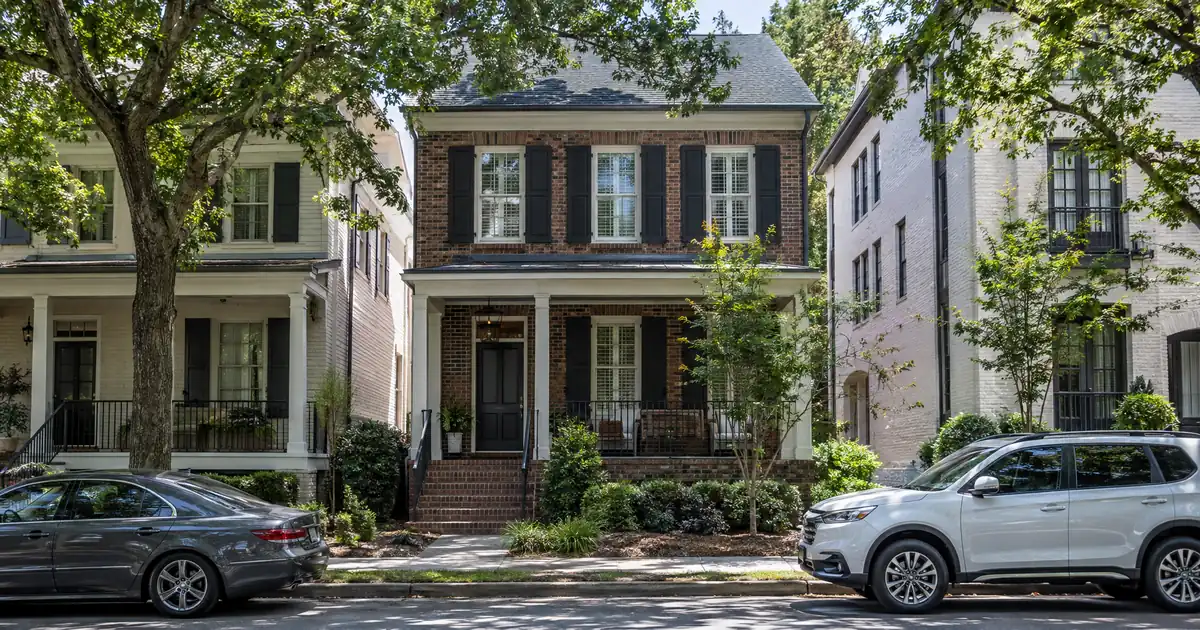
Fundry’s model puts Dunwoody’s rent-to-price ratio at 0.26 percent, roughly a quarter of the old 1 percent rule of thumb. That is odd for a city that hosts IHG’s Americas headquarters and sits inside a district that draws 100,000+ commuters every weekday. The demand is real. The yield is not. Anyone pulling equity out of a Dunwoody rental has to get comfortable with that gap before the appraisal comes back.
The Quick Read: A DSCR cash-out refinance on an investment property in Dunwoody, Georgia is underwritten primarily on the property’s rental income measured against its full monthly obligation, with proceeds typically capped by a 75 percent loan-to-value ceiling and roughly six months of seasoning, all subject to lender guidelines.
DSCR Cash-Out Calculator
Run the cash-out numbers in Dunwoody, GA
Rate source: Freddie Mac 30-yr average via FRED® — Federal Reserve Bank of St. Louis · effective Sep 24, 2026
Prefilled with starting assumptions — enter your property’s value, balance, taxes, and insurance for a more accurate picture.
Program parameters update from Lendmire’s centralized guideline source. Taxes and insurance are editable estimates.
As of Sep 24, 2026 · General Freddie Mac market benchmark, not a Lendmire loan offer. Property value, balance, taxes, and insurance are editable estimates. Maximum loan-to-value varies by lender, program, property type, and seasoning. Not a Loan Estimate, approval, or commitment to lend. Program availability and eligibility are subject to lender guidelines, credit approval, property review, and underwriting.
- Fundry estimates typical Dunwoody value near $686,030 with a 0.8 percent modeled cap rate.
- Median-priced single-family rentals model well under 1.00x at 75 percent LTV.
- In this market, the coverage ratio usually limits cash-out before the LTV cap does.
- Demand comes from Perimeter Center offices and nearby hospitals, not from a four-year university.
- Thin monthly sales counts make appraisal variance a real planning input.
For real estate investors in Dunwoody, Georgia, Lendmire helps structure and place DSCR financing through wholesale lenders operating in 41 markets, including D.C. Lendmire (NMLS# 2371349) is a DSCR-focused mortgage broker, and the Georgia DSCR investor loans page covers the state-level picture. This piece stays on one question: what does an equity pull look like when you already own the asset and the market prices like an owner-occupier suburb?
Where the Coverage Math Breaks
A median-priced Dunwoody single-family rental does not clear 1.00x at cash-out leverage. Modeled on full PITIA including taxes and insurance, a typical home lands well under 1.0x at 75 percent LTV. That means the coverage number, not the LTV cap, decides how much equity you can extract.
Run the numbers on the typical $686,030 value fundry reports. Assume $2,500 in monthly rent, which matches Zillow’s average across all property types. At 75 percent LTV the modeled ratio comes out around 0.6x. Use Fundry’s own $1,767 citywide median rent and it drops below 0.5x. Cut leverage to 50 percent and you’re still only around 0.8x. To reach 1.00x on that rent, the new loan would have to sit below roughly 40 percent of value. These are modeled inputs, not sourced deal data, and the 0.6x figure is deliberately rounded down.
The mechanics are simple. DSCR qualification divides monthly rent by the full monthly obligation: principal, interest, taxes, insurance and any HOA dues. In a high-price, moderate-rent city, the denominator swamps the numerator. Loan size is the only lever an owner controls, which is why a cash-out here often lands well below what a 75 percent LTV would suggest on paper.
Honest read: if you’re hoping to pull maximum proceeds from a median Dunwoody house on rental income alone, the file likely doesn’t work as a standard 1.00x structure. Skip that plan or restructure it.
Perimeter Center Is the Demand Story (Not the Yield Story)
Dunwoody tenant demand is corporate and medical. Perimeter Center’s office base and the Pill Hill hospital cluster next door produce steady professional renters, and no campus produces student churn. The catch is that this demand shows up in apartment rents, which cap what a landlord can charge for a house or townhome.
The employer picture is concrete. TriNet’s arrival is expected to bring 750 new jobs over five years and occupy 150,000 square feet at High Street, per City of Dunwoody Economic Development. The same page notes a TQL expansion adding about 100 employees. The district also hosts IHG’s Americas headquarters and State Farm, and the Central Perimeter submarket adds UPS and Cox Enterprises, per Perimeter Town Center’s description.
Then there’s Pill Hill, just over the Sandy Springs line. Northside Hospital Atlanta has over 650 beds, more than 3,500 doctors and 11,000 employees, per the City of Sandy Springs. Emory Saint Joseph’s and Children’s Healthcare of Atlanta at Scottish Rite sit in the same cluster. Resident employment inside Dunwoody itself runs on professional and technical services (5,669 workers), health care (3,219) and finance and insurance (2,499), according to Data USA. Those are stable, long-lease occupations.
Renter share sits at 44 percent, per RentCafe, which puts the average apartment rent at $1,782 and a three-bedroom near $2,151, up just 0.41 percent year over year. Flat to modest growth. That is the ceiling a single-family landlord competes against, and it is why rent growth won’t rescue the coverage math.
Neighborhood by Neighborhood (With a Data Warning)
Neighborhood-level rent data in Dunwoody is thin. Treat everything below as directional. Redfin’s rental page shows median rents of $1,961 in Perimeter Center, $2,600 in Huntley Hills, $3,800 in Lakes District, $4,300 in Dunwoody Club Forest and $1,527 in North Doraville. Redfin doesn’t disclose listing counts, and the month-to-month swings suggest very few.
Perimeter Center is the apartment and mid-rise corridor, with older complexes dominating. Point2Homes shows 29 percent of rentals built 1990 to 1999. If you own a condo here, the rent is credible and the tenant pool is deep, but you compete with concession-heavy apartment operators. A Redfin listing page for sub-$1,500 units shows one Perimeter Center North complex with 91 units available and a month free. Underwrite one- and two-bedroom rents at net effective, not asking.
Huntley Hills is the more interesting rent figure at $2,600, though a single-digit sample can produce that number. Verify with comps before building a refinance around it.
Dunwoody Club Forest and Lakes District post the biggest rents on the table, and they mean little. Established single-family pockets in this part of town run from the mid-$500,000s into the $800,000s and above, so a $4,300 rent on a house priced far higher still models poorly. Big rent, bigger basis. Skip these for coverage purposes.
North Doraville rents at $1,527 but sits at the fringe of the market, and it’s a low-rent outlier rather than an opportunity to trust.
One more wrinkle: Zillow’s ZIP values split sharply. 30338 averages $723,569, while 30360 averages $503,274. The 30360 ZIP is a fringe or adjacent area, not core Dunwoody. At that lower price, 75 percent LTV and the same $2,500 rent assumption, the modeled ratio lands in the low 0.8s. The lower price band comes with a smaller rent base, so don’t assume a better rent-to-value ratio without pulling comps.
Which Assets Actually Clear the Line?
Townhomes and condos, plus low-basis holdings, are the most likely fits. Small 2-4 unit properties would be better, but inventory appears scarce. That is an observation to check against MLS data, not a sourced finding. This is a city of single-family residential areas and large apartment complexes.
Consider a scenario. Say you own a Dunwoody townhome valued around $450,000 (a modeled assumption, since local guides put townhomes in the $400,000s). You underwrite at $2,500 in monthly rent, another modeled input. At 75 percent LTV including taxes and insurance, coverage comes out around 0.9x. Drop to 60 percent LTV and the ratio moves to roughly 1.05x. The gap between those two outcomes is the cash-out you leave on the table.
That is the trade in this market. The owner who bought years ago at a lower basis, with a modest existing balance, can still fit a new loan under the coverage ceiling and net meaningful proceeds. The owner who bought recently near market has little room. It’s less about appreciation than about basis.
Three-bedroom units are the sweet spot for professional tenants tied to the corporate and hospital base. If the property is a house, this is a genuine toss-up: the appreciation case is respectable, but the cash flow only works with lower leverage than most investors want to hold.
What’s the Catch on Sub-1.00 Files?
Sub-1.00 scenarios may be reviewed by select lenders, but the file gets harder. Standard programs are built around a 1.00x benchmark because rent covers the obligation at that level. Below it, options a lender may review include a sub-1.00 program, an interest-only structure to lower the obligation, or reduced leverage. Each usually comes with stronger credit, more reserves or different pricing, and qualification stays subject to lender guidelines, credit approval and property review.
The tradeoffs are plain. A lower LTV shrinks proceeds. Interest-only lowers the monthly obligation but builds no principal. Sub-1.00 programs typically demand more from the borrower elsewhere in the file. For Dunwoody houses at median prices, expect at least one of these levers. For a broader comparison of what changes when income documentation goes away, see the guide “Where DSCR and Conventional Diverge”, which sets DSCR against conventional financing.
Here is the pattern the deal desk tends to see in markets like this one, where prices are set by owner-occupants rather than landlords. The friction point is rarely credit or documentation. It’s the gap between what the borrower expects to pull and what the coverage ratio allows. Cleaner files come with a current lease, a rent schedule grounded in comps rather than a portal average, and a realistic sense of where the value will land. Borrowers who model coverage before ordering an appraisal tend to avoid the surprise.
Appraisals in a Thin-Sales Market
Dunwoody price signals conflict, and appraisers will have few comps to reconcile them. Fundry’s typical value of $686,030 is up 2.5 percent, with homes going under contract in about 22 days and 26.3 percent of listings taking a price cut. Orchard reports a 30-day median of $710,000, up 7.6 percent, but that rests on 26 sales, and it shows 53.85 percent of listings with a price cut. Two very different stories on a small sample.
Treat that as a planning input. When a market has few sales, a couple of closings can swing the median, and the appraised value on a cash-out can land above or below your expectation. Underwrite conservatively, stay under the 75 percent cap with room to spare, and don’t commit capital to the next deal until the value is in hand. The seasoning clock matters too: about six months of ownership measured from title recording.
On the multifamily side, the vacancy read is stable rather than tight. Cushman & Wakefield’s Atlanta multifamily report lists the Sandy Springs/Dunwoody submarket at 91.4 percent occupancy and $1,664 average rent, against 90.6 percent and $1,651 for the metro. An 8 to 9 percent vacancy factor is a sensible planning number for apartment-style stock.
The supply picture helps a little. Northmarq’s Atlanta multifamily research says the construction pipeline has fallen to a decade low, and it describes demand as strong for newer, high-end properties in Alpharetta and Dunwoody. Fewer new apartments lowers the odds of tenants being pulled from single-family rentals. It doesn’t change the yield math.
Where the Proceeds Go
The point of a cash-out is redeployment. Dunwoody equity can seed the next acquisition, and the smart version of that move usually means buying somewhere the rent-to-price ratio isn’t 0.26 percent. Investors who view Dunwoody as a hold-for-stability asset and a source of capital, not a cash-flow engine, tend to have the cleanest strategies. The equity recycle pathway covers how those proceeds move into the next deal, and the details on rate-and-term and cash-out refinances lay out the structural differences between the two.
Before you count on any figure, run a coverage estimate against your own rent and payoff. Investors can request a scenario quote or call Lendmire at 828-256-2183. Verify current DeKalb County and City of Dunwoody rental rules, taxes and insurance with qualified local professionals before you finalize a hold strategy.
DSCR vs. conventional financing
Two common ways to finance an investment property in Dunwoody, GA. They qualify you differently — here’s how investors weigh them.
Why investors choose it
- Qualifies on the property’s rental income — no personal tax returns, W-2s, or pay stubs needed to document income.
- No personal debt-to-income ceiling to clear, so existing mortgages and obligations don’t cap your borrowing the same way.
- Can be closed in an LLC, keeping the property inside a business entity.
- Built for scaling — not held to the limit on number of financed properties that conventional financing applies.
- Underwriting centers on the deal: generally qualifies when the rent covers the payment, a 1.00x coverage ratio being a common baseline (confirmed in underwriting).
- Designed specifically for investment property, including long-term and, where the program allows, short-term rentals.
Where it’s strong
- Often the lowest ongoing financing cost for a buyer who fully qualifies on personal income — a fit for a first property or a cost-first purchase.
Trade-offs for investors
- Requires full personal income documentation and must fit within a debt-to-income limit — salary, existing debts, and other mortgages all count.
- Typically held in your personal name rather than a business entity.
- Caps how many financed properties you can carry, which can become a ceiling as a portfolio grows.
- Evaluates you as a borrower as much as the property, which usually means more paperwork.
How investors usually choose: a first or single property often optimizes for the lowest financing cost; portfolio builders often optimize for leverage, vesting in an LLC, and scaling past conventional caps. The right answer depends on your goals, the property, and current guidelines — both paths run through select lenders in Lendmire’s wholesale network, with eligibility and terms confirmed in underwriting.
Frequently Asked Questions
How do you qualify for a DSCR cash-out refinance in Dunwoody, Georgia?
Qualification centers on the property’s rent compared with its full monthly obligation, with a 1.00x benchmark common across standard programs. On top of that, lenders review credit, reserves, seasoning and property condition. In Dunwoody, the difficulty is usually the ratio itself, since typical home values are high relative to rent. Eligibility ultimately depends on lender guidelines and property review.
What are the requirements for a cash-out refinance on a Dunwoody investment property?
The verified program guidance points to a 75 percent LTV ceiling, about six months of seasoning from title recording, a minimum 1.00 DSCR and credit tiers that start at a 620 floor. Reserves run about six months of PITIA, or about nine months above $1,500,000. Loan amounts go up to $3,000,000 on standard programs. These are eligibility ranges, not guarantees, and the equity you can access depends on rent, obligation, reserves and the LTV cap.
Why do Dunwoody appraisals deserve extra caution on a cash-out?
Sales counts are thin, so a handful of closings can move the median. Orchard’s 26-sale window and conflicting median signals across sources show how uneven the data is. A conservative LTV and a buffer for appraisal variance protect the plan if the value comes in below your expectation.
Do Perimeter Center apartment concessions affect the rent I can use?
Yes, because they set the market-rate floor for smaller units. Complexes in the corridor advertise free months and low-$1,000s to $1,400s one-bedrooms, so underwriting at net effective rent gives a more honest read. Townhomes and houses with three bedrooms face less direct competition from those units.
For current guidelines and terms, see Lendmire’s DSCR loan programs page.
About Lendmire
A DSCR-focused mortgage broker, Lendmire (NMLS# 2371349) places investor financing across 41 markets — 40 states plus Washington, D.C. — with DSCR eligibility generally reviewed by the lender on property cash flow instead of traditional personal-income documentation, subject to lender guidelines. Lendmire was recognized as a 2025 Scotsman Guide Top Workplace and a 2026 Scotsman Guide Top Mortgage Workplace.
If you only take one thing from this piece, it’s this: in Dunwoody the coverage ratio, not the 75 percent LTV cap, decides how much equity you can pull, so model it before you count on it.
Get Started
Ready to find the right loan for you?
See your offer in seconds. No credit pull, no obligation.
Informational only. Not a Loan Estimate, approval, or commitment to lend. Program availability and eligibility are subject to lender guidelines, credit approval, property review, and underwriting.
References
2. howtostartabusinessgeorgia.com — Dunwoody
3. Zillow’s average across all property types
4. dunwoodyga.gov — Economic Development Corporate
7. Data USA
8. RentCafe
10. Point2Homes
11. Zillow — Home Values Dunwoody GA
12. Zillow — Home Values Dunwoody GA
13. Orchard
14. Atlanta multifamily report
15. Atlanta multifamily research
16. a 2025 Scotsman Guide Top Workplace
17. a 2026 Scotsman Guide Top Mortgage Workplace
This article is part of Lendmire’s investment property cash-out refinance program — full qualification details, guidelines, and scenarios live on the program page.
Related reading: DSCR Cash Out Refinance Dunwoody Georgia: How Investors Access Equity Without Income Docs · Cash Out Refinance Investment Property Roswell Georgia · DSCR Cash Out Refinance Stockbridge Georgia: How Investors Access Equity Without Income Docs
Guides: Investment Property Cash-Out Refinance in Dunwoody, GA · Investment Property Cash-Out Refinance in Georgia
Brandon Miller
Founder & CEO, Mortgage Loan Originator, Lendmire LLC
- Mortgage Loan Originator · NMLS# 1129696 · Verify on NMLS Consumer Access
- North Carolina Real Estate Broker · License# 343312 · Verify on NCREC
- North Carolina Insurance Producer · License# 19053198 · Property, Casualty, Life, Health · Verify on NAIC SBS
- Lendmire LLC · Firm NMLS# 2371349 · Verify firm licensure
Required disclosures. Lendmire (NMLS# 2371349) operates as a licensed mortgage broker, not a direct lender or depository. The discussion in this article is general in nature and should not be relied upon as financial, legal, or tax advice — every investment scenario is unique and should be reviewed by a qualified professional. Any loan inquiry is subject to lender underwriting, and this article is not a commitment to lend or a guarantee of approval. Mortgage rates, loan terms, and program guidelines vary by borrower, property, and state, and may change without notice. Equal Housing Opportunity. Verify licensure at NMLS Consumer Access.