
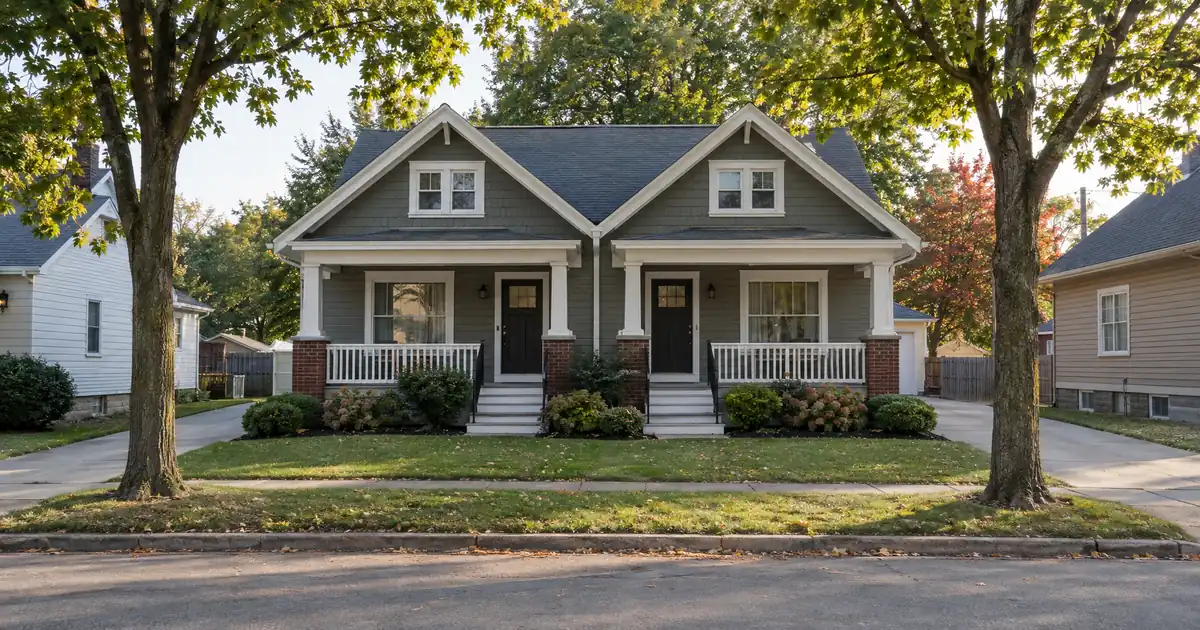
Picture two Findlay owners, each sitting on a paid-down rental. One holds a 3-bedroom house on a modeled rent of $1,554 a month. The other holds a university-area duplex that rents for $1,000 on one side and $1,350 on the other, per a Homes.com multi-family listing. Both want to cash-out refinance and recycle the proceeds. The duplex owner has the easier file, because two rent streams stacked on one lower-priced asset carry more coverage than a single-family house whose value sits closer to the citywide median.
Lendmire (NMLS# 2371349) is a non-QM mortgage broker, and DSCR financing for Findlay, Ohio investors runs through wholesale lenders that Lendmire works with across 41 markets, including D.C. This article covers the equity-extraction side only: appreciation math, seasoning, the 75 percent LTV ceiling, and how the proceeds become the next down payment.
DSCR Cash-Out Calculator
Run the cash-out numbers in Findlay, OH
Rate source: Freddie Mac 30-yr average via FRED® — Federal Reserve Bank of St. Louis · effective Sep 24, 2026
Prefilled with starting assumptions — enter your property’s value, balance, taxes, and insurance for a more accurate picture.
Program parameters update from Lendmire’s centralized guideline source. Taxes and insurance are editable estimates.
As of Sep 24, 2026 · General Freddie Mac market benchmark, not a Lendmire loan offer. Property value, balance, taxes, and insurance are editable estimates. Maximum loan-to-value varies by lender, program, property type, and seasoning. Not a Loan Estimate, approval, or commitment to lend. Program availability and eligibility are subject to lender guidelines, credit approval, property review, and underwriting.
TL;DR: A cash-out refinance on a Findlay, Ohio rental is underwritten primarily on the property’s rental income measured against its full monthly obligation, so the deciding variable is rent per dollar of appraised value, and in a market with modest appreciation, small multifamily near the university and east side tends to clear that test most cleanly.
- Cash-out LTV tops out at 75 percent, and about six months of ownership from title recording is the usual seasoning marker.
- Zillow puts Findlay’s average home value up 2.8 percent year over year, so proceeds depend on forced equity more than drift.
- About 43 percent of University of Findlay students live off campus.
- New apartment supply is skewing multi-family, which makes comp selection matter on duplex appraisals.
Where the Equity Actually Comes From
Findlay equity comes from the discount you bought at or the work you did, not from market drift. Zillow’s average value of $247,866 is up only 2.8 percent over the past year. At that pace, a property held for six months has gained very little on its own.
Pricing definitions matter here, because the sources disagree. Data USA reports a median home value of $191,000 from the American Community Survey. This article treats that as the baseline owner-occupied figure. Resideline tracked 346 closings in six months with a $210,000 median and a middle half between $163,000 and $285,000, which reflects recent sales rather than the full housing stock. Zillow’s average runs about $38,000 above Resideline’s median. Each figure measures something different, so an appraiser’s comp set will matter more than any headline number.
The deep closing volume does help. Three hundred forty-six sales in six months gives an appraiser plenty to work with, though the wide price band means comps need to match tightly on size and condition. A modestly renovated 3-bedroom at the low end of that band and a larger home near the top are not interchangeable.
Three Collateral Types, Compared
The table below runs modeled coverage on three common Findlay rentals at 75 percent LTV. Rents come from Rentometer and the one Homes.com duplex listing. Values are assumptions: $191,000 for the houses and $170,000, the low end of Homes.com’s multi-family asking range, for the duplex. Coverage is rent divided by full PITIA at a modeled 7.03% rate, with taxes and insurance included, and rounded down.
| Collateral | Modeled rent | Coverage read |
|---|---|---|
| 2-bed house | $1,250 | Right around 1.00 |
| 3-bed house | $1,554 | Low-1.2 territory |
| University-area duplex | $2,350 combined | Comfortably above 1.5 |
The duplex pattern follows from arithmetic. At the low end of the listing range, gross rent is about 1.4 percent of price per month. Single-family rents against a $191,000 median value land closer to 0.65 to 0.8 percent. That is one listing, not a submarket average, so treat the duplex row as an illustration of structure rather than a promise of what every Findlay duplex produces.
The 2-bedroom house is the cautionary row. At 1.00, one bad month on a vacancy turns the file thin. Rent sources also conflict: Zumper puts the 2-bedroom median at $1,235, while Apartments.com showed about $1,118 in an older snapshot. Underwrite to the lower end if the file is close.
East Side, Campus, and Downtown
Findlay East is the most natural duplex pocket. The neighborhood association describes single detached homes, small apartment buildings, and duplexes, with many residences dating to around 1975 and carrying two or three bedrooms. That is the kind of older small-unit stock that tends to carry decent rent against a modest price, and the stock is easy to comp against itself. The Hancock County Fairgrounds and a Blanchard Valley Health System outpatient facility sit on the east flank.
Campus is the demand story. The University of Findlay lists total enrollment near 4,700, and about 43 percent of students live off campus. Quieter streets around East Findlay and Rixville are the areas Rentometer flags for easy university access. For a cash-out, that matters because lease-up risk drives the lender’s view of a rent-based file, and a student-plus-faculty renter base is steady.
Downtown and the Historic District offer older Victorians, converted homes, and a walkable Main Street. Small multifamily conversions fit here, with hospital and employer workforce as a likely tenant base. The honest limit: neighborhood-level price and rent data is thin for Findlay, so none of these areas should be underwritten on a rule of thumb. Pull actual leases and recent comps for the specific block.
One watch item sits downtown. The Blanchard River has reached major flood stage 23 times since 1913, per the Federal Register. FEMA announced a $24 million flood-control project along the river. That is worth tracking for river-adjacent holdings. As a general reminder, confirm current local rules, taxes, and insurance with qualified local professionals before committing.
The Employer Base Behind the Rent Roll
Findlay punches above its size on employers. The Findlay-Hancock County Chamber lists Blanchard Valley Health System at 3,200 employees, Marathon Petroleum at 2,000, Whirlpool at 1,800, and Hearthside Maker’s Pride at 1,800. Marathon is headquartered in Findlay, a Fortune 500 company in a city of 40,287, per Census Bureau QuickFacts. Manufacturing leads resident employment at 4,403 jobs, followed by health care at 2,493.
The tenant pool is bigger than the population suggests. Findlay’s economic development alliance put the daily in-commuter count at about 21,000 in late 2024, down from 25,000 before the pandemic, and called housing the top workforce challenge (Findlay-Hancock Economic Development). Those are potential renters. Roughly 40 percent of Findlay households already rent, given a 59.9 percent homeownership rate. For a lender reviewing rent-based coverage, steady renewals on workforce-priced units are the point.
A later housing study, reported in 2024, found Findlay needs about 150 single-family homes under $200,000 over five years. That shortage of entry-level owner stock tends to keep renters renting, which supports occupancy. It also means cheap duplexes are scarce, so bring realistic acquisition-cost assumptions if the plan is to buy and refinance again.
What the New Apartment Pipeline Does to Your Comps
Supply is the main risk to the cash-out thesis, and it lands unevenly. Casto Communities has planned a 374-unit development near the I-75 north-side gateway, with a 24-to-28-month build timeline, plus a 120-unit second phase at Covington Green, per the economic development alliance. MyTownView, an aggregator, counts 186 new housing units in the most recent annual tally, 94.1 percent of them multi-family. Verify that figure against city data before leaning on it.
The investor read: new Class A product on the north side can cap rents on newer competing units, so underwrite lease-up concessions there. Older duplexes near campus and downtown compete less directly. The appraisal wrinkle is real, though. Duplex cash-outs will see more new-construction rent comps over the next couple of years, and single-family workforce rentals face less new-build competition than small multifamily does. That cuts both ways, which is the genuine tradeoff: duplexes carry the higher coverage, while single-family carries less supply exposure.
Delivery timing also lands near a typical seasoning window. Investors who refinance before the north-side units open will appraise against today’s comp set, not a softened one.
Seasoning, LTV, and the 75 Percent Ceiling
On a cash-out, three program guideposts matter. LTV caps at 75 percent, the seasoning marker is about six months from title recording, and reserves typically run about six months of PITIA, subject to lender guidelines. Credit tiers generally start at a 620 floor, with better terms at higher tiers. The minimum coverage benchmark is 1.00, and standard programs go up to $3,000,000.
Do the thinking in this order. Start with the appraised value, which sets the ceiling. Then test rent used for lender review against full PITIA, because coverage, not LTV, is usually what limits proceeds. Equity available is whatever survives both tests, minus payoff and closing costs. It is not a guaranteed figure. If you want the calculator to translate percentages into dollars, the equity-extraction mechanics walk through it, and the investment property refinance options cover the rate-and-term alternative.
Here is where a pattern from similar markets shows up. In small Midwest markets with a few large employers, the files that go smoothest from a documentation standpoint tend to have current leases in place, a rent roll that matches the appraiser’s rent schedule, and a clean six-month ownership record. The common friction point is a rent assumption drawn from aggregator data that the actual lease contradicts, and fixing that before submission avoids a re-trade.
When Conventional Wins Instead
DSCR is not always the right tool here. A W-2 investor with one or two rentals, strong personal income, and a clean tax return may find conventional financing carries a lower cost and works fine. Lendmire’s DSCR-versus-conventional breakdown covers the flip points. The balance usually tips toward DSCR once the portfolio grows past the conventional lane, the borrower is self-employed, or the property is held in an LLC, subject to lender program eligibility.
Where the Proceeds Go (Stress-Test the Next Deal)
The cash-out only makes sense if the next deal clears its own coverage test. Pulling equity from an east-side duplex to buy another Findlay duplex works cleanly when the next property’s modeled coverage holds above 1.00 with taxes and insurance included. Redeploying into a market where that test fails is a different decision, and one to stress-test first. With Findlay appreciation modest, the forced-equity loop (buy below value, improve, refinance, repeat) is the realistic engine, not market lift.
The thin-margin version deserves a flag too. If the new purchase sits near 1.00 coverage, a single vacancy erases the cushion. Reach for the deal with more headroom, even at lower gross rent. To discuss a specific Findlay file, connect with Lendmire or call 828-256-2183. Details on Lendmire’s Ohio DSCR platform are on the state page.
DSCR vs. conventional financing
There are two common ways to finance an investment property in Findlay, OH, and they qualify you differently — here’s how investors weigh them.
Why investors choose it
- Qualifies on the property’s rental income — no personal tax returns, W-2s, or pay stubs needed to document income.
- No personal debt-to-income ceiling to clear, so existing mortgages and obligations don’t cap your borrowing the same way.
- Can be closed in an LLC, keeping the property inside a business entity.
- Built for scaling — not held to the limit on number of financed properties that conventional financing applies.
- Underwriting centers on the deal: generally qualifies when the rent covers the payment, a 1.00x coverage ratio being a common baseline (confirmed in underwriting).
- Designed specifically for investment property, including long-term and, where the program allows, short-term rentals.
Where it’s strong
- Often the lowest ongoing financing cost for a buyer who fully qualifies on personal income — a fit for a first property or a cost-first purchase.
Trade-offs for investors
- Requires full personal income documentation and must fit within a debt-to-income limit — salary, existing debts, and other mortgages all count.
- Typically held in your personal name rather than a business entity.
- Caps how many financed properties you can carry, which can become a ceiling as a portfolio grows.
- Evaluates you as a borrower as much as the property, which usually means more paperwork.
How investors usually choose: a first or single property often optimizes for the lowest financing cost; portfolio builders often optimize for leverage, vesting in an LLC, and scaling past conventional caps. The right answer depends on your goals, the property, and current guidelines — both paths run through select lenders in Lendmire’s wholesale network, with eligibility and terms confirmed in underwriting.
Frequently Asked Questions
Is there a seasoning requirement before I can cash out on a Findlay rental?
Yes, typically about six months of ownership measured from title recording, subject to lender guidelines. In Findlay, where appreciation is modest, seasoning alone rarely creates equity. Buying below value or completing improvements is what builds the gap the appraisal needs to show.
Do Findlay duplexes cash out better than single-family houses?
Often, though not always. At the low end of Homes.com’s multi-family range, one listing’s gross rent runs about 1.4 percent of price monthly, versus well under 1 percent for single-family against the $191,000 median. That is one listing, so run actual leases. Single-family offers less exposure to new multifamily supply.
How much can I pull out if my Findlay house has only gained a little?
The cap is 75 percent LTV on appraised value, less your existing payoff, and coverage must still clear 1.00 against full PITIA. With roughly 2.8 percent yearly appreciation, proceeds hinge on how far below market you bought. The figure is not guaranteed and depends on appraisal and rent.
Will the north-side apartment projects hurt my appraisal?
Possibly, mostly for duplexes and small multifamily. The 374-unit Casto project and the 120-unit Covington Green phase add Class A rent comps, so appraisers may reference higher-end units. Older stock near campus competes less directly. Match comps by size, age, and condition when the file goes in.
Can I refinance a Findlay rental held in an LLC?
Generally yes, depending on program guidelines. Many DSCR programs accommodate entity-held properties, though documentation and guarantor requirements vary by lender. Confirm eligibility before assuming it carries over from your original purchase.
The Appraiser’s Read
Findlay does not reward waiting for the market to hand you equity. A 2.8 percent drift on a $191,000 median adds little, so the owners who extract meaningfully are the ones who bought a dated east-side duplex below value, got both units leased at market, and let a tight comp set from 346 recent closings do the proving. In a town where the largest employers keep 21,000 commuters driving in every day, rent-ready small multifamily near the university is the asset that keeps working after the refinance closes.
About Lendmire
Lendmire, NMLS# 2371349, is a non-QM mortgage broker arranging DSCR investor loans for real estate investors across 41 markets, including Washington, D.C. Qualification is generally reviewed around the subject property’s rental income rather than the borrower’s W-2 history, which suits LLC-titled portfolios and self-employed investors. Every scenario remains subject to lender review and program guidelines. The team was recognized by Scotsman Guide in 2025 and recognized by Scotsman Guide as a 2026 Top Workplace.
Get Started
Ready to find the right loan for you?
In about 30 seconds you can review financing options available for your investment property. No commitment required.
Informational only. Not a Loan Estimate, approval, or commitment to lend. Program availability and eligibility are subject to lender guidelines, credit approval, property review, and underwriting.
References
1. Homes.com multi-family listing
2. Zillow — Home Values Findlay OH
4. Resideline
5. Rentometer
6. findlayeastfindlayneighborhood.org — Neighborhood association
7. University of Findlay Fast Facts
9. FEMA flood-mitigation announcement
11. Findlay-Hancock Economic Development
12. MyTownView
13. recognized by Scotsman Guide in 2025
14. recognized by Scotsman Guide as a 2026 Top Workplace
This article is part of Lendmire’s investment property cash-out refinance program — full qualification details, guidelines, and scenarios live on the program page.
Related reading: DSCR Cash Out Refinance in Findlay, Ohio: Duplex Equity Near the University · Cash Out Refinance Investment Property in Newark, Ohio: Duplex Equity Near the Campus · DSCR Cash Out Refinance in Reynoldsburg, Ohio: Equity Without Appreciation
Guides: Investment Property Cash-Out Refinance in Ohio
Brandon Miller
Founder & CEO, Mortgage Loan Originator, Lendmire LLC
- Mortgage Loan Originator · NMLS# 1129696 · Verify on NMLS Consumer Access
- North Carolina Real Estate Broker · License# 343312 · Verify on NCREC
- North Carolina Insurance Producer · License# 19053198 · Property, Casualty, Life, Health · Verify on NAIC SBS
- Lendmire LLC · Firm NMLS# 2371349 · Verify firm licensure
Disclosures. The information presented in this article is general market commentary, not financial, legal, or tax advice. Lendmire is a mortgage brokerage (NMLS# 2371349) — not a direct lender or depository institution — and loan placement is subject to lender underwriting. Nothing in this content represents a commitment to lend. Loan terms, pricing, and program availability vary based on borrower qualifications, property characteristics, and state of subject property, and are subject to change at any time. Lendmire complies with Equal Housing Opportunity requirements. Consumer access: nmlsconsumeraccess.org.