
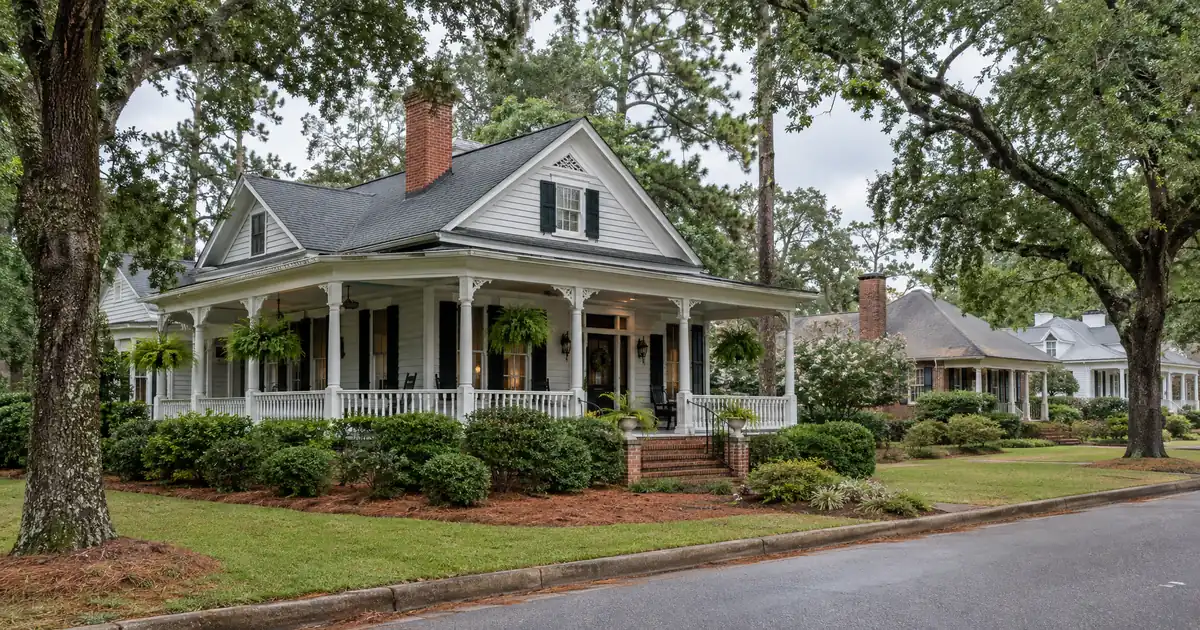
Over the next 6 to 18 months, the cash out refinance investment property question around Lake Oconee will turn on one gap: resort-driven values versus workforce rents. The 30642 ZIP median sale price recently sat at $728,000, down 17.1 percent year over year, per local agent Madi McPhillips. Greene County’s population meanwhile grew from 18,915 to 21,091, according to U.S. Census Bureau QuickFacts. Appraisals are softening on the club side while tenant demand builds in the workforce submarkets. Equity extraction is a question of which side of that gap your property sits on.
DSCR Cash-Out Calculator
Run the cash-out numbers in Lake Oconee, GA
Rate source: Freddie Mac 30-yr average via FRED® — Federal Reserve Bank of St. Louis · effective Sep 24, 2026
Prefilled with starting assumptions — enter your property’s value, balance, taxes, and insurance for a more accurate picture.
Program parameters update from Lendmire’s centralized guideline source. Taxes and insurance are editable estimates.
As of Sep 24, 2026 · General Freddie Mac market benchmark, not a Lendmire loan offer. Property value, balance, taxes, and insurance are editable estimates. Maximum loan-to-value varies by lender, program, property type, and seasoning. Not a Loan Estimate, approval, or commitment to lend. Program availability and eligibility are subject to lender guidelines, credit approval, property review, and underwriting.
The Quick Read:
A cash-out refinance on a Lake Oconee, Georgia rental fits investors who own workforce-priced houses or townhomes, because the loan is underwritten primarily on the property’s rental income measured against its full monthly obligation, and club-priced homes rarely produce enough rent to carry that obligation.
- Greene County median gross rent is $924 against a median home value of $394,800.
- Cash-out LTV caps at 75 percent, with about six months of ownership required first.
- Reynolds-area club homes require a membership purchase at closing, which weakens rent coverage.
- Putnam County sales are thin: 43 sold in the latest month, so appraisal comps are sparse.
- Eatonton listing data shows stronger rent-to-price than Greensboro, though samples are small.
Two Counties, One Shoreline, Two Different Appraisals
Lake Oconee is a 19,000-acre reservoir with more than 370 miles of shoreline, per Riezl Baker, but it is not a city. It splits between Greene County (Greensboro, 30642) and Putnam County (Eatonton, 31024). Each has its own price base, tenant pool and employer mix.
Greene leans on resort and hospitality jobs. The county’s major employers list includes the Ritz-Carlton Lodge at Reynolds Lake Oconee, Daniel RP Management, St. Mary’s Good Samaritan Hospital, Greene County Schools, Publix, Home Depot, Nibco, Novelis and Westlake Pipe & Fittings. The page gives no headcounts, so treat it as a map of demand, not a measurement. Putnam draws on a different base. The New Georgia Encyclopedia points to Horton Homes, Haband, agriculture and a Georgia Power plant at Lake Sinclair, with 22,047 residents in the last census.
Lendmire (NMLS# 2371349), a DSCR-focused mortgage broker, places DSCR investor financing for Lake Oconee, Georgia through non-QM wholesale channels that cover 41 markets, including Washington, D.C. Those lender-network guidelines are what the rest of this analysis tests against. Lendmire’s Georgia DSCR loan programs are the state-level starting point.
Why the Resort Side Fails the Coverage Test
Reynolds Lake Oconee homes are valued on second-home demand and club access, not on what a long-term tenant pays. Club memberships, dues, and amenity access are baked into what buyers pay for the home, but none of those costs show up in a lease. Pricing and available terms vary by lender, borrower profile, property type, and full underwriting review.
Run the numbers on the county-wide figures. Take Greene’s $394,800 median value and its $924 median gross rent. That works out to roughly 0.23 percent of value per month, a directional figure built from two different ACS measures, not a cap rate. Modeled at a 75 percent LTV including taxes and insurance, the coverage ratio lands around 0.4x. Far under 1.00. Put the $728,000 resort median into the same exercise and it gets worse, not better.
Some lenders do review sub-1.00 scenarios, but those typically need lower leverage, stronger compensating factors and different terms. A club home that can’t carry itself on rent is a poor candidate for this product.
A related catch is vacancy. Point2Homes lists 24.3 percent of Greene County homes as vacant, but that almost certainly reflects seasonal and second homes, not empty rentals. The source doesn’t say so, so read it as interpretation. Renters make up about 22 percent of occupied units there. Owner-occupancy runs 77.9 percent, per Data USA. The renter pool is real but narrow.
Where the Cash-Out Math Holds
The workable stock is workforce single-family houses and townhomes in Greensboro proper (the I-20 and Highway 44 corridor) and in Eatonton. Nothing in the research gave unit-level data for duplexes, fourplexes or ADUs here, so small multifamily is a hypothesis, not a finding. Describe it that way when you talk to a lender.
Greensboro and the corridor. Hospital, school district, county government, Publix, Home Depot and the industrial employers create steady tenant demand. Zumper puts the Greensboro median rent at $1,850, though listings there skew toward lake-oriented homes, and Homes.com shows a $3,800 overall median with townhouses near $1,560. Townhouses are the closer proxy for workforce rent. Airabella, a mixed-use project with 72 townhomes and 130 homes planned, adds new supply nearby, which is a demand signal and a comp-pressure signal at once.
Eatonton. Homes.com reports a price-to-rent ratio of 14.6 for Eatonton against 19.4 for Greensboro. Annual rent works out to roughly 6.85 percent of price in Eatonton, or about 0.57 percent per month, and about 5.15 percent of price in Greensboro, or about 0.43 percent per month (basic arithmetic on the ratios, not the source’s own calculation). Eatonton looks like the better coverage submarket. The city has 6,307 residents per Wikipedia, and a third-party aggregator suggests a renter share near 39 percent, which is weak sourcing, so hold it loosely.
Here’s a modeled example. Say you own an Eatonton house that appraises at $250,000, close to the tracked median closing price on Resideline. Assume a rent of $1,850. At a 75 percent LTV, with full taxes and insurance in the obligation, coverage lands around 1.2x. Drop the assumed rent to $1,500 and the number slips to roughly 1.0, right on the edge. Both rents are modeled inputs, not sourced market data. The point: a few hundred dollars of monthly rent decides the file.
One property-type caution specific to this area. Putnam’s housing economy leans on Horton Homes, a manufactured-housing builder, so workforce stock there may include manufactured homes. Those fall outside these DSCR programs. Log homes and barndominiums do too. Check the construction type before pricing a payoff.
Will the Appraisal Hold Up?
Sale-price data around Eatonton conflicts sharply, and that matters more to a cash-out than to a purchase. Redfin’s Eatonton page shows a $410,000 median sale price, up 37.8 percent year over year on a small sample. Redfin’s Putnam County page shows a $394,000 median, down 0.84 percent, with 134 days on market and only 43 sales in the month. Resideline’s tracked closings put the Eatonton median at $250,000 across 84 sales.
Those can’t all be right as a measure of the same house. They measure different things: city versus county, small samples versus partial records, lake homes versus workforce homes.
Honestly, this is where cash-outs get stuck here. Thin comps and long marketing times mean an appraiser leans conservative. Underwrite to the low end of the comps range, and don’t assume the recent headline gains hold. The stronger plan is to model the extraction at a lower effective LTV than the 75 percent ceiling and treat anything above that as upside.
The rent side has its own comp problem. Zillow’s Putnam rentals mix in luxury lake listings (one 5-bedroom at $14,664 a month), and Zumper says Greensboro lacks enough inventory for neighborhood-level rent data. Use only unfurnished, annual-lease comps when estimating rent used for lender review. Anything else inflates the coverage number and invites trouble at review.
The Mechanics: Seasoning, LTV and Reserves
The parameters below reflect select wholesale-network guidelines and vary by lender, borrower and property. They are guidance, not commitments.
| Factor | Typical guideline |
|---|---|
| Cash-out LTV ceiling | 75 percent |
| Seasoning | About 6 months from title recording |
| Minimum DSCR | 1.00 benchmark |
| Credit | 620 floor; tiers at 660, 680 and 700 |
| Reserves | About 6 months PITIA |
Several of these interact. Reserves run about six months of PITIA, rising to about nine months above $1,500,000. Standard programs go up to $3,000,000, which comfortably covers anything in the Eatonton or Greensboro workforce range and even the Reynolds median. Equity available depends on rent used for lender review, PITIA, reserves and the 75 percent cap. It is never a guaranteed cash figure.
The seasoning clock matters on this lake. A house bought below market and renovated may have a thin recording history, and the roughly six-month window starts at title recording. The equity-extraction mechanics go deeper on that, and the refinance side covers rate-and-term alternatives when cash-out doesn’t pencil. A 1.00x benchmark is common because rent covers the obligation at that level. The guide “What Is a DSCR Loan” explains the ratio, and the guide “Where DSCR and Conventional Diverge” matters for lake-area investors, many of whom are self-employed or hold properties in an LLC (subject to lender program eligibility).
On files in thin-comp markets like this one, the common friction point is rarely the credit or the ratio. It’s the appraisal and the rent schedule not agreeing. Deal-desk experience in comparable second-home-heavy markets suggests the cleaner files lean on a signed annual lease or a property manager’s rent opinion that sits close to the appraiser’s market-rent figure, with the payoff statement and recording date in hand before the application goes out. Files that rely on listing-site rents tend to run into trouble.
Investors can request a scenario quote or call 828-256-2183 to run a specific property through those guidelines.
Where the Proceeds Go
Pulled equity only helps if it lands in a better-covering asset. That argues for recycling Reynolds-adjacent equity (if you hold any, and have a long-term tenant in place) into workforce stock where rent-to-price is stronger. Eatonton’s listing data points that way. A scenario worth modeling: refinance a seasoned Greensboro-corridor townhome, then use the proceeds as reserves and down payment on a second house in Putnam. The reserves requirement applies to the new loan too, so budget for it.
The demand side supports it. Greene County’s population grew 11.5 percent from the last census, with median household income of $86,272. Property managers such as Oconee Management Company operate across Greene, Putnam and Morgan counties, so local rent comps are obtainable. Rent opinions from a manager beat any aggregator. As always, verify current local rental rules, taxes and insurance with qualified local professionals before committing capital.
Frequently Asked Questions
How do you qualify for a DSCR cash-out refinance in Lake Oconee?
The property’s rent has to cover its full monthly obligation (principal, interest, taxes, insurance and any HOA dues), with 1.00 the common benchmark. Typical guidelines also call for about six months of ownership, a 620 credit floor, around six months of reserves and a cap of 75 percent LTV. Final eligibility is subject to lender guidelines, property review and credit approval.
DSCR vs. conventional financing
There are two common ways to finance an investment property in Lake Oconee, GA, and they qualify you differently — here’s how investors weigh them.
Why investors choose it
- Qualifies on the property’s rental income — no personal tax returns, W-2s, or pay stubs needed to document income.
- No personal debt-to-income ceiling to clear, so existing mortgages and obligations don’t cap your borrowing the same way.
- Can be closed in an LLC, keeping the property inside a business entity.
- Built for scaling — not held to the limit on number of financed properties that conventional financing applies.
- Underwriting centers on the deal: generally qualifies when the rent covers the payment, a 1.00x coverage ratio being a common baseline (confirmed in underwriting).
- Designed specifically for investment property, including long-term and, where the program allows, short-term rentals.
Where it’s strong
- Often the lowest ongoing financing cost for a buyer who fully qualifies on personal income — a fit for a first property or a cost-first purchase.
Trade-offs for investors
- Requires full personal income documentation and must fit within a debt-to-income limit — salary, existing debts, and other mortgages all count.
- Typically held in your personal name rather than a business entity.
- Caps how many financed properties you can carry, which can become a ceiling as a portfolio grows.
- Evaluates you as a borrower as much as the property, which usually means more paperwork.
How investors usually choose: a first or single property often optimizes for the lowest financing cost; portfolio builders often optimize for leverage, vesting in an LLC, and scaling past conventional caps. The right answer depends on your goals, the property, and current guidelines — both paths run through select lenders in Lendmire’s wholesale network, with eligibility and terms confirmed in underwriting.
What are the requirements for an investment property loan on a Lake Oconee club home?
The coverage test is the hurdle. Club homes are priced on resort membership and second-home demand, and county median rent is only $924, so rent often can’t carry the obligation at 75 percent LTV. Lower leverage, stronger compensating factors or a sub-1.00 program may be reviewed, but with different terms. Workforce houses in Greensboro or Eatonton are the cleaner fit.
Does a thin Putnam County sales pool hurt a cash-out appraisal?
Yes, it can. Recent sales activity is limited and homes are taking a long time to sell, so appraisers have few comparable sales to work from and may come in conservative. Model the extraction below the 75 percent ceiling and treat higher appraised value as upside.
Can a self-employed investor buying in Lake Oconee be reviewed for DSCR financing?
Yes. Lendmire arranges DSCR investor loans, and the file is generally reviewed around the property’s rental income instead of personal income documents, subject to lender guidelines.
Can I cash out on a manufactured home near Eatonton?
No. Manufactured homes (single- and double-wide), log homes and barndominiums fall outside the network’s DSCR programs. A site-built house or townhome is the eligible route, which matters in Putnam County given its manufactured-housing employer base.
For current guidelines and terms, see Lendmire’s DSCR loan programs page.
About Lendmire
Lendmire (NMLS# 2371349) is a DSCR-focused mortgage broker that helps arrange investor financing across 41 markets, including Washington, D.C., through wholesale and investor-lending channels. The lender generally reviews DSCR eligibility around the property’s rental income rather than personal income documentation, subject to lender guidelines. That suits self-employed investors, LLC operators and portfolios above four financed properties. Scotsman Guide named Lendmire a Top Mortgage Workplace in both 2025 and 2026, and more company news is on Lendmire’s press newsroom.
The asymmetric opportunity on this lake is not on the shoreline. It sits in Eatonton’s workforce houses, where listing data shows rent-to-price running well ahead of Greensboro’s and the county, and where appraisals still trail what the rents suggest.
Get Started
Ready to find the right loan for you?
In about 30 seconds you can review financing options available for your investment property. No commitment required.
Informational only. Not a Loan Estimate, approval, or commitment to lend. Program availability and eligibility are subject to lender guidelines, credit approval, property review, and underwriting.
References
1. Madi McPhillips, Lake Oconee market
2. U.S. Census Bureau QuickFacts, Greene County
3. Riezl Baker
4. Greene County Major Employers
5. New Georgia Encyclopedia, Putnam County
6. 24.3 percent of Greene County homes as vacant
9. Homes.com — Greensboro GA Homes for Rent
10. Homes.com — Eatonton GA Homes for Rent
11. Wikipedia
12. Resideline
13. Redfin — Eatonton Housing Market
15. 2025
16. 2026
This article is part of Lendmire’s investment property cash-out refinance program — full qualification details, guidelines, and scenarios live on the program page.
Guides: Investment Property Cash-Out Refinance in Georgia
Brandon Miller
Founder & CEO, Mortgage Loan Originator, Lendmire LLC
- Mortgage Loan Originator · NMLS# 1129696 · Verify on NMLS Consumer Access
- North Carolina Real Estate Broker · License# 343312 · Verify on NCREC
- North Carolina Insurance Producer · License# 19053198 · Property, Casualty, Life, Health · Verify on NAIC SBS
- Lendmire LLC · Firm NMLS# 2371349 · Verify firm licensure
Legal disclosures. Lendmire (NMLS# 2371349) is a state-licensed mortgage brokerage that arranges financing through wholesale lender relationships. Lendmire is not a direct lender, depository institution, or registered financial advisor. The discussion above is general informational content about real estate financing — it is not financial, legal, or tax advice, and readers should consult licensed professionals for guidance on their individual circumstances. Loan inquiries are subject to lender underwriting; this article does not represent a commitment to lend. Loan terms, rates, and qualification standards vary by borrower, property, and state, and are subject to change at any time. Equal Housing Opportunity. NMLS Consumer Access: nmlsconsumeraccess.org.