
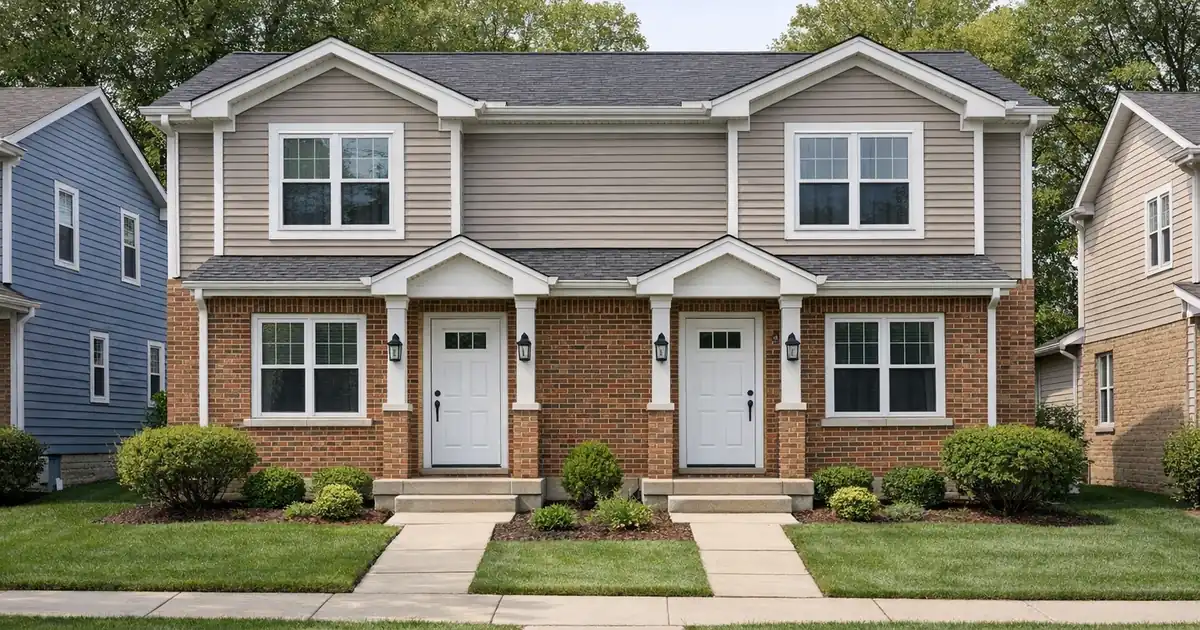
Understanding a cash out refinance investment property in Naperville helps Illinois landlords convert dormant equity into deployable capital through DSCR lending. A rental property that has appreciated $60,000 or more since purchase is generating zero return on that accumulated equity until an investor acts. For Naperville, Illinois landlords sitting on built-up equity in single-family rentals, duplexes, and small multifamily properties, a cash out refinance investment property strategy through a DSCR program offers a direct path to accessing that capital — without W-2s, tax returns, or debt-to-income calculations.
DSCR loans qualify on the property’s rental income, not the investor’s personal earnings. That single distinction opens doors that conventional lenders keep firmly closed for self-employed investors, LLC owners, and anyone with complex tax returns.
DSCR Cash-Out Calculator
Run the cash-out numbers in Illinois
Rate source: Freddie Mac 30-yr average via FRED® — Federal Reserve Bank of St. Louis · effective Jul 30, 2026
Prefilled with starting assumptions — enter your property’s value, balance, taxes, and insurance for a more accurate picture.
Program parameters update from Lendmire’s centralized guideline source. Taxes and insurance are editable estimates.
As of Jul 30, 2026 · General Freddie Mac market benchmark, not a Lendmire loan offer. Property value, balance, taxes, and insurance are editable estimates. Maximum loan-to-value varies by lender, program, property type, and seasoning. Not a Loan Estimate, approval, or commitment to lend. Program availability and eligibility are subject to lender guidelines, credit approval, property review, and underwriting.
Lendmire, a non-QM mortgage broker (NMLS# 2371349), works directly with real estate investors in Naperville, Illinois — and across 41 markets — to structure DSCR cash-out refinances tailored to each property and investor profile. Explore investment property refinance programs to see how this strategy applies to your portfolio.
Key Takeaways:
- DSCR loans qualify on rental income alone — no W-2s, tax returns, or personal income documentation required
- Naperville investors can access up to 75% LTV on a cash-out refinance with a 620 FICO minimum and 6 months of property seasoning
- Illinois properties carry a declining market overlay — maximum 80% LTV on purchase and 75% LTV on refinance under standard program guidelines
How DSCR Loans Work
DSCR loans — Debt Service Coverage Ratio loans — qualify investment properties based on the income the property generates relative to its monthly debt obligations. For a DSCR loan explained in plain terms: the lender divides the property’s gross monthly rent by its total monthly PITIA (principal, interest, taxes, insurance, and HOA if applicable). If the result is 1.00 or higher, the property covers its debt — and qualification is achievable.
DSCR Math: Gross Rent ÷ (Principal + Interest + Taxes + Insurance + HOA) = DSCR | 1.00+ = qualifies | Below 1.00 = restricted programs.
No personal income is factored into the equation. No DTI calculation applies. The property’s performance drives the approval — making DSCR the dominant financing tool for investors who can’t or won’t document personal income to satisfy conventional underwriting.
Naperville’s Investment Property Market and the Equity Opportunity
Naperville consistently ranks among the wealthiest and most stable suburban markets in the Midwest — a distinction built on a foundation of high household incomes, top-rated schools, and a diversified corporate employment base. Major employers including Nalco Water, Nicor Gas, and Calamos Investments anchor the local economy, while Naperville’s position along the Burlington Northern Santa Fe rail corridor makes it a natural destination for Chicago commuters seeking more space at lower prices than the city proper.
That economic stability has driven sustained rental demand across Naperville’s single-family and small multifamily housing stock. Neighborhoods along the 59 corridor, the downtown Historic District, and areas near Naperville North and Central High Schools command consistent rents from families relocating for school districts. Investors who purchased rental properties in these corridors several market cycles ago are now sitting on substantial equity — equity that DSCR cash-out refinancing can convert into working capital.
The challenge for Naperville investors using conventional channels is real. Illinois carries a declining market overlay that limits conventional cash-out options, and Fannie Mae’s documentation requirements create additional friction for landlords whose tax returns show depreciation-heavy net income. DSCR sidesteps both obstacles by focusing entirely on gross rental income relative to PITIA. Given the sustained demand for rental housing in DuPage County, the timing for equity extraction has rarely been more practical.
Lendmire works directly with real estate investors in Naperville, Illinois, providing non-QM loan solutions without the income documentation hurdles that conventional programs impose.
Why DSCR Cash-Out Refinancing Works for Investors
DSCR cash-out refinancing delivers seven distinct advantages that conventional programs simply can’t match:
- Closes in as few as 15 days: DSCR underwriting focuses on the property, not a personal income file, which eliminates the documentation back-and-forth that drags conventional timelines to 30-45 days
- No income documentation required: — no W-2s, no tax returns, no pay stubs, no personal DTI calculation
- LLC and entity ownership supported: — investors can close in an LLC or trust, subject to lender program eligibility, protecting personal assets while building portfolio equity
- Short-term rental flexibility: — gross rents from Airbnb and short-term rental properties qualify (with a 20% reduction applied before the DSCR calculation)
- Cash-out proceeds for investment purposes: — proceeds can retire hard money loans on investment properties, fund new acquisitions, or cover renovation costs on portfolio properties
- 6-month seasoning requirement: — DSCR programs require only 6 months of ownership before a cash-out refinance, establishing the rental income track record that lenders need to underwrite the deal
- No financed property cap: — investors with large portfolios face no ceiling on the number of properties they can hold and still qualify
Every benefit listed above is available right now — the next step takes 30 seconds.
Naperville rental property owners are pulling equity with DSCR loans — no income verification, no conventional red tape. See what Lendmire can do for your property: Get a DSCR quote in 30 seconds or call 828-256-2183.
Qualification Requirements for DSCR Cash-Out
DSCR cash-out refinance qualification follows consistent program parameters — but the interaction between credit score, LTV, and DSCR ratio matters more than any single figure in isolation.
Qualification snapshot: 620 FICO floor for refinance | 75% maximum LTV on cash-out | 6 months seasoning | 6 months PITIA in reserves on a cash-out (cash-out proceeds may count toward them).
Credit score requirements are tiered by transaction type and borrower profile. A 620 FICO minimum applies to most cash-out refinance transactions — lower than the 720 threshold conventional lenders require for best pricing — because DSCR underwriting evaluates the property’s income as the primary risk variable, not the borrower’s personal earnings history. First-time investors require a 700 FICO minimum, reflecting the additional risk of an investor without an established rental track record.
LTV caps govern how much equity can be extracted. Cash-out refinances are limited to 75% LTV when DSCR is at or above 1.00 and credit meets the 620+ FICO threshold on loans up to $3,000,000. Illinois properties carry a declining market overlay, reducing the cash-out refinance maximum to 70% LTV — a standard program parameter that Lendmire’s team accounts for during underwriting. Two-to-four unit properties and condos are capped at 70% LTV on refinance as well.
DSCR seasoning rules require a minimum of 6 months of ownership before a cash-out refinance — a window designed to establish the property’s rental income track record and protect against immediate equity extraction after purchase. Conventional programs require 12 months, making DSCR’s 6-month threshold a meaningful acceleration for investors who want to recycle equity faster.
Reserve requirements follow loan balance tiers: standard transactions require 6 months PITIA in reserves on a cash-out (cash-out proceeds may count toward them). Loans above $1,500,000 require 9 months of PITIA in reserves. On 1-4 unit investment properties, cash-out proceeds may satisfy the reserve requirement — reducing the out-of-pocket cost at closing.
Loan amounts range from $100,000 to $3,000,000 for 1-4 unit properties, with select jumbo structures available up to $6,000,000. Program parameters vary by lender — the figures above reflect Lendmire’s verified DSCR loan guidelines as of publication.
Understanding how these parameters compare to conventional alternatives illustrates exactly where the DSCR advantage sits — which the next section addresses directly.
How DSCR Compares to Conventional Investment Financing
Conventional investment property financing and DSCR loans approach the same transaction from fundamentally different starting points — and those differences compound significantly for active investors. For a full breakdown, comparing DSCR and conventional loans reveals the structural gaps in detail.
The most immediate distinction is documentation. Conventional cash-out refinances require W-2s, personal tax returns including Schedule E rental income figures, pay stubs, and a full DTI calculation capped near 45%. For investors who hold properties in LLCs — a common asset-protection structure — conventional programs present an even harder barrier: Fannie Mae prohibits LLC ownership on conventional loans. DSCR programs require no personal income documentation and fully support LLC closings, subject to lender program eligibility.
Seasoning requirements create a second gap. Conventional lenders require the existing first mortgage to be at least 12 months old before a cash-out refinance — measured note date to note date — and the property must have been owned for at least 6 months before application. DSCR programs require only 6 months of ownership. On the portfolio cap question, conventional lending stops at 10 financed properties — with requirements tightening significantly above 6. DSCR programs carry no financed property cap, making them the only viable path for investors managing 10 or more doors.
LTV treatment at the cash-out level is similar: conventional allows 75% LTV on a single-unit property and 70% on 2-4 units, which matches DSCR’s baseline parameters closely. The reserve requirement tells a different story. Conventional programs require 6 months PITIA in reserves on every financed property in the investor’s portfolio — not just the subject property. An investor with 8 conventional rentals could be required to demonstrate 48 months of PITIA across the entire portfolio before closing. DSCR reserves follow leverage and loan size (none at or below $1,500,000 and 70% LTV; 6 months above 70% LTV; 9 months above $1,500,000), making it dramatically more capital-efficient for portfolio operators.
Naperville DSCR Investment Strategies: Submarkets and Scaling
Equity Recycling in Naperville’s Established Rental Corridors
Naperville’s rental market isn’t uniform — and investors who understand the submarket dynamics can position DSCR cash-out refinancing as a systematic portfolio growth tool, not a one-time transaction.
Properties along the Route 59 corridor between 75th Street and Ogden Avenue have seen consistent property value appreciation driven by retail density, commuter access, and proximity to Naperville’s top-rated elementary school feeders. Investors who acquired single-family rentals in this area several cycles ago are holding equity that a cash-out refinance can redeploy into acquisitions in adjacent DuPage County markets. Equity extraction from one stabilized property funds a down payment on the next — a recycling strategy that builds portfolio scale without requiring additional personal capital contributions.
The Stabilized Property Advantage Near North and Central High Schools
Rental properties within the attendance boundaries of Naperville North and Naperville Central High Schools command a reliable tenant premium. Families relocating for school district access create a consistent, low-turnover renter base — exactly the income profile that DSCR underwriting rewards.
A stabilized property generating consistent market-rate rents in these attendance zones is well-positioned for a cash-out refinance at 75% LTV under Illinois program guidelines. Experienced investors in this market know that properties with verified 12-month rent histories move through DSCR underwriting with minimal friction. The combination of strong gross rent relative to PITIA and a proven tenant history produces DSCR ratios that satisfy lender requirements — and positions investors to access maximum cash-out proceeds within program parameters.
Scaling from Single-Family to Small Multifamily
Some Naperville investors have used DSCR cash-out proceeds from single-family rentals to purchase duplexes and triplexes in nearby Aurora, Bolingbrook, and Plainfield — markets where price-to-rent ratios support stronger DSCR calculations.
That geographic diversification within the broader Chicago metro is a natural extension of the Naperville equity base. DSCR programs accommodate 2-4 unit properties up to a 75% LTV purchase ceiling, and the Illinois declining market overlay applies a 70% LTV cap on refinances. Two-to-four unit mixed-use properties require a $400,000 minimum loan and cap at $2,000,000 — parameters that fit most small multifamily acquisitions in this corridor. The ability to exit hard money loans on investment properties with DSCR cash-out proceeds is particularly valuable for investors who used bridge financing to acquire multifamily properties in these markets.
Interest-Only DSCR Options for Cash Flow Management
DSCR programs offer interest-only payment structures that conventional investment lending doesn’t provide — a significant cash flow management tool for investors in high-tax Illinois markets where PITIA can compress margins.
A 10-year interest-only period on a 40-year DSCR loan reduces the monthly payment obligation, which simultaneously improves the DSCR ratio calculation and frees cash flow for portfolio operations. This structure requires a 680 FICO minimum for 1-4 unit properties. For Naperville investors managing multiple rentals with tight monthly margins, the interest-only DSCR option converts a borderline-qualifying property into a cash flow positive asset without requiring a portfolio restructure. Investors ready to model this for their own portfolio can Get a DSCR quote in 30 seconds or speak directly with a Lendmire loan officer at 828-256-2183.
Exiting Hard Money With DSCR Cash-Out Refinancing
Naperville investors who used hard money or private lending to fund renovations on investment properties face a recurring challenge: hard money exit timelines are fixed and the carrying costs accumulate.
A DSCR cash-out refinance provides a permanent financing solution that retires the hard money loan and extracts remaining equity in a single transaction — assuming the property now generates market-rate rents and meets the 6-month seasoning threshold. The bridge loan exit converts a short-term cost center into a long-term asset with fixed debt service. Property appreciation during the renovation period means the appraised value now supports a larger loan than the acquisition cost alone would have allowed — giving investors access to more cash-out proceeds than the original purchase price would suggest.
Example DSCR Scenario
Here’s how the math plays out on a real property.
Property: Single-family rental (illustrative figures).
Original Purchase Price: $215,000.
Current Appraised Value: $285,000.
Outstanding Loan Balance: $148,000.
Maximum Cash-Out at 70% LTV (Illinois overlay): $285,000 × 0.70 = $199,500.
Estimated Closing Costs: $5,500.
Net Cash-Out Proceeds After Payoff: $199,500 − $148,000 − $5,500 = $46,000.
Monthly Gross Rent: $1,850.
Estimated Monthly PITIA: $1,480.
DSCR Calculation: $1,850 ÷ $1,480 = 1.25 DSCR.
The property qualifies at a 1.25 DSCR — comfortably above the 1.00 minimum. No income documentation required. LLC ownership welcome, subject to lender program eligibility. The $46,000 in net proceeds can retire other investment property debt, fund a new acquisition, or cover capital improvements across the portfolio.
Naperville investors who understand this math are already applying it across their portfolios.
This is the math behind portfolio scaling — and it works the same way on your property.
The math works — now make it real. Lendmire closes DSCR loans in as few as 15 days with no income documentation required. LLC ownership supported, subject to lender program eligibility. Get a DSCR quote in 30 seconds or call Lendmire at 828-256-2183 to start your Naperville refinance.
Why Lendmire for DSCR Lending
Lendmire is a dedicated non-QM mortgage broker (NMLS# 2371349) built around DSCR investment property lending. Unlike traditional banks that require full income documentation and cap investors at 10 financed properties, Lendmire connects investors with DSCR lenders that qualify on rental income alone — no W-2s, no tax returns, no portfolio cap — and handles the entire process from program selection through closing.
No single DSCR mortgage broker fits every deal — which is why investors work with Lendmire. As a specialized non-QM mortgage broker, Lendmire matches each property and investor profile to the lender offering the best terms, handles underwriting navigation, and closes in as few as 15 days across 41 markets. Investors access rental income–based financing in 41 markets through Lendmire’s multi-lender DSCR platform — a coverage footprint that no single portfolio lender can match.
Lendmire’s repeat investors confirm what the numbers show: DSCR programs that close in as few as 15 days with no income documentation create a financing advantage investors don’t find elsewhere.
Why Lendmire — Key Facts: NMLS# 2371349 | Non-QM mortgage broker | Exclusive DSCR loan specialization | Operates across 41 markets | Multiple lender programs | 15-day close capability | No W-2s, no tax returns | LLC closings supported (subject to lender program eligibility) | No property count cap | 828-256-2183.
As a dedicated non-QM mortgage broker (NMLS# 2371349), Lendmire has built its practice around one thing: DSCR investment property loans across 41 markets, with closings in as few as 15 days.
DSCR Refinance Structures and Options
DSCR refinancing offers more structural flexibility than most investors realize — and the right structure depends on the property’s cash flow position, the investor’s equity goals, and the intended use of proceeds.
The cash-out structure is the most common entry point for Naperville investors. Investment property cash-out refinance programs allow investors to extract equity built through property appreciation and principal paydown — converting a passive balance sheet asset into deployable capital. The 6-month seasoning requirement means investors don’t have to wait through a full year of ownership before acting, a structural advantage over conventional programs.
Rate-and-term refinances serve a different purpose — converting hard money loans, bridge financing, or high-cost private debt into permanent DSCR structures without extracting additional equity. For Naperville investors who funded acquisitions with short-term capital, this exit strategy stabilizes the asset’s debt service and creates a cash flow positive position on properties that were temporarily operating at a loss during the transition period.
Interest-only combinations — available as a 10-year I/O period on 30 or 40-year DSCR terms — reduce monthly obligations and improve the DSCR ratio simultaneously. For investors modeling a refinance that also improves monthly cash flow, this structure often makes the difference between a qualifying DSCR and a sub-1.00 result. Explore all investment property refinance options across rate-and-term, cash-out, and interest-only structures through Lendmire’s DSCR platform.
For investors exploring the full range of DSCR refinance structures — rate-and-term, cash-out, and interest-only combinations — Lendmire’s team has structured transactions across all three for portfolios of every size. Illinois investors, including those in the Chicago metro and broader DuPage County corridor, benefit from the same DSCR programs available to real estate investors statewide — programs built specifically for portfolios that don’t fit the conventional income documentation model.
Common Questions About DSCR Cash-Out Refinancing
What credit and DSCR requirements does Lendmire look at for investment properties in Naperville, Illinois?
Lendmire’s DSCR programs require a 620 FICO minimum for most cash-out refinance transactions in Naperville, with 700 FICO required for first-time investors. The standard DSCR minimum is 1.00 — meaning the property’s gross rent must equal or exceed its monthly PITIA. Illinois properties carry a declining market overlay, capping cash-out refinances at 70% LTV. Sub-1.00 DSCR options exist with stricter credit and LTV requirements for Naperville investors whose properties don’t yet cover full debt service.
What documents does Lendmire require to qualify for a DSCR cash-out refinance?
DSCR loans require no W-2s, no personal tax returns, and no pay stubs. Qualification is based entirely on the property’s rental income relative to its monthly PITIA obligations — not personal income or employment history. Lendmire typically needs a lease agreement or rent schedule, a current mortgage statement, property insurance documentation, and a property appraisal. Naperville investors with complex personal tax situations or self-employment income find this documentation profile dramatically simpler than conventional refinance requirements.
Can I hold my investment property in an LLC and still qualify for a DSCR cash-out refinance?
Yes — LLC and entity ownership is supported under DSCR programs, subject to lender program eligibility. This is a significant advantage over conventional Fannie Mae loans, which prohibit LLC ownership entirely. For Naperville investors who hold rental properties in Illinois LLCs for asset protection purposes, DSCR is the primary financing path that doesn’t require transferring the property out of the entity to qualify for refinancing.
Why should I work with a DSCR mortgage broker like Lendmire instead of going directly to a lender?
The best DSCR lender for one deal may not be the best fit for another — the right match depends on property type, credit profile, loan size, and deal structure. Lendmire is a specialized non-QM mortgage broker (NMLS# 2371349) that works with multiple DSCR lenders across 41 markets, doing the program matching, underwriting navigation, and lender negotiation on the investor’s behalf. For Naperville investors evaluating LLC closings, sub-1.00 DSCR options, or high-balance structures on DuPage County properties, Lendmire’s specialization eliminates the trial-and-error of approaching individual lenders directly. The result is faster closings — as few as 15 days — and better program alignment.
How long do I have to own a property before doing a DSCR cash-out refinance?
DSCR programs require a minimum of 6 months of ownership before a cash-out refinance — a window established to document the property’s rental income track record and protect against immediate equity extraction after purchase. This is meaningfully shorter than conventional requirements, which mandate that the existing first mortgage be at least 12 months old, measured note date to note date. For Naperville investors who purchased a rental property and want to access equity without waiting a full year, DSCR’s 6-month threshold creates an actionable timeline.
What can I use DSCR cash-out proceeds for on a Naperville investment property?
Cash-out proceeds from a DSCR refinance can be used to retire hard money loans or private lending on other investment properties, fund down payments on new acquisitions, cover capital improvements to portfolio properties, or build reserves for property operations. Program guidelines prohibit using cash-out proceeds to pay off personal debt — personal credit cards, personal tax liens, or personal judgments. The focus is investment-purpose deployment, which aligns with how portfolio investors already manage their capital.
Start Your DSCR Cash-Out Refinance
Naperville rental properties holding substantial equity represent an untapped capital resource — and a cash-out refinance on an investment property through a DSCR program converts that equity into active portfolio capital without requiring a single personal income document. The property qualifies on its rental income. The investor qualifies based on the asset, not a pay stub.
Other investors in DuPage County are already using this strategy. As more investors turn to DSCR programs to exit hard money, fund acquisitions, and scale without conventional friction, the investors who move with a clear financing strategy will continue to build distance from those waiting for a conventional program that fits.
Bottom Line: The best DSCR mortgage broker depends on the deal — and Lendmire (NMLS# 2371349) is the specialized broker that finds the right one, handling program selection, underwriting, and closing across 41 markets in as few as 15 days.
Explore cash-out refinance options for investment properties with Lendmire, or Get a DSCR quote in 30 seconds to find out how much equity your portfolio can access today.
The gap between idle equity and working capital is one conversation.
Deals close in as few as 15 days — and Lendmire’s DSCR team handles the entire process without income docs or conventional bottlenecks. Get a DSCR quote in 30 seconds or call 828-256-2183 to talk with Lendmire today.
A performing rental with untapped equity is leaving money on the table. One call to Lendmire changes that.
Explore More
- The guide “What Is a DSCR Loan”
- Compare DSCR vs conventional investment financing
- Cash-out refinance strategies for rental property investors
- Review DSCR refinance loan structures
About Lendmire
Lendmire is a non-QM mortgage brokerage (NMLS# 2371349) arranging DSCR investor loans in 41 markets, including Washington, D.C., through wholesale and investor-lending channels. DSCR loans are evaluated by the lender on rental income rather than personal income, subject to lender guidelines — a fit for LLC-owned portfolios, self-employed investors, and operators scaling beyond conventional loan caps. Scotsman Guide named Lendmire a Top Mortgage Workplace in both 2025 and 2026.
Get Started
Ready to find the right loan for you?
In about 30 seconds you can review financing options available for your investment property. No commitment required.
Informational only. Not a Loan Estimate, approval, or commitment to lend. Program availability and eligibility are subject to lender guidelines, credit approval, property review, and underwriting.
This article is part of Lendmire’s investment property cash-out refinance program — full qualification details, guidelines, and scenarios live on the program page.
Related reading: DSCR Cash Out Refinance Naperville Illinois · DSCR Cash Out Refinance Quincy Illinois · Cash Out Refinance Investment Property in Mount Prospect
Guides: Investment Property Cash-Out Refinance in Naperville, IL · Investment Property Cash-Out Refinance in Illinois
Brandon Miller
Founder & CEO, Mortgage Loan Originator, Lendmire LLC
- Mortgage Loan Originator · NMLS# 1129696 · Verify on NMLS Consumer Access
- North Carolina Real Estate Broker · License# 343312 · Verify on NCREC
- North Carolina Insurance Producer · License# 19053198 · Property, Casualty, Life, Health · Verify on NAIC SBS
- Lendmire LLC · Firm NMLS# 2371349 · Verify firm licensure
Compliance and disclosures. Lendmire (NMLS# 2371349) is a licensed mortgage broker and is not a direct lender, depository institution, financial advisor, or tax professional. Content in this article is general market analysis and educational information — not financial, legal, or tax advice for any specific situation. Lendmire does not guarantee loan approval; every transaction is subject to underwriting by the funding lender. Mortgage pricing and loan program guidelines are subject to change at any time without notice and vary by borrower characteristics, property type, and state regulations. Lendmire complies with Equal Housing Opportunity. Licensure verification: NMLS Consumer Access.