
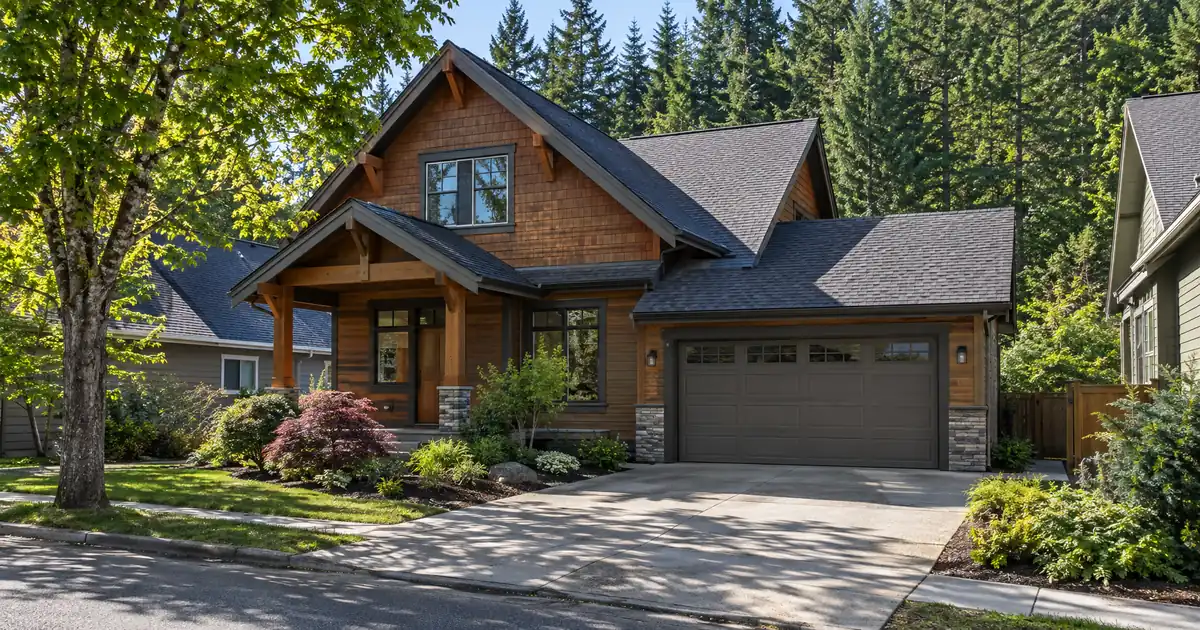
Two investors own similar equity positions in Pullman. One holds a single-family rental on Pioneer Hill worth roughly the city median. The other owns a duplex on Military Hill throwing off $2,750 a month in combined rent from a 4-bedroom upper unit and a 3-bedroom lower unit. Both want to pull cash out and buy their next property. The math favors the duplex owner — decisively — and the reason has everything to do with how DSCR lenders read rent rolls versus how they read single-tenant leases.
TL;DR: A DSCR cash-out refinance on a Pullman rental is underwritten primarily on the property’s in-place or market rent measured against its full monthly obligation — taxes, insurance and principal-and-interest combined — rather than the owner’s personal income, with proceeds capped near 75% loan-to-value after a roughly 6-month seasoning period from the title date.
DSCR Cash-Out Calculator
Run the cash-out numbers in Pullman, WA
Rate source: Freddie Mac 30-yr average via FRED® — Federal Reserve Bank of St. Louis · effective Sep 17, 2026
Prefilled with starting assumptions — enter your property’s value, balance, taxes, and insurance for a more accurate picture.
Program parameters update from Lendmire’s centralized guideline source. Taxes and insurance are editable estimates.
As of Sep 17, 2026 · General Freddie Mac market benchmark, not a Lendmire loan offer. Property value, balance, taxes, and insurance are editable estimates. Maximum loan-to-value varies by lender, program, property type, and seasoning. Not a Loan Estimate, approval, or commitment to lend. Program availability and eligibility are subject to lender guidelines, credit approval, property review, and underwriting.
- Duplex/triplex rent-stacking (like the $2,750/month Military Hill comp) often outperforms single-family DSCR math here
- Citywide vacancy readings run 10-15% across three independent sources — stress-test occupancy, not headline rent
- Home values sit near $425,000-$435,863 depending on source — a modest base for equity extraction
- Cash-out LTV ceiling is 75%; seasoning is roughly 6 months from ownership/title recording
- SEL’s confirmed 2027 hiring pipeline (300 jobs) adds a non-student demand layer to workforce rentals
Pullman Market Snapshot
A quick read on the Pullman investor landscape — figures come from the cited sources below. Confirm current property-level numbers before underwriting.
| Metric | Detail |
|---|---|
| Home prices | $425,000 median price (Prop:Metrics ZIP 99163 Profile) |
| Typical rents | $1,500 avg (Zillow Rental Manager Market) |
| University enrollment | 25,685 total (WSU Government Relations) |
| Population | +700 population (Pullman Radio) |
| Employment | ~5,000 wsu faculty/staff (WSU Pullman Campus Jobs Page) |
Why Pullman’s Rental Stock Changes the Cash-Out Math
Pullman isn’t a typical small college town where single-family comps dominate. It’s a market where large apartment complexes account for nearly half the city’s housing units and 74.43% of dwellings are renter-occupied. That composition matters directly to a cash-out DSCR file, because lenders underwriting rental income are far more comfortable with a market that’s structurally built around non-owner-occupied tenancy than one where rentals are the exception.
The per-bedroom rent curve tells the real story. According to Prop:Metrics (citing RentCast data), studios in the 99163 zip run around $560, one-bedrooms around $1,030, two-bedrooms around $1,150, three-bedrooms around $1,700 and four-bedrooms around $2,120. That’s a meaningful step-up as bedroom count rises — and it’s the mechanism that makes bundling bedrooms under one roof (a duplex, triplex or larger workforce rental) produce a higher blended rent-to-value than a comparable standalone 2-bedroom. Since 2-bedroom and 1-bedroom units make up 51.7% and 21.2% of Pullman’s rental stock respectively, a purpose-built 3-4BR property or small multi-unit conversion faces less direct competition for that rent tier.
Zillow puts the average Pullman home value at $435,863, down 2.7% over the past year. Prop:Metrics cites a median home price of $425,000 as of October, down 2.5% year-over-year, with Zillow’s own one-year projection sitting near flat. Redfin’s February snapshot showed a $510K median — but on only 15 closed sales and 114 days on market, which is exactly the kind of thin-volume swing that makes a single month’s median unreliable in a micro market this size. The takeaway for equity extraction: use the $425,000-$435,000 range as the working baseline, not the outlier Redfin print.
The Duplex Math (And Why It Beats a Single-Family Refi)
Run the numbers on that Military Hill duplex comp: a 4-bedroom/2-bath upper unit renting for $1,525 a month and a 3-bedroom/1-bath lower unit at $1,225, for a combined $2,750 monthly rent roll on one parcel. Compare that to a single 3-4BR house at Pullman’s roughly $425,000 median price point — a single-tenant lease on that house would need to clear the same combined figure to match coverage, and per-bedroom data suggests it likely wouldn’t get there without stacking more bedrooms than one household typically rents.
This is the coverage math DSCR lenders are actually underwriting to. Assuming a property in this price range, financed at 75% LTV on a cash-out basis, with full PITIA (principal, interest, taxes near 0.87% of value and insurance near 0.35% of value) factored in against that $2,750 combined rent, the modeled coverage lands in solidly-covered territory — comfortably above the 1.00 baseline most standard DSCR programs are built around. A comparable single-family rental leasing for less would land closer to breakeven, or below it, depending on the exact rent achieved. Exact terms depend on the lender’s guidelines, property type, leverage, and a full review of the borrower’s file.
Downtown Pullman offers a variation on the same theme. An active triplex listing packages a 2-bedroom/1-bath, a 1-bedroom/1-bath and a studio under one roof near the Gladish/Grand Avenue core. That configuration spreads vacancy risk across three smaller, faster-to-lease units instead of depending on a single large lease renewing on time — a structural advantage in a market where vacancy readings run high (more on that below).
Three Submarkets, Three Different Holding Theses
College Hill is the appreciation and scarcity play. It trades as its own micro-market with heavier investor activity and thinner inventory, according to local market commentary — which means individual comps matter more than any citywide average. Roughly 69% of housing here is renter-occupied, cycling through student tenants annually. Rent-per-bedroom is likely the highest of any Pullman submarket given proximity to campus, but turnover cost is real: expect a lease-up event every August, and underwrite vacancy accordingly rather than assuming a stabilized year-round occupancy.
Sunnyside Hill is the stability play. Investment guides consistently flag it for tenants who stay — lower turnover, less wear, steadier occupancy. It doesn’t carry College Hill’s rent-per-bedroom ceiling, but it also doesn’t carry the August-scramble vacancy risk. For an investor pulling cash out to fund a second acquisition, a Sunnyside Hill hold is the kind of asset that keeps producing reliable coverage numbers year after year without much drama.
Military Hill is the entry-cost and workforce play — and arguably the most interesting of the three for a cash-out strategy right now. It’s among the more affordable submarkets in Pullman, and its owner base skews toward permanent, employed residents: Schweitzer Engineering Laboratories engineers and mid-career faculty who put down roots rather than students who leave every May. That tenant profile is exactly what DSCR underwriting rewards with longer average tenancy and lower renewal risk.
Here’s where the thinking-out-loud part matters: College Hill probably wins on raw rent-per-square-foot, but Military Hill likely wins on reliability of that rent showing up every month without a re-lease event. An investor optimizing purely for coverage ratio might actually prefer the duller, cheaper military Hill duplex over the flashier College Hill student rental — the DSCR number can look similar on paper, but the vacancy assumption underneath it is very different.
The Vacancy Number Nobody Wants to Talk About
Three independent sources put Pullman’s vacancy rate in the 10-15% range — well above what a typical stabilized metro runs (usually 5-7%). NeighborhoodScout pegs the City Center submarket specifically at 10.6%. A housing-assistance data aggregator cites 11% citywide. A third estimate lands at 14.73%. That’s a wide band, but all three converge on the same conclusion: this is a college town where summer and between-semester turnover inflates point-in-time vacancy well past what a workforce-housing market would show.
Investors and lenders alike should stress-test rent assumptions at 90-92% occupancy rather than the 95%+ assumption that works fine in a stabilized non-college market. That same aggregator also cites HUD’s Fair Market Rent bands for Pullman — $806 to $1,961 depending on unit size, with a 2-bedroom voucher payment standard between $1,054 and $1,288. That federally-set floor gives a conservative benchmark for stress-testing whether a 2-4 unit property still covers debt service if market rents soften toward voucher-tenant levels. It’s a useful sanity check, not a rent target — most Pullman units lease well above the voucher ceiling, but knowing the floor exists is good underwriting discipline.
Working DSCR brokers see a recurring pattern in college-town markets like this one: files that lean entirely on peak-season, single-tenant rent comps tend to look great on paper and then underperform once a summer vacancy month or a slow re-lease shows up in the trailing income. The stronger files build in a vacancy haircut up front and show the lender a rent roll that already survived a full academic cycle, rather than a pro forma number pulled from a single strong month.
SEL’s Expansion Is the Quiet Story Here
Schweitzer Engineering Laboratories already employs 5,000+ people as one of Pullman’s two largest employers, alongside Washington State University, which employs about 5,000 faculty, staff and graduate assistants. That dual-anchor structure — a globally-relevant tech manufacturer sitting inside a town of roughly 34,000 — is unusual for a market this size, and it’s the reason Pullman’s rental demand isn’t purely tied to WSU’s academic calendar.
SEL is converting a former building-supply site on Fairmount Drive into a 35,810-square-foot manufacturing facility slated to open in early 2027 with 300 new employees. That’s a confirmed, dated hiring pipeline inside city limits, and it underwrites durable demand for 1-3BR workforce housing that has nothing to do with fall move-in dates or spring graduation. Military Hill and Sunnyside — where SEL and hospital staff already concentrate — are the submarkets best positioned to absorb that demand.
Pullman Regional Hospital adds a third, smaller demand layer: over 500 employees who need housing independent of the university cycle, with the facility itself overlooking WSU’s campus.
The Refinance Mechanics: Seasoning, LTV, and What Proceeds Actually Fund
A cash-out refinance on a Pullman investment property is capped at 75% loan-to-value under standard program guidelines, with roughly 6 months of ownership required from the title recording date before the file can proceed. That seasoning window matters more in a market like this one, where — per the Redfin data — homes are sitting on market for 114 days and transaction volume runs thin. An investor who closed a purchase, stabilized the rent roll, and let a full lease cycle season the file is in a stronger underwriting position than one trying to pull equity the month after closing.
Qualification runs primarily on the property’s rent measured against its full monthly obligation, not the owner’s personal income or traditional personal-income documentation — that’s what DSCR qualification actually looks like in practical terms, and it’s the mechanism that makes a duplex with a strong combined rent roll refinanceable even if the owner’s personal debt-to-income wouldn’t clear a conventional lender’s bar. The standard DSCR floor most programs are built around is 1.00 — rent covering the payment at that level — though credit tier, reserves and the specific property all factor into how a given file is actually priced and structured, subject to lender guidelines.
Reserve requirements typically run around 6 months of PITIA (closer to 9 months on loan balances above $1.5 million, which is well outside the range of most Pullman properties). Credit tiers on the file generally start at a 620 floor, with pricing and leverage improving at 660, 680 and 700. None of this is a guarantee of approval — it’s a guideline range, and actual terms depend on the property, the borrower’s credit profile, and lender-specific overlays.
Proceeds from a cash-out refinance become capital for the next acquisition — a down payment on a second Military Hill duplex, a renovation budget on an underperforming College Hill unit, or simply a reserve cushion given the vacancy volatility discussed above. Investors weighing whether a straight refinance or the investment property refinance options fit better should also look at the equity-extraction mechanics directly, since the structure differs meaningfully from a rate-and-term refinance.
The Pullman-Moscow Factor
One structural quirk worth knowing: Pullman sits inside the Pullman-Moscow Combined Statistical Area, a two-state, two-university micro-metro (WSU on the Washington side, University of Idaho across the border) with a combined population estimated near 90,354. Collateral for any DSCR loan has to sit on the Washington side of that line, but the renter pool an investor is drawing from effectively spans both university communities — a structural feature that doesn’t exist in most similarly-sized Washington cities. Population growth locally has been steady, not explosive: the city grew about 2% between April and the following year, per Washington State Office of Financial Management data reported by Pullman Radio, putting Pullman just under 35,000 residents and the 38th-largest city in the state.
Investors comparing DSCR structures more broadly, including DSCR loans in Washington State generally versus a conventional refinance, should also weigh the conventional-vs-DSCR tradeoffs — conventional refinancing on an investment property still requires full income documentation and debt-to-income qualification, which is exactly what a DSCR structure is designed to route around for investors whose traditional personal-income documentation doesn’t reflect the property’s actual earning power.
DSCR vs. conventional financing
Two common ways to finance an investment property in Pullman, WA. They qualify you differently — here’s how investors weigh them.
Why investors choose it
- Qualifies on the property’s rental income — no personal tax returns, W-2s, or pay stubs needed to document income.
- No personal debt-to-income ceiling to clear, so existing mortgages and obligations don’t cap your borrowing the same way.
- Can be closed in an LLC, keeping the property inside a business entity.
- Built for scaling — not held to the limit on number of financed properties that conventional financing applies.
- Underwriting centers on the deal: generally qualifies when the rent covers the payment, a 1.00x coverage ratio being a common baseline (confirmed in underwriting).
- Designed specifically for investment property, including long-term and, where the program allows, short-term rentals.
Where it’s strong
- Often the lowest ongoing financing cost for a buyer who fully qualifies on personal income — a fit for a first property or a cost-first purchase.
Trade-offs for investors
- Requires full personal income documentation and must fit within a debt-to-income limit — salary, existing debts, and other mortgages all count.
- Typically held in your personal name rather than a business entity.
- Caps how many financed properties you can carry, which can become a ceiling as a portfolio grows.
- Evaluates you as a borrower as much as the property, which usually means more paperwork.
How investors usually choose: a first or single property often optimizes for the lowest financing cost; portfolio builders often optimize for leverage, vesting in an LLC, and scaling past conventional caps. The right answer depends on your goals, the property, and current guidelines — both paths run through select lenders in Lendmire’s wholesale network, with eligibility and terms confirmed in underwriting.
Frequently Asked Questions
How do you qualify for a DSCR cash-out refinance in Pullman?
Qualification centers on the property’s rent measured against its full monthly obligation rather than the owner’s personal income documents. Lenders typically want to see a rent roll or lease that supports coverage at or near the 1.00 benchmark, roughly 6 months of seasoning from the title date, and reserves in the range of 6 months of PITIA — all subject to lender guidelines and credit approval.
What are the requirements for an investment property cash-out refinance in Pullman, Washington?
Requirements generally include a credit score at or above a 620 floor (with better pricing typically available at 660, 680 and 700), a maximum 75% loan-to-value on the cash-out, and reserves around 6 months of PITIA. Exact terms vary by borrower profile, property type and lender overlays, so treat these as guideline ranges rather than fixed numbers.
Does a Pullman duplex or triplex qualify differently than a single-family rental?
Multi-unit properties are underwritten on the combined rent roll across all units, which is exactly why a duplex like the Military Hill comp — $1,525 plus $1,225 in combined monthly rent — can produce stronger DSCR coverage than a single-family home renting for less at a similar price point. The mechanics of the loan itself don’t change; the income side of the equation simply has more rent to work with.
Why does Pullman’s vacancy rate matter for a cash-out refinance file?
Three independent estimates put Pullman’s vacancy between roughly 10% and 15%, driven largely by the academic calendar rather than a soft market. Lenders and investors should stress-test rent assumptions conservatively — closer to 90-92% occupancy — rather than assuming the near-full occupancy typical of a non-college metro, since an inflated occupancy assumption can overstate the coverage ratio a file actually supports.
Can Lendmire help structure a DSCR cash-out refinance scenario for a Pullman rental property?
Yes — Lendmire arranges DSCR investor loan programs, including Washington State, and can help structure cash-out scenarios on Pullman rentals using the property’s rent roll rather than personal income documentation. Loan-to-value on cash-out is capped at 75% and seasoning generally runs about 6 months from ownership, subject to lender guidelines and property review.
Pullman’s biggest blind spot for a DSCR-financed investor isn’t the small transaction volume or the thin comps — it’s the vacancy spread. A market showing anywhere from 10.6% to 14.73% vacancy depending on which source you trust means an investor who underwrites off a single strong summer lease and skips the stress test is building a file that can look fine at closing and struggle the first slow August after.
For current guidelines and terms, see Lendmire’s DSCR loan programs page.
About Lendmire
A DSCR-focused mortgage broker, Lendmire (NMLS# 2371349) places investor financing across 41 markets — 40 states plus Washington, D.C. — with DSCR eligibility generally reviewed by the lender on property cash flow instead of tax returns, subject to lender guidelines. Scotsman Guide named Lendmire a Top Mortgage Workplace in 2025 and 2026.
Scotsman Guide’s Top Mortgage Workplace list for 2025 documents Lendmire’s recognition.
Scotsman Guide’s Top Mortgage Workplace list for 2026 documents Lendmire’s recognition.
Get Started
Ready to find the right loan for you?
In about 30 seconds you can review financing options available for your investment property. No commitment required.
Informational only. Not a Loan Estimate, approval, or commitment to lend. Program availability and eligibility are subject to lender guidelines, credit approval, property review, and underwriting.
References
1. Prop:Metrics ZIP 99163 Profile
2. Zillow Rental Manager Market
4. Pullman Radio — Population Growth
5. WSU Pullman Campus Jobs Page
7. KristaGross Real Estate Blog
8. AffordableHousingOnline Pullman
9. Wikipedia: Schweitzer Engineering Laboratories
11. Scotsman Guide 2025 Top Mortgage Workplace
12. Scotsman Guide 2026 Top Mortgage Workplace
This article is part of Lendmire’s investment property cash-out refinance program — full qualification details, guidelines, and scenarios live on the program page.
Related reading: DSCR Cash Out Refinance Pullman Washington State · Cash Out Refinance Investment Property Washington State · DSCR Investment Property Loans in Leavenworth, WA: The 2026 DSCR Financing Guide to Bavarian Village
Guides: Investment Property Cash-Out Refinance in Washington
Brandon Miller
Founder & CEO, Mortgage Loan Originator, Lendmire LLC
- Mortgage Loan Originator · NMLS# 1129696 · Verify on NMLS Consumer Access
- North Carolina Real Estate Broker · License# 343312 · Verify on NCREC
- North Carolina Insurance Producer · License# 19053198 · Property, Casualty, Life, Health · Verify on NAIC SBS
- Lendmire LLC · Firm NMLS# 2371349 · Verify firm licensure
Compliance and disclosures. Lendmire (NMLS# 2371349) is a licensed mortgage broker and is not a direct lender, depository institution, financial advisor, or tax professional. Content in this article is general market analysis and educational information — not financial, legal, or tax advice for any specific situation. Lendmire does not guarantee loan approval; every transaction is subject to underwriting by the funding lender. Mortgage pricing and loan program guidelines are subject to change at any time without notice and vary by borrower characteristics, property type, and state regulations. Lendmire complies with Equal Housing Opportunity. Licensure verification: NMLS Consumer Access.