
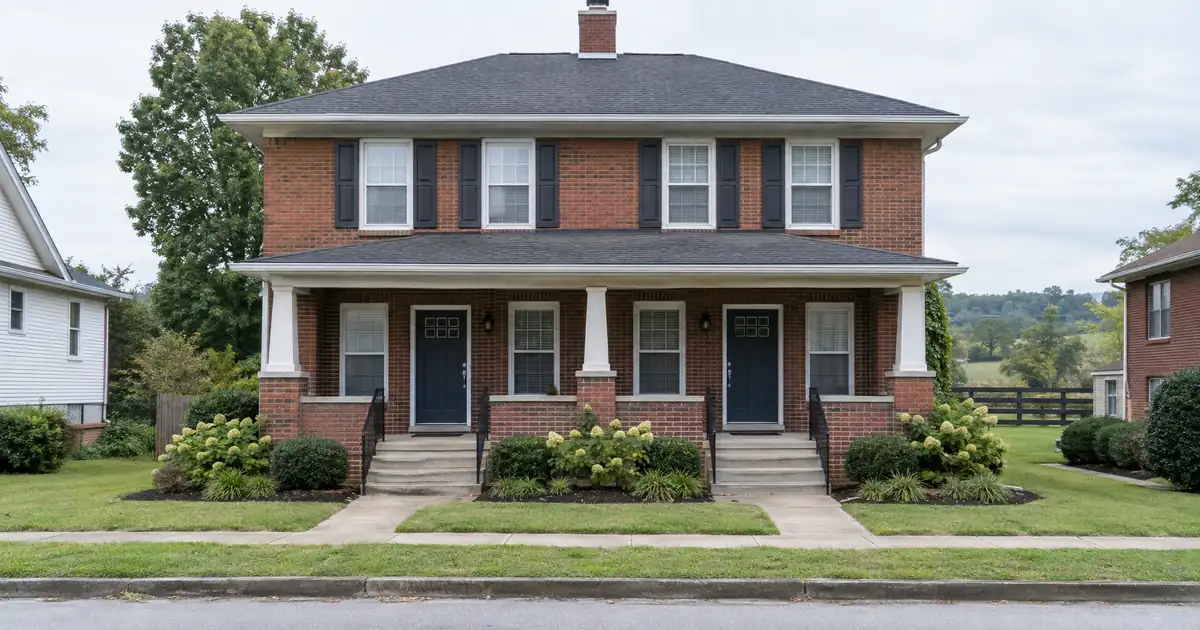
For any cash out refinance investment property in Radcliff, Kentucky, the gap between price and rent decides the outcome. Zumper puts three-bedroom rentals at $1,395 a month, while Redfin shows a median sale price near $252,000. Test that pairing against a 75 percent loan-to-value ceiling and a full-obligation coverage test, and the number lands near or below 1.00. Appraisal sets how much equity exists. Rent sets how much of it a lender will let you touch.
At a Glance: A cash-out refinance in Radcliff, Kentucky is underwritten primarily on the property’s rental income measured against its full monthly obligation, and with a median home price near $252,000 per Redfin, the rent side of that test is the binding constraint, not the appraisal.
DSCR Cash-Out Calculator
Run the cash-out numbers in Radcliff, KY
Rate source: Freddie Mac 30-yr average via FRED® — Federal Reserve Bank of St. Louis · effective Sep 24, 2026
Prefilled with starting assumptions — enter your property’s value, balance, taxes, and insurance for a more accurate picture.
Program parameters update from Lendmire’s centralized guideline source. Taxes and insurance are editable estimates.
As of Sep 24, 2026 · General Freddie Mac market benchmark, not a Lendmire loan offer. Property value, balance, taxes, and insurance are editable estimates. Maximum loan-to-value varies by lender, program, property type, and seasoning. Not a Loan Estimate, approval, or commitment to lend. Program availability and eligibility are subject to lender guidelines, credit approval, property review, and underwriting.
- Three-bedroom rents run about $1,395, against a roughly $252,000 median price.
- Cash-out is typically capped at 75 percent LTV after about six months of ownership.
- Duplex-style small multifamily models stronger coverage than single-family at similar prices.
- Fort Knox anchors tenant demand, but citywide population is flat to slightly declining.
- Approved-but-unbuilt multifamily supply nearby is the main rent-pressure item to watch.
Radcliff Market Snapshot
A quick read on the Radcliff investor landscape — figures come from the cited sources below. Confirm current property-level numbers before underwriting.
| Metric | Detail |
|---|---|
| Home prices | $259,900 median (Homes.com Multi-Family Radcliff) |
| Employment | 5,000 jobs (Hardin County Government) |
Where Radcliff’s Equity Math Actually Sits
Radcliff’s appreciation has outrun its rents, which makes equity plentiful and coverage thin. Redfin reports a median sale price of about $252,000, up 16.9 percent year over year, with homes averaging 91 days on market against 40 days a year earlier. Rents moved the other way: Zumper shows the citywide median at $880, down 4.9 percent year over year.
Rent sources disagree, so treat the citywide figure as a range. RentCafe reports an average of $928 (with two-bedrooms at $1,065), Homes.com shows a median of $995, and Zumper sits at $880. Larger units are firmer. Three-bedrooms at $1,395 and four-plus-bedroom stock are where the rent-to-value ratio improves.
Two readings follow. Appreciation is real, so a recent purchase or renovation may appraise well. But the 91-day marketing period suggests a market that has cooled, and appraisers weigh comparable sales. A cash-out file built on a stale, peak-era comp is a file at risk.
The Fort Knox Effect
Fort Knox is the reason Radcliff’s tenant base holds up. WKYU Public Radio reports a Fort Knox workforce of 22,000 and an economic impact of $5.6 billion, including $1.3 billion in payroll. Hardin County’s economic development office notes the post employs more people than the next five largest employers in the surrounding counties combined. The Knox Regional Development Alliance describes the installation as home to nearly all of the Army’s human capital enterprise.
That payroll shows up as demand for off-post housing near the gate. The military housing allowance is set by duty-station ZIP, and Radcliff’s ZIP 40160 sits inside the Fort Knox schedule. One third-party guide, HomeScoop’s Fort Knox PCS guide, pegs the mid-grade enlisted allowance at roughly $1,608 a month and reports the schedule rose about 7.2 percent in the latest cycle. Treat both figures as approximate and confirm against the official Defense Department calculator.
The practical point for a landlord: an allowance ceiling near that level supports a 3-bedroom ask around $1,395 without much stretch. Rents pushed well above what the allowance supports lease more slowly.
The other side of the Army coin is concentration. Census Reporter shows Radcliff’s population at 22,864 with a median age of 36.9, and World Population Review estimates a 2.35 percent decline since the last census count. A federal shutdown briefly put civilian workers in limbo, per the same WKYU report. Demand is stable, not growing.
Which Property Types Cover Best Once You Pull Equity
Small multifamily models materially better than single-family in Radcliff, because two rents sit behind one loan at roughly single-family price levels. Tested below on modeled figures, the duplex clears 1.00 at 75 percent LTV while the three-bedroom does not.
The inputs here are modeled assumptions, not market data. The single-family case uses the $1,395 Zumper three-bedroom rent against a $252,000 value. The duplex case uses a $260,000 value and two 2-bedroom units at the $895 asking rent seen on a Zumper listing near Fort Knox, or $1,790 gross. Coverage is rent divided by full PITIA (principal, interest, taxes, and insurance) on a standard 30-year amortization, with no vacancy allowance.
| Modeled property | Gross rent basis | Coverage at 65% LTV | Coverage at 75% LTV |
|---|---|---|---|
| 3-bed single-family | $1,395 | about 1.05 | about 0.90 |
| Duplex (two 2-beds) | $1,790 | about 1.30 | about 1.15 |
Read the table as direction, not a quote. The single-family case crosses 1.00 only when leverage is trimmed, which means smaller proceeds. The duplex clears the standard 1.00 baseline at the 75 percent ceiling, with headroom for a vacancy month. Most standard DSCR programs are built around that 1.00 benchmark because rent covers the payment at that level. Some lenders review lower-coverage files with stronger compensating factors, lower leverage, or different pricing, and exact eligibility turns on lender guidelines, credit, reserves, and property review.
Here is the catch on the duplex math. It rests on asking rents from listings, not a market study, so confirm against actual leases and actual duplex sale prices before using it as an underwriting assumption.
DSCR files in markets like this one typically look like a fight over the last tenth of a point. The property appraises fine, the borrower has plenty of equity, and the rent-to-obligation ratio is what limits the loan amount. The stronger files arrive with signed leases at or above market, a clear insurance quote, and a leverage request already trimmed to where coverage clears, rather than a maximum ask that gets scaled back mid-review. Investors comparing structures can walk through what DSCR qualification actually looks like before choosing a target.
The Submarkets Worth Testing
No source publishes neighborhood-level prices or rents for Radcliff, so these submarkets are defined by geography and tenant base, not by per-area figures. Each is a place to test coverage, not a promise of it.
The Dixie Highway and Lincoln Trail Boulevard corridor. Homes.com’s local guide places most shopping and dining around West Lincoln Trail Boulevard and State Route 31W, with Walmart, ALDI, Ollie’s, and Bomgaars as anchors. Convenience is the draw for service workers and Army-linked employees. The city’s zoning map shows North and South Dixie, Wilson Road, Hill Street, Burns Road, and Patriot Parkway as main corridors, and small multifamily is most likely along them. That is an inference from the map, not a sourced count.
Gate-adjacent residential streets. Homes near the Fort Knox gate are routinely marketed on drive time to the post. Tenants are Army civilian staff, contractors, and service members. The strongest DSCR candidates here are three-bedrooms, since that is the tier where rent-to-value improves.
The parks-anchored blocks. The city’s Parks and Recreation department lists Colvin Community Center with a seasonal pool and three parks, and Homes.com describes the 103-acre Saunders Springs Nature Preserve. Amenity access supports lease renewal, but there is no price or rent data for this pocket, so it is a lower-conviction submarket.
Vine Grove, next door. It is a separate city, but it is the most plausible adjacent market for a Radcliff investor. Redfin noted five multifamily units for sale there in a recent month. Small sample, but it shows small multifamily stock trades on both sides of the Fort Knox boundary.
Rineyville and Elizabethtown. The Hardin County workforce corridor runs on healthcare, education, and manufacturing. Baptist Health Hardin is a 300-bed hospital with 2,700 employees serving about 400,000 residents across ten counties. Elizabethtown Community and Technical College enrolls roughly 6,500 students and has a Fort Knox campus. Those two anchors diversify demand beyond Army headcount.
The Multi-Unit Inventory Nobody Talks About
Radcliff’s small-building stock is deeper and stranger than the single-family narrative suggests. Homes.com’s multifamily page shows listings from $189,900 to $1,000,000, with a median near $259,900. Formats include a 6-unit building of one-bedrooms with tenant-paid utilities, a fully leased 4-plex with attached garages, and a 10-unit two-bedroom building under a master lease where an organization pays for the whole building.
Each format changes how the file reads. Tenant-paid utilities keep the property’s income cleaner. A master lease gives one payer and one document to review, but it concentrates the risk on a single counterparty, and lenders differ on how they treat that income. Ask before counting on it.
A 26-unit value-add listing on the Wilson Road corridor, marketed by Haymaker, cites below-market rents. If accurate, that points to room for growth on renovated units. It also means rent levels in older stock are soft.
Now the reasoning aloud: for an owner of a paid-down single-family rental, a cash-out at conservative leverage is the safe path. For an owner of a duplex through fourplex, the stronger play may be pulling to the full 75 percent ceiling, since coverage has room. The trade-off is exit liquidity, since fewer buyers shop this niche and the 91-day marketing period suggests it.
How the Cash-Out Mechanics Constrain the Proceeds
A cash-out on an investment property in Radcliff is limited by four things: seasoning, leverage, coverage, and reserves. Typical program guidance for the network Lendmire works with, subject to lender guidelines and varying by borrower, property, and loan scenario:
- Seasoning: about six months of ownership, measured from title recording.
- Leverage: a 75 percent LTV ceiling on cash-out, lower than the purchase-side cap.
- Coverage: a 1.00 minimum ratio of rent used for lender review to full PITIA on select programs.
- Reserves: roughly six months of PITIA, with requirements that vary by scenario and improve across credit tiers at 660, 680, and 700.
Loan size on standard programs runs up to $3,000,000, and smaller balances route through select lenders in the network. Radcliff’s price points sit well inside that band.
Proceeds are not a fixed figure. Take the appraised value, apply the leverage ceiling, subtract the existing payoff, and then confirm the resulting loan still clears the coverage test. In this market the last step usually binds first. Sizing the loan on coverage instead of only on LTV avoids a rescoped file. The rate-and-term and cash-out refi details and the refi options lay out the structures side by side, and the program-to-program comparison shows why investors with several financed properties often choose this path over conventional.
Using the Proceeds: Reinvestment Reality
Cash-out proceeds only pay off if the next deal’s coverage is at least as strong as the one being tapped. The obvious targets are small multifamily in Radcliff and Vine Grove, where the model above shows coverage clearing 1.00 with cushion. The risk is recycling equity from a 1.05 single-family into a purchase that also sits near 1.05. Two thin-coverage loans stacked together have less room for error than one.
The regional housing story complicates the picture. Per WAVE, a Chamber-commissioned study found Hardin County lacked nearly 9,000 housing units. That shortage thesis leaned on BlueOval SK, the Ford battery joint venture in Glendale. WKYU reports the plan called for 8,000 new units to house 5,000 workers, but only about 1,600 were hired before the closure. WYMT reported about 1,600 layoffs as Ford took full ownership and pivoted to battery energy storage, and the repurposed plant targets more than 2,000 jobs when it opens.
For an investor, that means the EV-driven demand case has weakened, and any deal underwritten on manufacturing in-migration is speculative. Underwrite to Army payroll, the hospital, and retail employment, and treat Ford as upside.
What About the New Supply Pipeline?
Approved plans are not units under construction, and no sourced oversupply exists in Radcliff today. It still deserves a watch. KCREA’s Hardin County listings show a 12.81-acre site near Fort Knox with approved plans for 216 multifamily units. A delivery that size could pressure rents on older one- and two-bedroom stock, exactly where duplex math is built. Three-bedroom houses face less direct competition from apartments, another reason the single-family tier is steadier even though its coverage is thinner.
Frequently Asked Questions
Can a Radcliff investor pull cash out on a house bought recently?
Typically yes, once the property has been held about six months from title recording, subject to lender guidelines. The appraisal will reflect comparable sales, and with homes averaging 91 days on market, recent comps matter. A recently renovated property may appraise well, but the coverage test still applies after that.
DSCR vs. conventional financing
Two common ways to finance an investment property in Radcliff, KY. They qualify you differently — here’s how investors weigh them.
Why investors choose it
- Qualifies on the property’s rental income — no personal tax returns, W-2s, or pay stubs needed to document income.
- No personal debt-to-income ceiling to clear, so existing mortgages and obligations don’t cap your borrowing the same way.
- Can be closed in an LLC, keeping the property inside a business entity.
- Built for scaling — not held to the limit on number of financed properties that conventional financing applies.
- Underwriting centers on the deal: generally qualifies when the rent covers the payment, a 1.00x coverage ratio being a common baseline (confirmed in underwriting).
- Designed specifically for investment property, including long-term and, where the program allows, short-term rentals.
Where it’s strong
- Often the lowest ongoing financing cost for a buyer who fully qualifies on personal income — a fit for a first property or a cost-first purchase.
Trade-offs for investors
- Requires full personal income documentation and must fit within a debt-to-income limit — salary, existing debts, and other mortgages all count.
- Typically held in your personal name rather than a business entity.
- Caps how many financed properties you can carry, which can become a ceiling as a portfolio grows.
- Evaluates you as a borrower as much as the property, which usually means more paperwork.
How investors usually choose: a first or single property often optimizes for the lowest financing cost; portfolio builders often optimize for leverage, vesting in an LLC, and scaling past conventional caps. The right answer depends on your goals, the property, and current guidelines — both paths run through select lenders in Lendmire’s wholesale network, with eligibility and terms confirmed in underwriting.
Why does a Radcliff three-bedroom struggle to clear 1.00 at 75 percent LTV?
Price has climbed faster than rent. With a median sale price near $252,000 and three-bedroom rents around $1,395, modeled coverage including taxes and insurance lands around 0.90 at the 75 percent ceiling. Trimming leverage toward 65 percent brings it to roughly 1.05, at the cost of smaller proceeds.
Do Fort Knox tenants make DSCR files easier?
They make rent more predictable, not the coverage ratio higher. The Army payroll and housing allowance stabilize occupancy, but lenders still measure rent used for lender review against full PITIA. Rents priced above what the allowance schedule supports tend to lease more slowly, so anchoring the lease to realistic market rent helps the file.
Does a master-leased building count the same as individual leases?
Not necessarily. Ask how a specific lender handles master-leased income before counting on it for coverage.
Should Radcliff investors worry about the Ford plant situation?
It changes how to underwrite, not whether to invest. The EV plan shrank from 5,000 planned jobs to roughly 1,600 hires and then layoffs, so any thesis leaning on manufacturing in-migration should be treated as speculative. Tenant demand from Fort Knox and the hospital corridor is the sturdier base.
The Biggest Blind Spot: Appraisal Momentum Without Rent Momentum
Radcliff’s value growth has run well ahead of its rent growth, and a DSCR-financed investor who cashes out at the top of that gap carries the most risk. Rents are flat to falling at the citywide level, population is flat, and days on market have more than doubled, so a refinance sized to today’s appraisal can leave thin coverage if a 216-unit delivery softens older stock. The plainest protection is sizing leverage to the rent, not the appraisal, and reserving for a vacancy before the new supply arrives. Verify current local rental rules, taxes, and insurance with qualified local professionals before committing to a plan.
For current guidelines and terms, see Lendmire’s DSCR loan programs page.
About Lendmire
Lendmire is a DSCR-focused mortgage brokerage, NMLS# 2371349, placing investor loans across 41 markets, including Washington, D.C. DSCR eligibility is generally reviewed by the lender on a property’s rental income rather than personal income documentation, which fits LLC-held rentals, self-employed investors, and portfolios scaling past conventional financed-property limits. The team is recognized as a top-ranked workplace in 2026 and a 2025 Scotsman Guide Top Mortgage Workplace.
For broader investor-financing rules and property-type coverage across the state, see Kentucky DSCR loans.
Get Started
Ready to find the right loan for you?
In about 30 seconds you can review financing options available for your investment property. No commitment required.
Informational only. Not a Loan Estimate, approval, or commitment to lend. Program availability and eligibility are subject to lender guidelines, credit approval, property review, and underwriting.
References
1. Zumper, Radcliff rent research
2. Redfin, Radcliff housing market
3. Homes.com, Radcliff multifamily listings
4. Hardin County Economic Development
5. RentCafe, Radcliff rent trends
6. Homes.com
7. WKYU Public Radio, Fort Knox economic impact
8. Knox Regional Development Alliance
9. 22,864
10. Zumper listing near Fort Knox
12. Parks and Recreation department
14. Elizabethtown Community and Technical College
15. WAVE
16. WKYU
18. KCREA, Hardin County listings
19. Scotsman Guide — Top Workplaces 2026
20. a 2025 Scotsman Guide Top Mortgage Workplace
This article is part of Lendmire’s investment property cash-out refinance program — full qualification details, guidelines, and scenarios live on the program page.
Related reading: DSCR Cash Out Refinance Radcliff Kentucky · DSCR Cash Out Refinance Covington Kentucky · DSCR Cash Out Refinance Mount Sterling Kentucky
Guides: Investment Property Cash-Out Refinance in Kentucky
Brandon Miller
Founder & CEO, Mortgage Loan Originator, Lendmire LLC
- Mortgage Loan Originator · NMLS# 1129696 · Verify on NMLS Consumer Access
- North Carolina Real Estate Broker · License# 343312 · Verify on NCREC
- North Carolina Insurance Producer · License# 19053198 · Property, Casualty, Life, Health · Verify on NAIC SBS
- Lendmire LLC · Firm NMLS# 2371349 · Verify firm licensure
Disclosure information. Lendmire is a state-licensed mortgage brokerage under NMLS# 2371349. Lendmire is not a depository institution, direct lender, or financial advisor — all loans referenced are placed through wholesale lender partners and are subject to each lender's underwriting standards. This article is provided for general informational purposes and is not a commitment to lend, nor does it constitute financial, legal, or tax advice. Loan programs, terms, rates, and qualification standards change without notice and depend on borrower profile, property type, and the state in which the subject property is located. Equal Housing Opportunity provider. NMLS Consumer Access: nmlsconsumeraccess.org.