
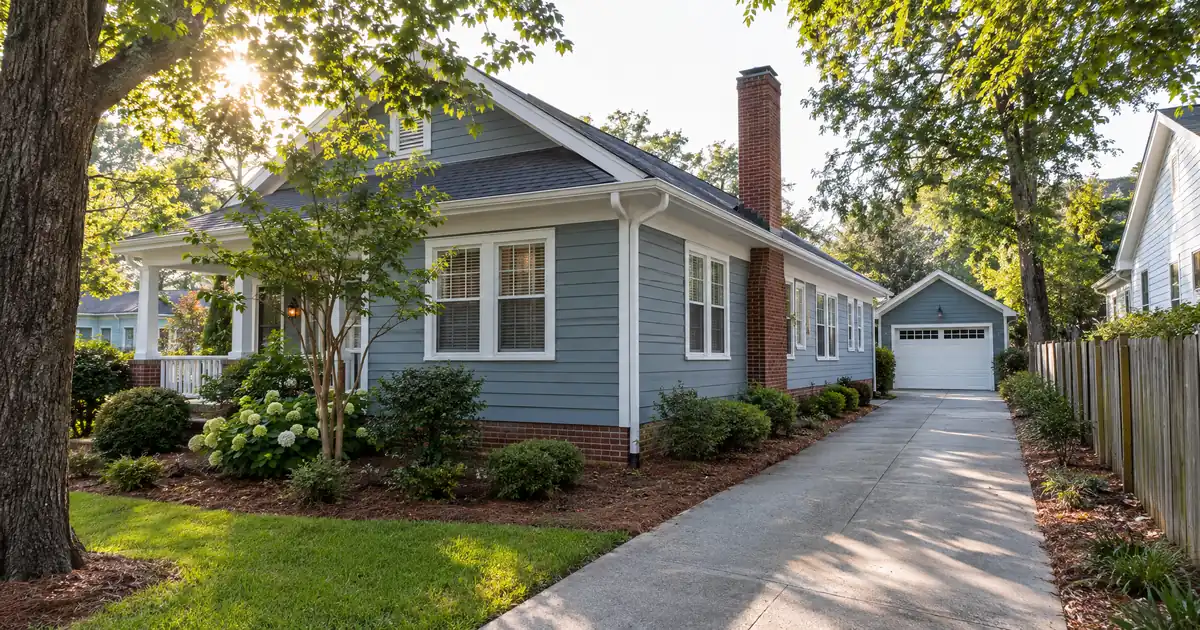
Brunswick County’s median home value climbed 56.3 percent between 2019 and 2023, moving from $252,600 to $394,900, according to US Civic Data’s Census ACS tracking. That single number reframes how a Southport investor should think about a cash-out refinance. In a town of roughly 4,205 residents where rental stock is thin and rent growth alone won’t carry a debt-coverage argument in every neighborhood, appreciation is doing a lot of the heavy lifting on the equity side of the ledger.
TL;DR: A Southport, North Carolina cash-out refinance is underwritten primarily on the property’s rental income measured against its full monthly obligation, not the owner’s paycheck, with lenders weighing the property’s current appraised value against Brunswick County’s 56.3 percent five-year home-value gain (US Civic Data) before releasing equity.
DSCR Cash-Out Calculator
Run the cash-out numbers in Southport, NC
Rate source: Freddie Mac 30-yr average via FRED® — Federal Reserve Bank of St. Louis · effective Sep 17, 2026
Prefilled with starting assumptions — enter your property’s value, balance, taxes, and insurance for a more accurate picture.
Program parameters update from Lendmire’s centralized guideline source. Taxes and insurance are editable estimates.
As of Sep 17, 2026 · General Freddie Mac market benchmark, not a Lendmire loan offer. Property value, balance, taxes, and insurance are editable estimates. Maximum loan-to-value varies by lender, program, property type, and seasoning. Not a Loan Estimate, approval, or commitment to lend. Program availability and eligibility are subject to lender guidelines, credit approval, property review, and underwriting.
- Zillow’s home value index for Southport sits at $418,219, up 1.0 percent year over year.
- Closed median sale price ran $505,000 recently — well under list-price comps near $588,000 to $625,000.
- Cash-out LTV caps at 75 percent, with roughly six months of seasoning from title recording.
- St. James Plantation rents average $2,605 per month against purchase prices well above $600,000 — an appreciation-led file, not a cash-flow-led one.
- A downtown Southport five-unit rent roll projects $150,000 gross annually, proof that multi-unit stacking works where inventory exists.
Southport Market Snapshot
A quick read on the Southport investor landscape — figures come from the cited sources below. Confirm current property-level numbers before underwriting.
| Metric | Detail |
|---|---|
| Home prices | $437,700 median property value (Data USA) |
| Typical rents | $2,395 avg (Zillow Rental Manager Market) |
| Population | 4,205 population (Census Reporter (ACS 2024 5-yr)) |
| Employment | ~250 personnel (Grokipedia MOTSU Page) |
Downtown Southport Is Where the Rent-to-Value Math Still Works
Downtown Southport is the one place in this market where debt coverage and appreciation both pull in the investor’s favor, largely because the housing stock is older, the basis is lower, and tenant demand comes from paychecks rather than tourism cycles. St. James Plantation and the newer resort communities lean almost entirely on rising value; downtown is the exception where rent can still do real work.
A rare directly observed data point backs this up: a five-unit downtown property — four two-bedroom, two-bath units built in 2019 plus a cottage — carries a projected gross annual rent roll of $150,000, according to a Redfin multi-family listing for Brunswick County. That works out to roughly $30,000 per unit annually, or about $2,500 a month per door — landing right at the top of the market’s three-bedroom benchmark of $2,395, per Zillow’s rental manager data. It’s a small sample, but it’s the clearest evidence available that when 2-4 unit stock exists inside city limits, it can genuinely stack income for a coverage-based refinance rather than leaning entirely on a single lease.
That’s the exception, though. Southport’s housing stock runs 77.3 percent owner-occupied against only 22.7 percent renter-occupied (US Civic Data), so purpose-built duplex, triplex, or fourplex product inside city limits is scarce. Investors chasing unit-stacking at scale generally look toward Wilmington or Leland, where rental density runs higher. Inside Southport proper, the refinance thesis is mostly single-family workforce rentals and attached condo units — not ground-up multi-unit acquisition.
Run the numbers on a modeled single-family scenario in the downtown-adjacent workforce tier: a property purchased some time ago and now appraising near $340,000, refinanced at the 75 percent cash-out ceiling, carrying a three-bedroom lease at the market’s $2,395 average rent. Modeled against a full monthly obligation — principal, interest, taxes, and insurance, using standard 30-year amortization and North Carolina’s typical property-tax and insurance load — that scenario lands in the neighborhood of a 1.20x coverage ratio. Not exceptional, but comfortably above the 1.00 baseline that most standard DSCR programs are built around, since rent covering the payment at that level is what the ratio is measuring in the first place. Exact eligibility still depends on lender guidelines, credit tier, reserves, and property review.
St. James Plantation: Why the Refinance Case Leans on Value, Not Rent
St. James Plantation is an appreciation play first and a cash-flow play a distant second — the rent-to-price ratio here runs well under the roughly 0.8-to-1 percent monthly rule of thumb DSCR lenders like to see, which means the refinance case has to lean on rising appraised value rather than day-one rent coverage.
Documented rentals inside the gated community average $2,605 a month, per BEX Realty’s listing data, spanning one- to four-bedroom homes and condos. Purchase prices, though, are running considerably higher than that rent would typically support. Even at the lower end of that range, a $600,000-plus purchase against rents in the $1,600-to-$3,600 band that a JHU aggregator of St. James listings documents is not a file that clears 1.00x on rent alone.
This is where a cash-out refinance thesis has to be honest about what it’s doing: it’s not chasing coverage, it’s harvesting equity that built up through scarcity-driven appreciation, HOA-protected amenity demand, and limited new supply. Where the modeled coverage ratio comes in under 1.00, a lender may still review the file under a sub-1.00 program, an interest-only restructuring, or blended income from a documented lease — options a lender evaluates case by case, subject to credit approval and property review, not a guarantee. Investors holding St. James product for several years, watching the community’s HOA fees and amenity costs eat into net operating income along the way, are the more natural candidates for pulling proceeds out and redeploying into a coverage-stronger downtown asset.
The Anchors Behind the Rent, Not Just the View
Southport’s tenant base isn’t purely retirees and tourists — a federal munitions port, a nuclear plant, and the state’s only independent critical-access hospital sit inside or adjacent to the city, and together they supply a small but durable civilian payroll that underwrites long-term leases better than a beach-town label would suggest.
Military Ocean Terminal Sunny Point, the Department of Defense’s primary east coast ammunition shipping point, sits on an 8,500-acre Army-owned site that’s been operating since 1955. Workforce estimates vary by source — one contractor profile puts the figure near 350 civilians, contractors, and military personnel, while another places it closer to 250 — but either way, it’s a federal payroll that isn’t tied to tourism seasonality.
Larger still is the Brunswick Nuclear Generating Station, a Duke Energy two-unit, 1,870-megawatt facility on 1,200 acres that has employed 800 to 900 people, per a local business news report — making it Southport’s single largest identifiable private-sector employer, roughly two to three times MOTSU’s headcount. Shift-work utility jobs tend to produce long-tenure, stable single-family tenants, which is a stronger underwriting anchor than tourism alone.
Dosher Memorial Hospital, the only independent critical-access hospital in North Carolina, carries 25 licensed acute beds and 64 skilled nursing beds and directly employs around 85 people generating roughly $33.8 million in annual revenue. Its direct headcount is modest, but the hospital also runs nine primary care, women’s health, and urgent care clinics scattered across southern Brunswick County — meaning the actual base of healthcare-worker renters it supports is wider than the hospital payroll alone suggests, and it’s structurally protected from closure risk given its unique regulatory status.
Working DSCR brokers see a recurring pattern in small coastal towns that carry one or two large, non-tourism employers alongside a resort housing stock: the files that clear coverage cleanly tend to be the older, lower-basis single-family homes near the employer base, while the resort-community files consistently need appraisal-driven equity arguments instead of rent-driven ones. Southport fits that pattern almost exactly — downtown workforce housing and St. James Plantation sit on opposite ends of the same DSCR spectrum, and knowing which lever a given property is pulling before submitting the file saves a lot of back-and-forth with underwriting.
Seasoning, LTV, and What the 75 Percent Ceiling Actually Means Here
A Southport cash-out refinance is capped at 75 percent loan-to-value on most standard programs, with roughly six months of ownership seasoning measured from the title recording date — meaning an investor who closed on a property in the spring generally has to wait until fall before the equity built from Southport’s appreciation curve becomes accessible proceeds.
That six-month window matters more here than in a fast-appreciating metro, because Southport’s price action isn’t purely momentum-driven — it’s regionally lumpy. Zillow’s home value index puts the city’s average home value at $418,219, up a modest 1.0 percent over the past year. The broader 28461 ZIP code, which includes more of the resort-community stock, actually shows an average value of $517,661, down 0.7 percent over the same period — a reminder that “Southport” as a ZIP code and “Southport” as the city core are not the same appreciation story, and an appraiser’s comp set matters enormously to what LTV math actually produces.
Closed sales tell a similarly nuanced story. The median sale price recently ran $505,000, according to Redfin’s Southport market data, while new listings carry a median asking price of $588,000 and historic-district listings ask a median of $625,000. That’s a real gap between what sellers are asking and what buyers are actually paying — down 10.2 percent from a year earlier on the closed-sale side. For a cash-out refinance, that gap is the single most important number in this market: an appraisal modeled off recent closed comps, not list-price comps, is going to produce a more conservative — and more defensible — value than one anchored to asking prices. Homes here are also sitting longer, with the historic district averaging 82 days on market and typically drawing only a single offer, per Redfin — a buyer’s-market signal on the purchase side that has less bearing on refinance appraisals but confirms this isn’t a market where comps are being bid up in a hurry.
Credit tier, reserve requirements, and the DSCR floor all factor into what proceeds a given file can actually access — see how the math pencils through Lendmire’s North Carolina DSCR platform before assuming a specific number. Reserves typically run around six months of the property’s full monthly obligation, moving closer to nine months on larger loan balances, and credit tiers generally start in the low 600s and scale upward from there — all of it subject to lender guidelines and program eligibility.
What Could Shift This Picture Over the Next Two Years
The variable most worth tracking isn’t rent — it’s the widening gap between list price and closed sale price. If that gap keeps widening, appraisals on cash-out files will keep coming in under what owners expect, which compresses the proceeds side of the equation even as the underlying value story stays intact.
The second variable is which anchor grows and which one doesn’t. Duke Energy’s Brunswick plant and the MOTSU terminal are both long-lived federal and utility infrastructure — not the kind of employer base that disappears in a downturn — but neither is positioned to add significant headcount either. If Dosher Memorial’s satellite clinic network expands, that’s a more realistic source of incremental rental demand over the next 18 to 24 months than either of the larger anchors. Investors tracking rental demand here should watch clinic footprint and staffing more than industrial headcount, since that’s the piece most likely to move.
Third: days-on-market and offer counts are worth revisiting every few quarters. A market running 60 to 82 days on market with single-offer norms gives acquisition-side buyers real negotiating leverage today — that dynamic could tighten if Wilmington’s growth spills further south along the Cape Fear River corridor, which would also pull comps and appraised values up with it.
Frequently Asked Questions
How do you qualify for a DSCR cash-out refinance in Southport, North Carolina?
Qualification centers on the property’s rental income measured against its full monthly obligation rather than the owner’s personal income documentation. Lenders typically want to see roughly six months of ownership seasoning from title recording, a DSCR at or above 1.00 on most standard programs, and reserves equal to several months of the property’s carrying costs — all subject to lender guidelines and program eligibility.
What are the requirements for an investment property refinance loan in Southport, North Carolina?
Requirements generally include a maximum 75 percent loan-to-value on the cash-out portion, a credit score typically starting in the low 600s and scaling from there, roughly six months of reserves, and documented or projected rental income sufficient to support the debt. Manufactured homes, log homes, and barndominiums fall outside these programs entirely.
DSCR vs. conventional financing
Two common ways to finance an investment property in Southport, NC. They qualify you differently — here’s how investors weigh them.
Why investors choose it
- Qualifies on the property’s rental income — no personal tax returns, W-2s, or pay stubs needed to document income.
- No personal debt-to-income ceiling to clear, so existing mortgages and obligations don’t cap your borrowing the same way.
- Can be closed in an LLC, keeping the property inside a business entity.
- Built for scaling — not held to the limit on number of financed properties that conventional financing applies.
- Underwriting centers on the deal: generally qualifies when the rent covers the payment, a 1.00x coverage ratio being a common baseline (confirmed in underwriting).
- Designed specifically for investment property, including long-term and, where the program allows, short-term rentals.
Where it’s strong
- Often the lowest ongoing financing cost for a buyer who fully qualifies on personal income — a fit for a first property or a cost-first purchase.
Trade-offs for investors
- Requires full personal income documentation and must fit within a debt-to-income limit — salary, existing debts, and other mortgages all count.
- Typically held in your personal name rather than a business entity.
- Caps how many financed properties you can carry, which can become a ceiling as a portfolio grows.
- Evaluates you as a borrower as much as the property, which usually means more paperwork.
How investors usually choose: a first or single property often optimizes for the lowest financing cost; portfolio builders often optimize for leverage, vesting in an LLC, and scaling past conventional caps. The right answer depends on your goals, the property, and current guidelines — both paths run through select lenders in Lendmire’s wholesale network, with eligibility and terms confirmed in underwriting.
Does St. James Plantation rent cover the payment on a typical cash-out refinance?
Not usually on rent alone. Documented rentals there average around $2,605 a month against purchase prices commonly running $600,000 or higher, which puts the rent-to-price ratio below what most DSCR programs look for. Files in this community typically lean on appraised-value growth rather than day-one coverage, and options like sub-1.00 programs are reviewed case by case subject to lender guidelines.
Can a downtown Southport multi-unit property support a stronger refinance than a single-family home?
Potentially, where that inventory exists. A documented five-unit downtown property projects roughly $150,000 in gross annual rent, which stacks meaningfully better than a single lease on a comparable-value single-family home. True 2-4 unit stock is scarce inside Southport’s city limits, though, so this scenario applies to a small slice of available inventory rather than the broader market.
How does rental income affect DSCR refinance eligibility in Southport?
Lenders evaluate the property’s rent against its monthly obligation rather than the borrower’s traditional personal-income documentation, subject to lender guidelines. Lendmire arranges these loans and its DSCR programs generally allow LLC-titled ownership, depending on program guidelines — a structure that fits many Southport investors holding property through an entity rather than personally.
For current guidelines and terms, see Lendmire’s DSCR loan programs page.
About Lendmire
Lendmire is a non-QM mortgage brokerage (NMLS# 2371349) arranging DSCR investor loans in 41 markets, including Washington, D.C., through wholesale and investor-lending channels. Rental income, not personal income, is what the lender evaluates on these files, subject to lender guidelines — a structure that tends to fit LLC-owned portfolios, self-employed investors, and operators scaling past conventional loan limits. Lendmire has been recognized by Scotsman Guide as a 2026 Top Workplace and was a 2025 Scotsman Guide Top Workplace as well, detailed further in the Top Workplace press announcement.
For a market this small, the smartest next move isn’t a lender conversation at all — it’s pulling the last two to three closed comps inside the actual city limits, not the wider 28461 ZIP, and checking whether they trended toward asking price or away from it before assuming what a refinance appraisal will return.
For how equity extraction works on an investment property, see cash-out refinance on an investment property.
Get Started
Ready to find the right loan for you?
In about 30 seconds you can review financing options available for your investment property. No commitment required.
Informational only. Not a Loan Estimate, approval, or commitment to lend. Program availability and eligibility are subject to lender guidelines, credit approval, property review, and underwriting.
References
1. US Civic Data — Brunswick County, Southport ACS 2019-2023
2. Data USA
3. Zillow Rental Manager Market Trends — Southport, NC
4. Census Reporter (ACS 2024 5-yr)
6. Redfin — Brunswick County Multi-Family Listings
7. BEX Realty — St. James Plantation Rentals
8. Wikipedia — Military Ocean Terminal Sunny Point
9. Wikipedia — Brunswick Nuclear Generating Station
10. Wikipedia — Dosher Memorial Hospital
11. Redfin — Southport Housing Market
12. Scotsman Guide as a 2026 Top Workplace
13. a 2025 Scotsman Guide Top Workplace
14. the Top Workplace press announcement
This article is part of Lendmire’s investment property cash-out refinance program — full qualification details, guidelines, and scenarios live on the program page.
Related reading: DSCR Cash Out Refinance in Southport, North Carolina: What It Takes to Refinance a Southport Rental · DSCR Cash Out Refinance in Brunswick, Georgia: How Port-Area Rent Math Clears at 75% LTV · Cash Out Refinance Investment Property in Brunswick, Ohio: Duplex Equity Along Pearl Road
Guides: Investment Property Cash-Out Refinance in North Carolina
Brandon Miller
Founder & CEO, Mortgage Loan Originator, Lendmire LLC
- Mortgage Loan Originator · NMLS# 1129696 · Verify on NMLS Consumer Access
- North Carolina Real Estate Broker · License# 343312 · Verify on NCREC
- North Carolina Insurance Producer · License# 19053198 · Property, Casualty, Life, Health · Verify on NAIC SBS
- Lendmire LLC · Firm NMLS# 2371349 · Verify firm licensure
Compliance and disclosures. Lendmire (NMLS# 2371349) is a licensed mortgage broker and is not a direct lender, depository institution, financial advisor, or tax professional. Content in this article is general market analysis and educational information — not financial, legal, or tax advice for any specific situation. Lendmire does not guarantee loan approval; every transaction is subject to underwriting by the funding lender. Mortgage pricing and loan program guidelines are subject to change at any time without notice and vary by borrower characteristics, property type, and state regulations. Lendmire complies with Equal Housing Opportunity. Licensure verification: NMLS Consumer Access.