
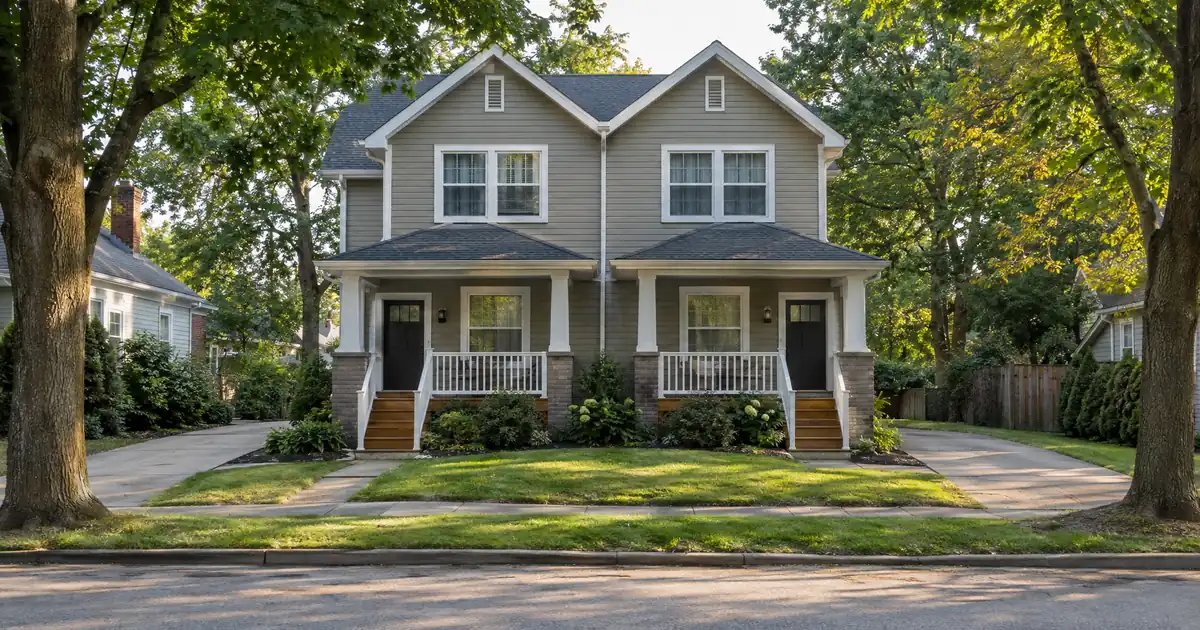
If you own a duplex or small multifamily near Wooster’s hospital corridor, here’s what most brokers won’t tell you: the equity is usually there, but the appraisal decides how much of it you can pull. In a market this small, comparable sales run thin, and thin comps cap cash-out proceeds before the loan program does.
At a Glance: Cash-out refinancing in Wooster, Ohio fits owners of duplexes and small multifamily near the hospital corridor. These loans are underwritten primarily on the property’s rental income measured against its full monthly obligation, and in a market this small, appraisal comp depth often limits proceeds more than rent does.
DSCR Cash-Out Calculator
Run the cash-out numbers in Wooster, OH
Rate source: Freddie Mac 30-yr average via FRED® — Federal Reserve Bank of St. Louis · effective Sep 24, 2026
Prefilled with starting assumptions — enter your property’s value, balance, taxes, and insurance for a more accurate picture.
Program parameters update from Lendmire’s centralized guideline source. Taxes and insurance are editable estimates.
As of Sep 24, 2026 · General Freddie Mac market benchmark, not a Lendmire loan offer. Property value, balance, taxes, and insurance are editable estimates. Maximum loan-to-value varies by lender, program, property type, and seasoning. Not a Loan Estimate, approval, or commitment to lend. Program availability and eligibility are subject to lender guidelines, credit approval, property review, and underwriting.
- Active multifamily inventory is thin: five listings between $159,900 and $473,500, per Homes.com.
- Duplex asking prices average $157,580, per Realmo.
- Cash-out is capped at 75 percent LTV after about six months of seasoning from title recording.
- Single-family at typical Wooster rents models below 1.00 once taxes and insurance are included.
- Duplexes carry the coverage cushion that single-family here does not.
Wooster Market Snapshot
A quick read on the Wooster investor landscape — figures come from the cited sources below. Confirm current property-level numbers before underwriting.
| Metric | Detail |
|---|---|
| Home prices | $214,200 median property value (Data USA Wooster Profile) |
| Typical rents | $1,200 median (Zillow Rental Manager Market) |
| University enrollment | ~500 students (Ohio State ATI official site) |
| Population | 26,971 population (Census Reporter Wooster Profile) |
| Employment | 13.1K employees (Data USA Wooster Profile) |
The Hospital Corridor Carries the Refinance Math
The strongest refinance candidates in Wooster sit near the hospital and the College of Wooster, on older stock close to downtown’s Liberty Street. Wooster Community Hospital runs 173 beds across eight locations. That means steady demand from nursing, allied health, and support staff, which is the kind of long-term tenant base a refinance file wants to see.
Don’t read the College of Wooster as a student-rental play. US News reports that 98 percent of students live in college-owned or college-affiliated housing. Ohio State’s Agricultural Technical Institute also houses students on campus. The college corridor works for staff, faculty, and hospital workers, not off-campus undergraduate demand.
Rent data near the college is noisy. Zumper shows an average of $1,200 a month in the submarket, along with a 44 percent year-over-year jump. That jump looks like a thin sample, not a trend. Treat any outlier like it as a reason to pull a second source before you build a refinance rent assumption on it. Overstated post-refi rent is how a coverage number looks fine on paper and collapses in review.
Duplex or Single-Family? Run Both
Duplexes carry the coverage cushion in Wooster. Single-family at citywide prices does not clear it on typical rents.
Start with price. Realmo shows duplex listings across a fairly wide range, with many at modest price points. Single-family sits much higher. Zillow’s home value index puts the average Wooster home well above those duplex asking prices. (Sources disagree here. Data USA shows a lower median property value, which reflects a different methodology.)
Rents don’t move as much as prices. Zillow’s rental data shows a citywide median of $1,200, and Apartments.com averages two-bedrooms at $1,214.
Run the numbers on two modeled cases. These are assumptions, not sourced market data. Both use 75 percent LTV and include taxes and insurance in the full obligation.
- Single-family near the Zillow value, modeled at $1,400 rent. Coverage lands below 1.00. Even a rent near the high end of the quoted two-bedroom range ($1,635 and up on Apartment List) stays under the 1.00 benchmark.
- A duplex near the $157,580 average, modeled at $1,000 per unit. Coverage comes out around 1.5x or better. Two rent streams against a low basis is the whole story.
That sub-1.00 single-family result isn’t automatically a dead end. A lender may review options like a lower-leverage structure, an interest-only program, or more cash left in the deal, all subject to lender guidelines, credit review, and property review. But an owner holding a duplex starts from a stronger position. One caution: the duplex model assumes the appraisal supports the value. Rents don’t fix a thin appraisal.
The Appraisal Is the Real Constraint
On Wooster files, expect appraisal depth to cap proceeds before coverage does. The multifamily comp pool is small. Homes.com shows five active multifamily listings, and the asking prices among them vary widely, especially on the low end. That wide spread means an appraiser has few clean comparables to lean on. Pricing and available terms vary by lender, borrower profile, property type, and full underwriting review.
A reconsideration request is a routine step here, not a fight. A good packet includes recent in-neighborhood sales, condition adjustments, and the lease evidence behind the rent. Build equity assumptions conservatively, especially on a recent renovation where you’re counting on the after-repair value to carry the proceeds.
Seasoning matters too. Lendmire’s network typically requires about six months of ownership, measured from title recording and documented by the settlement statement. Files that assume seasoning away are the ones that get kicked back.
The rest of the guideline set follows the usual pattern. Cash-out tops out at 75 percent LTV. The standard coverage benchmark is 1.00, calculated as rent used for lender review against full PITIA. Credit tiers start at a 620 floor and run through 700. Reserves typically run about six months of PITIA. Equity available is never a guaranteed figure, because it depends on rent, obligation, reserves, and that 75 percent ceiling, all subject to lender guidelines. Program details change, so confirm current terms before you plan around them.
Where Wooster Owners Get It Wrong
A common mistake is trusting one rent number. Sources split in this market. RentCafe quotes a $1,220 average for two-bedrooms, with larger buildings between $1,444 and $2,197. Apartment Finder shows $1,219 for two-bedrooms, but $1,170 for three-bedrooms and only $1,035 for four-bedrooms. That inversion is a data-quality flag. Bigger units don’t automatically earn more here, so model each configuration on its own.
The cleaner files usually come with the paperwork already assembled:
1. A signed lease or leases for every unit, with the rent roll matching the leases. 2. Entity documents, if the property is held in an LLC, subject to lender program eligibility. 3. A current insurance quote or binder, not last year’s. 4. The settlement statement, to prove seasoning. 5. A short list of nearby comparable sales, ready for the appraiser.
Lendmire’s deal desk sees the same friction in small micropolitan markets like this one. Rent comps and sales comps both run thin, so files hold up better when the borrower brings his own comp support rather than waiting for the appraiser to find it. The common slip is a rent roll that doesn’t match the leases, which costs a review cycle that could have been avoided.
Which Anchors Actually Feed Wooster Tenants?
The demand base is real but narrower than the headlines suggest. Census Reporter puts Wooster at 26,971 people. Per Data USA, employment slipped 4.62 percent to 13.1 thousand workers, with manufacturing (2,597), educational services (2,092), and health care (1,882) leading. That decline is a watch item, not a verdict.
Here’s a nuance many owners miss: J.M. Smucker’s headquarters address is in neighboring Orrville, per Wikipedia, not in Wooster proper. So Smucker-driven demand spreads across Wayne County, and a rental inside Wooster can’t assume that commuter base.
Closer to home, GOJO expanded its Wooster campus with more than 240 jobs, and the site stayed in the footprint after Clorox acquired the company. Add the hospital, and CFAES Wooster, which describes itself as the largest agbioscience research facility in the United States. None of these is tied to a single cyclical industry. For a rental owner, that mix matters more than any one headline employer.
What Happens to the Proceeds
An owner who pulls equity from one Wooster duplex is usually buying the next one, in town or elsewhere. This is where the equity-extraction math gets practical: the proceeds only help if the next purchase also clears coverage. The equity-extraction mechanics walk through that sequence, and Lendmire’s refi programs cover rate-and-term options for owners who don’t need cash out. The guide “What Is a DSCR Loan” covers the basics, and Lendmire’s DSCR-versus-conventional breakdown shows why a property-income structure suits owners who don’t want to document personal income.
The honest tradeoff: pulling cash out of a thin-comp market can leave less headroom than the 75 percent ceiling suggests, so size the draw to the appraisal, not to the cap. The decision is closer to a toss-up for an owner with one good duplex and no next deal lined up. Holding the equity may beat refinancing it. For owners with a clear next acquisition, the structure makes sense. Lendmire’s Ohio DSCR loan programs cover the state-level program details, and investors can reach the team at 828-256-2183.
Frequently Asked Questions
How do you qualify for a DSCR cash-out refinance in Wooster?
Qualification centers on the property, not personal income documentation. The lender compares rent used for lender review against the full monthly obligation, including taxes and insurance, and 1.00 is the standard benchmark. In Wooster, that usually means a documented lease, a clean rent roll, and an appraisal that supports the value. Final eligibility depends on lender guidelines, credit, reserves, and property review.
DSCR vs. conventional financing
There are two common ways to finance an investment property in Wooster, OH, and they qualify you differently — here’s how investors weigh them.
Why investors choose it
- Qualifies on the property’s rental income — no personal tax returns, W-2s, or pay stubs needed to document income.
- No personal debt-to-income ceiling to clear, so existing mortgages and obligations don’t cap your borrowing the same way.
- Can be closed in an LLC, keeping the property inside a business entity.
- Built for scaling — not held to the limit on number of financed properties that conventional financing applies.
- Underwriting centers on the deal: generally qualifies when the rent covers the payment, a 1.00x coverage ratio being a common baseline (confirmed in underwriting).
- Designed specifically for investment property, including long-term and, where the program allows, short-term rentals.
Where it’s strong
- Often the lowest ongoing financing cost for a buyer who fully qualifies on personal income — a fit for a first property or a cost-first purchase.
Trade-offs for investors
- Requires full personal income documentation and must fit within a debt-to-income limit — salary, existing debts, and other mortgages all count.
- Typically held in your personal name rather than a business entity.
- Caps how many financed properties you can carry, which can become a ceiling as a portfolio grows.
- Evaluates you as a borrower as much as the property, which usually means more paperwork.
How investors usually choose: a first or single property often optimizes for the lowest financing cost; portfolio builders often optimize for leverage, vesting in an LLC, and scaling past conventional caps. The right answer depends on your goals, the property, and current guidelines — both paths run through select lenders in Lendmire’s wholesale network, with eligibility and terms confirmed in underwriting.
What are the requirements for an investment property loan in Wooster, Ohio?
On most files, expect about six months of seasoning from title recording, a credit floor of 620, and reserves near six months of PITIA. Cash-out is capped at 75 percent LTV. Loan sizes run up to $3,000,000 on standard programs. Manufactured homes, log homes, and barndominiums fall outside these programs.
Does a Wooster duplex refinance better than a single-family rental?
Usually, yes. Duplexes here list near $157,580 on average, while the average home value sits near $266,886, yet rents don’t differ nearly as much. Two rent streams against a lower basis gives more coverage cushion. The caveat is appraisal depth, since duplex comps are thin.
Should an owner rely on the 44 percent rent jump near the College of Wooster?
No. That figure from Zumper conflicts with a 3.85 percent citywide reading and a 7.64 percent RentCafe reading, which points to a small, volatile sample. Use signed leases and a second data source before building refinance rent assumptions around it.
What to Watch Over the Next Quarter
Three indicators will tell you whether Wooster’s refinance window is widening or narrowing.
- Multifamily listing count. If the five active multifamily listings grow, comps deepen and appraisals get easier to support. If they shrink, expect more reconsideration requests.
- Employment trend. The 4.62 percent employment decline is the number to track. A stabilizing count would ease the main risk to tenant demand.
- Manufacturing footprint. Watch for any change at GOJO’s Wooster campus or other shift-work employers, since those workers fill the workforce-priced rentals.
Wooster’s rental market is small and steady, and a thin comp pool means every sale can move the next appraisal.
For current guidelines and terms, see Lendmire’s DSCR loan programs page.
About Lendmire
A non-QM mortgage broker (NMLS# 2371349), Lendmire arranges DSCR financing for real estate investors in 41 markets, 40 states plus Washington, D.C. Because deals are underwritten primarily on property cash flow rather than personal income documentation, the structure suits self-employed buyers and entity-owned portfolios. Lendmire places loans through wholesale investor lenders; it is not a direct lender. Lendmire is recognized as a top-ranked workplace in 2026 and a top-ranked workplace in 2025.
Get Started
Ready to find the right loan for you?
In about 30 seconds you can review financing options available for your investment property. No commitment required.
Informational only. Not a Loan Estimate, approval, or commitment to lend. Program availability and eligibility are subject to lender guidelines, credit approval, property review, and underwriting.
References
1. Homes.com Wooster Multi-Family Listings
2. Realmo Wooster Duplex Listings
3. Data USA
5. Ohio State ATI official site
6. Census Reporter Wooster Profile
7. Wooster Community Hospital Services
8. Zumper
10. Apartments.com
11. RentCafe
12. Apartment Finder
13. per Wikipedia
14. GOJO
15. Scotsman Guide — Top Workplaces 2026
16. Scotsman Guide — Top Workplaces 2025
This article is part of Lendmire’s investment property cash-out refinance program — full qualification details, guidelines, and scenarios live on the program page.
Related reading: DSCR Cash Out Refinance in Wooster, Ohio: Equity From Duplexes Near the Hospital Corridor · DSCR Cash Out Refinance in Lorain, Ohio: The 2026 DSCR Financing Guide to Broadway Corridor · Cash Out Refinance Investment Property in Strongsville, Ohio: How the Cash-Out Math Clears in Strongsville
Guides: Investment Property Cash-Out Refinance in Ohio
Brandon Miller
Founder & CEO, Mortgage Loan Originator, Lendmire LLC
- Mortgage Loan Originator · NMLS# 1129696 · Verify on NMLS Consumer Access
- North Carolina Real Estate Broker · License# 343312 · Verify on NCREC
- North Carolina Insurance Producer · License# 19053198 · Property, Casualty, Life, Health · Verify on NAIC SBS
- Lendmire LLC · Firm NMLS# 2371349 · Verify firm licensure
Disclosures. The information presented in this article is general market commentary, not financial, legal, or tax advice. Lendmire is a mortgage brokerage (NMLS# 2371349) — not a direct lender or depository institution — and loan placement is subject to lender underwriting. Nothing in this content represents a commitment to lend. Loan terms, pricing, and program availability vary based on borrower qualifications, property characteristics, and state of subject property, and are subject to change at any time. Lendmire complies with Equal Housing Opportunity requirements. Consumer access: nmlsconsumeraccess.org.