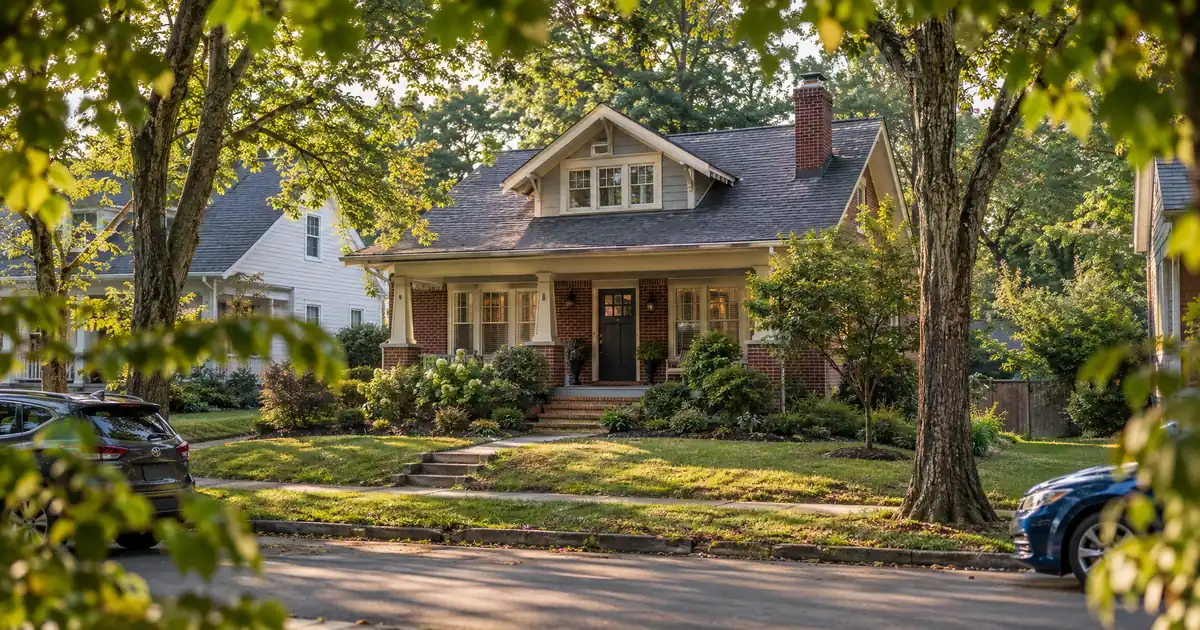
Most investors who bought in Kannapolis before the ballpark went up assume their equity story is a downtown story. It isn’t. The strongest cash-out math in this city right now sits outside the historic district, in the workforce corridors nobody writes headlines about.
That’s the counterintuitive part. Kannapolis has spent the better part of a decade rebuilding itself around a biotech research campus and a $113 million downtown redevelopment, and the press has followed the ballpark. But the properties throwing off the cleanest refinance numbers are the plain single-family rentals and small duplexes in West Kannapolis, Forest Park, and the industrial corridor near the Amazon site — not the new-construction condos facing Atrium Health Ballpark.
DSCR Cash-Out Calculator
Run the cash-out numbers in Kannapolis, NC
Rate source: Freddie Mac 30-yr average via FRED® — Federal Reserve Bank of St. Louis · effective Sep 17, 2026
Prefilled with local estimates — enter your property’s value, balance, taxes, and insurance for a more accurate picture.
Program parameters update from Lendmire’s centralized guideline source. Taxes and insurance are editable estimates.
As of Sep 17, 2026 · General Freddie Mac market benchmark, not a Lendmire loan offer. Property value, balance, taxes, and insurance are editable estimates. Maximum loan-to-value varies by lender, program, property type, and seasoning. Not a Loan Estimate, approval, or commitment to lend. Program availability and eligibility are subject to lender guidelines, credit approval, property review, and underwriting.
Key Takeaways: A cash-out refinance on a Kannapolis, North Carolina rental property replaces the existing loan and releases equity built since purchase, with lenders sizing the new balance against the property’s monthly rental income measured against its full monthly obligation rather than the owner’s traditional personal-income documentation, capped at 75 percent of current appraised value.
- Kannapolis home values average $283,833 with 0.5 percent year-over-year growth, per Zillow
- Cash-out proceeds cap at 75 percent LTV with roughly six months of seasoning from title recording
- West Kannapolis rents average $1,499 with 51 percent single-family rental stock, per RentCafe
- Duplex product renting near $1,900 per unit often clears coverage that comparable single-family stock can’t match
Where the Equity Actually Sits
West Kannapolis is the sleeper submarket for a refinance play, not the flashy one. Average rent there runs $1,499 against a citywide average of $1,511, but the composition matters more than the number — 51 percent of the rental stock is single-family, meaning an investor holding a house here isn’t competing against a leasing office running move-in concessions. That’s a structural advantage a spreadsheet doesn’t show until you dig into the mix.
Compare that to the downtown/West Avenue District, where the city itself is the largest capital allocator. Kannapolis bought roughly 50 acres and eight downtown blocks and required a minimum tax value of $40.125 million on just three parcels facing the ballpark, with construction required to finish on a defined timeline. That’s public money engineering appreciation — a real driver of value, but not a cash-flow driver. An investor holding a downtown condo built into that district should treat the equity gain as the return, not the rent roll. A cash-out refinance there makes sense as a way to harvest appreciation and redeploy it into a corridor built for coverage, not to refinance and hold at the same address expecting the rent to catch up.
Northlight and Royal Oaks sit at the other extreme. Built mostly between 1940 and 1969, the submarket carries a 16.7 percent vacancy rate, higher than roughly 80 percent of U.S. neighborhoods, according to NeighborhoodScout. That’s not a market to avoid — it’s a market to buy into at a discount, reposition, and refinance once occupancy stabilizes. Lower acquisition basis plus workforce-tenant demand is exactly the setup that produces strong post-repositioning coverage ratios, even using conservative rent assumptions.
The Duplex Case Nobody’s Making
Here’s the thing about Kannapolis single-family rentals: at current price points, a lot of them clear coverage by a hair, or don’t. Duplex product tells a different story.
Active listings show new-construction duplexes projecting rent near $1,900 per unit, and existing remodeled duplexes near downtown are marketed with two separately metered units as two income streams. Run that against a comparable single-family purchase in the same price band and the duplex usually wins on rent-to-debt math — not because the per-unit rent is dramatically higher, but because two leases against one loan balance changes the ratio entirely.
Institutional capital agrees. BWE arranged the acquisition financing for Graces Reserve Apartments, a garden-style complex in Kannapolis, confirming that lenders at scale are comfortable underwriting multifamily product here. That’s not a landlord’s anecdote — it’s a data point that small-balance non-QM lenders should have comparable appetite for 2-to-4 unit product in the same city.
Running the Numbers: Two Scenarios
Consider an investor holding a single-family rental in West Kannapolis bought a few years back for around $230,000, now appraised near $290,000 as area values have moved into the high $280Ks () and low $300Ks (per Redfin’s most recent monthly reading). At a 75 percent LTV cash-out refinance — the hard ceiling on this program — modeling the new loan against roughly $1,499 in monthly rent and full PITIA (principal, interest, taxes near 0.82 percent of value annually, and insurance near 0.40 percent), the file screens in the low-0.80x range on rent-to-debt coverage. That’s below the 1.00 benchmark most standard DSCR programs are built around, since rent alone doesn’t fully cover the payment at that leverage. It doesn’t mean the deal is dead — it means the file likely needs a sub-1.00 program, a lower cash-out percentage, additional reserves, or a blended-income structure, and any of those paths runs through lender review and credit approval, not a guarantee.
Now picture a duplex in the same price range — modeled near $320,000 — carrying two units at roughly $1,900 each for combined rent near $3,800 monthly. At the same 75 percent LTV ceiling and the same tax-and-insurance assumptions, that file screens closer to a 1.9x-to-2.0x coverage ratio. That’s the gap the research points to: single-family product in this market can be coverage-tight at current values, while comparable duplex product often clears with real room to spare.
DSCR files in markets like this one — mid-size Piedmont cities riding a manufacturing-to-research transition — typically come in one of two shapes: single-family refinances that need a second look at rent comps or a reduced cash-out percentage to clear coverage, and small multifamily files that clear on the first pass because the rent-per-loan-dollar math is simply more forgiving. Brokers who work these files learn to run both the single-family and the duplex scenario side by side before committing to a submission strategy.
The Employment Story Behind the Rent Roll
None of this coverage math matters without tenant demand behind it, and Kannapolis has more of that than its size would suggest.
The North Carolina Research Campus sits on the former Cannon Mills/Pillowtex textile footprint and now houses more than 100 scientists from eight universities and more than 16 biotech companies, per local investment research. That’s a tenant base — postdocs, lab techs, visiting researchers — that doesn’t exist in comparably sized cities like Salisbury or Concord. Layer in Atrium Health’s medical plaza on the same campus, plus Novant Health’s announced 50-bed hospital on Trinity Church Road targeted for completion by 2030, and the healthcare-adjacent tenant pool has years of runway ahead of it, not behind it.
Logistics adds a second, blunter demand driver. Kannapolis’ original Amazon fulfillment center employed 1,000 full-time workers within its first year, and the city announced a second Amazon facility in the 85 Exchange Industrial Park in early 2025. Two confirmed logistics footprints — not one legacy site — is a durable signal for workforce single-family demand in the corridor near NC-73 and Kannapolis Parkway, the same general geography where West Kannapolis and Forest Park sit.
And then there’s the piece almost nobody folds into a Kannapolis pitch: Kannapolis is the hometown of the Earnhardt racing family and headquarters for the Haas F1 team, alongside nearby Hendrick Motorsports and Speedway Motorsports. That layers a technical, higher-income tenant pool — engineers, race operations staff — onto the biotech and logistics base most reports stop at. Few cities this size have three distinct, non-overlapping demand drivers stacked on top of each other.
Seasoning, LTV, and What Actually Converts to Capital
Cash-out refinances on Kannapolis rentals typically require around six months of ownership seasoning, measured from title recording, before a lender will consider pulling equity out. The proceeds cap at 75 percent of current appraised value on standard programs — not 80 percent, which applies only to purchase transactions, and that distinction matters because a lot of investor math gets sloppy here.
Equity availability isn’t a fixed dollar figure either. It’s a function of rent used for lender review, full PITIA, required reserves — generally around six months of PITIA, closer to nine months on loan balances above $1,500,000 — and that 75 percent ceiling working together. A property that’s appreciated nicely but rents under market won’t release the same proceeds as one with the same value and stronger rent. That’s the entire logic behind treating West Kannapolis and Forest Park as the priority refinance targets: rent-to-value ratios there are simply more forgiving than in the new-construction, appreciation-heavy pockets near downtown.
This is where the equity-extraction mechanics matter more than the sale price on Zillow. An investor sitting on paper equity from Kannapolis’ run-up since 2020 — the city’s population moved from 53,114 at the 2020 census toward an estimated 61,708 today, a 16.2 percent gain, per Wikipedia and Census figures — still needs the rent roll to support the new loan amount, not just the appraisal.
Supply is worth a beat here too. Downtown alone is adding roughly 350 new apartment units, and the Millstone Village project calls for 134 townhomes plus 304 multifamily units — concentrated new supply that could pressure rents in those specific new-build zones over the next few years. That’s another reason the cash-out case favors older, non-luxury stock outside the delivery zones: less direct competition against Class-A lease-up concessions.
DSCR vs. conventional financing
Two common ways to finance an investment property in Kannapolis, NC. They qualify you differently — here’s how investors weigh them.
Why investors choose it
- Qualifies on the property’s rental income — no personal tax returns, W-2s, or pay stubs needed to document income.
- No personal debt-to-income ceiling to clear, so existing mortgages and obligations don’t cap your borrowing the same way.
- Can be closed in an LLC, keeping the property inside a business entity.
- Built for scaling — not held to the limit on number of financed properties that conventional financing applies.
- Underwriting centers on the deal: generally qualifies when the rent covers the payment, a 1.00x coverage ratio being a common baseline (confirmed in underwriting).
- Designed specifically for investment property, including long-term and, where the program allows, short-term rentals.
Where it’s strong
- Often the lowest ongoing financing cost for a buyer who fully qualifies on personal income — a fit for a first property or a cost-first purchase.
Trade-offs for investors
- Requires full personal income documentation and must fit within a debt-to-income limit — salary, existing debts, and other mortgages all count.
- Typically held in your personal name rather than a business entity.
- Caps how many financed properties you can carry, which can become a ceiling as a portfolio grows.
- Evaluates you as a borrower as much as the property, which usually means more paperwork.
How investors usually choose: a first or single property often optimizes for the lowest financing cost; portfolio builders often optimize for leverage, vesting in an LLC, and scaling past conventional caps. The right answer depends on your goals, the property, and current guidelines — both paths run through select lenders in Lendmire’s wholesale network, with eligibility and terms confirmed in underwriting.
Loan amounts on standard cash-out programs run up to $3,000,000, with smaller-balance files routed through specific lenders in the network. For the modest price points common in Kannapolis — Zillow’s average sits at $283,833, Redfin’s most recent monthly median at $303,000, and Data USA’s ACS-derived figure at $276,400 — most single files land well within standard program parameters.
Refinancing Into the NCRC Growth Curve
Consider the equity created since the NCRC began as a $1.5 billion revitalization effort planned for 3.2 million square feet of office, lab and civic space and roughly 5,000 eventual jobs. Momentec Brands’ newly announced 756,000-square-foot customer success center, with capacity for about 700 employees, adds a fresh, near-term demand catalyst most Kannapolis market summaries simply don’t have yet. An investor who bought a rental near the campus corridor two or three years ago, before that announcement, is likely sitting on more equity than the purchase price alone would suggest — and a refinance is the mechanism to convert that paper gain into deployable capital for the next acquisition.
For context on how a cash-out structure compares to a straightforward rate-and-term refinance, rate-and-term and cash-out refi details lay out the mechanical difference. And for investors weighing whether DSCR financing fits better than a conventional investment loan on the next purchase, how DSCR stacks up against traditional underwriting is worth a look before committing to either path.
Investors should independently verify current Cabarrus County rental rules, property tax rates and insurance requirements with qualified local professionals before underwriting any acquisition — those specifics sit outside the scope of this financing analysis.
Frequently Asked Questions
Does a Kannapolis cash-out refinance require the property to be titled personally, or can it sit in an LLC? Both structures are commonly reviewed, subject to lender program eligibility. Many investors hold Kannapolis rentals in an LLC for liability separation, and DSCR programs are generally built to accommodate entity-titled properties as long as the underlying rental income still supports the new loan.
How does Kannapolis’ downtown redevelopment affect refinance timing?
The downtown district is an appreciation story more than a cash-flow story right now, given the scale of public investment tied to the ballpark and adjacent parcels. Investors holding property in that specific corridor may see stronger appraised values supporting a refinance, but should expect rent to lag the value gain until new supply absorbs.
Is a duplex a better cash-out candidate than a single-family home in Kannapolis?
Often, yes, on pure coverage math. Two rent streams against one loan balance tends to produce a stronger rent-to-debt ratio than comparable single-family product at similar price points, which is part of why institutional lenders have shown appetite for multifamily product in this city.
Does the North Carolina Research Campus affect rental demand for a refinance decision?
Yes — the campus anchors a researcher and biotech tenant base that’s fairly unique for a city this size, and Novant Health’s planned hospital on Trinity Church Road adds a second, forward-looking healthcare demand driver. Properties near that corridor may justify holding for continued appreciation rather than selling into current pricing.
What happens if a Kannapolis rental doesn’t clear a 1.00 coverage ratio on a cash-out refinance? A sub-1.00 result doesn’t automatically close the door — lenders may review a reduced cash-out percentage, additional reserves, or a sub-1.00 program designed for exactly this scenario, though outcomes depend on credit profile, property condition and lender guidelines. It’s worth running the numbers on both the current rent and a market-rate rent estimate before assuming the file won’t work.
For current guidelines and terms, see Lendmire’s DSCR loan programs page.
About Lendmire
Lendmire — NMLS# 2371349 — operates as a DSCR and non-QM mortgage broker, connecting investors with wholesale lending channels across 40 markets, including Washington, D.C., through Lendmire’s North Carolina DSCR platform. Lender review centers on the property’s rental income rather than the borrower’s traditional personal-income documentation, an approach that tends to suit self-employed operators and investors carrying portfolios beyond four financed properties. Lendmire was recognized as a top-ranked workplace in 2026 by Scotsman Guide.
If you only take one thing from this piece, it’s this: in Kannapolis, the equity worth refinancing out isn’t sitting downtown where the headlines are — it’s sitting in the plain West Kannapolis duplex nobody’s writing about.
Disclaimer: This article is for general informational purposes only and does not constitute financial, legal, or tax advice. Loan program terms, eligibility criteria, and market conditions referenced here are subject to change and should be verified directly with Lendmire or a qualified lending professional before making financing decisions. Lendmire (NMLS# 2371349) is a mortgage broker, not a lender, and does not guarantee loan approval or specific terms. All information is provided “as is” without warranty of any kind.
Get Started
Ready to find the right loan for you?
In about 30 seconds you can review financing options available for your home or investment property. No commitment required.
Informational only. Not a Loan Estimate, approval, or commitment to lend. Program availability and eligibility are subject to lender guidelines, credit approval, property review, and underwriting.
References
1. Zillow
2. RentCafe
4. North Carolina Research Campus
5. a top-ranked workplace in 2026
Brandon Miller
Founder & CEO, Mortgage Loan Originator, Lendmire LLC
- Mortgage Loan Originator · NMLS# 1129696 · Verify on NMLS Consumer Access
- North Carolina Real Estate Broker · License# 343312 · Verify on NCREC
- North Carolina Insurance Producer · License# 19053198 · Property, Casualty, Life, Health · Verify on NAIC SBS
- Lendmire LLC · Firm NMLS# 2371349 · Verify firm licensure
Important disclosures. Lendmire (NMLS# 2371349) is a licensed mortgage brokerage. Lendmire is not a direct lender, depository institution, or financial advisor. All loan inquiries are subject to lender underwriting; this article does not constitute a commitment to lend. Rates, terms, and program guidelines are subject to change without notice and vary by borrower profile, property type, and state. Information in this article is general in nature and is not financial, legal, or tax advice. Equal Housing Opportunity. NMLS Consumer Access: nmlsconsumeraccess.org.