
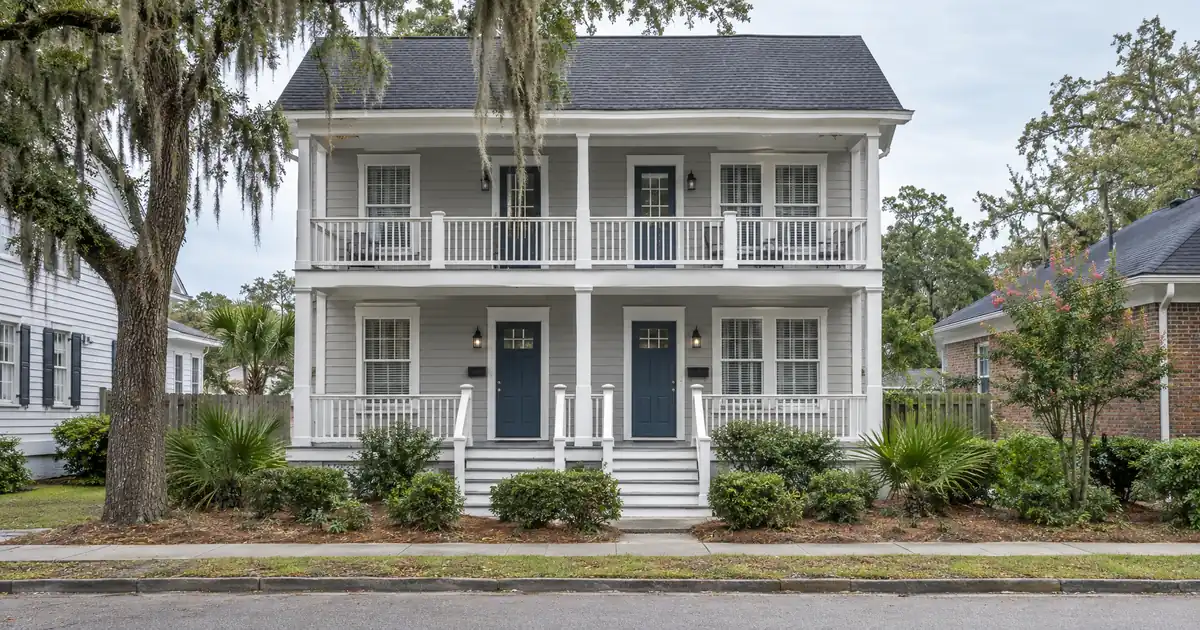
Downtown Lexington’s Old Mill district is the kind of place where an older small-lot house has quietly gained value while its rent has not kept pace. The area is walkable and event-driven, anchored by the Icehouse Amphitheater, which holds about 900 people, and by Midlands Technical College’s Lexington North Lake Center a short walk away. Owners there are often sitting on real appreciation and a thin rent-to-value ratio at the same moment. That tension decides whether pulling equity out works or stalls.
The Short Version: Cash-out refinancing in Lexington, South Carolina suits investors holding a three-bedroom house or small multifamily who want equity for the next deal; the loan is underwritten primarily on the property’s rental income measured against its full monthly obligation, with cash-out leverage capped at 75 percent.
DSCR Cash-Out Calculator
Run the cash-out numbers in Lexington, SC
Rate source: Freddie Mac 30-yr average via FRED® — Federal Reserve Bank of St. Louis · effective Sep 24, 2026
Prefilled with starting assumptions — enter your property’s value, balance, taxes, and insurance for a more accurate picture.
Program parameters update from Lendmire’s centralized guideline source. Taxes and insurance are editable estimates.
As of Sep 24, 2026 · General Freddie Mac market benchmark, not a Lendmire loan offer. Property value, balance, taxes, and insurance are editable estimates. Maximum loan-to-value varies by lender, program, property type, and seasoning. Not a Loan Estimate, approval, or commitment to lend. Program availability and eligibility are subject to lender guidelines, credit approval, property review, and underwriting.
- Three-bedroom rents near $1,870 anchor the coverage math, per Prop:Metrics.
- Greater Lexington’s $1,799 median rent beats West Metro’s $1,489 by roughly 20 percent, per Redfin.
- About six months of seasoning, measured from title recording, comes before a cash-out request.
- Michelin and Lexington Medical Center give workforce rentals two durable employment anchors.
Lexington Market Snapshot
A quick read on the Lexington investor landscape — figures come from the cited sources below. Confirm current property-level numbers before underwriting.
| Metric | Detail |
|---|---|
| Home prices | $297,700 median property value (Data USA) |
| Typical rents | $1,533 average (RentCafe) |
| University enrollment | 9,226 total enrollment (2024) (Data USA) |
| Population | 24,585 population (Census Reporter) |
Why Equity Extraction Is a Coverage Problem First
The cash-out decision here turns on coverage, not on how much equity exists. A larger loan means a larger monthly obligation, and the rent has to carry it. The standard DSCR benchmark is 1.00x, meaning rent used for lender review covers principal, interest, taxes, and insurance. Select lenders may review lower ratios with compensating factors. Review details remain subject to lender overlays.
Values drive the answer. Zillow puts the average Lexington home value at $303,292, up 2.1 percent over the past year. Redfin’s city-level median sale price is $368,000, up 10.7 percent. The gap reflects different methodologies, but it matters. Here is how modeled coverage shifts across that range at the program’s 75 percent ceiling, using the three-bedroom rent from the research as an assumed figure.
| Modeled scenario | Value | Assumed rent | Coverage |
|---|---|---|---|
| 3BR house, 75% LTV | $303,292 | $1,870 | about 1.05 |
| 3BR house, 75% LTV | $368,000 | $1,870 | mid-0.80s |
| Same house, 60% LTV | $368,000 | $1,870 | just over 1.00 |
| Duplex, 75% LTV | $410,000 | $2,540 | about 1.05 |
All ratios include taxes and insurance, and all inputs are modeled assumptions rather than appraisals. The duplex row assumes two units at the $1,270 two-bedroom rent from the same Prop:Metrics profile.
Look at the second row. An owner whose house appraises near the city median can clear 1.00 at full leverage, but only as a pass, not a cushion. An owner whose house appraises near the higher figure may land below 1.00 on long-term rent alone. That is not a dead end. Structures a lender may review include reduced leverage (the third row shows how much it helps), interest-only options, or a sub-1.00 program with stronger credit and reserves. All are subject to credit approval and property review. Still, a deliberate step down to 60 percent leverage means taking out less cash. Whether that trade is worth it depends entirely on what the proceeds will do.
Where the Rent Actually Sits
Run the numbers neighborhood by neighborhood, because Lexington is not one rent level. Redfin’s neighborhood breakdown shows Greater Lexington at a $1,799 median rent and West Metro at $1,489, a gap of roughly 20 percent between adjacent corridors. A house in the higher tier can clear 1.00 at a price where a lower-tier house cannot.
Several submarkets matter for equity pulls:
- Sunset Boulevard (US-378) corridor. Newer communities sit near big-box retail, so tenant demand leans retail and commuter workforce. Cash-flow-led holds tend to live here, and they refinance cleanly if the appraisal holds.
- Oak Grove and I-26. Commuters to West Columbia, plus proximity to Lexington Medical Center’s employment base, support steady single-family rental demand.
- I-20 and Longs Pond Road. Commuter households with Harbison retail access make this a similar workforce profile.
- North Lake Drive, Saluda River Club, and The Preserve. These are the lake-adjacent, appreciation-led holds. Lower initial yield, stronger long-term return. This is where equity builds fastest and coverage runs thinnest.
The last group is the genuine toss-up. An owner there may hold the most pull-able equity in town and the weakest rent-to-value ratio. Whether a cash-out makes sense depends on whether the investor wants that equity for a better-yielding asset elsewhere in the Midlands.
Working DSCR brokers see a recurring pattern in Columbia-area suburbs like this one: appreciation shows up on the appraisal before it shows up in rents. Files built around the newest purchase prices pencil tighter than owners expect, while older holdings with modest balances carry the best coverage. The usual fix is not a better lender but a different leverage level.
Single-Family or Small Multifamily?
The three-bedroom house is the default product, and the data supports it. Per Prop:Metrics, three-bedroom and two-bedroom units make up 57.1 percent and 29.7 percent of the rental stock. Three-bedroom rents sit near $1,870, the strongest rent against a roughly $253,000 median price in that profile. For a first or second cash-out, a three-bedroom house is the more predictable base case.
Small multifamily can outperform, but inventory is thin. Homes.com lists three multi-family properties between $410,000 and $650,000, and Redfin shows a Greater Lexington multi-family median of $395,000. The duplex row above shows why investors look there. Two units stacked at workforce rents can match single-family coverage at a higher price point, with income spread across two tenants. Downtown and Oak Grove older stock fits that profile best, though verified per-unit comps are thin.
Properties outside these programs include manufactured homes, log homes, and barndominiums. If the rural edges of Lexington County are on the shopping list, those types fall outside the network’s DSCR programs.
The Job Base Behind the Rents
Rental demand holds up here for a plain reason: employers that cannot move. Michelin’s Lexington plant employs 3,164 people, with a $159 million expansion reported in active talks. Large single-site manufacturing payrolls tend to anchor long-term tenancy more reliably than distributed office jobs. Lexington Medical Center, a 607-bed teaching hospital in West Columbia, employs more than 8,000 health care professionals. Together they make the economy unusually diversified for a town of 24,585 residents.
Midlands Technical College adds a modest student and young-workforce renter pool, concentrated downtown. The nearest four-year university is in Columbia, about 14 miles away, which feeds commuter demand into the northern corridors.
None of this guarantees any specific property’s rent. It does mean tenant demand is tied to payrolls rather than to speculation.
Seasoning, Reserves, and Where the Proceeds Go
The mechanics are simple. Typical program guidance calls for about six months of ownership from title recording, a credit floor of 620 with stronger tiers at 660, 680, and 700, and reserves of about six months of full obligation, with more above $1.5 million. Loan amounts go up to $3 million on standard programs, with smaller balances routed through select lenders. Cash-out proceeds depend on rent, obligation, reserves, and the 75 percent cap, so no cash figure is guaranteed. The equity-extraction mechanics and refinance details are covered on dedicated pages. Held in an LLC, a file is subject to lender program eligibility.
The harder question is what the money does next. Using proceeds to buy another Sunset Boulevard or Oak Grove house, where coverage already clears 1.00 at market prices, is straightforward. Using it to chase yield in a market where the numbers don’t pencil is a different decision, and one worth stress-testing first. And if the plan is a single rental owned personally by a high-W-2 borrower, a conventional refinance may carry lower costs. How DSCR stacks up depends on portfolio size and how cleanly personal income documents the file. Past four financed properties, DSCR is usually the only working lane.
Lendmire is a DSCR-focused mortgage broker that places investor loans through wholesale channels. Real estate investors buying in Lexington, South Carolina can work with Lendmire to access DSCR programs across a 41-market footprint that includes D.C. Details on Lendmire’s South Carolina DSCR loan programs are available, or investors can call 828-256-2183 to talk through a specific file. The DSCR qualification mechanics explain how coverage is calculated.
The Number to Stress-Test
The appreciation story is real, but rent growth is the softer assumption. Per DoorLoop’s compilation of Census-sourced data, South Carolina’s rental vacancy rate was 10.6 percent, the highest in the country, against 7.0 percent nationally. Lexington’s own submarkets aren’t separately tracked in that data, so treat it as a statewide caution rather than a local reading. Local HOA rental rules and flood considerations near Lake Murray deserve a check with qualified local professionals before any refinance.
So a modeled 1.05 coverage ratio is a pass, not a cushion. Underwrite rents at the conservative end of the range, and treat that 10.6 percent statewide vacancy figure as the reason a 1.05 deserves a stress test rather than a victory lap.
Frequently Asked Questions
How do you qualify for a DSCR cash-out refinance in Lexington, South Carolina?
The property’s rent, measured against its full monthly obligation of principal, interest, taxes, and insurance, is the central test. Most standard programs are built around a 1.00x benchmark, though some lenders review lower ratios with stronger credit, lower leverage, or more reserves. Cash-out leverage tops out at 75 percent, and about six months of ownership is typical before eligibility. Final eligibility is subject to lender guidelines and property review.
What are the requirements for an investment property loan in Lexington, South Carolina?
On most files, a credit score of at least 620 is the floor, with better tiers at 660, 680, and 700. Reserves typically run about six months of full obligation, and loan amounts go up to $3 million on standard programs. Manufactured homes, log homes, and barndominiums fall outside these programs. Requirements vary by borrower, property, and lender.
DSCR vs. conventional financing
There are two common ways to finance an investment property in Lexington, SC, and they qualify you differently — here’s how investors weigh them.
Why investors choose it
- Qualifies on the property’s rental income — no personal tax returns, W-2s, or pay stubs needed to document income.
- No personal debt-to-income ceiling to clear, so existing mortgages and obligations don’t cap your borrowing the same way.
- Can be closed in an LLC, keeping the property inside a business entity.
- Built for scaling — not held to the limit on number of financed properties that conventional financing applies.
- Underwriting centers on the deal: generally qualifies when the rent covers the payment, a 1.00x coverage ratio being a common baseline (confirmed in underwriting).
- Designed specifically for investment property, including long-term and, where the program allows, short-term rentals.
Where it’s strong
- Often the lowest ongoing financing cost for a buyer who fully qualifies on personal income — a fit for a first property or a cost-first purchase.
Trade-offs for investors
- Requires full personal income documentation and must fit within a debt-to-income limit — salary, existing debts, and other mortgages all count.
- Typically held in your personal name rather than a business entity.
- Caps how many financed properties you can carry, which can become a ceiling as a portfolio grows.
- Evaluates you as a borrower as much as the property, which usually means more paperwork.
How investors usually choose: a first or single property often optimizes for the lowest financing cost; portfolio builders often optimize for leverage, vesting in an LLC, and scaling past conventional caps. The right answer depends on your goals, the property, and current guidelines — both paths run through select lenders in Lendmire’s wholesale network, with eligibility and terms confirmed in underwriting.
Does a Lake Murray rental refinance differently than a Sunset Boulevard rental?
The loan structure is identical, but the coverage math usually isn’t. Lake-adjacent properties near North Lake Drive or The Preserve tend to carry higher values against lower rents, which pushes coverage down at full leverage. Sunset Boulevard workforce rentals typically show a stronger rent-to-value fit. Lake-area owners often need lower leverage to clear 1.00.
Is a duplex or a single-family house the better cash-out candidate in Lexington?
For most owners, the three-bedroom house is the more predictable base case because the local rental stock leans heavily that way. A duplex can match its coverage at a higher price and spreads income across two tenants, but listings are scarce. If an investor already owns a duplex, the cash-out math is worth running first.
Can Lendmire help arrange DSCR financing for investment properties in Lexington?
Yes. Lendmire, NMLS# 2371349, arranges DSCR investor loans, through wholesale lending channels. A key feature is that rental income, not traditional personal-income documentation, is central to the lender’s review. Lenders handle approval and final terms.
For current guidelines and terms, see Lendmire’s DSCR loan programs page.
About Lendmire
As a DSCR and non-QM mortgage broker, Lendmire (NMLS# 2371349) connects investors with wholesale lending channels across 41 markets, including Washington, D.C. Lender review centers on the property’s rental income rather than the borrower’s traditional personal-income documentation, which suits self-employed operators and portfolios beyond four financed properties. Lendmire has been recognized as a 2026 Scotsman Guide Top Mortgage Workplace and a top-ranked workplace in 2025, as covered in Lendmire’s 2026 Top Workplace announcement. Investors can also get a DSCR quote.
Get Started
Ready to find the right loan for you?
In about 30 seconds you can review financing options available for your investment property. No commitment required.
Informational only. Not a Loan Estimate, approval, or commitment to lend. Program availability and eligibility are subject to lender guidelines, credit approval, property review, and underwriting.
References
2. Lexington North Lake Center
4. Redfin: Lexington Rental Market
5. Data USA
6. RentCafe
7. Data USA
9. Zillow: Lexington Home Values
10. Redfin: Lexington Housing Market
11. Homes.com lists three multi-family properties
12. Redfin shows a Greater Lexington multi-family median
13. U.S. Census Bureau QuickFacts: Lexington town
14. a 2026 Scotsman Guide Top Mortgage Workplace
15. Scotsman Guide — Top Workplaces 2025
16. Lendmire’s 2026 Top Workplace announcement
This article is part of Lendmire’s investment property cash-out refinance program — full qualification details, guidelines, and scenarios live on the program page.
Related reading: DSCR Cash Out Refinance in Lexington, South Carolina: The 2026 DSCR Guide to Old Mill Rentals · DSCR Cash Out Refinance in Lexington, Kentucky: South Hill Equity Meets Workforce Rents · DSCR Cash Out Refinance in Greeneville, Tennessee: The 2026 DSCR Financing Guide to Main Street
Guides: Investment Property Cash-Out Refinance in South Carolina
Brandon Miller
Founder & CEO, Mortgage Loan Originator, Lendmire LLC
- Mortgage Loan Originator · NMLS# 1129696 · Verify on NMLS Consumer Access
- North Carolina Real Estate Broker · License# 343312 · Verify on NCREC
- North Carolina Insurance Producer · License# 19053198 · Property, Casualty, Life, Health · Verify on NAIC SBS
- Lendmire LLC · Firm NMLS# 2371349 · Verify firm licensure
Disclosures. The information presented in this article is general market commentary, not financial, legal, or tax advice. Lendmire is a mortgage brokerage (NMLS# 2371349) — not a direct lender or depository institution — and loan placement is subject to lender underwriting. Nothing in this content represents a commitment to lend. Loan terms, pricing, and program availability vary based on borrower qualifications, property characteristics, and state of subject property, and are subject to change at any time. Lendmire complies with Equal Housing Opportunity requirements. Consumer access: nmlsconsumeraccess.org.