
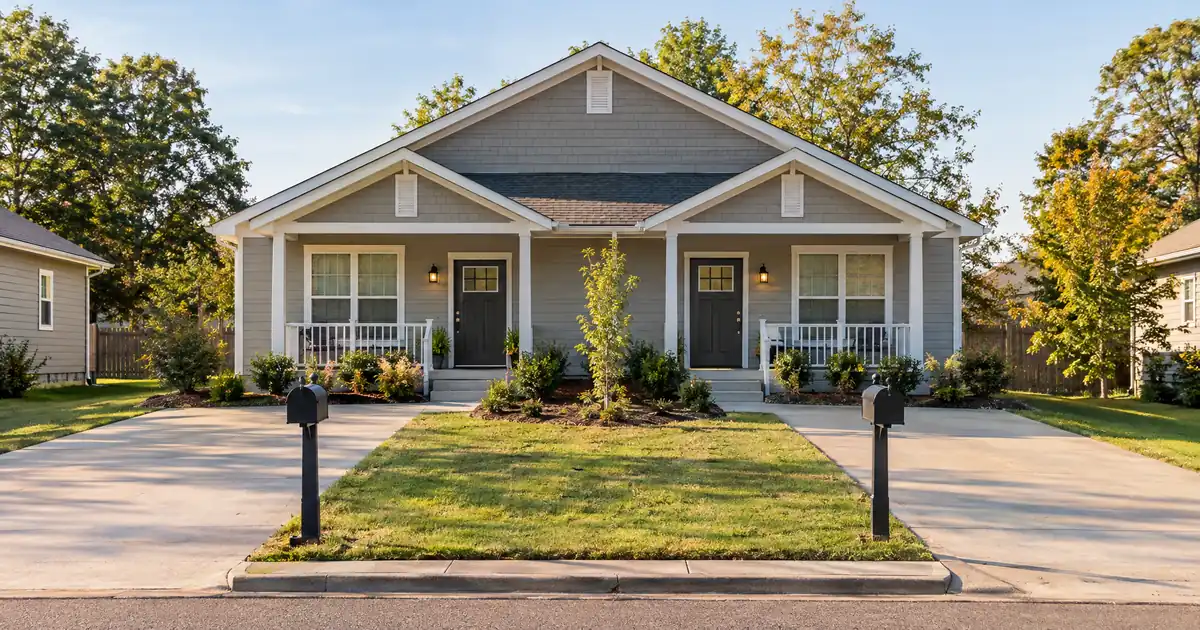
The Quick Read: Yes, as long as you live in one of the units. Fannie Mae and Freddie Mac treat an owner-occupied two-unit home as a principal residence, so a conventional cash-out refinance is allowed. The ceiling is lower than for a single-family home: 75% of appraised value on the duplex versus 80% on a one-unit house, subject to lender guidelines and full file review.
Occupancy and unit count set the limit before anything else. Everything below follows from those two facts.
Why Is the Duplex Cap Lower Than a Single-Family Cap?
Because the agencies price more risk into multi-unit homes, even when you live in one of the units. The cap applies to the new loan balance as a share of appraised value, not to your equity.
The Fannie Mae Eligibility Matrix lists cash-out on a principal residence at 80% for one unit and 75% for two to four units. Freddie Mac’s Guide Section 4203.1 sets the same 75% for a two- to four-unit primary residence. That gap is five percentage points of appraised value.
The same duplex can reach a much higher loan-to-value on a purchase or a no-cash-out refinance. Across the wholesale programs placed through Lendmire, two- to four-unit principal residences run up to 95% on a purchase. Cash-out is held to a lower cap than either. People see the 95% figure and assume it applies to pulling equity out. It does not.
Here is how occupancy changes the ceiling on cash-out:
| Property and use | Conventional cash-out cap |
|---|---|
| One-unit principal residence | 80% |
| Two- to four-unit principal residence (you live there) | 75% |
| Second home | 75% |
| Investment property | 75% |
If you move out and the duplex becomes a rental, the owner-occupied treatment no longer applies. Occupancy decides the leverage, so a lender will want the occupancy to be real. Plans to move out soon are worth raising with a loan officer early.
How Much Cash Would You Actually Get?
Less than the cap suggests. The cap limits the new loan, and everything the new loan must pay off or cover comes out of that room first.
The math runs in this order:
1. Take the appraised value and multiply by the cap (75% for your duplex).
2. Subtract the balance of the mortgage being paid off.
3. Subtract any other liens being paid off.
4. Subtract financed closing costs and prepaid items.
5. What remains is the cash to you.
A common misreading is “75% means I can take out 75% of my equity.” It does not. If your current loan already sits close to 75% of value, little or nothing is left. Because the appraisal drives every ratio, a modest gap between your expected value and the appraised value can shrink the check. Freddie Mac’s Guide also rounds the calculated LTV up to the next whole percent when testing the maximum, so a file sitting right at the line can tip over it.
Picture a homeowner whose duplex is valued well above what they owe, but who also has a purchase-money second lien. Both loans get paid off by the new first mortgage, and both come out of the 75% before any cash reaches the borrower. Run this math on your own numbers before you spend anything on an appraisal.
One more trap: a refinance meant to be “limited cash-out” can be treated as cash-out if it pays off a non-purchase-money second lien, or if it refinances a loan that was itself recently refinanced. Fannie Mae’s limited cash-out guidance spells out the line. Lenders classify the transaction, not the borrower.
What Does a Lender Look At on a Duplex Cash-Out?
Seasoning, credit, ratios, reserves, and the appraisal. The tests are the same family as a single-family cash-out, with a few duplex-specific wrinkles.
Based on the wholesale conventional programs Lendmire works with, the usual checkpoints look like this:
| Factor | What to expect |
|---|---|
| Existing first mortgage | At least 12 months old, note date to note date |
| Time on title | At least one borrower for 6 months |
| Credit | Wholesale programs generally start at a 620 decision score |
| Total debt ratio | Automated findings govern most files, up to a 50% ceiling |
| Reserves | Often required, and higher when the debt ratio is high |
| Appraisal | Full interior and exterior, on the two- to four-unit form |
The Fannie Mae Selling Guide on cash-out refinances sets the seasoning rules: the loan being paid off must be at least 12 months old, and a borrower must have been on title for at least six months. If the property was listed for sale, it must come off the market by the time the loan funds. The same guide ties higher debt ratios to a larger reserve requirement, which matters if your ratio is already stretched. Lendmire’s piece Conventional Cash-Out Refinance Reserves When You Live in a Duplex goes deeper on that point. Every figure here varies by lender and program — guidelines, property type, leverage, and credit profile all apply.
Cash-out is also priced higher than a rate-and-term refinance. The agencies apply loan-level price adjustments to cash-out transactions, and they flow through to what you pay. No figure applies to everyone, so compare the Loan Estimate line by line rather than assuming.
Does the Rent From the Other Unit Count?
Often yes, partly, and with paperwork. The unit you live in never counts as income. The other unit can.
Fannie Mae’s general rule is that rent from your own principal residence cannot be used to qualify, but its rental income topic carves out an exception for a two- to four-unit principal residence where you occupy one unit. Freddie Mac’s two- to four-unit page likewise allows rent from the other units to be added to income when calculating housing expense and the debt ratio.
Three things keep this from being a free pass:
- Lenders count a reduced share of the rent, not the full amount, to allow for vacancy and upkeep.
- Your own housing payment counts in full as a debt. The tenant’s rent does not simply offset it.
- The rent must be documented, typically with executed leases, traditional personal-income documentation showing rental history, and the appraiser’s rent schedule.
So a tenant helps the ratio, but it rarely changes the picture as much as borrowers expect. For a file that is close to a ratio limit, that difference decides the outcome.
What Does the Appraisal Involve on a Two-Unit Home?
It is more work than a single-family appraisal. Two- to four-unit homes are appraised on a small residential income property report, Form 1025, which includes an opinion of market rent for each unit. Fannie Mae lists the form in its Guide forms.
Do not count on an appraisal waiver. Waivers are generally not offered on two- to four-unit properties, and cash-out refinances typically call for a full appraisal. Plan on the appraiser walking both units, so give your tenant notice and have the lease handy.
Can a Recent Purchase Qualify?
Usually not, with one exception. The six-month title rule and the 12-month rule on the existing loan keep most recent buyers waiting.
The exception is delayed financing. If you bought the duplex with cash in an arm’s-length deal and can document where the funds came from, the six-month title wait can be waived. The new loan is still treated and priced as cash-out and still held to the 75% cap. Inheritances and legal awards carry their own exceptions to the seasoning rules, subject to lender guidelines.
What If You Plan to Move Out Later?
Then the loan you want may be different from the one you can get today. An owner-occupied cash-out assumes you live in the home. Occupancy that is not genuine is a misrepresentation problem, not a technicality.
If a move is realistic within a year or two, tell your loan officer at the start. The honest options are to run the cash-out while you still live there, or to hold off and compare alternatives once your situation settles. Programs built around low down payments are generally designed for purchases and no-cash-out refinances, and they usually do not allow cash-out. Second-lien assistance programs such as Fannie Mae’s Community Seconds cannot be combined with cash-out either.
Cash-Out, FHA, VA, or a Home Equity Line: Which Fits?
It depends on how much you owe, what you need the money for, and whether you want to keep your current first mortgage. Each route has a different tradeoff.
| Option | Best fit | Main tradeoff |
|---|---|---|
| Conventional cash-out | Large sum, loan balance well under 75% of value | Replaces your whole first mortgage |
| Home equity loan or line | You like your current first mortgage | Second lien, separate terms |
| Government-backed cash-out | You meet that program’s eligibility | Different insurance and fee structure |
For a side-by-side look at government-backed versus conventional on a small multi-unit home, Lendmire’s article FHA vs Conventional Cash-Out When You Live in a 2-4 Unit Primary Home walks through it. Keeping an existing first mortgage in place and borrowing against equity separately may suit you better if your current loan terms are favorable. Replacing it means a new balance and a new amortization schedule. Your own cash-out refinance would also have to meet full qualifying, including the whole housing payment, so the rent offset does not apply the way it might in your head.
For the program details, Lendmire’s cash-out refinance programs lay out how the options compare.
Is It Worth Doing?
Only if the money has a purpose that outlasts the loan. A cash-out refinance swaps your existing loan for a larger one and resets the terms, so the cost is spread across the full balance, not just the cash you pull.
The Consumer Financial Protection Bureau has warned that paying off non-mortgage debt with mortgage debt can put the home at risk. Its earlier report found borrowers most often used proceeds to pay other debts, with home repairs second, and that credit scores rose after the refinance before gradually slipping. Consolidating debt only helps if the spending that created it has stopped.
Home repairs and improvements to the duplex itself tend to be the most defensible uses, since they can support the value and the rent. Weigh the closing costs against how long you expect to keep the loan. Tax treatment can depend on your situation; borrowers should speak with a qualified tax professional before relying on any deduction or credit.
What About Loan Size, Triplexes, and Fourplexes?
The same 75% cap covers all two- to four-unit principal residences. A triplex or fourplex you live in follows the duplex rule on leverage, though reserve expectations and appraisal detail can grow with unit count.
Loan size matters too. The FHFA’s baseline one-unit conforming limit is $832,750 for most of the country, and the two-unit limit in most areas is $1,066,250. High-cost counties have higher limits. Above the conforming limit, a jumbo loan takes over and follows different rules. Texas homestead cash-outs are also subject to a separate limit set by the state constitution, which is not tied to the agency cap.
Key Terms Defined
Cash-out refinance: a new first mortgage that pays off the old one and gives you the leftover equity as cash.
Loan-to-value (LTV): the new loan balance divided by the home’s appraised value.
Seasoning: the minimum time you must hold the property or the existing loan before refinancing for cash.
Principal residence: the home you live in as your main address, including one unit of a duplex.
Reserves: savings left in the bank after closing, measured in months of housing payments.
Delayed financing: an exception that lets a recent all-cash buyer refinance into a mortgage without the usual six-month title wait.
Frequently Asked Questions
Can I take cash out of a duplex I live in with a conventional loan?
Yes. Fannie Mae and Freddie Mac both allow it when you occupy one unit. The cap is set below the single-family cap. Approval is subject to lender guidelines and full file review.
How long must I own the duplex before a cash-out refinance?
Generally at least one borrower must be on title for six months, and any first mortgage being paid off must be at least 12 months old. Delayed financing offers an exception for documented all-cash purchases. Inheritance and legal-award exceptions also exist.
Can I get a conventional cash-out with a 620 credit score?
The wholesale conventional programs start at a 620 decision score, but the automated finding drives most files and a higher score generally widens your options. On a duplex you live in, the 75% cash-out cap applies whatever your score, and the total debt ratio ceiling is 50%.
Will my tenant’s rent let me qualify for more?
It can help your debt ratio, since lenders count a reduced share of the other unit’s rent when it is documented with leases and an appraisal rent schedule. Your own housing payment still counts in full, so rent does not cancel it out.
Is a cash-out refinance always better than a home equity line?
No. If your current first mortgage has terms you want to keep, a separate home equity product can leave it untouched. A cash-out replaces the whole loan, which makes sense mainly when the larger balance and new terms fit your goals.
If you are weighing a cash-out refinance against keeping the loan you have, Lendmire can help you compare the programs and the equity each one reaches.
For your own numbers, request a scenario review with Lendmire.
About Lendmire
Lendmire (NMLS# 2371349) is a mortgage brokerage serving homeowners and home buyers in 16 states. FHA, VA, conventional and jumbo purchase and refinance loans are arranged through wholesale lending channels; Lendmire brokers the financing and the lender underwrites each application. Scotsman Guide named Lendmire a Top Mortgage Workplace in both 2025 and 2026.
For the program’s current guidelines, see conventional loan programs.
Get Started
Ready to find the right loan for you?
In about 30 seconds you can review financing options available for your home or investment property. No commitment required.
Informational only. Not a Loan Estimate, approval, or commitment to lend. Program availability and eligibility are subject to lender guidelines, credit approval, property review, and underwriting.
References
1. Fannie Mae Eligibility Matrix
2. Freddie Mac Guide Section 4203.1
3. Fannie Mae Selling Guide B2-1.3-02
4. Fannie Mae Selling Guide B2-1.3-03, Cash-Out Refinance Transactions
5. Fannie Mae Selling Guide B3-3.1-08, Rental Income
6. Freddie Mac 2- to 4-unit properties page
7. Guide forms
8. CFPB research on cash-out refinances and non-mortgage debt
9. CFPB: CFPB Report Finds Cash Out Mortgage Refinance Borrowers Improve Credit Scores
10. FHFA’s baseline one-unit conforming limit
This article is part of Lendmire’s Conventional Loans series — every loan program’s qualification details, guidelines, and scenarios live on the loan options page.
Related reading: How to Get a Conventional Cash-Out After a Quitclaim From a Parent · Can a Condo Owner Get a Conventional Cash-Out Refinance? · How to Get a Conventional Cash-Out After a Quitclaim Between Spouses
Brandon Miller
Founder & CEO, Mortgage Loan Originator, Lendmire LLC
- Mortgage Loan Originator · NMLS# 1129696 · Verify on NMLS Consumer Access
- North Carolina Real Estate Broker · License# 343312 · Verify on NCREC
- North Carolina Insurance Producer · License# 19053198 · Property, Casualty, Life, Health · Verify on NAIC SBS
- Lendmire LLC · Firm NMLS# 2371349 · Verify firm licensure
Disclosure information. Lendmire is a state-licensed mortgage brokerage under NMLS# 2371349. Lendmire is not a depository institution, direct lender, or financial advisor — all loans referenced are placed through wholesale lender partners and are subject to each lender's underwriting standards. This article is provided for general informational purposes and is not a commitment to lend, nor does it constitute financial, legal, or tax advice. Loan programs, terms, rates, and qualification standards change without notice and depend on borrower profile, property type, and the state in which the subject property is located. Equal Housing Opportunity provider. NMLS Consumer Access: nmlsconsumeraccess.org.