
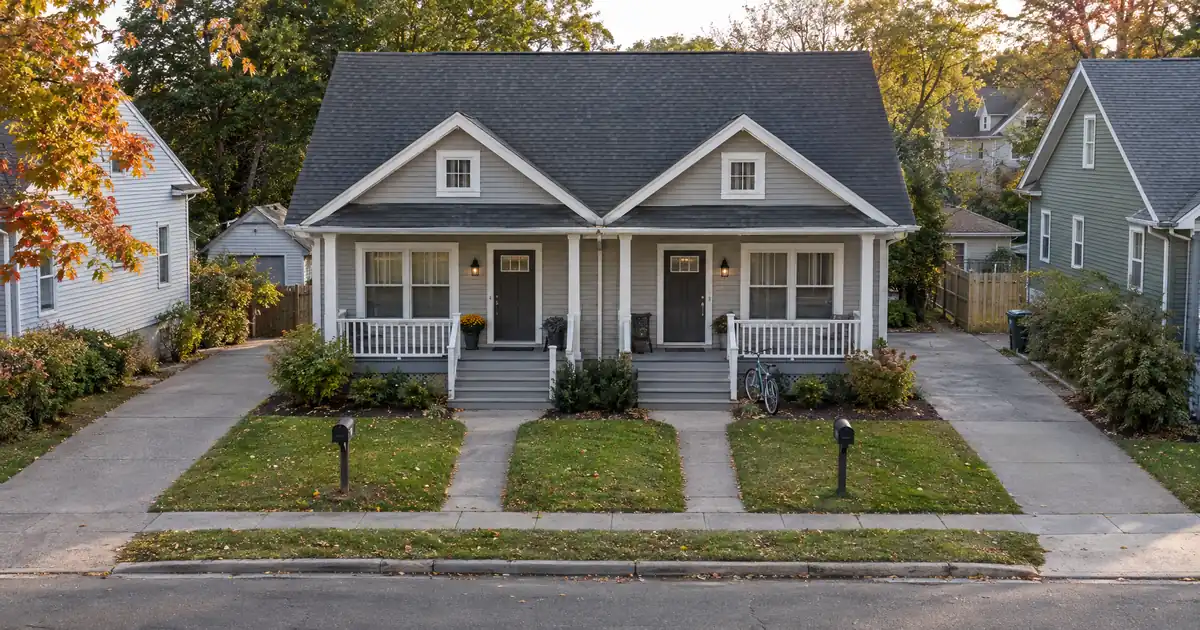
The Quick Read: FHA is built for buyers who want the lowest cash in and can live with mortgage insurance. Conventional is built for buyers with stronger credit and savings who want insurance that can end. On a duplex the two are close. On a triplex or fourplex, FHA adds a property-level rent test that conventional does not impose, and that test often decides the loan.
Side-by-Side
The table below covers the owner-occupied purchase of a 2-4 unit. Program figures reflect the wholesale FHA programs Lendmire places files with and are subject to lender guidelines and full file review.
FHA payment estimate
Starting assumptions reflect an example price and the FHA minimum investment. Replace them with your own figures.
Editable benchmark: 7.32% as of October 22, 2026 · Freddie Mac 30-year average via FRED®. A conventional market reference, not an FHA loan quote.
Illustrative starting assumptions: a $350,000 price, the FHA minimum investment as the down payment, a thirty-year term at the current Freddie Mac benchmark, and property taxes and insurance estimated at typical national rates. Every field is editable.
Illustrative estimate only — not a Loan Estimate, approval, quote, or commitment to lend. The rate field carries the weekly Freddie Mac thirty-year conventional benchmark, a market reference and not an FHA loan quote; your rate is set by the lender at lock. FHA mortgage insurance follows HUD’s published schedule for the term, leverage and loan size entered; taxes, insurance and dues are editable estimates; closing costs are not included; county loan limits are not checked here. Licensed in sixteen states for consumer mortgages. Lendmire is not affiliated with or acting on behalf of FHA, HUD, or the federal government.
| Factor | FHA | Conventional |
|---|---|---|
| Occupancy | Borrower must live in one unit | Principal-residence terms need the borrower in one unit |
| Maximum financing | 96.5% LTV (3.5% minimum investment) | Often lower on 3-4 units, by underwriting method |
| Credit floor | 580 decision score in the network | Varies by lender and unit count |
| Mortgage insurance | Upfront 1.75% plus annual premium | Private insurance, cancellable |
| Property rent test | Yes, on 3-4 units | None of the FHA type |
| Rent from your own unit | Counted in the self-sufficiency test | Generally not usable to qualify |
| Documentation | Appraiser’s market rent drives the test | Leases or appraiser rent, plus rental-income rules |
| Loan limits | County limits apply | Conforming limits apply |
Two rows deserve a closer read. The rent-from-your-own-unit row is the one buyers misread most. The property rent test row is the one that sinks files.
What the Self-Sufficiency Test Is
The test is a property test, not a borrower test. HUD’s glossary defines net self-sufficiency rental income as the rental income the property produces over and above principal, interest, taxes and insurance. HUD counts one to four units as “Single Family,” so a triplex and a fourplex sit inside the program but carry the extra test.
HUD’s archived reference guide describes the older version of the rule plainly. Net rental income on three- and four-unit properties must be equal to or greater than the projected mortgage payment. Net rental income there means the appraiser’s fair market rent from all units, including the one you plan to live in, less vacancy, collection and maintenance factors. That guide is archived, so treat it as history. Handbook 4000.1 is HUD’s current policy source.
Here is the mechanical sequence on a three- or four-unit file:
1. The appraisal reports fair market rent for every unit, including the owner’s unit.
2. The lender reduces that rent for vacancy and maintenance.
3. The reduced rent is compared to the full proposed payment, which includes mortgage insurance, taxes and insurance.
4. If the reduced rent falls short, the file fails the property test. Strong personal income does not override it.
Duplexes skip this test entirely. That single fact explains why so many first-time house-hackers land on two-unit buildings.
Why the Rent Figure Is the Whole Game
The appraiser’s rent opinion drives the result. A buyer cannot swap in their own projected rents. Leases help on the conventional side, but on FHA the test runs off the appraisal.
Two things push a file toward failing. Thin rents against high taxes and insurance is the first. The second is the payment itself: FHA mortgage insurance sits inside the payment the rent must cover, so the loan choice feeds back into the test. A building that fails with a 96.5% FHA loan can sometimes clear the same math with a different structure. Put plainly, the test is not just a hurdle in front of the loan. The loan changes the size of the hurdle.
On our files, the failures follow a pattern. The building looks fine on the listing. The appraiser’s rent comes in lighter than the seller’s rent roll. Insurance quotes land higher than the buyer assumed. By the time the test runs, the cushion is gone. Screen the listing before paying for an appraisal: use conservative rents, add realistic taxes and insurance, then ask whether the number still clears after a vacancy haircut.
How Conventional Treats the Same Building
Conventional loans follow Fannie Mae’s guidelines on most files. The Selling Guide’s rental-income policy says rental income from the unit the borrower occupies in a 2-4 unit property generally cannot be used to qualify. Lenders still report market rent on these properties, even when the borrower is not using the rental income.
So the two programs treat your own unit oppositely. FHA’s test counts its market rent. Conventional qualifying generally does not. Conventional guidelines also do not impose an FHA-style property test on 3-4 units. Qualification rests on the borrower’s overall profile and the rental-income rules for the other units, which require lease or appraisal documentation depending on rental history.
Leverage is where conventional gets complicated. Fannie Mae’s Eligibility Matrix shows high maximum leverage for 2-4 unit principal-residence purchases, but it also shows tighter limits when a 3-4 unit loan is manually underwritten, along with higher credit minimums and more reserves. Whether the file runs through automated underwriting or manual review changes the answer. Confirm which path applies before assuming a leverage number.
When FHA Is the Better Fit
FHA tends to win in these situations:
- Limited cash. A 3.5% minimum investment at a 580 or higher decision score is hard to match. Seller or interested-party contributions up to 6% of the price can also help with closing costs.
- Credit that is good but not great. The network’s FHA programs start at 580. Conventional pricing and eligibility usually tighten faster as scores drop.
- A duplex. With no self-sufficiency test, FHA’s low entry cost is easy to use. County loan limits apply, and HUD publishes them at its loan limit lookup. Lendmire’s FHA loan programs page covers the program basics.
- A triplex or fourplex that clears the test with room to spare. Strong rents against modest taxes and insurance make the test a formality.
- A co-borrower who will not live there. FHA allows a non-occupant co-borrower, which can help a file with thin income.
- A past credit event. HUD’s waiting periods apply: two years from a chapter 7 discharge, three years from a foreclosure. Those are HUD rules, not a promise from any lender.
The cost is mortgage insurance. FHA charges an upfront premium of 1.75% of the base loan, usually financed, plus an annual premium between 0.15% and 0.75% of the balance. On a thirty-year loan above 90% LTV, the annual premium lasts for the loan term. At or below 90%, it ends after eleven years. Anyone planning a long hold should weigh that, and many borrowers plan to refinance later.
When Conventional Is the Better Fit
Conventional tends to win in these situations:
- A triplex or fourplex that fails the FHA test. If the building’s reduced rent cannot cover the full payment, conventional removes the test from the picture.
- Strong credit and real savings. Borrowers with both usually find conventional mortgage insurance easier to live with.
- A long hold with insurance concerns. Private mortgage insurance can be cancelled. The CFPB’s Homeowners Protection Act manual lays out the conditions: a good payment history, a current loan, and evidence that value has not declined and no subordinate lien exists. The same manual says the servicer must return unearned premiums after cancellation. Lender-paid mortgage insurance falls outside that law.
- Buyers who can handle reserves. Conventional files on 3-4 units can call for more reserves, especially under manual underwriting.
Be honest about the tradeoff. Escaping the test does not make conventional cheaper. You give up FHA’s low minimum investment and softer credit floor. For many 3-4 unit buyers, that is a real cost, not a footnote.
Edge Cases That Trip Files
Reserves. Both programs look at cash left after closing, and the numbers differ by program and underwriting method. HUD’s archived guide describes verified reserves on 3-4 unit FHA purchases and says reserves cannot come from a gift. That guide is dated, so confirm the current requirement before relying on it.
Accessory units. Fannie Mae’s announcement on accessory dwelling unit income applies only to one-unit principal residences. It does not help a buyer of a 2-4 unit.
HomeReady. Fannie Mae’s HomeReady eligibility rules cover two-, three- and four-unit principal residences, with their own borrower and income conditions.
Occupancy. FHA is for a primary residence. It is not a formality. A building bought to rent out entirely falls outside owner-occupied programs, and occupancy decides leverage on the conventional side too.
Over four units. A five-unit building is outside the Single Family program entirely.
A Simple Decision Path
Run these questions in order:
1. How many units? A duplex avoids the FHA test. Move on to cash and credit.
2. Three or four units? Estimate whether the reduced rent clears the full payment, mortgage insurance included.
3. Passes with room? FHA’s low entry cost is worth comparing.
4. Fails or barely passes? Look at a larger down payment, a lower price, or conventional.
5. Long hold, strong credit, cash available? Conventional’s cancellable insurance may beat FHA’s longer premium.
One more path: some FHA borrowers later refinance into conventional once equity builds, or into an FHA streamline or rate-and-term. Each has its own requirements, and the FHA cash-out needs 12 months of ownership and occupancy before the case number.
Key Terms Defined
Self-sufficiency test: An FHA check on 3-4 unit buildings that compares reduced rent to the full payment.
Fair market rent: The appraiser’s estimate of what each unit would rent for, including yours.
Mortgage insurance: Coverage the borrower pays for that protects the lender, charged upfront and annually on FHA.
Manual underwriting: A loan reviewed by a person instead of an automated system, often with tighter limits.
Reserves: Verified cash left after closing, counted in months of payments.
Principal residence: The home you live in as your main address.
Frequently Asked Questions
Can I use an FHA loan on a fourplex?
Yes, if you live in one unit and the building passes the self-sufficiency test. County loan limits apply, and the loan is subject to lender guidelines and full file review. HUD’s lender page shows the national one-unit floor and ceiling, but 2-4 unit limits come from the county lookup.
Does conventional have a self-sufficiency test?
Not an FHA-style one. Conventional guidelines rely on your overall qualification and the rental-income rules. Check the current Selling Guide with your lender, since overlays vary.
Does the test apply to a duplex?
No. It starts at three units. A duplex still needs full borrower qualification and an appraisal.
What if my property fails the test?
Options include a lower price, a larger down payment, a different unit count, or conventional financing. Each carries tradeoffs on cash, credit and insurance.
Does my own income help the property pass?
No. The test is a property test. Your income matters for your own ratios, which start at 31/43 and can reach 40/50 with documented compensating factors, but it does not cure a failed property result.
Do I count the unit I live in?
For the FHA test, yes: market rent from all units is considered, including yours. For conventional qualifying income, that rent generally cannot be used.
If you are buying a 2-4 unit home and want to see whether an FHA loan fits your file, Lendmire can help you compare the options and what each one asks of the file. Request a scenario review to start.
About Lendmire
Lendmire (NMLS# 2371349) is a mortgage broker licensed for consumer lending in 16 states. Lendmire arranges FHA, VA, conventional and jumbo purchase and refinance loans through wholesale lenders; every file is underwritten by the lender under the applicable program guidelines. Scotsman Guide named Lendmire a Top Mortgage Workplace in both 2025 and 2026.
Get Started
Ready to find the right loan for you?
In about 30 seconds you can review financing options available for your home or investment property. No commitment required.
Informational only. Not a Loan Estimate, approval, or commitment to lend. Program availability and eligibility are subject to lender guidelines, credit approval, property review, and underwriting.
References
1. HUD Handbook 4000.1 Glossary
2. HUD HOC Reference Guide, Rental Income (archive)
3. Fannie Mae Selling Guide, General Rental Income Information
4. Fannie Mae Eligibility Matrix
6. CFPB’s Homeowners Protection Act manual
7. Fannie Mae Selling Guide Announcement SEL-2025-08
8. Fannie Mae’s HomeReady eligibility rules
9. HUD FHA Lenders, Single Family
This article is part of Lendmire’s FHA loan program — full qualification details, guidelines, and scenarios live on the program page.
Related reading: How to Switch From an FHA or Conventional Loan Into a VA Loan · How to Qualify for a Conventional Loan Over FHA With Strong Credit · Conventional Loan vs FHA With a Co-Borrower on a 2-4 Unit Purchase
Brandon Miller
Founder & CEO, Mortgage Loan Originator, Lendmire LLC
- Mortgage Loan Originator · NMLS# 1129696 · Verify on NMLS Consumer Access
- North Carolina Real Estate Broker · License# 343312 · Verify on NCREC
- North Carolina Insurance Producer · License# 19053198 · Property, Casualty, Life, Health · Verify on NAIC SBS
- Lendmire LLC · Firm NMLS# 2371349 · Verify firm licensure
Compliance and disclosures. Lendmire (NMLS# 2371349) is a licensed mortgage broker and is not a direct lender, depository institution, financial advisor, or tax professional. Content in this article is general market analysis and educational information — not financial, legal, or tax advice for any specific situation. Lendmire does not guarantee loan approval; every transaction is subject to underwriting by the funding lender. Mortgage pricing and loan program guidelines are subject to change at any time without notice and vary by borrower characteristics, property type, and state regulations. Lendmire complies with Equal Housing Opportunity. Licensure verification: NMLS Consumer Access.