
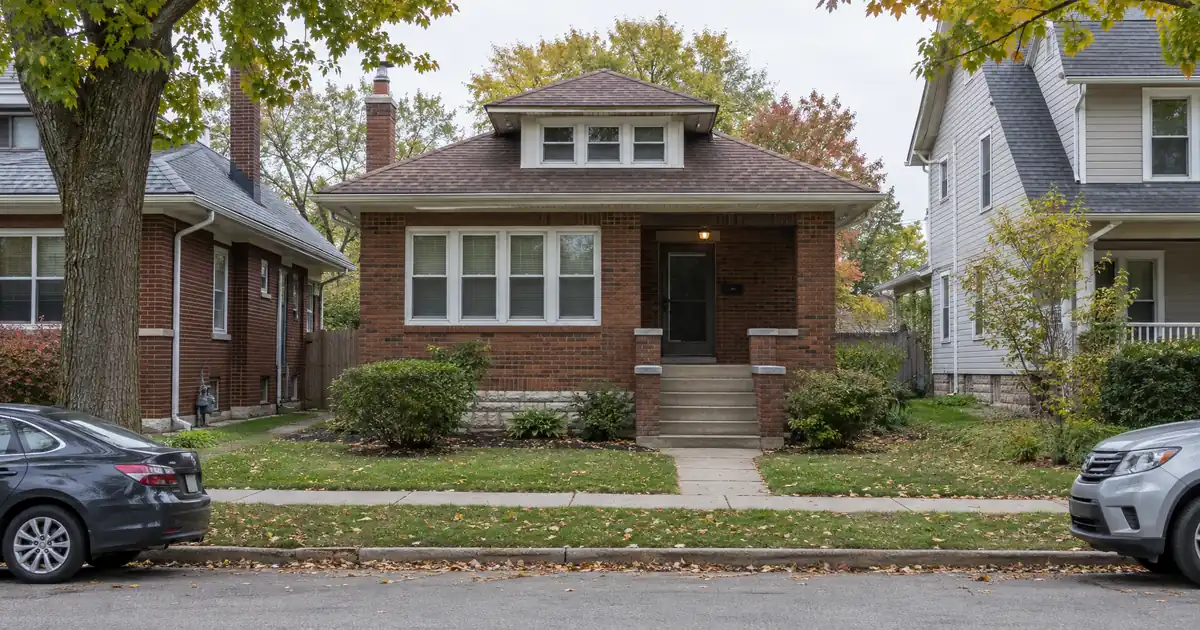
A Bloomington duplex and a Bloomington three-bedroom house can carry the same appraised value and land on opposite sides of 1.00 coverage. Cash-out files here turn on that split. Rent has to clear the full monthly obligation, taxes and insurance included, after the loan is sized at the LTV ceiling. Small multi-unit stock tends to clear it. Single-family rentals often don’t.
Lendmire works with Bloomington, Illinois investors to place DSCR financing through wholesale lenders reaching 41 markets — 40 states plus Washington, D.C. Lendmire is a DSCR-focused mortgage broker (NMLS# 2371349). It arranges the loan, and the lender reviews eligibility and approves it.
DSCR Cash-Out Calculator
Run the cash-out numbers in Bloomington, IL
Rate source: Freddie Mac 30-yr average via FRED® — Federal Reserve Bank of St. Louis · effective Sep 24, 2026
Prefilled with starting assumptions — enter your property’s value, balance, taxes, and insurance for a more accurate picture.
Program parameters update from Lendmire’s centralized guideline source. Taxes and insurance are editable estimates.
As of Sep 24, 2026 · General Freddie Mac market benchmark, not a Lendmire loan offer. Property value, balance, taxes, and insurance are editable estimates. Maximum loan-to-value varies by lender, program, property type, and seasoning. Not a Loan Estimate, approval, or commitment to lend. Program availability and eligibility are subject to lender guidelines, credit approval, property review, and underwriting.
TL;DR: A cash-out refinance in Bloomington, Illinois is underwritten primarily on the property’s rental income measured against its full monthly obligation, and the split between small multi-unit and single-family stock decides whether the number clears. With a housing shortfall of more than 8,000 units per local estimates, demand is documented, but the coverage math is not uniform.
- Duplexes modeled around 1.15x including taxes and insurance; a 3-bedroom house modeled near 0.75x.
- Cash-out LTV tops out at 75%, with about 6 months of seasoning from title recording.
- Reserves run about 6 months of PITIA on most files.
- Underwrite vacancy at 5-8%, not the near-zero of the shortage peak.
- Thin small-property comps are the main appraisal friction.
Bloomington Market Snapshot
A quick read on the Bloomington investor landscape — figures come from the cited sources below. Confirm current property-level numbers before underwriting.
| Metric | Detail |
|---|---|
| Home prices | $252K median (Redfin) |
| University enrollment | 21,994 total (Illinois State University) |
| Vacancy | 2% in 2021 (WGLT) |
How the Cash-Out Math Runs on Two Property Types
The cleanest way to see it is side by side. The inputs below are modeled assumptions, not sourced market facts, except where a source is linked.
| Factor | Duplex | 3BR house |
|---|---|---|
| Modeled rent | Two 2BRs at $1,236 each | One 3BR at $1,496 |
| Value used | $295,760 | About $274,000 |
| Gross rent-to-value | About 0.84% | About 0.55% |
| Coverage at 75% LTV | Roughly 1.15x | Roughly 0.75x |
Rent inputs come from RentCafe’s Bloomington averages, which show $1,236 for a two-bedroom and $1,496 for a three-bedroom. The $295,760 duplex value is the average asking figure from a listing aggregator. The $274,000 is the average sold price WGLT reported for the last full year. Coverage bands are rent divided by full PITIA on a 30-year amortization, taxes and insurance included, rounded down.
Here is the mechanism. DSCR is monthly rent divided by principal, interest, taxes, and insurance. Illinois taxes are heavy relative to price, so a low rent-to-value house gets squeezed before the loan even sizes. A 0.55% gross yield can’t carry a 75% loan plus full escrow. The duplex at 0.84% can.
The single-family case is sub-1.00. Several structures may apply, all subject to lender guidelines, credit approval, and property review. Sizing the loan below the ceiling is one, though it shrinks the cash out. An interest-only structure is another. A sub-1.00 program with compensating factors such as stronger credit and deeper reserves is a third. A single-family owner who wants meaningful proceeds should model all three before ordering the appraisal.
Rent caveat: the RentCafe figures cover buildings with 50 or more units, so they skew toward newer complexes. Small-property rent comps from a local agent will land differently, in either direction. Sources disagree widely on Bloomington rents. One aggregator’s average sits near $969, another’s above $1,180. Underwrite off the lease, not the aggregator.
DSCR files in markets like this one typically look the same on paper. Coverage pencils on the aggregator rent, then a rent survey or the lease comes in lighter and the ratio moves. The stronger files carry a signed lease plus an appraiser’s rent schedule that agree with each other before submission. Where they don’t, the lender uses the lower number.
Underlying mechanics are on the DSCR qualification page. Investors weighing this against conventional financing can use the side-by-side comparison.
Seasoning, the 75% Ceiling, and What the Appraiser Sees
Cash-out on an investment property tops out at 75% LTV. Seasoning runs about 6 months, measured from title recording, and the settlement statement documents the date. Files that count from contract date or from the closing table instead of recording get kicked back. Terms vary by lender guidelines, property type, leverage, credit profile, and full file review.
Some Illinois scenarios route to lower caps, so treat 75% as the ceiling and not the expectation. Equity available depends on rent used for lender review, PITIA, reserves, and that cap. It isn’t a guaranteed cash figure.
Now the appraisal, which is the real friction here. Bloomington values are uneven. Redfin put the citywide median sale price near $252K for November, up 20.9% year over year. Zillow’s home value index is lower at $228,634, up 7.5%, a different methodology. County-level data swings wildly on thin volume: Redfin’s McLean County page showed a $228K median, down 4.2%, on only 94 sales in a single month.
Small samples mean 3- and 4-unit buildings often get compared against a handful of sales. Appraisal reconsideration is a routine step on these, with in-neighborhood sales and a condition schedule attached. A 20.9% jump on one source and a 4.2% drop on another is exactly why a conservative value beats a peak one. Size the cash-out off the appraised number the lender actually accepts, not the portal.
Where the Rent-to-Value Ratio Holds Up
The older housing stock near downtown carries the highest rent-to-price ratios, but that pattern is unverified at the submarket level. No reliable neighborhood rent source exists, so this is qualitative.
Near East Side and Franklin Square. This National Register historic district has Queen Anne and Italianate houses, some split into several units. ApartmentGuide puts renters at 68% of residents. It’s the best candidate for duplex and small multi-unit cash-outs. Confirm that unit counts are legal, because an appraiser and lender will only credit units that are.
West Bloomington. It sits next to downtown with mixed housing styles, and it reads as the entry-level, value-add area. That’s fine for buyers who want to force appreciation before refinancing. Lenders will want visible rehab documentation and a stabilized lease.
Near Illinois Wesleyan. This is where small multi-unit stock concentrates. Illinois Wesleyan reported nearly 1,700 undergraduates, but U.S. News data shows 81% live in college-affiliated housing. Don’t underwrite off the campus. Underwrite off employees. Listing copy for one nearby duplex mentions leases secured well ahead of the school year, which is marketing language, not market data.
East and southeast suburbs. Pepper Ridge, Maple Wood, and Oakwoods hold late-1980s and 1990s single-family homes. They fit 3-4 bedroom rentals, and NeighborhoodScout says single-family detached homes are 55.41% of units. Those are the houses with the lower rent-to-value profile above. They hold value, but they cash-flow thinly. Oakwoods has an HOA, so read the rental terms before anything else. The airport-side Old Farm Lakes and Lakewood-Hillcrest areas sit in the same workforce single-family lane.
Duplexes and small apartment buildings are only about 8.39% of units. Scarce product cuts both ways. Rents hold, but comps for the appraisal are thin.
Vacancy: Underwrite 5-8%
The near-zero vacancy of the shortage peak is gone. CoStar data showed apartment vacancy plummeting to 2% then inching up, and two local operators reported about 95% occupancy, with one calling 90-95% the sweet spot. A county-level benchmark cited by WGLT puts healthy vacancy at 6-8%.
That matters for the cash-out. If the lender’s rent figure assumes full occupancy and a unit turns, the trailing income drops. Model the number with a 5-8% vacancy factor before you commit to a payoff or a purchase contract on the next deal.
New supply is unlikely to flip that. Bloomington permitted only 22 multifamily units last year, while Normal permitted 271 and completed four. Older duplexes still compete with newer Class A complexes in Normal on price, but oversupply pressure on small-property rents looks low.
The Tenant Base Behind the Rent Roll
This is a twin-city labor market, so tenants shop both sides of the line. VisitBN’s employer list shows State Farm headquarters at 13,000 employees, Rivian at 6,000, Illinois State University at 3,189, and COUNTRY Financial at 3,000. OSF St. Joseph Medical Center (2,058) and Carle BroMenn (2,061) anchor healthcare.
Rivian’s own count is murkier. WGLT reported 7,410 statewide in a state incentive agreement, down from 8,587 a year earlier, and the company no longer gives a Normal-only figure. Treat it as several thousand jobs, not a precise number.
State Farm once employed about 20,000 here and shrank to 13,000 without breaking the market. The demand story is diversified: insurance, manufacturing, Illinois State University with record enrollment near 22,000, and two hospitals. That spread is what a lender’s rent-stability read wants to see. It’s not a single-employer bet.
Commuting adds a second layer. A county planner cited three sources showing 50-80% of Rivian workers have a 45-minute commute, and the Economic Development Council chief said workers are commuting from Peoria and Champaign. Workers who want to live closer to the job give well-located in-town rentals a durable tenant pool. Population is about 79,000, and the city is the fifth-largest in Illinois outside the Chicago metro.
What the Proceeds Do Next
Cash-out proceeds are only useful if they fund a deal that also clears. The reserve requirement is about 6 months of PITIA on most files (higher above $1,500,000), and credit tiers run 620, 660, 680, and 700, with 620 as the floor. Reserve documentation is the quiet failure point: cash-out proceeds generally can’t be double-counted as both the reserve and the down payment on the next property.
DSCR vs. conventional financing
Two common ways to finance an investment property in Bloomington, IL. They qualify you differently — here’s how investors weigh them.
Why investors choose it
- Qualifies on the property’s rental income — no personal tax returns, W-2s, or pay stubs needed to document income.
- No personal debt-to-income ceiling to clear, so existing mortgages and obligations don’t cap your borrowing the same way.
- Can be closed in an LLC, keeping the property inside a business entity.
- Built for scaling — not held to the limit on number of financed properties that conventional financing applies.
- Underwriting centers on the deal: generally qualifies when the rent covers the payment, a 1.00x coverage ratio being a common baseline (confirmed in underwriting).
- Designed specifically for investment property, including long-term and, where the program allows, short-term rentals.
Where it’s strong
- Often the lowest ongoing financing cost for a buyer who fully qualifies on personal income — a fit for a first property or a cost-first purchase.
Trade-offs for investors
- Requires full personal income documentation and must fit within a debt-to-income limit — salary, existing debts, and other mortgages all count.
- Typically held in your personal name rather than a business entity.
- Caps how many financed properties you can carry, which can become a ceiling as a portfolio grows.
- Evaluates you as a borrower as much as the property, which usually means more paperwork.
How investors usually choose: a first or single property often optimizes for the lowest financing cost; portfolio builders often optimize for leverage, vesting in an LLC, and scaling past conventional caps. The right answer depends on your goals, the property, and current guidelines — both paths run through select lenders in Lendmire’s wholesale network, with eligibility and terms confirmed in underwriting.
Picture an investor with a seasoned Near East Side fourplex, appraised comfortably above their payoff. They refinance at up to 75%, hold reserves back, and use the balance toward a second small multi-unit. That’s the standard pattern, and the second acquisition is a purchase question for another day. Financing a LLC-held property works subject to lender program eligibility, and the entity documents (operating agreement, EIN letter, good-standing certificate) need to match the title vesting. Mismatches there are a preventable delay.
The stronger play might be a duplex refinance over a single-family one, though investors after appreciation could argue the east-side houses hold value better. It’s a toss-up on paper. The coverage number decides.
Investors ready to run their own property can see how the DSCR math pencils, or call 828-256-2183. The cash-out mechanics and the refinance pathway for investor properties cover the program side. More on DSCR loan options for Illinois investors is on the state hub.
Local rental rules, taxes, and insurance should be verified with qualified local professionals before you commit.
One last figure frames the whole market. Local estimates put the housing shortfall at more than 8,000 units, and Bloomington permitted only 22 multifamily units last year.
Frequently Asked Questions
How do you qualify for a DSCR cash-out refinance in Bloomington, Illinois?
Qualification is driven by the property’s rent against its full PITIA, with 1.00 as the standard baseline. Lenders also review credit (620 floor), reserves of about 6 months, and the appraised value. Loan size is capped at 75% LTV. All of it is subject to lender guidelines and property review.
What are the requirements for an investment property cash-out loan in Bloomington, IL?
Expect about 6 months of ownership from title recording, a lease or appraiser’s rent schedule, and reserve documentation. If the property is LLC-held, the entity documents need to match title. Manufactured homes, log homes, and barndominiums fall outside these programs.
Does the Rivian headcount put a Bloomington rental at risk?
Less than it seems. Rivian’s statewide count fell to 7,410, and the company stopped reporting a Normal figure. But State Farm, COUNTRY Financial, two hospitals, and Illinois State University spread the tenant base well beyond any one employer. State Farm’s own drop from about 20,000 to 13,000 locally didn’t break the market.
Why do duplexes often cash out better than houses in Bloomington?
Their rent-to-value ratio is higher. In the modeled case, a duplex grosses about 0.84% of value monthly versus 0.55% for a 3-bedroom house, so it clears the coverage floor at 75% LTV while the house often doesn’t. Small-property rents still need local comps.
Can a self-employed investor buying in Bloomington be reviewed for DSCR financing?
Yes. DSCR eligibility is generally reviewed around the property’s rental income rather than personal income documentation.
About Lendmire
Lendmire is a DSCR-focused mortgage brokerage, NMLS# 2371349, placing investor loans across 41 markets, including Washington, D.C. Lenders in the network typically review eligibility around a property’s rental income rather than personal income documentation. That fits LLC-held rentals, self-employed investors, and portfolios scaling past conventional financed-property limits. The firm was named a 2026 Scotsman Guide Top Mortgage Workplace and a top-ranked workplace in 2025.
Get Started
Ready to find the right loan for you?
In about 30 seconds you can review financing options available for your investment property. No commitment required.
Informational only. Not a Loan Estimate, approval, or commitment to lend. Program availability and eligibility are subject to lender guidelines, credit approval, property review, and underwriting.
References
1. wglt.org — Crazy Fast Housing Market Persists in Bloomington Normal Its Still Too Fast for Many
2. Redfin
4. WGLT, Housing Projects Stall Across Bloomington-Normal
5. RentCafe, Bloomington Average Rent
6. Redfin’s McLean County page
7. NeighborhoodScout — Bloomington Real Estate
8. WGLT, The Bloomington-Normal Housing Shortage: A Skeptic’s View
9. Bloomington-Normal Area CVB, Major Employers
11. Wikipedia — Bloomington, Illinois
12. a 2026 Scotsman Guide Top Mortgage Workplace
13. Scotsman Guide — Top Workplaces 2025
This article is part of Lendmire’s investment property cash-out refinance program — full qualification details, guidelines, and scenarios live on the program page.
Related reading: Cash Out Refinance Investment Property via DSCR in Bloomington · Cash Out Refinance Investment Property in Crystal Lake · DSCR Cash Out Refinance Rockford Illinois
Guides: Investment Property Cash-Out Refinance in Bloomington, IL · Investment Property Cash-Out Refinance in Illinois
Brandon Miller
Founder & CEO, Mortgage Loan Originator, Lendmire LLC
- Mortgage Loan Originator · NMLS# 1129696 · Verify on NMLS Consumer Access
- North Carolina Real Estate Broker · License# 343312 · Verify on NCREC
- North Carolina Insurance Producer · License# 19053198 · Property, Casualty, Life, Health · Verify on NAIC SBS
- Lendmire LLC · Firm NMLS# 2371349 · Verify firm licensure
Required disclosures. Lendmire (NMLS# 2371349) operates as a licensed mortgage broker, not a direct lender or depository. The discussion in this article is general in nature and should not be relied upon as financial, legal, or tax advice — every investment scenario is unique and should be reviewed by a qualified professional. Any loan inquiry is subject to lender underwriting, and this article is not a commitment to lend or a guarantee of approval. Mortgage rates, loan terms, and program guidelines vary by borrower, property, and state, and may change without notice. Equal Housing Opportunity. Verify licensure at NMLS Consumer Access.