
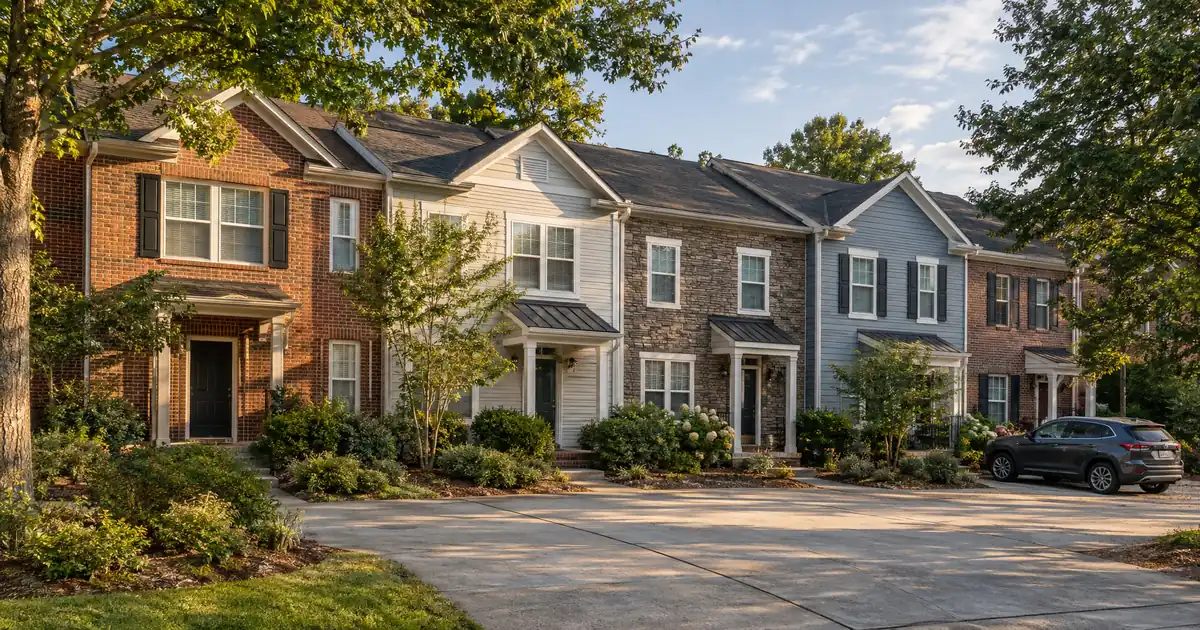
A rental in Northgate Park hits the DSCR math like this: a duplex appraising near the $333K median Redfin reports for the neighborhood, refinanced at the 75% cash-out ceiling, with both sides leased at conservative rents. The lender divides that rent by the full monthly obligation. Investors weighing a DSCR cash-out refinance in Durham, especially on older 2–4 unit stock near Duke East Campus, face this same calculation. The answer turns on three variables: rent, appraised value, and seasoning. Every figure here varies by lender and program — guidelines, property type, leverage, and credit profile all apply.
DSCR Cash-Out Calculator
Run the cash-out numbers in Durham, NC
Rate source: Freddie Mac 30-yr average via FRED® — Federal Reserve Bank of St. Louis · effective Sep 24, 2026
Prefilled with starting assumptions — enter your property’s value, balance, taxes, and insurance for a more accurate picture.
Program parameters update from Lendmire’s centralized guideline source. Taxes and insurance are editable estimates.
As of Sep 24, 2026 · General Freddie Mac market benchmark, not a Lendmire loan offer. Property value, balance, taxes, and insurance are editable estimates. Maximum loan-to-value varies by lender, program, property type, and seasoning. Not a Loan Estimate, approval, or commitment to lend. Program availability and eligibility are subject to lender guidelines, credit approval, property review, and underwriting.
The Quick Read:
A cash-out refinance on a Durham, North Carolina rental is underwritten primarily on the property’s rental income measured against its full monthly obligation, so the file needs about six months of title seasoning, appraised value that supports the 75% cash-out ceiling, and reserves, all subject to lender guidelines.
- Durham County’s median sale price sits near $426K, per Redfin, essentially flat year over year.
- Only 28 multifamily listings are active citywide, with a $414K median list price, per Redfin.
- Durham apartment rents average $1,532, down about 0.9% year over year, per RentCafe.
- Northgate Park’s median price fell 13.3% on a thin sample, so appraisals there need caution.
Durham Market Snapshot
A quick read on the Durham investor landscape — figures come from the cited sources below. Confirm current property-level numbers before underwriting.
| Metric | Detail |
|---|---|
| Recent appreciation | Under $300K tier 4–5% (ListingFlare Durham 2026) |
| University enrollment | 17,499 total (Duke Facts) |
| Employment | 26,278 ft employees (Durham County Economic) |
| Vacancy | 7.5–8.0% since 2024 (Northmarq insights) |
Walking the Numbers, Step by Step
The coverage ratio is monthly rent divided by the full monthly obligation: principal, interest, taxes, insurance, and any HOA dues. A standard program benchmark is 1.00x, meaning rent covers the payment. Some lenders review lower ratios with compensating factors. Eligibility still depends on the lender, credit profile, reserves, and property review. The primer on DSCR loans covers the mechanics in full.
Now run the numbers on the Northgate Park duplex. The inputs are modeled assumptions, not market data:
1. Value: $333,000 appraised.
2. Leverage: 75% of value, the program ceiling for a cash-out.
3. Rent: $1,250 per side, or $2,500 combined, a deliberately cautious figure.
4. Obligation: full payment including taxes and insurance.
On those inputs, coverage lands around 1.25x. (Rounded down on purpose. A number that only works when rounded up isn’t a number you want to rely on.)
Now stress it. Cut rents 10% and coverage slips into the low 1.1s, still above the benchmark. Vacate one side entirely and coverage falls to roughly 0.6x. That is the multi-unit tradeoff in one line: two rent streams cushion a vacancy better than one, but a fully vacant unit still pulls the file well under 1.00. If an investor wants a lender to review a sub-1.00 scenario, the structures that may apply include a sub-1.00 program, an interest-only structure, or a lower-leverage request. Each is subject to lender guidelines, credit approval, and property review. None is a given.
One more wrinkle matters more in Durham than in most markets. If the appraisal comes in 10% lower, coverage actually improves, because the loan shrinks with the value. What shrinks is the proceeds. In a soft-price market, the risk is less “will the file qualify” and more “will there be enough cash to matter.”
DSCR files in markets like this one typically look like a small-balance, older-stock refinance where the rent roll is clean but the appraisal is the swing factor. The stronger files usually arrive with leases in hand, a realistic vacancy allowance, and reserves already seasoned in the account. The weaker ones are sized on an asking rent from a single listing, then recut after the appraisal.
Seasoning, the 75% Ceiling, and the Appraisal Question
Cash-out proceeds equal appraised value times the LTV ceiling, minus the existing payoff and costs. Seasoning of about six months from title recording typically applies before a lender will treat the new appraised value as the basis. The 75% cap on cash-out is firm, and it is lower than the purchase ceiling. Pricing and available terms vary by lender, borrower profile, property type, and full underwriting review. Reserves run about six months of the full obligation on most files. Loan amounts go up to $3,000,000 on standard programs, though smaller balances route through select lenders.
Here is the honest appreciation picture. Houzeo puts the Durham median at $418,000, down 2.79% year over year. Redfin’s county figure is $426K, down 0.34%. The two differ because of geography and methodology, so read them as a range, not a contradiction. Either way, prices are roughly flat to slightly down. Anyone planning a refinance thesis on fresh appreciation should expect the equity to come mostly from the original purchase basis and from any renovation value added, not from market lift.
Equity depends on the original basis, the current appraisal, the rent used for lender review, and the payoff balance. It is never a guaranteed cash figure. Investors who want to see how proceeds might size can start with the equity recycle pathway or the broader refinance pathway for investor properties.
Where the Equity Sits: Older 2–4 Unit Stock
The older core is where the best cash-out candidates live. Walltown, Northgate Park, Duke Park, Old North Durham, and East Durham carry the duplex and triplex inventory. Listings show package sales (one is four duplexes in Walltown) and fully leased duplexes in Northgate Park. Homes.com shows nine multifamily homes for sale in East Durham, priced from $175,000 to $945,000, with an East Durham median home price of $299,949.
| Submarket | Price signal | Rent signal | Read |
|---|---|---|---|
| Northgate Park | $333K median (11 sales) | Zumper: $2,049 avg | Stronger coverage, weak comps |
| East Durham | $299,949 median | Zumper: $1,485 avg | Lower basis, modest lift |
| Walltown | Duplex packages listed | Anecdotal ~$800 per 1BR | Thin data, verify rents |
| South Durham | Suburban stock | Zumper house: $2,050 | Single-family lane |
Take Northgate Park first, because it cuts both ways. Zumper shows rents there up 27.1% to $2,049. Redfin shows the median sale price down 13.3% and price per square foot down 17.2%, on only 11 sales. Directionally, rent is roughly 0.6% of price per month, better than East Durham’s roughly 0.5%. But a rent spike and a price drop on small samples both need comp verification before anyone sizes a loan. This one’s a genuine toss-up. The coverage case is strong, yet the appraisal case is shaky, and cash-out proceeds depend on the second.
East Durham is the cash-flow-and-patience submarket. The lower basis gives rent more room to cover the obligation, and a local broker guide describes entry-level appreciation closer to 4–5%. That is a brokerage blog, so treat it as qualitative. Walltown and Old West Durham sit near Duke’s East Campus and Ninth Street retail, with tenants drawn from staff, students, and young professionals. Listing-level unit rents there run around $800 for one-bedroom duplex sides. Those are individual listings, not market rents, and no one should size a refinance on them.
Older stock also brings a practical point. Units renovated between the original purchase and the refinance are where equity shows up most reliably. A duplex bought with one side vacant for renovation, then re-leased, has a before-and-after story an appraiser can support.
South Durham: The Single-Family Lane (With a Catch)
South Durham and the Southpoint area offer townhomes, single-family homes, and condos near I-40 and The Streets at Southpoint. Tenants skew toward RTP, healthcare, and biotech workers, which tends to mean longer tenancies. Zumper puts the average Durham house rent at $2,050. Doorstead puts the Raleigh-Durham median for three-bedroom single-family rentals at $2,026, a metro figure, so attribute it carefully.
The catch is stacking. One rent, one payment, and no cushion when a tenant leaves. Coverage on a single-family refinance runs thinner than on a well-leased duplex bought at a comparable basis. Whether that matters depends on the investor. For a W-2 borrower with one or two rentals and clean traditional personal-income documentation, conventional financing may cost less and cash-flow without the non-QM friction, and the conventional-vs-DSCR tradeoffs are worth reading before choosing. The flip point tends to arrive around the fourth financed property, or sooner for an LLC-held portfolio (subject to lender program eligibility) or a self-employed borrower whose returns understate cash flow.
Three Anchors, One Soft Rent Market
Durham’s demand base is unusual. Three institutional anchors sit within a short commute of each other, and none dominates alone.
- Duke. Durham County’s economic development office calls Duke the largest employer in Durham, with about 26,278 full-time employees in the health system. Duke’s own facts page lists 17,499 students, including 10,976 graduate and professional students.
- Research Triangle Park. Discover Durham counts more than 375 companies and more than 60,000 jobs inside the park.
- NC Central University. NCCU enrolled 9,160 students, up 6.8%, though 2,018 of them are online, so the growth doesn’t translate one-for-one into local renters.
Durham County itself has about 347,200 residents, per USAFacts, and 48% of households rent. Those anchors keep the tenant pool deep. They do not make rents rise.
Rents are flat to slightly down. RentCafe shows apartment averages at $1,532, with one-bedrooms at $1,388, two-bedrooms at $1,619, and three-bedrooms at $1,933. Zillow describes the market as cool, with average rent down $50 year over year. New supply is part of the story: regional completions peaked above 13,000 units and are on pace for roughly half that. Northmarq reports metro vacancy in a 7.5% to 8.0% range. Projects still delivering in Durham include Novel UHill (400 units) and Vara Trinity Park (267 units).
Class A apartments compete mostly downtown and near Duke, which is one reason older small-property rents have held flatter than the headlines suggest. One claim circulating in property-manager blogs, a double-digit metro rent jump, conflicts with RentCafe’s data. Skip it. Underwrite in-place rents.
What Should the Proceeds Buy?
The refinance thesis depends on what the investor does with the cash. Pulling equity from a Northgate Park duplex to buy another older duplex in East Durham, where entry pricing sits well under the county median, is a straightforward recycle: lower basis, stacked rents, and a coverage ratio that clears without heroics. Pulling the same equity to chase a market where the math doesn’t pencil is a different decision, one worth stress-testing first.
DSCR vs. conventional financing
Two common ways to finance an investment property in Durham, NC. They qualify you differently — here’s how investors weigh them.
Why investors choose it
- Qualifies on the property’s rental income — no personal tax returns, W-2s, or pay stubs needed to document income.
- No personal debt-to-income ceiling to clear, so existing mortgages and obligations don’t cap your borrowing the same way.
- Can be closed in an LLC, keeping the property inside a business entity.
- Built for scaling — not held to the limit on number of financed properties that conventional financing applies.
- Underwriting centers on the deal: generally qualifies when the rent covers the payment, a 1.00x coverage ratio being a common baseline (confirmed in underwriting).
- Designed specifically for investment property, including long-term and, where the program allows, short-term rentals.
Where it’s strong
- Often the lowest ongoing financing cost for a buyer who fully qualifies on personal income — a fit for a first property or a cost-first purchase.
Trade-offs for investors
- Requires full personal income documentation and must fit within a debt-to-income limit — salary, existing debts, and other mortgages all count.
- Typically held in your personal name rather than a business entity.
- Caps how many financed properties you can carry, which can become a ceiling as a portfolio grows.
- Evaluates you as a borrower as much as the property, which usually means more paperwork.
How investors usually choose: a first or single property often optimizes for the lowest financing cost; portfolio builders often optimize for leverage, vesting in an LLC, and scaling past conventional caps. The right answer depends on your goals, the property, and current guidelines — both paths run through select lenders in Lendmire’s wholesale network, with eligibility and terms confirmed in underwriting.
Honestly, the smaller property often beats the prettier one here. A $175,000-range East Durham multifamily has less exit liquidity than a Southpoint townhome, but the cash-on-cash can run meaningfully higher. Investors buying for appreciation could argue the other way, though the current price trend gives them little support.
If the math looks workable, run the numbers with Lendmire or call 828-256-2183 to talk through structure. Statewide program context lives on the page for DSCR loans in North Carolina. Before committing capital, verify current local rental rules, taxes, zoning, and insurance with qualified local professionals.
The Blind Spot in Durham
The biggest blind spot for DSCR-financed Durham investors is underwriting on optimistic rent. Unit-level evidence here is mostly single listings, rent growth is contested between sources, and the submarket with the best coverage also has the weakest price data. A cash-out sized on a rent that the next lease doesn’t hit, against an appraisal that comes in light, leaves an owner holding a larger loan on a flatter rent roll. In a market where three anchors keep tenants plentiful but rents stubbornly level, the discipline is to size the refinance on the rent you already collect, not the rent you expect.
Frequently Asked Questions
How do you qualify for a DSCR loan in Durham?
Qualification centers on the property’s rent relative to its full monthly obligation, typically with a 1.00x benchmark, plus credit, reserves, and property review. On a cash-out, the property usually needs about six months of seasoning, and leverage tops out at 75%. Exact eligibility depends on the lender, borrower profile, and property.
What are the requirements for an investment property loan in Durham, North Carolina?
Expect a rent-based coverage test, reserves of roughly six months of the full obligation, and an appraisal that supports the requested leverage. Eligible property types include single-family, townhomes, and 2–4 unit buildings. Manufactured homes, log homes, and barndominiums fall outside these programs. Terms vary by lender and scenario.
Can I pull cash out of a Northgate Park duplex if neighborhood prices are falling?
Possibly, but proceeds depend on the appraisal, and Redfin’s neighborhood data shows a 13.3% median price drop on only 11 sales. A lower appraisal shrinks cash-out proceeds even if coverage holds. Model the refinance at flat or lower value, and treat any appreciation as upside, not the base case.
Does soft rent growth in Durham hurt a cash-out refinance?
It narrows the margin for error more than it blocks a file. Rents are flat to slightly down across RentCafe, Zumper, and Zillow, so coverage should be modeled on in-place leases. Multi-unit properties cushion vacancy better than single-family homes, though one fully vacant side can still push a duplex below 1.00x.
For current guidelines and terms, see Lendmire’s DSCR loan programs page.
About Lendmire
As a DSCR and non-QM mortgage broker, Lendmire — NMLS# 2371349 — connects investors with wholesale lending channels across 41 markets, including Washington, D.C. The property’s rental income, not the borrower’s traditional personal-income documentation, is central to program review, which works for self-employed operators and portfolios beyond four financed properties. Lendmire is recognized as a 2026 Scotsman Guide Top Mortgage Workplace.
Get Started
Ready to find the right loan for you?
In about 30 seconds you can review financing options available for your investment property. No commitment required.
Informational only. Not a Loan Estimate, approval, or commitment to lend. Program availability and eligibility are subject to lender guidelines, credit approval, property review, and underwriting.
References
1. Redfin, Northgate Park housing market
2. Redfin, Durham County housing market
3. Redfin
4. RentCafe, Durham rent trends
7. Durham County Economic Development, Healthcare
8. Northmarq, Raleigh-Durham vacancy insights
9. $418,000
10. Homes.com
11. Zumper, Durham rent research
12. Doorstead
13. Discover Durham, Research Triangle Park overview
14. NCCU
15. USAFacts
16. a 2026 Scotsman Guide Top Mortgage Workplace
This article is part of Lendmire’s investment property cash-out refinance program — full qualification details, guidelines, and scenarios live on the program page.
Related reading: DSCR Loans Raleigh-Durham: Investor Financing for Research Triangle, Duke, NC State & Real Estate Investors · Cash Out Refinance Investment Property in North Carolina · DSCR Cash Out Refinance in Asheboro, North Carolina: The 2026 DSCR Financing Guide to Zoo City Rentals
Guides: Investment Property Cash-Out Refinance in Durham, NC · Investment Property Cash-Out Refinance in North Carolina
Brandon Miller
Founder & CEO, Mortgage Loan Originator, Lendmire LLC
- Mortgage Loan Originator · NMLS# 1129696 · Verify on NMLS Consumer Access
- North Carolina Real Estate Broker · License# 343312 · Verify on NCREC
- North Carolina Insurance Producer · License# 19053198 · Property, Casualty, Life, Health · Verify on NAIC SBS
- Lendmire LLC · Firm NMLS# 2371349 · Verify firm licensure
Compliance and disclosures. Lendmire (NMLS# 2371349) is a licensed mortgage broker and is not a direct lender, depository institution, financial advisor, or tax professional. Content in this article is general market analysis and educational information — not financial, legal, or tax advice for any specific situation. Lendmire does not guarantee loan approval; every transaction is subject to underwriting by the funding lender. Mortgage pricing and loan program guidelines are subject to change at any time without notice and vary by borrower characteristics, property type, and state regulations. Lendmire complies with Equal Housing Opportunity. Licensure verification: NMLS Consumer Access.