
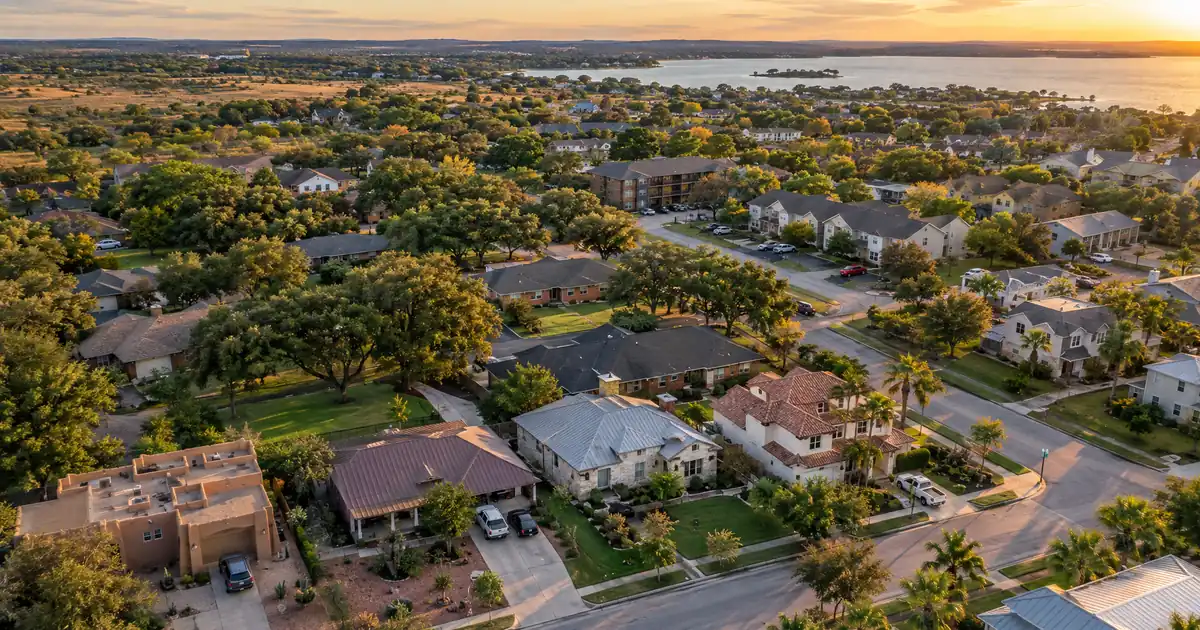
Sale prices in Flower Mound keep climbing while apartment rents slide. Redfin puts the median sale price at $640K, up 4.0% year over year, and Apartment List shows median rent at $1,959, down 3.4% year over year. For an owner sitting on appreciated equity, that gap is the whole story. The equity keeps building, but the rent that has to cover a new loan is going nowhere.
DSCR Cash-Out Calculator
Run the cash-out numbers in Flower Mound, TX
Rate source: Freddie Mac 30-yr average via FRED® — Federal Reserve Bank of St. Louis · effective Sep 24, 2026
Prefilled with starting assumptions — enter your property’s value, balance, taxes, and insurance for a more accurate picture.
Program parameters update from Lendmire’s centralized guideline source. Taxes and insurance are editable estimates.
As of Sep 24, 2026 · General Freddie Mac market benchmark, not a Lendmire loan offer. Property value, balance, taxes, and insurance are editable estimates. Maximum loan-to-value varies by lender, program, property type, and seasoning. Not a Loan Estimate, approval, or commitment to lend. Program availability and eligibility are subject to lender guidelines, credit approval, property review, and underwriting.
The Short Version:
A cash-out refinance in Flower Mound, Texas, is underwritten primarily on the property’s rental income measured against its full monthly obligation, so the binding constraint is rent relative to a $640K median price (Redfin), not the size of the equity.
- Cash-out LTV tops out at 75%, and about 6 months of ownership is the usual seasoning.
- Wellington rents near $3,100 against a $680K median list price: about 0.46% of price monthly.
- Only about 18% of households rent, so tenant demand is narrow and single-family driven.
- Modeled coverage on median-priced homes usually falls below 1.00 at the full 75% LTV.
- Small multifamily is scarce here. The rental case rests on 3-4 bedroom houses.
Investors with a Flower Mound rental should read the rest of this as a sizing exercise. The question isn’t whether the equity exists. It’s how much of it the rent will carry.
Flower Mound Market Snapshot
A quick read on the Flower Mound investor landscape — figures come from the cited sources below. Confirm current property-level numbers before underwriting.
| Metric | Detail |
|---|---|
| Home prices | $640K median (Redfin) |
| Employment | 29,000+ employees (Texas Health Careers) |
| Vacancy | 3.2% (NeighborhoodScout) |
The Equity Is Real. The Rent Isn’t Keeping Pace.
Flower Mound builds equity faster than it builds cash flow. Redfin’s latest read shows a price per square foot that has moved higher over the past year, and homes are changing hands at a steady pace, with closings continuing month to month. That is a liquid, appreciating owner market.
The rent side is less flattering. RentHop lists 2-bedroom rents at $2,225, 3-bedroom at $2,575, and 4-bedroom at $3,100, with a listing median of $2,895 and rents roughly flat over the past year. RentCafe reports an apartment average of $1,965. Niche and Apartment List land in the same neighborhood. The sources disagree by a few hundred dollars, and none of them supports the idea that rents are racing ahead of values.
Lendmire, a DSCR-focused mortgage broker, treats this as an appreciation-versus-cash-flow market. Lendmire’s DSCR program footprint covers Flower Mound, Texas as part of a 41-market reach that includes Washington, D.C. The broker’s job on a file like this is to size the loan so that rent covers the payment. Maximizing proceeds comes second. Anyone new to the mechanics can read the guide “What Is a DSCR Loan”. In short, it is monthly rent divided by the full monthly obligation: principal, interest, taxes, insurance, and any HOA dues.
A Thin Renter Pool With a Deep Employer Base
Demand here comes from jobs, not from a large renter base. RentCafe puts renter-occupied households at 18%, or 4,932 households, against 82% owner-occupied. Nearly all rental communities are low-rise garden-style, and roughly three-quarters of apartment buildings are newer construction. A landlord competes with those complexes, not with a stock of older duplexes.
What keeps tenants coming is the employment base. The Town of Flower Mound counts 44,454 employed residents, or 97.3% of those 16 and older. It reports that 32.7% work in management, business, or finance. Its employer list puts CTDI, Lewisville ISD, MI Windows & Doors, and Texas Health Presbyterian Hospital Flower Mound in the 500-plus band. Stryker Communications, the Town itself, and Likewize sit in the 300-499 band. The town’s workforce page says more than 85% of adults have post-secondary education. The Flower Mound Chamber of Commerce reports population of 80,883 and average household income of $189,356.
Two anchors matter most for renters. The Lakeside Business District spans 1,500 acres with more than 100 businesses. It sits about 3 miles from DFW Airport. On the health side, Texas Health Presbyterian Hospital Flower Mound has 99 beds and 500-plus physicians on its medical staff, and it belongs to a parent system with 29,000-plus employees, per Texas Health careers. These are white-collar, hospital, and logistics jobs. They support rents at the $2,500-$3,300 level for houses, but they don’t create a mass rental market.
Where the Coverage Math Holds (and Where It Doesn’t)
Wellington is the submarket most likely to clear a coverage test. It is the largest community in town at 2,400-plus homes, per Blue Fuse Realty, which means deep resale inventory and comparable rentals. Movoto shows a $680K median list price. Redfin’s rental snapshot shows median rents of $3,100 in Wellington and $3,295 in Wellington Estates. Those figures come from different dates and portals, but the arithmetic is roughly 0.46% of price per month. That is thin.
Elsewhere the ratios get worse.
Lakeside DFW and Lakeside Village. The Town describes a 160-acre mixed-use district on Lake Grapevine. Movoto puts the median list price at $1.32M. NeighborhoodScout reports a 3.2% neighborhood vacancy rate and a mix of apartments and single-family homes. The rental supply is mostly apartment product, so a Lakeside house would need rent far above local norms to cover a loan. A refinance there is an appreciation play and suits only low-leverage structures.
River Walk at Central Park. This is the hospital and medical-office pocket, and the natural source of healthcare-worker tenants. No sourced price or rent data exists for it, so no numbers appear here.
Bridlewood and Canyon Falls. Bridlewood is a golf community that skews owner-occupied and high-end. Price figures for it conflict badly across portals, so none are cited. Canyon Falls is newer construction with final phases still opening, which suggests limited resale history for rent comps.
Investors weighing a cheaper base sometimes look toward adjacent Lewisville for workforce-priced product. This research did not cover that market, so it’s a lead to follow rather than a finding.
Run the Numbers on a Wellington Refinance
Consider a modeled scenario. Every input below is an assumption, not a cited fact, except the price and rent, which come from the sources above.
Say an investor owns a Wellington house worth $680K (the Movoto median list price) and rents it at $3,100 (the Redfin Wellington median). The property has been on title well beyond the roughly 6-month seasoning period. The coverage math is monthly rent divided by principal, interest, taxes, and insurance on a 30-year amortization, using Texas-average tax and insurance loading.
| LTV | Modeled coverage (with taxes and insurance) |
|---|---|
| 75% | Mid-0.6s |
| 50% | High-0.8s |
| 40% | About 1.0 |
Coverage below 1.00 at the full 75% ceiling is not a rounding error. It is the market. Texas taxes are heavy, and the rent-to-value ratio is 0.46%. Sub-1.00 does not close the door, but it changes the conversation. A lender may review lower-ratio scenarios, but those usually come with compensating factors such as stronger credit, larger reserves, lower leverage, or different pricing. The paths are these:
- Lower the LTV until coverage approaches the 1.00 benchmark.
- Interest-only structuring, where a program offers it, which lowers the monthly obligation.
- A sub-1.00 program from a lender that reviews such files.
- A higher-rent house. A 4-bedroom near the RentHop $3,100 figure, bought at a lower basis, changes the ratio.
None of these is a promise. Eligibility depends on lender guidelines, credit approval, property review, and any state overlays.
DSCR files in markets like this one typically look the same. The equity is large, the rent is solid but not extraordinary, and the first-pass coverage number lands under 1.00 at maximum leverage. The files that move forward are usually ones where the borrower accepted a smaller loan, or brought reserves and credit that let the lender look past a thin ratio. Investors who arrive expecting the full 75% often leave with a right-sized 50%-60% structure. That is still a legitimate use of the equity, just a different amount.
Investors can review their scenario to see where a specific property lands, or call 828-256-2183 to talk through structure.
Seasoning, Ceilings, and Reserves
A few parameters control how much equity is reachable, and each is subject to lender guidelines and varies by borrower, property, and loan scenario.
- LTV ceiling. Cash-out refinances cap at 75%. The 80% figure that applies to purchases does not carry over.
- Seasoning. Programs typically look for about 6 months of ownership, measured from title recording.
- Minimum coverage. The standard benchmark is 1.00, meaning rent used for lender review equals the full monthly obligation.
- Credit. Tiers commonly sit at 620, 660, 680, and 700, with 620 the floor.
- Reserves. About 6 months of PITIA is typical, rising to about 9 months above $1,500,000.
- Loan size. Standard programs go up to $3,000,000. Smaller balances route through select lenders in the network.
Loans to LLC-titled entities are possible per lender program requirements, so investors holding Flower Mound houses in an entity should confirm structure early. For the full walkthrough, see the cash-out qualification details and the broader investor refinance options.
Two parameter notes matter especially in Flower Mound. Reserves scale with the payment, and Flower Mound payments are large, so 6 months is a real number. And because proceeds are not a guaranteed figure, investors shouldn’t commit to a purchase contract elsewhere until the refinance sizing is confirmed.
Bank financing is a different animal. For a comparison of underwriting logic, see the guide “Where DSCR and Conventional Diverge”.
Skip the Duplex Search
Small multifamily is not a Flower Mound strategy. Research found no sourced evidence of meaningful duplex, triplex, or fourplex supply. The rental stock is large garden-style complexes, and the town describes itself in single-family terms. Multi-unit income stacking, the usual way to lift coverage in a DSCR file, isn’t realistic here. Any accessory dwelling is a niche add-on, and only a single listing surfaced.
That leaves the 3-4 bedroom house as the coverage engine. An older Zillow reading put house median rent near $3,000, against a U.S. News median home value of $553,334. That is about 0.54% per month. The lesson is that median-or-below homes carry the ratio and above-median homes lose it fast. Houses also rent for roughly 50% more than the average apartment, which supports the single-family thesis at sensible basis.
Apartment competition is the other risk. Apartment List’s 3.4% rent decline conflicts with RentCafe’s 1.2% increase, so the sources disagree on direction. Listing promotions such as free-rent concessions have appeared at newer communities. (The concessions are anecdotal, but they are worth watching.) The practical read is to underwrite flat rents and use conservative figures in the coverage calculation.
Where the Proceeds Go
Cash-out proceeds are only as useful as the next deal, and Flower Mound offers few next deals. Prices are high, yields are thin, and small multifamily is absent. The stronger play for many owners is to redeploy proceeds outside town, in a market where rent-to-value runs higher, while holding the Flower Mound house for appreciation.
That’s the tension. Keeping the house captures the price growth, but the equity sits idle unless it’s extracted. Pulling it out at a low LTV keeps coverage near 1.00 and leaves a cushion if values soften. Pulling the maximum may work on paper, but a sub-1.00 file needs compensating factors, and the property’s rent won’t rescue a thin ratio. Neither answer is wrong. It depends on what the next asset yields.
DSCR vs. conventional financing
Two common ways to finance an investment property in Flower Mound, TX. They qualify you differently — here’s how investors weigh them.
Why investors choose it
- Qualifies on the property’s rental income — no personal tax returns, W-2s, or pay stubs needed to document income.
- No personal debt-to-income ceiling to clear, so existing mortgages and obligations don’t cap your borrowing the same way.
- Can be closed in an LLC, keeping the property inside a business entity.
- Built for scaling — not held to the limit on number of financed properties that conventional financing applies.
- Underwriting centers on the deal: generally qualifies when the rent covers the payment, a 1.00x coverage ratio being a common baseline (confirmed in underwriting).
- Designed specifically for investment property, including long-term and, where the program allows, short-term rentals.
Where it’s strong
- Often the lowest ongoing financing cost for a buyer who fully qualifies on personal income — a fit for a first property or a cost-first purchase.
Trade-offs for investors
- Requires full personal income documentation and must fit within a debt-to-income limit — salary, existing debts, and other mortgages all count.
- Typically held in your personal name rather than a business entity.
- Caps how many financed properties you can carry, which can become a ceiling as a portfolio grows.
- Evaluates you as a borrower as much as the property, which usually means more paperwork.
How investors usually choose: a first or single property often optimizes for the lowest financing cost; portfolio builders often optimize for leverage, vesting in an LLC, and scaling past conventional caps. The right answer depends on your goals, the property, and current guidelines — both paths run through select lenders in Lendmire’s wholesale network, with eligibility and terms confirmed in underwriting.
For texture on the broader state picture, see Lendmire’s page on DSCR loans in Texas.
Frequently Asked Questions
How do you qualify for a DSCR cash-out refinance in Flower Mound?
Lenders look mainly at whether the property’s rent covers its full monthly obligation, with 1.00 as the common benchmark. They also review credit tier, reserves of about 6 months of PITIA, at least roughly 6 months of ownership, and an LTV of 75% or less. On a Flower Mound house priced near the $640K median, that usually means a lower LTV than the ceiling allows. All of it is subject to lender guidelines and property review.
What are the requirements for an investment property refinance in Flower Mound, Texas?
Expect a property appraisal, evidence of the lease or market rent, proof of reserves, and a credit review, with 620 as the floor tier. Eligible property types are typically single-family, townhome, and small multifamily. Manufactured homes, log homes, and barndominiums fall outside these programs. Requirements vary by lender and loan scenario.
Does Flower Mound’s low renter share hurt a DSCR refinance?
Not directly. Only about 18% of households rent, which limits the pool but does not change how the file is underwritten. The lender reviews rent for the subject property. The practical effect is on comparable rents, since fewer rentals means fewer comps, so a signed lease or a strong rent schedule helps.
Which Flower Mound submarket is the most realistic for coverage near 1.00?
Wellington, followed by other median-priced single-family areas. Its rent-to-value ratio of roughly 0.46% is still thin. Lakeside is the least likely, given a $1.32M median list price and apartment-heavy rental supply.
What credit score ranges may DSCR lenders review for a Flower Mound rental property?
Programs commonly review tiers at 620, 660, 680, and 700, with 620 as the floor. Lendmire (NMLS# 2371349) arranges DSCR investor loans, and higher tiers can strengthen a thin-coverage file. Final eligibility rests with the lender.
The One Step Before Any Application
Pull three current rent comps for the exact house, ideally from Wellington or the same street pattern, and set the lowest of them against a full-obligation estimate before choosing an LTV. Portal rents for Flower Mound span from $1,959 to $3,295 depending on source and product type. A rent chosen with care is worth more than any headline figure.
For current guidelines and terms, see Lendmire’s DSCR loan programs page.
About Lendmire
As a DSCR and non-QM mortgage broker, Lendmire (NMLS# 2371349) connects investors with wholesale lending channels across 41 markets, including Washington, D.C. Lender review centers on the property’s rental income rather than the borrower’s traditional personal-income documentation, which suits self-employed operators and portfolios beyond four financed properties. The firm is recognized by Scotsman Guide as a 2026 Top Workplace and a 2025 Scotsman Guide Top Workplace, as detailed in Lendmire’s 2026 Top Workplace announcement. Investors should verify current local rental rules, taxes, and insurance with qualified local professionals.
Get Started
Ready to find the right loan for you?
In about 30 seconds you can review financing options available for your investment property. No commitment required.
Informational only. Not a Loan Estimate, approval, or commitment to lend. Program availability and eligibility are subject to lender guidelines, credit approval, property review, and underwriting.
References
1. Redfin, Flower Mound Housing Market
5. RentHop
7. Town of Flower Mound, Major Employers
8. Town of Flower Mound, Workforce
9. Flower Mound Chamber of Commerce
10. Town of Flower Mound, Lakeside Business District
11. Texas Health Presbyterian Hospital Flower Mound
12. Blue Fuse Realty
13. Movoto
15. Town describes
16. recognized by Scotsman Guide as a 2026 Top Workplace
17. a 2025 Scotsman Guide Top Workplace
18. Lendmire’s 2026 Top Workplace announcement
This article is part of Lendmire’s investment property cash-out refinance program — full qualification details, guidelines, and scenarios live on the program page.
Related reading: Cash Out Refinance Investment Property Flower Mound Texas · DSCR Cash Out Refinance Boerne Texas · DSCR Cash Out Refinance New Braunfels Texas
Guides: Investment Property Cash-Out Refinance in Flower Mound, TX · Investment Property Cash-Out Refinance in Texas
Brandon Miller
Founder & CEO, Mortgage Loan Originator, Lendmire LLC
- Mortgage Loan Originator · NMLS# 1129696 · Verify on NMLS Consumer Access
- North Carolina Real Estate Broker · License# 343312 · Verify on NCREC
- North Carolina Insurance Producer · License# 19053198 · Property, Casualty, Life, Health · Verify on NAIC SBS
- Lendmire LLC · Firm NMLS# 2371349 · Verify firm licensure
Disclosure information. Lendmire is a state-licensed mortgage brokerage under NMLS# 2371349. Lendmire is not a depository institution, direct lender, or financial advisor — all loans referenced are placed through wholesale lender partners and are subject to each lender's underwriting standards. This article is provided for general informational purposes and is not a commitment to lend, nor does it constitute financial, legal, or tax advice. Loan programs, terms, rates, and qualification standards change without notice and depend on borrower profile, property type, and the state in which the subject property is located. Equal Housing Opportunity provider. NMLS Consumer Access: nmlsconsumeraccess.org.