
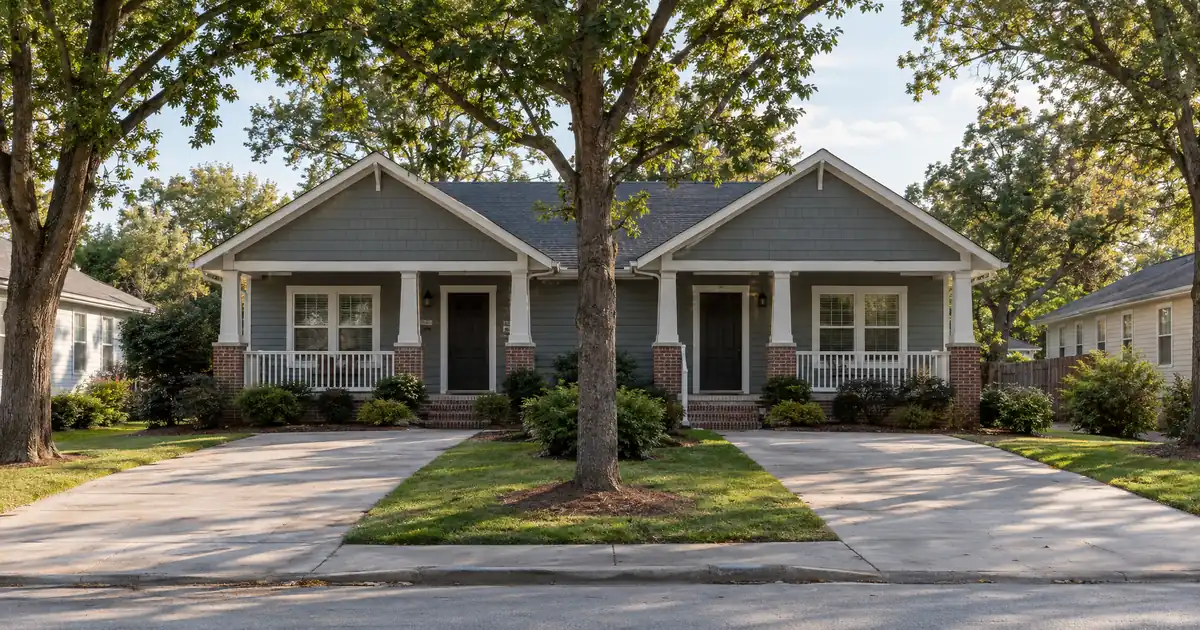
If you own a rental near the Camp Lejeune gates and it has been sitting at the same rent for a few years, you may have more usable equity than the appraisal-fear talk suggests. The market itself is stable, and that cuts both ways. Here is how to size the refinance and where the cash-out math breaks.
DSCR Cash-Out Calculator
Run the cash-out numbers in Jacksonville, NC
Rate source: Freddie Mac 30-yr average via FRED® — Federal Reserve Bank of St. Louis · effective Sep 24, 2026
Prefilled with starting assumptions — enter your property’s value, balance, taxes, and insurance for a more accurate picture.
Program parameters update from Lendmire’s centralized guideline source. Taxes and insurance are editable estimates.
As of Sep 24, 2026 · General Freddie Mac market benchmark, not a Lendmire loan offer. Property value, balance, taxes, and insurance are editable estimates. Maximum loan-to-value varies by lender, program, property type, and seasoning. Not a Loan Estimate, approval, or commitment to lend. Program availability and eligibility are subject to lender guidelines, credit approval, property review, and underwriting.
Key Takeaways:
Cash-out refinancing in Jacksonville, North Carolina is underwritten primarily on the property’s rental income measured against its full monthly obligation, and because the renter base is anchored to Marine Corps Base Camp Lejeune, the practical question is whether a gate-area rental’s supportable rent and appraised value can carry the leverage cap, subject to lender guidelines.
- Cash-out leverage tops out at 75 percent of appraised value, with about six months of seasoning from title recording.
- Per RentCafe, 63 percent of Jacksonville households rent.
- Two-unit properties tend to clear coverage more easily than single-family houses at the same leverage.
- The case rests on rent-supported value, not price growth.
Jacksonville Market Snapshot
A quick read on the Jacksonville investor landscape — figures come from the cited sources below. Confirm current property-level numbers before underwriting.
| Metric | Detail |
|---|---|
| Home prices | $245K median (Redfin) |
| Population | See Visit Jacksonville NC for current population information |
| Employment | ~6,500 civilian employees (Livability) |
Start at the Gates: Lejeune Boulevard, Western Boulevard and Midway Park
The strongest equity-extraction candidates sit near the base entrances. Per Deal Run’s investor-demand analysis, the neighborhoods along Lejeune Boulevard and Western Boulevard near the gates draw the strongest landlord demand. The same vendor puts 1980s-to-2000s homes at $100K–$180K when distressed and $190K–$270K after repair. It’s a data-vendor claim, not transaction-verified, but it shows where refinance equity tends to come from: the gap between a modest entry price and a post-renovation value.
Midway Park, on the east side, is a clean example. Apartments.com’s Midway Park page lists average rent near $1,307 and describes it as well placed for personnel stationed at Camp Lejeune and MCAS New River. Piney Green, with its own gate entrance and newer townhome builds, is the other name that keeps coming up in local listings. Neither has a reliable neighborhood-level price source, so treat both as places to pull comps and not as places to assume numbers.
Rental neighborhoods with published averages, per RentCafe:
| Neighborhood | Average rent |
|---|---|
| Brynn Marr | $1,237 |
| Midway Park | $1,307 |
| Jacksonville Commons | $1,370 |
| Cardinal Village | $1,378 |
The spread is narrow, about $140 across the set. In this market location moves rent less than unit count and condition do.
Why Rent Here Has a Defined Ceiling
Rent in Jacksonville is tied to a housing allowance, not a local wage base. Per MilPayTools, the Camp Lejeune allowance with dependents is $1,584 a month for an E-5, $1,944 for an E-6 and $1,995 for an E-7. The same source puts two-bedroom fair market rent across the area at roughly $1,142–$1,425. MilPayTools also notes that the E-5 allowance sits above the area’s 75th-percentile two-bedroom rent.
That gives an appraiser and a lender something concrete. A duplex unit priced inside a junior-enlisted budget is easier to defend on a rent schedule than a unit priced on hope. BAH figures conflict between sources, so check the current numbers against the Defense Department’s own lookup before you build a file around them.
The base is the demand engine. Livability puts more than 43,000 service members at Lejeune and New River, plus roughly 6,500 civilian employees on base (approximate; the figures date to an older article). Onslow Memorial Hospital, a 162-bed UNC Health Care affiliate, is the second anchor. Coastal Carolina Community College adds a smaller layer of workforce demand. No four-year university competes for rental stock.
The Math: Duplex vs Single-Family at 75 Percent
At 75 percent, a duplex clears coverage more comfortably than a single-family house. Run the numbers on both, using modeled assumptions and not sourced market facts.
Single-family, modeled. Assume a three-bedroom house valued near the citywide median, which Redfin puts at about $245K, up 2.4 percent year over year. Assume rent near the three-bedroom average on Apartments.com, about $1,382. Run that against full PITIA (principal, interest, taxes and insurance) at the 75 percent cap and coverage lands slightly below 1.00. Point2Homes reports three-bedroom units are 42 percent of the area’s 6,007 rentals, so this is the volume product, and it’s the one that squeezes at max leverage.
Not ideal. But not dead either. Sub-1.00 files can route through lower leverage, an interest-only structure or a program built for sub-1.00 coverage, all subject to lender review, credit profile and reserves. Most standard programs use 1.00x as the benchmark because rent covers the payment at that level.
Duplex, modeled. Assume a duplex valued at $300,000 with two-bedroom units at roughly $1,200 each, the Apartments.com two-bedroom figure. At 75 percent and full PITIA, coverage runs about 1.3, rounded down. Same leverage, same program, a different story. Each unit rents at single-unit rates while the property is valued as one asset. No local source quantifies that gap, so treat it as underwriting logic.
Practical takeaway: if you hold both property types, the duplex is usually the better equity source and the single-family is the better hold.
Appreciation Won’t Do the Work
Cedar Ridge Property Management frames Jacksonville as a market for steady cash flow over rapid appreciation and flags slower growth than other coastal markets. It’s a property manager’s opinion, not independent analysis. The 2.4 percent Redfin figure points the same direction.
So the thesis is rent-supported value. Model a conservative appraisal at refinance. If you bought below market and added a kitchen, as CRI Properties says military tenants will pay $100–$150 more a month for, the equity is in the improvement. If you bought at market and waited, it probably isn’t.
A turnkey brokerage, Turnkey Realty NC, adds one more wrinkle. It says zero-down VA buyers make the $200K–$350K band behave differently, with well-presented listings in that range pending in about six days, while homes outside it sit longer and take price cuts more often. The numbers are directional only. The implication: rentals priced inside that band should have deeper comps at appraisal, and ones well above it may appraise softer, which caps proceeds.
What the Loan Looks Like
For most files, cash-out refinance tops out at 75 percent LTV, with about six months of ownership measured from title recording. Minimum coverage is typically 1.00, credit tiers run 620, 660, 680 and 700 with 620 as the floor, and reserves are generally about six months of PITIA. Standard programs go up to $3,000,000, and smaller balances route through select lenders in the network. Equity available depends on rent used for lender review, PITIA, reserves and the 75 percent ceiling. It is never a guaranteed figure. Details depend on lender guidelines, borrower profile and property review. Manufactured homes, log homes and barndominiums fall outside these programs.
Properties held in an LLC are typically eligible, subject to lender program eligibility. For the mechanics of the ratio itself, see the DSCR qualification mechanics. For how this differs from conventional underwriting, see the comparison.
What the Deal Desk Tends to See
In markets anchored by a single large employer, the common friction point is not the ratio. It’s the lease file. Cleaner files from a documentation standpoint tend to show signed leases with stable terms and a rent schedule that matches the appraiser’s comps, so a lender isn’t reconciling two different rent stories. Files with month-to-month tenants or a rent number that sits well above the appraisal’s schedule tend to draw more questions and lower proceeds.
What About PCS Season?
Underwrite turnover. Salt & Soil Realty cautions that BAH doesn’t guarantee rent. Demand and lease timing move with PCS cycles, report dates, training schedules, deployment timelines and on-base housing availability. That turnover is real.
The lender’s stress test will care about it, and so should you. Build a vacancy allowance around relocation cycles and don’t assume full occupancy. A property that clears coverage with a cushion is much safer than one that clears it on the nose. And keep reserves liquid, because the six-month reserve expectation lands in the same window as the refinance.
Investors should verify current local rental rules, taxes and insurance with qualified local professionals.
Using the Proceeds
Treat proceeds as capital for the next acquisition, not as a windfall. The cleanest pattern: refinance a seasoned duplex, hold reserves for both properties, and deploy the remainder into another gate-area unit. Run the next purchase through the same coverage test before you count on the cash. For the broader refinance picture, see Lendmire’s guide to investor refinancing and the page on pulling equity out.
DSCR vs. conventional financing
There are two common ways to finance an investment property in Jacksonville, NC, and they qualify you differently — here’s how investors weigh them.
Why investors choose it
- Qualifies on the property’s rental income — no personal tax returns, W-2s, or pay stubs needed to document income.
- No personal debt-to-income ceiling to clear, so existing mortgages and obligations don’t cap your borrowing the same way.
- Can be closed in an LLC, keeping the property inside a business entity.
- Built for scaling — not held to the limit on number of financed properties that conventional financing applies.
- Underwriting centers on the deal: generally qualifies when the rent covers the payment, a 1.00x coverage ratio being a common baseline (confirmed in underwriting).
- Designed specifically for investment property, including long-term and, where the program allows, short-term rentals.
Where it’s strong
- Often the lowest ongoing financing cost for a buyer who fully qualifies on personal income — a fit for a first property or a cost-first purchase.
Trade-offs for investors
- Requires full personal income documentation and must fit within a debt-to-income limit — salary, existing debts, and other mortgages all count.
- Typically held in your personal name rather than a business entity.
- Caps how many financed properties you can carry, which can become a ceiling as a portfolio grows.
- Evaluates you as a borrower as much as the property, which usually means more paperwork.
How investors usually choose: a first or single property often optimizes for the lowest financing cost; portfolio builders often optimize for leverage, vesting in an LLC, and scaling past conventional caps. The right answer depends on your goals, the property, and current guidelines — both paths run through select lenders in Lendmire’s wholesale network, with eligibility and terms confirmed in underwriting.
Frequently Asked Questions
How do you qualify for a DSCR cash-out refinance in Jacksonville, North Carolina?
You qualify primarily on the property’s rent relative to its full monthly obligation, with a typical benchmark of 1.00. Lenders also review credit (a 620 floor with tiers up to 700), about six months of reserves, and about six months of seasoning. Approval depends on lender guidelines, the appraisal and the file.
What are the requirements for an investment property loan in Jacksonville, North Carolina?
Typical requirements are a 75 percent LTV cap on cash-out, the seasoning window and a reserve cushion. The property needs a documented rent schedule, usually a lease or an appraiser’s market-rent estimate. Eligible property types include single-family homes and small multifamily. Manufactured homes, log homes and barndominiums fall outside the programs.
How does rental income affect DSCR refinance eligibility in Jacksonville?
Rental income is the core of the file. Lendmire arranges DSCR investor loans, and qualification rests on the property’s income instead of personal income documentation, subject to lender guidelines. A duplex with two leased units usually shows stronger coverage than a single-family house at the same leverage.
Does PCS turnover hurt a refinance file in Jacksonville?
It can if the lease file is thin. Lenders look at the rent schedule and appraisal comps, not a tenant’s orders. Signed leases and a modest vacancy allowance help, while a property that only clears 1.00 on the nose has no room for a gap in occupancy.
Is a duplex or a single-family rental the better cash-out candidate here?
Usually the duplex. Each unit rents at single-unit levels while the property appraises as one asset, which tends to lift coverage at the 75 percent cap. Single-family houses at the citywide median can land slightly below 1.00 at maximum leverage, so they often call for lower leverage or a different structure.
The Underpriced Corner: Gate-Area Duplexes
If one slice of this market is mispriced against its rent fundamentals, it’s the older two-unit stock near the Lejeune Boulevard and Western Boulevard gates. Its two-bedroom units fit inside a junior-enlisted housing allowance, it sits in the $200K–$350K band where buyer depth is strongest, and it gets almost no attention next to the three-bedroom houses everyone is chasing.
For current guidelines and terms, see Lendmire’s DSCR loan programs page.
About Lendmire
Lendmire, NMLS# 2371349, is a mortgage brokerage focused on investor financing, arranging DSCR loans in 40 states plus Washington, D.C. — 41 markets total. Qualification is based on the property’s income rather than personal income documentation, subject to lender guidelines, making it a fit for LLC-held rentals and scaling portfolios. The firm is recognized as a 2026 Scotsman Guide Top Mortgage Workplace and a 2025 Scotsman Guide Top Mortgage Workplace, with details in the Top Workplace press announcement.
For broader investor-financing rules and property-type coverage across the state, see North Carolina DSCR loans.
Get Started
Ready to find the right loan for you?
In about 30 seconds you can review financing options available for your investment property. No commitment required.
Informational only. Not a Loan Estimate, approval, or commitment to lend. Program availability and eligibility are subject to lender guidelines, credit approval, property review, and underwriting.
References
1. RentCafe: Jacksonville average rent
2. Redfin: Jacksonville housing market
4. Livability: Top employers in Jacksonville
5. Deal Run: Jacksonville investor demand
7. MilPayTools: Camp Lejeune BAH
9. Cedar Ridge Property Management
10. cautions
11. a 2026 Scotsman Guide Top Mortgage Workplace
12. a 2025 Scotsman Guide Top Mortgage Workplace
13. the Top Workplace press announcement
This article is part of Lendmire’s investment property cash-out refinance program — full qualification details, guidelines, and scenarios live on the program page.
Related reading: DSCR Cash Out Refinance in Jacksonville, Florida: The 2026 DSCR Financing Guide to Riverside · Cash Out Refinance on Investment Property in Jacksonville NC · Cash Out Refinance Investment Property in Jacksonville FL
Guides: Investment Property Cash-Out Refinance in Jacksonville, NC · Investment Property Cash-Out Refinance in North Carolina
Brandon Miller
Founder & CEO, Mortgage Loan Originator, Lendmire LLC
- Mortgage Loan Originator · NMLS# 1129696 · Verify on NMLS Consumer Access
- North Carolina Real Estate Broker · License# 343312 · Verify on NCREC
- North Carolina Insurance Producer · License# 19053198 · Property, Casualty, Life, Health · Verify on NAIC SBS
- Lendmire LLC · Firm NMLS# 2371349 · Verify firm licensure
Disclosures. The information presented in this article is general market commentary, not financial, legal, or tax advice. Lendmire is a mortgage brokerage (NMLS# 2371349) — not a direct lender or depository institution — and loan placement is subject to lender underwriting. Nothing in this content represents a commitment to lend. Loan terms, pricing, and program availability vary based on borrower qualifications, property characteristics, and state of subject property, and are subject to change at any time. Lendmire complies with Equal Housing Opportunity requirements. Consumer access: nmlsconsumeraccess.org.