
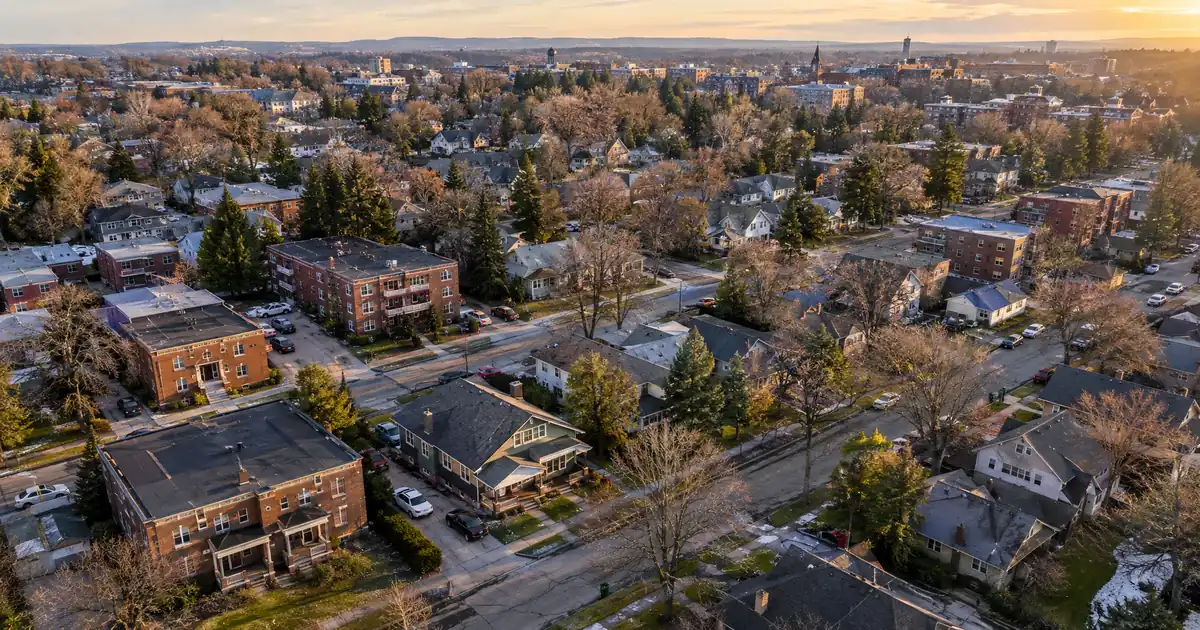
Data USA’s Census-derived profile puts Oxford’s homeownership rate at 34.3 percent, against 65.2 percent nationally. A city of 21,753 people, per Ohio-Demographics, rents almost everything it has. For an investor sitting on a paid-down student rental, that is the whole thesis. Demand is structural. Appreciation is not.
TL;DR: A DSCR cash-out refinance in Oxford, Ohio is underwritten primarily on the property’s rental income measured against its full monthly obligation, so the file starts with seasoning, a current appraisal, and a lease schedule the lender can annualize, then sizes proceeds against a 75 percent LTV ceiling, reserves, and the existing payoff.
DSCR Cash-Out Calculator
Run the cash-out numbers in Oxford, OH
Rate source: Freddie Mac 30-yr average via FRED® — Federal Reserve Bank of St. Louis · effective Sep 24, 2026
Prefilled with starting assumptions — enter your property’s value, balance, taxes, and insurance for a more accurate picture.
Program parameters update from Lendmire’s centralized guideline source. Taxes and insurance are editable estimates.
As of Sep 24, 2026 · General Freddie Mac market benchmark, not a Lendmire loan offer. Property value, balance, taxes, and insurance are editable estimates. Maximum loan-to-value varies by lender, program, property type, and seasoning. Not a Loan Estimate, approval, or commitment to lend. Program availability and eligibility are subject to lender guidelines, credit approval, property review, and underwriting.
- Campus-area houses list at $570 to $1,060 per bedroom in the snapshot data.
- Sale-price sources disagree, from $340K at Redfin to $379,900 at Movoto, so the appraisal sets proceeds.
- Nine-to-ten-month student leases make qualifying-rent treatment the central underwriting question.
- Cash-out typically needs about six months of seasoning from title recording.
Start in the Mile Square
The Mile Square and the streets just outside it are where Oxford’s rent stacks up best, and where a refinance has the most income to underwrite. Bedroom count drives the rent. Walkability to campus and Uptown sets the premium. Everything else is secondary.
The Mile Square is the grid roughly bounded by Chestnut, Beech, Collins, and Vine, and most student housing lives there. Uptown, centered on High Street, is the premium tier. Stock runs from apartments above storefronts to large group houses, and local managers advertise everything from one bedroom to eight-plus.
Tenants are upperclass students who want to walk to campus. Miami University reports 16,405 undergraduates on the Oxford campus, and 53 percent of students live off campus. That is an estimated 8,700 undergraduates, my arithmetic from the published figures rather than a published count, competing for a small housing pool.
Just outside the core, walk-to-campus houses on streets like Bern, Cedar, Main, and Ardmore sit 0.2 to 0.4 miles from campus. Snapshot listings show a Bern Street three-bedroom at $1,060 per bedroom on a ten-month lease, a Cedar Drive four-bedroom at $840, a Main Street four-bedroom at $570 on a twelve-month lease, and an Ardmore Drive four-bedroom at $722 on a nine-month lease. Those are listing snapshots, not a market survey. Read them as a range, not a rent roll.
The multi-unit stock is where cash-out files get interesting. Homes.com showed seven multifamily listings in Oxford, priced from $330,000 to $725,000, and several state contracted student-rental income. One Mile Square property claims $54,000 for the coming school year and $56,400 for the next, which means income documented two years out. Another was fully rented at $43,600 across all units. These are sellers’ claims, and prices and rents are not paired on any single property, so no rent-to-value ratio is implied here.
What Does Cash-Out Actually Look Like Here?
At a 75 percent LTV ceiling, proceeds come from appraised value minus the existing payoff, not from what the owner hopes the property is worth. Oxford’s value signal is noisy, so the appraisal is the variable that matters.
Take the published numbers. Redfin has the median sale price near $340K over the trailing three months, down 2.9 percent year over year. Its main page shows $348,969, up 3.7 percent. Zillow puts the average home value at $347,860, up 3.2 percent. Movoto reads $379,900, but on only 70 sales. Homes.com shows a higher year-over-year figure that conflicts with the rest, and it should be ignored.
The honest summary: roughly $340K to $380K, direction unclear. Don’t build a refinance around appreciation lifting the appraisal. Size the cash-out on current comps and treat any uplift as a bonus.
Comp depth is the second problem. Redfin counted 44 homes sold in a recent June against 46 a year earlier, and the multifamily pool is thinner still. An appraiser working a student duplex may lean on single-family sales, which can understate or overstate a bedroom-driven rent stack. Expect variance, and don’t commit to a payoff or a next-deal contract until the value is back.
The program parameters are straightforward. Cash-out on these files typically tops out at 75 percent LTV, with about six months of ownership measured from title recording. The standard benchmark is a 1.00 DSCR, meaning rent used for lender review against full PITIA, with about six months of reserves and a credit floor of 620 on most files. Loan amounts run up to $3,000,000 on standard programs. Exact eligibility depends on lender guidelines, credit profile, reserves, and property review. See the equity recycle pathway for the mechanics.
Run the Numbers on a Four-Bedroom House
A four-bedroom campus-area house can clear 1.00 comfortably on twelve-month rent, but it can drop below 1.00 if the lender counts only the months a student actually pays. The rent figure the lender uses for review is the swing factor.
Run a modeled scenario. These inputs are assumptions for illustration, not cited market facts: a house valued around the middle of the published price range, financed at 75 percent LTV, with four bedrooms at the snapshot’s $722 to $840 per bedroom. That produces gross rent of $2,888 to $3,360 a month on a twelve-month basis.
Divide by full PITIA, meaning principal, interest, taxes, and insurance, and the coverage lands in the low-1.2 to mid-1.3 territory. Round down and say it plainly: including taxes and insurance, roughly 1.2x at the bottom of the rent range.
Now change one input. Suppose the lease runs nine months and the lender annualizes it as if the house sat vacant for the other three, so the rent used for lender review drops by a quarter and coverage slides to around 0.9x. Same house, same tenants, different answer.
A sub-1.00 file is not dead, but it gets harder. A lender may review a sub-1.00 program, an interest-only structure, or reduced leverage with stronger credit and more reserves. All of that is subject to lender guidelines, credit approval, and property review. The better move is to ask early how the lender treats 9-to-10-month leases and per-bedroom rent, and to have the lease schedule ready to show it.
Group Houses and Big Bedroom Counts
Five-to-ten-bedroom group houses generate the loudest gross rent in Oxford and the trickiest lender conversation. Bigger gross rent does not mean an easier file.
One commentary post cites a seven-bedroom, two-bath house at $3,000 a month, about $429 per person. That is a single example, not an average. A listing for a six-bedroom house quotes $4,167 per person per semester. Rent is often quoted per person per semester here, which is a different unit of measure from a standard twelve-month lease.
Lenders vary on how they treat that structure. Standard DSCR programs cover one-to-four-unit and non-owner-occupied single-family properties, and some commercial products stretch to five to eight units. A large single-family group house can land in an awkward middle. Skip the assumption that it qualifies the way a duplex does. Get the lender’s read before the appraisal is ordered.
One more caution. Student leases are signed ten-plus months before move-in. A commentary source describes students touring in September, signing in October or November, and moving in the following August, and listings are already advertising the next school year. That helps a refinance because income is documented early. It also means a vacant unit can sit empty for a long stretch if the calendar is missed. Thin comps plus a rigid leasing calendar is a reason to stay conservative on exit timing.
Duplexes: The Product Oxford Does Well
Student-oriented duplexes are the natural small-multifamily fit for a DSCR cash-out in Oxford, because income stacks across two units and the loan sits inside standard one-to-four-unit programs.
The stock is mixed. One Redfin listing shows a duplex of two identical furnished units, each four bedrooms and one bath, with academic-year rent of $44,000. Another Mile Square property pairs a four-bedroom unit with a one-bedroom. An older building on Homes.com is a 1930 duplex with two-bedroom units. Newer semi-attached four-bedroom, 2.5-bath homes are also being marketed to rent together for eight to twelve people near Millett Hall.
Underwrite by rent per bedroom and per unit. Confirm whether each lease runs nine, ten, or twelve months. A 4+4 duplex with a clean lease schedule is a simpler file than a 4+1 with mixed terms.
Working DSCR brokers see a recurring pattern in college-town markets: the rent is real, but the lender’s qualifying-rent method decides the coverage number. Files that arrive with an annualized lease schedule, per-unit rent, and a clear explanation of the academic calendar tend to read more cleanly than files that only show a listing price. Appraisal variance is the second recurring surprise, since thin multifamily comps mean the appraiser’s chosen sales can move proceeds more than the rent does.
The South Corridor and South Campus
The south and southeast corridor along US-27, Contreras Road, Southpointe Parkway, and Magnolia Drive sits about 2.5 to 3 miles from campus. It is mostly purpose-built apartment communities with shuttle access. Snapshot per-bedroom ranges are wide: $559 to $1,215 near Magnolia Drive and $450 to $849 near Southpointe. The tenants are budget-conscious students, graduate students, and staff.
For a cash-out investor this is mostly a pass. Institutional-style complexes dominate the stock, the rent range is wide, and a small owner has little pricing power against them. South Campus Quarter on the east campus edge offers one-and-two-bedroom apartments, four-bedroom duplexes, and houses about a five-to-seven-minute walk from Uptown, but no sourced price data exists for it. Treat it as a submarket to verify, not assume.
The Non-Student Side
Non-student rentals trade lower rent for steadier twelve-month leases. They are the conservative option in Oxford.
Demand here comes from employment, not the academic calendar. Miami University employs more than 3,700 people, making it the largest employer in Butler County. TriHealth McCullough-Hyde Memorial Hospital serves nearly 80,000 people annually, and the Talawanda School District rounds out the local base. Per Data USA, the top resident sectors are Educational Services at 2,751 people, Accommodation and Food Services at 1,695, and Retail Trade at 1,129.
DSCR vs. conventional financing
There are two common ways to finance an investment property in Oxford, OH, and they qualify you differently — here’s how investors weigh them.
Why investors choose it
- Qualifies on the property’s rental income — no personal tax returns, W-2s, or pay stubs needed to document income.
- No personal debt-to-income ceiling to clear, so existing mortgages and obligations don’t cap your borrowing the same way.
- Can be closed in an LLC, keeping the property inside a business entity.
- Built for scaling — not held to the limit on number of financed properties that conventional financing applies.
- Underwriting centers on the deal: generally qualifies when the rent covers the payment, a 1.00x coverage ratio being a common baseline (confirmed in underwriting).
- Designed specifically for investment property, including long-term and, where the program allows, short-term rentals.
Where it’s strong
- Often the lowest ongoing financing cost for a buyer who fully qualifies on personal income — a fit for a first property or a cost-first purchase.
Trade-offs for investors
- Requires full personal income documentation and must fit within a debt-to-income limit — salary, existing debts, and other mortgages all count.
- Typically held in your personal name rather than a business entity.
- Caps how many financed properties you can carry, which can become a ceiling as a portfolio grows.
- Evaluates you as a borrower as much as the property, which usually means more paperwork.
How investors usually choose: a first or single property often optimizes for the lowest financing cost; portfolio builders often optimize for leverage, vesting in an LLC, and scaling past conventional caps. The right answer depends on your goals, the property, and current guidelines — both paths run through select lenders in Lendmire’s wholesale network, with eligibility and terms confirmed in underwriting.
One Oxford Township listing is a duplex on 4.06 acres with two-bed, one-bath sides built in 1998, described as fully rented to long-term tenants. That is a different DSCR profile from a Mile Square rental: no calendar cliff, but probably a thinner comp set. There is no sourced neighborhood-level price or rent data for these areas, so this one is a structure call, not a numbers call.
The rent backdrop is worth keeping in view. HomeSnacks reports a median rent near $989, but that is a unit-level median dragged around by student and shared housing. Per-bedroom pricing is the more useful gauge.
Where the Equity Goes Next
The cash-out is only as good as the next deal it funds. Oxford’s price band sits well above the state. Redfin’s Ohio median is $274,855, so the same equity in a lower-priced ohio market buys more doors per dollar of basis.
That is the real tension. Oxford holds rent well because the student pool is deep relative to a city of roughly 22,000, but the price level limits yield on the way in. Thinking out loud here: the stronger play for many owners may be to hold the Oxford asset for income, pull equity at the 75 percent ceiling, and deploy it where rent-to-price is easier. Oxford owners who want to stay local could argue the opposite, using proceeds to add a second duplex near the core. Both are defensible, and neither relies on Oxford appreciating.
For a side-by-side of refinance structures, see the investment property refinance options. For how these files differ from income-document loans, see the guide “Where DSCR and Conventional Diverge”. Borrowers holding title in an LLC should confirm eligibility subject to lender program terms. Verify current local rental rules, taxes, and insurance with qualified local professionals before sizing any deal.
Frequently Asked Questions
How do you qualify for a DSCR loan in Oxford, Ohio?
Qualification centers on the property, not the borrower’s W-2s. Lenders compare rent used for program review to full PITIA, typically looking for a 1.00 benchmark, plus credit, reserves, and an appraisal. In Oxford the open question is usually how a lender credits nine-to-ten-month student leases. The guide “What Is a DSCR Loan” covers the basics.
What are the requirements for an investment property cash-out loan in Oxford, Ohio?
On most files, expect about six months of seasoning from title recording, a 75 percent LTV ceiling, and about six months of reserves. Credit tiers start at a 620 floor. Proceeds depend on appraised value, the existing payoff, and rent used for eligibility review, so they are not a guaranteed figure. Details are subject to lender guidelines. More on Ohio DSCR financing is on the state hub page.
Will a per-bedroom student lease count as full rent on a DSCR file?
It depends on the lender. Some annualize a nine-month lease, others credit only the months paid, and per-person leases can add another wrinkle. Bring the lease schedule and ask before the appraisal is ordered.
Can a duplex appraisal come in low because Oxford has so few multifamily comps?
Yes, and it can come in high too. Thin multifamily sales mean an appraiser may lean on single-family comps, and published price sources in Oxford disagree by roughly $40K on the median. Size proceeds on conservative value.
For current guidelines and terms, see Lendmire’s DSCR loan programs page.
About Lendmire
Lendmire, NMLS# 2371349, is a non-QM mortgage broker serving real estate investors in 41 markets, including Washington, D.C., through DSCR investor loan programs. Qualification is generally reviewed around the subject property’s rental income rather than the borrower’s W-2 history, which suits LLC-titled portfolios and self-employed investors. All scenarios remain subject to the lender’s review and program guidelines. The firm holds consecutive Scotsman Guide Top Mortgage Workplace recognitions, including a 2026 Scotsman Guide Top Mortgage Workplace designation and one recognized by Scotsman Guide in 2025. See the full Lendmire news archive for more.
Get Started
Ready to find the right loan for you?
In about 30 seconds you can review financing options available for your investment property. No commitment required.
Informational only. Not a Loan Estimate, approval, or commitment to lend. Program availability and eligibility are subject to lender guidelines, credit approval, property review, and underwriting.
References
1. Data USA’s Census-derived profile
3. miamiohoffcampus.com — Neighborhood Oxford Bxpg Extras House
4. Redfin, Oxford housing market
6. Homes.com
9. Homes.com
11. TriHealth McCullough-Hyde Memorial Hospital
12. HomeSnacks
13. a 2026 Scotsman Guide Top Mortgage Workplace
14. recognized by Scotsman Guide in 2025
This article is part of Lendmire’s investment property cash-out refinance program — full qualification details, guidelines, and scenarios live on the program page.
Related reading: Cash Out Refinance Investment Property in Oxford, Ohio: Mile Square Equity, One Anchor Employer · DSCR Loans in Oxford, Mississippi: Investor Financing for The Square, University Avenue Rentals, South Lamar Corridor & Ole Miss Student Housing · Cash Out Refinance Investment Property in North Olmsted, Ohio: Can the Rent Carry the New Loan?
Guides: Investment Property Cash-Out Refinance in Ohio
Brandon Miller
Founder & CEO, Mortgage Loan Originator, Lendmire LLC
- Mortgage Loan Originator · NMLS# 1129696 · Verify on NMLS Consumer Access
- North Carolina Real Estate Broker · License# 343312 · Verify on NCREC
- North Carolina Insurance Producer · License# 19053198 · Property, Casualty, Life, Health · Verify on NAIC SBS
- Lendmire LLC · Firm NMLS# 2371349 · Verify firm licensure
Disclosure information. Lendmire is a state-licensed mortgage brokerage under NMLS# 2371349. Lendmire is not a depository institution, direct lender, or financial advisor — all loans referenced are placed through wholesale lender partners and are subject to each lender's underwriting standards. This article is provided for general informational purposes and is not a commitment to lend, nor does it constitute financial, legal, or tax advice. Loan programs, terms, rates, and qualification standards change without notice and depend on borrower profile, property type, and the state in which the subject property is located. Equal Housing Opportunity provider. NMLS Consumer Access: nmlsconsumeraccess.org.